A horse is built to run. A donkey is built to stand and think about it. You have met Hector. This is the other half of his field.
Here is the thing nobody warns you about a parade horse. Hector stood through the King's Troop and the massed bands and a nation's worst day without shifting a hoof, and he will still, in a quiet Welsh field, levitate sideways at a pheasant coming out of a hedge. A carrier bag on the wind is, to a horse, a clear and present danger. The guns were a job, and the job had rules. The hedge has a pheasant in it and no rules at all, and so the flight animal underneath the seventeen years of training remains, on the matter of pheasants, entirely undefeated.
Nelson does not look up.
Nelson has never looked up. A donkey does not flee, it assesses, and it assessed the pheasant long ago and found it beneath comment. People call that stubbornness. It is an animal declining to spend adrenaline it sees no reason to spend.
And here is the domestic arrangement, which anyone who has kept the two together will know on sight. Nelson is a third of Hector's size and entirely in charge. He eats first. He picks the dry spot. He decides when they move. The black charger who carried the weight of the state stands by, with enormous patience, while a small grey donkey finishes the good hay.
The one thing that reliably undoes Hector is Nelson leaving the field. Five minutes, a foot trim, a vet down the lane, and the great composed horse comes apart at the gate, calling and calling, because a horse is herd to its bones and has decided that its herd is one unbothered donkey.
Nelson, for his part, despises rain. A desert animal washed up in Denbighshire, he stands in the shelter looking martyred while Hector grazes out in the wet, waterproof and serene.
Two opposite natures, each propping up the other exactly where it is weak. The horse who fears small things and the donkey who fears nothing at all. It works. It was always going to.
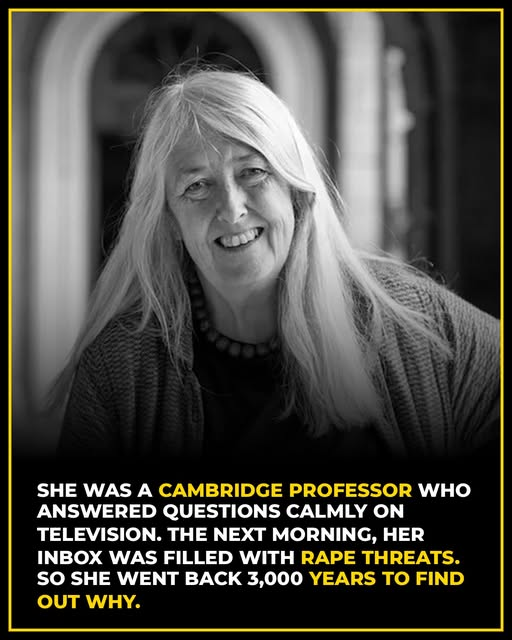
She was 57 years old.
White hair. No carefully managed image. No media training designed to make her more palatable. Just thirty years of accumulated knowledge and the calm, unhurried authority of a woman who had spent her life mastering her subject.
She sat on a BBC panel, answered questions about immigration and politics, cited evidence, made arguments — and then went home.
The next morning, her inbox looked like a crime scene.
Her name is Mary Beard — Cambridge professor, classicist, one of the most respected scholars of ancient Rome and Western civilisation alive. And the internet had decided that a woman speaking with quiet authority on television needed to be punished for it.
The messages were not criticism. They were not debate. They were rape threats. Death threats. Coordinated campaigns of personal destruction targeting her appearance, her age, her voice — anything that could be used to remind her that spaces like the one she had just occupied were not meant for her.
Most people would have gone quiet.
Mary Beard went further in.
She did what scholars do when they find a pattern that disturbs them: she followed it backward. Through decades. Through centuries. Through millennia. All the way back to some of the oldest texts in Western civilisation.
And she found it had always been there.
In Homer's Odyssey — one of the foundational works of Western literature, nearly three thousand years old — there is a scene that most readers pass over without registering its quiet violence. Penelope comes downstairs and asks the poet to sing a different song. Her own son, Telemachus, cuts her off. He orders her back to her room and tells her plainly: speech is the business of men.
She goes.
Mary Beard read that scene and recognized it immediately.
Not as ancient history. As a pattern.
In ancient Rome, women who dared to speak in public were not described as orators or thinkers. They were described as noise — disorderly sound, something that did not deserve to be called language or argument. Their voices were not speech. Their thoughts were not thoughts.
In the medieval world, women who claimed public authority were labeled as witches.
Elizabeth I — Queen of England, ruler of a nation — had to rhetorically reshape herself into something masculine just to be taken seriously as the leader of her own country.
The silencing of women who speak with authority was not invented by social media. It was not a modern pathology or a cultural accident. It was built deliberately, over centuries, into the very foundations of how Western civilisation defined who gets to speak, what authority sounds like, and who is allowed to take up space in public life.
Mary Beard had found something important.
In 2017, she published Women & Power: A Manifesto — short enough to read in an afternoon, substantial enough to reframe everything you thought you understood about why this keeps happening.
Her argument was precise and devastating.
The problem is not that women lack the ability to lead. The problem is that the model of leadership itself — the template for what public authority looks, sounds, and feels like — was built by men over centuries and has never been redesigned. When a woman enters public life and doesn't fit that template, she is not failing. The template was never built for her. It was built specifically to exclude her, and it has been doing exactly that, efficiently and continuously, for three thousand years.
The solution, Beard argued, is not to teach women to perform power the way men have always performed it. The solution is to dismantle and rebuild the very concept of what power is allowed to look like.
She kept teaching. She kept writing. She kept appearing on television — white-haired, unhurried, carrying her decades of authority without performing it, without packaging it for comfort, without apologizing for it.
The threats continued.
But other messages began arriving too. Letters from women and girls who had spent their entire lives feeling that every door was slightly too narrow, every table slightly too high, every room slightly reluctant to make space for them. Women who had spent years wondering what was wrong with them — why they couldn't quite fit, couldn't quite belong, couldn't quite be taken seriously no matter how much they knew or how hard they worked.
They read the book and understood, perhaps for the first time, that nothing had ever been wrong with them.
The room had been designed without them in mind.
That is not a personal failing.
That is a three-thousand-year-old architectural decision.
And one Cambridge professor with white hair and a calm voice — who refused to go quiet when the internet told her to — spent her career documenting it, naming it, and handing that knowledge to everyone who needed to hear it.
Telemachus told Penelope that speech was the business of men.
He was wrong then.
He is still wrong now.
And Mary Beard has three thousand years of evidence to prove it.
via The Inspireist
#FeministFriday #HERstory
🧐🤔YOU WANTED A WALL, TRUMP? YOU’LL HAVE ONE.
Mexico’s president, Claudia Sheinbaum, responded to Trump’s threats:
“So you voted to build a wall.
Well then, dear Americans — even if geography isn’t your strong suit, and you see America as a country rather than a continent — you should know that on the other side of that wall stand 7 billion people.
And if the word ‘people’ doesn’t resonate with you, let’s call them ‘consumers.’
Those 7 billion consumers can switch from iPhone to Samsung or Huawei in less than two days.
They can trade Levi’s for Zara or Massimo Dutti, and within six months replace Ford and Chevrolet with Toyota, KIA, Mazda, Honda, Hyundai, Volvo, Subaru, Renault, or BMW — brands that are already more popular in many places.
They can cancel DirecTV.
And even if they choose not to, they can stop watching Hollywood films and turn instead to higher-quality productions from Latin America or Europe — with richer storytelling and better filmmaking.
Believe it or not, people can skip Disney and visit the Xcaret resort in Cancún instead — or explore destinations across Mexico, Canada, or South America.
Even in Mexico, you can find better burgers than McDonald’s — with higher nutritional value.
Have you ever seen pyramids in the United States?
Egypt, Mexico, Peru, Guatemala, and Sudan have ancient wonders — none of them in the U.S.
If they were, Trump would probably have bought and resold them by now.
We know Nike isn’t the only sneaker brand. There’s Adidas — and even Mexican brands like Panama.
We understand economics better than you think.
And we also know that when those 7 billion consumers stop buying American products, unemployment will rise, and your economy — trapped behind its own self-imposed wall — will begin to collapse to the point where you’ll be begging for help.
We didn’t want to do this.
But you wanted a wall?
Well.
You’ve got one.”
Her approval rating has reached a historic level — according to a recent poll, it stands at 85%.
A tired-looking dog wanders into a guy's yard. The man examined the dog's collar, feels his well-fed belly and knows the dog has a home. The dog follows him into the house, gets comfortable on the couch and falls asleep...
The man thinks its rather odd, but lets him sleep.
After about an hour the dog wakes up, walks to the door and the guy lets him out.
The dog wags his tail and leaves.
The next day the dog comes back and scratches at the door.
The guy opens the door, the dog comes in, goes down the hall, jumps on the couch, gets comfortable and falls asleep again.
The man lets him sleep.
After about an hour the dog wakes up, walks to the door and the guy lets him out.
The dog wags his tail and leaves.
This goes on for days.
The guy grows really curious, so he pins a note on the dog's collar:
"Your dog has been taking a nap at my house every day."
The next day the dog arrives with another note pinned to his collar:
"He lives in a home with four children... He's trying to catch up on his sleep.
Can I come with him tomorrow?'
"Kiedy Vincent van Gogh zmarł w 1890 roku, mając zaledwie 37 lat, zostawił po sobie życie pełne niepowodzeń, kilka znoszonych ubrań i obrazy, których prawie nikt nie chciał kupować.
Sześć miesięcy później zmarł jego brat Theo — jedyny człowiek, który wspierał go do samego końca.
Wydawało się, że wszystko gaśnie.
Zostało małe dziecko, setki listów i ogromna liczba obrazów, których świat jeszcze nie rozumiał.
Wtedy na scenę weszła Jo van Gogh-Bonger, młoda wdowa po Theo.
Miała 28 lat, syna do wychowania, świeżą żałobę i żadnego obowiązku, by zajmować się artystycznym dziedzictwem szwagra.
Wielu uważało, że te płótna nie mają większej wartości.
Ona jednak zrozumiała coś, czego inni nie widzieli: za tymi gorączkowymi pociągnięciami pędzla i intensywnymi kolorami krył się geniusz, którego epoka nie potrafiła jeszcze usłyszeć.
Zaczęła od listów Vincenta i Theo.
Porządkowała je, tłumaczyła, przygotowywała do publikacji.
To właśnie w tej korespondencji odsłaniała się dusza Vincenta — jego wrażliwość, samotność, wewnętrzne poszukiwania, ból i światło.
Te listy zmieniły wszystko.
Pokazały, że za łatką „szalonego malarza od słoneczników” stał poeta, myśliciel i człowiek, który czuł więcej, niż potrafił unieść.
Potem Jo zajęła się obrazami.
Organizowała wystawy, pisała do krytyków, kontaktowała się z galeriami i muzeami.
Nie zgadzała się sprzedawać prac za bezcen, nawet wtedy, gdy brakowało pieniędzy.
Starannie decydowała, kiedy sprzedać obraz, komu i w jakim celu.
Nie tylko chroniła dorobek Vincenta.
Cierpliwie uczyła publiczność, jak na niego patrzeć.
Najpierw Berlin, potem Paryż, później Holandia…
Wystawa po wystawie, recenzja po recenzji, krok po kroku budowała reputację Van Gogha.
To nie była romantyczna legenda o wierze w artystę.
To była przemyślana strategia: wytrwałość, intuicja i konsekwencja.
Gdy zarzucano jej, że przecenia Vincenta, nie wdawała się w wielkie spory.
Odpowiadała jego obrazami.
Kiedy zmarła w 1925 roku, Vincent van Gogh był już uznawany za jednego z najważniejszych artystów swojego stulecia.
A rodzinna kolekcja, która później stała się fundamentem Muzeum Van Gogha w Amsterdamie, istnieje w dużej mierze dzięki niej.
Jo van Gogh-Bonger nigdy nie trzymała pędzla jak malarka.
Ale to ona pokazała Vincenta światu.
To ona pomogła przemienić niedocenionego artystę w uniwersalny symbol ludzkiej wrażliwości i twórczości.
Bez niej Van Gogh mógłby zniknąć w cieniu.
Dzięki niej stał się wieczny."
za Przytulność
Opossums live short, difficult lives, yet they spend their nights doing work many people never see.
Most only live about one to two years in the wild. They move through backyards, forests, roadsides, and neighborhoods after dark, searching for food while avoiding cars, dogs, predators, and harsh weather. Their lives are brief, but their role in nature is meaningful.
Opossums help clean the world around you. They eat pests, insects, carrion, and sometimes even venomous snakes. They also help reduce ticks, which can carry disease. In their quiet way, they support the balance of the places they pass through.
Still, many people fear them because of how they look or because they appear at night. But opossums are usually shy, gentle animals. When scared, they often freeze, hiss, drool, or play dead because they want to survive, not attack.
Kindness can be simple. Give them space. Do not harm them. Slow down when you see one near the road. Let them keep doing the work nature gave them.
Opossums may not live long, but they leave the world cleaner than they found it.
@Paroles_auteurs Aperçu d'une expo vivante de Frida Khalo aux carrières des lumières des Beaux de Provence. Vu il y a deux semaines, c'était juste magnifique. Picasso y est aussi exposé, je conseille fortement.