The problem isn’t that we forget history. It’s that we misread it — denying, distorting, and misrecognising the lessons meant to free us. And so we stumble back into the pain we claim to have outgrown, instead of stepping into the future the past was nudging us toward.
The hatred you enflame will unfortunately stand in the way of your attempt to love. Love, if you embrace it, and let it fill & overflow your heart & life, you will find, often drives out fear & hatred.
She was four when a stranger in naval uniform took her hand in a war zone.
It was a port in Yemen eleven years ago. There were smoke and explosions in the distance. But she thought the gunfire was fireworks.
The uniformed woman didn't say much. She just held her hand and walked her onto the ship. A photo captured that moment and the two became known across China (top left). Eleven years later, they met again.
In the spring of 2015, as Yemen's civil war intensified, Chinese naval vessels on anti-piracy missions in the Gulf of Aden were ordered to divert for an evacuation.
Within 10 days, three Chinese Navy vessels crossed three countries, four ports and one island, evacuating 600+ Chinese nationals as well as 270+ foreign citizens at the request of their governments.
On March 29, among the first group evacuated, the youngest was a four-and-a-half-year-old girl Li Yufei from Harbin in northeast China. A young female sailor, Guo Yan, just a year out of military academy, held her hand as they were to board the missile frigate Linyi.
I remember seeing that photo at the time. It felt quietly warm. But I never imagined that 11 years later, I would meet them in person.
The little girl has grown up, now in high school. The young sailor, Guo Yan is now a sergeant first class serving in the Northern Theater Command. Their heights have reversed, too: the girl now stands a head taller than the woman who once led her to safety (top right).
Recently, Li traveled from her hometown to visit Guo during a break from exams, marking their third reunion. I was there to witness the moment, and learned more about their story.
Back then, Guo had been assigned to help guide evacuees onto the ship after security checks.
Li and her parents were among the first to pass through. Concerned the child might struggle on the gangway, Guo took her by the hand and guided her forward.
That was how the famous photograph came to be.
Naturally, you would ask if they contacted or met each again. They lost touch for years.
Guo tried on several occasions to find Li's family, but without success. It was not until five years later that she was finally able to make contact, with the help of a fellow service member.
In 2022, the two were finally reunited on a program by China Media Group. To surprise Guo, the production team had kept the arrangement from her in advance. It was only when Li slowly walked toward her on stage that Guo realized the long-awaited moment had arrived.
In 2024, Li put on paper the moment they reached for each other's hand during the evacuation and gifted the drawing to Guo, who has kept it carefully at home.
I am no expert on the Middle East, but through Li's mother, Wang Yingying, I was able to learn a little about what Yemen was like. Yemen only became a unified country in 1990. Before that, it was divided into North and South Yemen, one once part of the British colonial sphere, the other under Ottoman rule. During the Cold War, one aligned with the Soviet Union, the other with the West.
As the Cold War drew to a close, the two were unified, but tensions soon emerged over uneven distribution of power and resources. The situation worsened after the Arab Spring, and by 2015, armed groups seized the capital, forcing the president to flee to Aden. The fighting was spreading.
The runway at Aden airport had been destroyed, and roads leading out of the country were fraught with risk. For many foreigners, leaving by sea became the only visible option. Before their evacuation, explosions echoed throughout the city, shaking the windows and floors of their home. She could even find spent bullets in the yard.
At the beginning, the US had indicated it would not close its embassy, but then abruptly shut it down and evacuated its diplomatic staff. It did not provide organized evacuation assistance to American citizens left in the country, citing security risks. Some US citizens lost their lives.
Here's what the State Department said on April 6, 2015:
"We have sent out emergency messages to US citizens remaining in Yemen to alert them to opportunities to leave the country. We're continuing to reevaluate the situation, and if we have any changes to whether or not we'll evacuate people, we will certainly let folks know."
China completed its evacuation mission in the early hours of April 7.
The State Department was right about the security risks. According to Guo, during the second docking, a stray bullet struck a crane just about 20 meters from the vessel's bow. As the evacuation neared its end, unidentified armed individuals also attempted to approach the ship.
Years later, the events would be retold on screen. In 2018, the film Operation Red Sea (红海行动), inspired by the evacuation, was released during the Chinese New Year holiday and became a major box office success in China. Guo watched it with her mother.
I saw it during the Spring Festival that year as well, not for leisure, but for work. I had been assigned to write a feature on holiday films, and there was no reimbursement for tickets. So from the first to the third day of the Chinese New Year, I spent my time moving from one cinema to another, watching film after film. When Operation Red Sea ended, the audience broke into spontaneous applause. It was something I had never witnessed before in a cinema.
"My mother started crying as she watched. She said she hadn't realized how dangerous it had been. Although some scenes were dramatized, I felt like returning to that day. These moments will stay with me for the rest of my life," Guo told me.
During escort missions, the Linyi typically resupplied once a month. When the evacuation order came, the ship happened to be nearing the end of its supplies. There was no time to replenish.
Guo said crew members rationed what remained, setting aside food for evacuees. Space on board was limited, and many sailors gave up their own bunks, laying out clean sheets and blankets for those being evacuated, while they themselves slept on the floors of passageways (bottom left).
I was told one Japanese evacuee, after coming aboard, turned toward the Chinese flag and bowed.
But the little Li said her memories of the evacuation have faded. At the time, she had little understanding of war. She even mistook the sound of gunfire for firecrackers, though she remembered telling adults that they should hide in a cupboard when shots were fired.
What has stayed with her, however, is the sense of being cared for aboard.
She watched Ice Age, ate a hearty meal, and was given a stuffed tiger, building blocks and chocolate by the general and other crew members.
During the nearly eight-hour journey on the Linyi, the little one imitated a military salute, saying she wanted to join the Chinese navy when she grew up. They arrived in Djibouti around midnight, and flew back to China from there.
The experience became one of the most defining moments of Li's childhood.
In primary school, a textbook passage about the Yemen evacuation led her teacher to invite her to the front of the classroom to share her own story. Li often returned to those memories in her writing. Now, she regularly follows news about the navy on her cellphone.
Guo joined the navy in 2009. She said the images of PLA soldiers rescuing victims during the 2008 Wenchuan earthquake had left a lasting impression on her. She decided to become one of them.
Years later, that sense of purpose has quietly taken root in another younger pair of eyes.
The little Li told me if she had the chance, she would like to join the navy too.
Some memories fade. But not all of them.
Australia, again showing its true colours.
Anyone surprised by this?
Australia Shies Away From UN Slavery Worst Crime Vote | Mirage News
https://t.co/EP1OWXtoZP
As an Aussie citizen, I wonder if my representative in Paliament will ask the current & the past governments of Australia whether they too knew the rules based order was fake but went along with the charade anyway. And, if not, why were they so ignorant? #auspol@AdamBandt
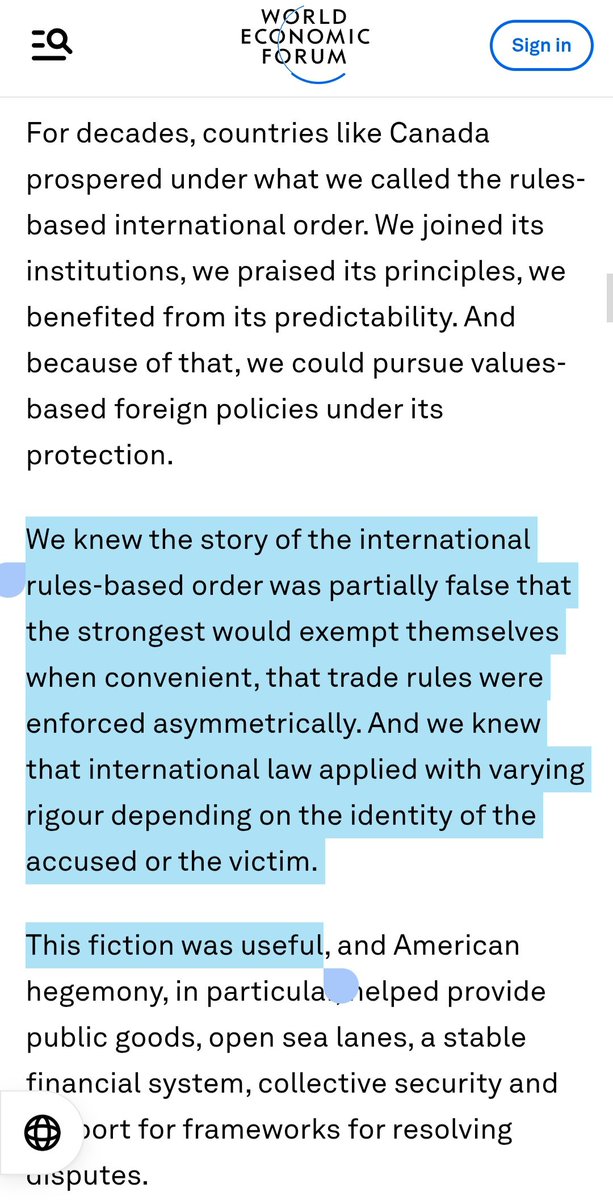
The historic speech given by Canada's Prime Minister Mark Carney at the World Economic Forum in Davos has gotten a lot of attention, but many people are overlooking the most revealing admission he made, which exposes the blatant hypocrisy of Western imperialism.
It is perhaps understandable that most observers are focusing on Carney's response to Donald Trump's threats and his announcement that Canada will "fundamentally shift our strategic posture" and "diversify" away from the US. This is significant and historic.
Nevertheless, an even more important part of the speech was when Canada's prime minister admitted that the so-called "rules-based international order" was always deeply hypocritical and biased, serving the interests of the imperialist West.
He said, "We knew the story of the international rules-based order was partially false, that the strongest would exempt themselves when convenient, that trade rules were enforced asymmetrically. And we knew that international law applied with varying rigour depending on the identity of the accused or the victim".
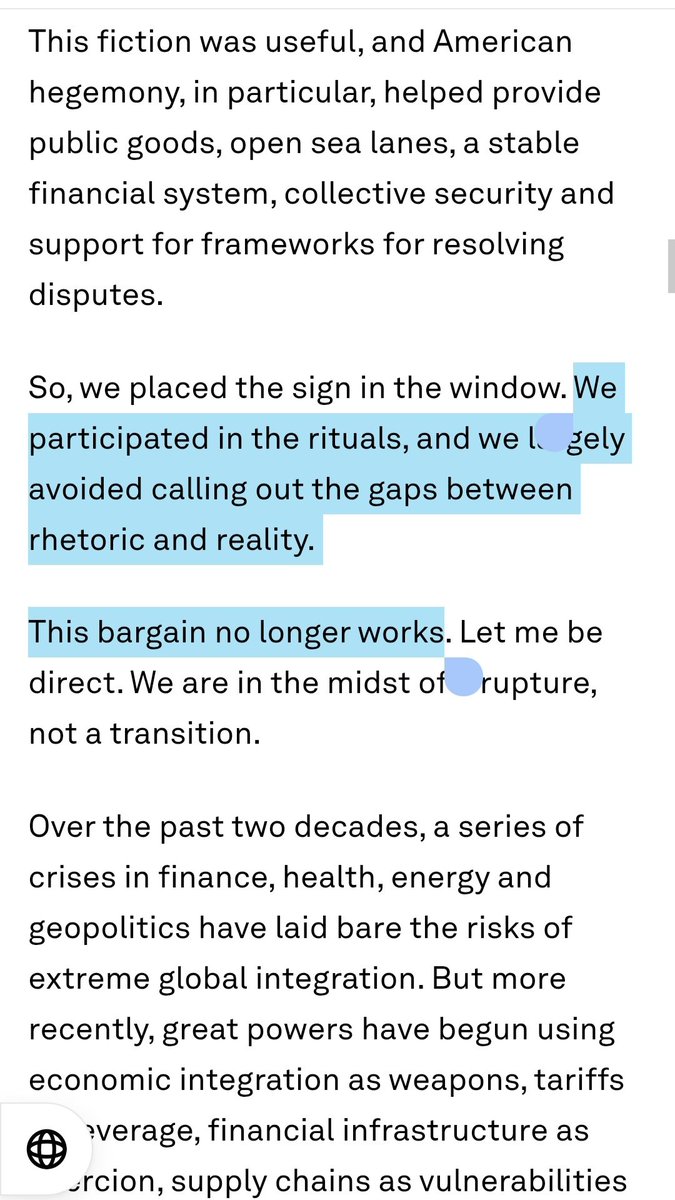
"This fiction was useful" for Western imperialist countries, Carney added. Which is why, "We participated in the rituals, and we largely avoided calling out the gaps between rhetoric and reality".
However, "This bargain no longer works", he stressed.
In other words, Carney was admitting that Western "middle powers" (like Canada or European countries) willingly went along with US hegemony and supported the US-led imperialist system -- which is predicated on the systematic subjugation and exploitation of Global South countries in the periphery -- because these Western middle powers also benefited from this pillage of the Global South.
But now that the US empire has turned against these Western imperialist middle powers that it previously called its "allies", and now that they are getting just a glimpse of what it feels like to be on the receiving end of what they have been doing to the Global South for centuries, they are (ostensibly) turning against the exploitative system that they had helped to sustain for so long.
They supported imperialism as long as it benefited them. Now that it doesn't, they pretend to be acting in a principled way, supposedly to uphold international law and defend sovereignty. But Canada's prime minister has publicly acknowledged that they never truly cared about that. It was just the public relations narrative.
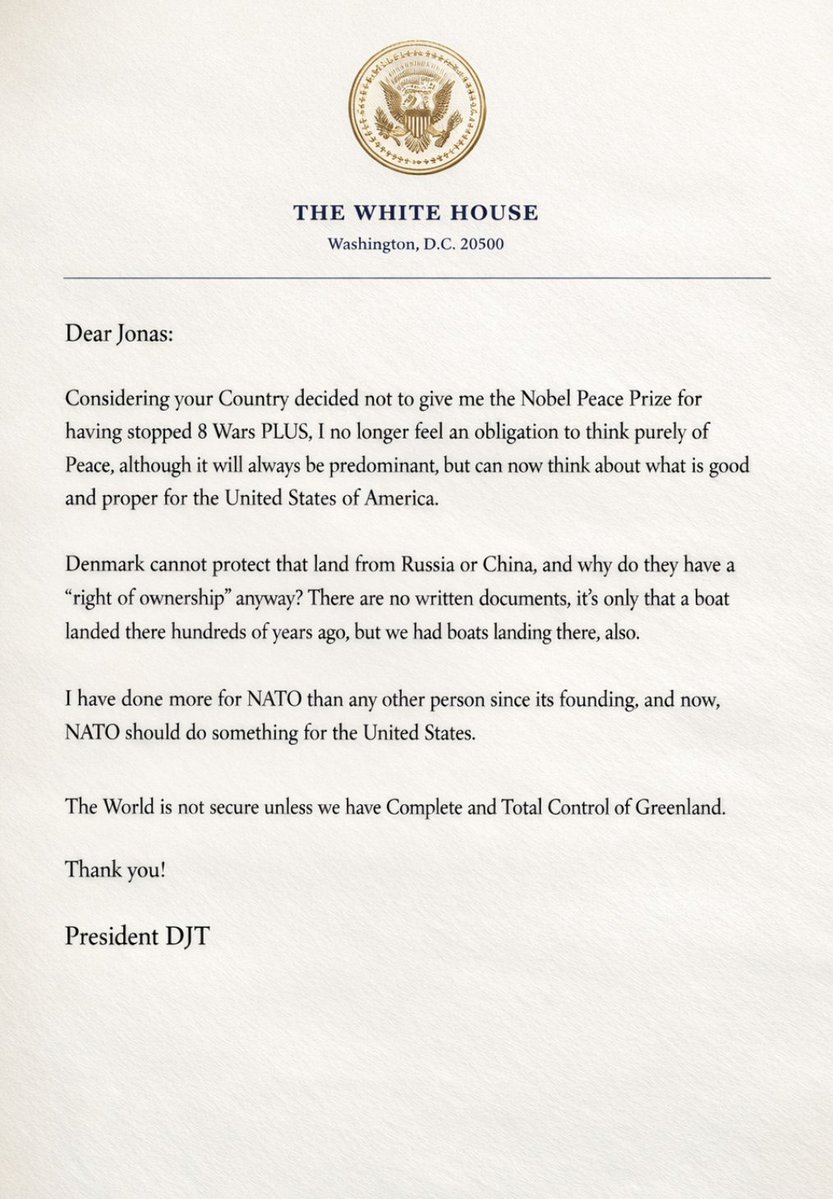
The letter that Donald Trump sent to Prime Minister Jonas Gahr Støre of Norway is insane!
This is why you don't elect a narcissist to be your president.
Is this what you voted for, Trump's supporters?
@missingelm@n004477@NuryVittachi cf. Bonnhoeffer: “The power of the one needs the stupidity of the other..." and "...only an act of liberation, not instruction, can overcome stupidity” (Bonhoeffer, 1951).
What do you call it when the system forces you, out of economic neccesity, to work for minimum wages way beyond your retirement age so you can afford to fund it, and the media attribute it to your refusal to retire? https://t.co/qj9xaxtZiL
@grok@Jiminemister@shinsukay@zed_q72@Xinjiangstory@grok one way Adrian Zenz used to add credibility to his work is to release a work with little references or sources and let other sources quote that work without verification then later quote these sources. You can verify this by checking what he often refers to as his "sources"
This is insane. China is preparing to require tourists to hand over 5 years of social media history, all email addresses and phone numbers used in the last 5 years, and the freaking names and addresses of family members. No thanks won't be visiting anytime soon!