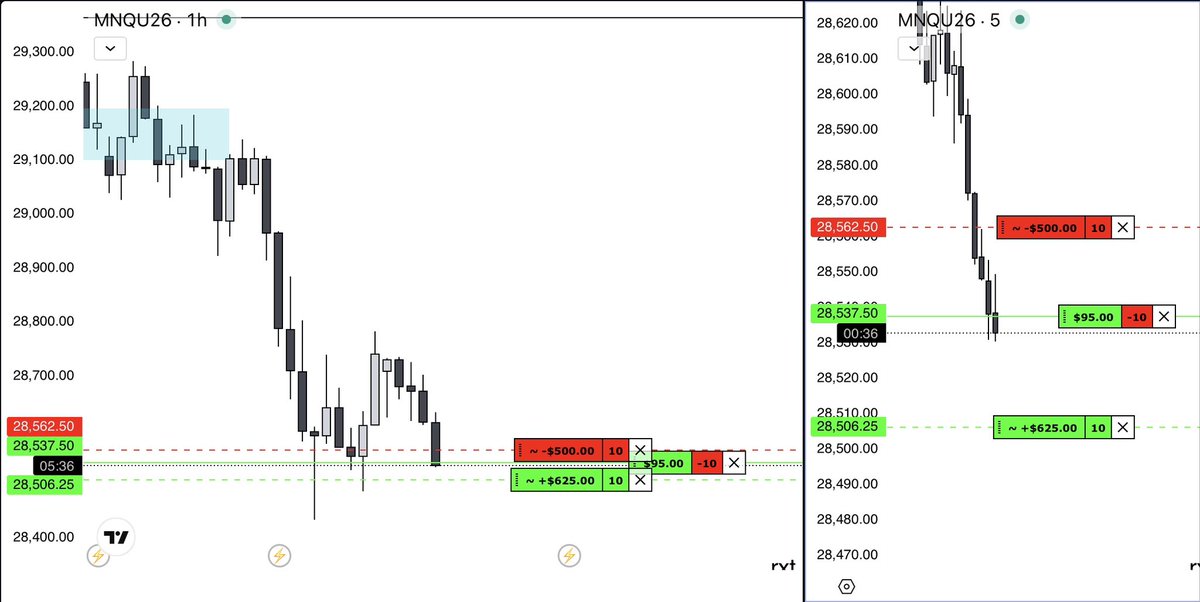
@XYJtrades drop more posts like this. This reminds me of your older videos, you spoke like an engineer when explaining MMXM, liquidity dispersal theory and other concepts but you never over complicated anything.
I have a few mechanical filters for deciding whether or not I will trade at the reversal, or wait for the continuation.
This is 1 of them | CiC Filter
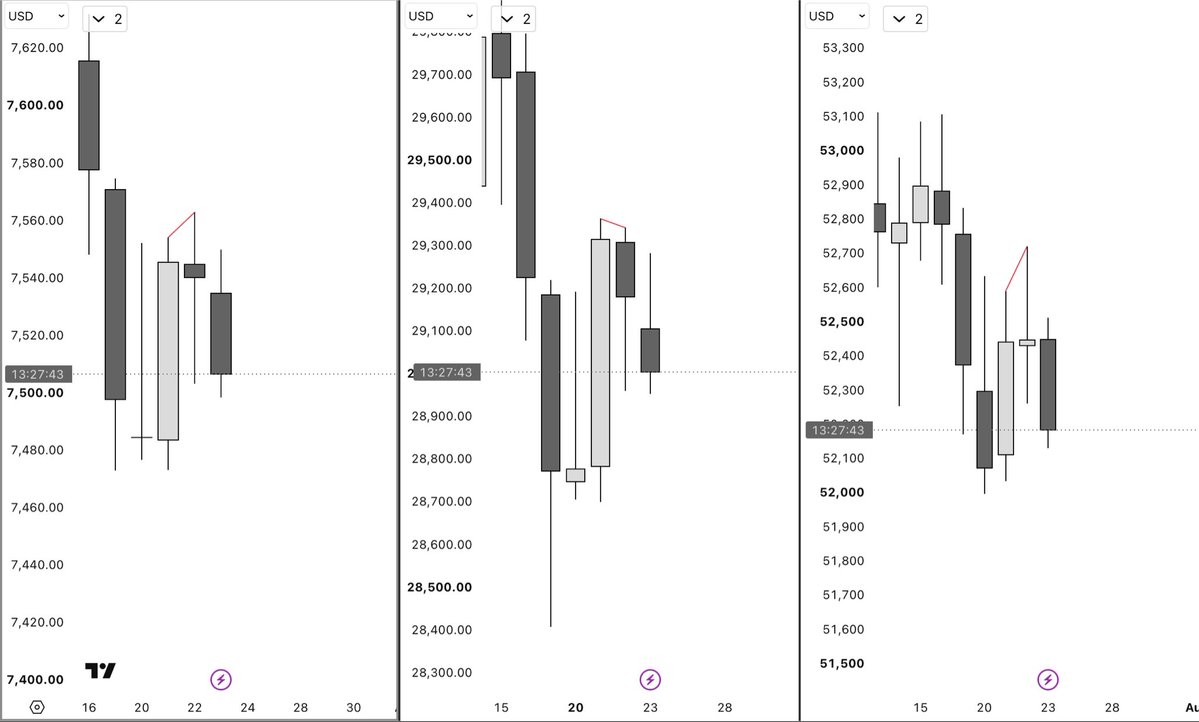
Thesis: Cracks in Correlation (SMT & PSP Variants I have taught you) validate swing formations and phases of distribution in a MMXM.
Phase 1 = SMR (reversal)
Phase 2/3 =redistributions (continuation)
Fair Value Gaps away from reversals define new invalidations I.e. where continuations form.
n = # of CiC necessary to validate a swing point.
HTF True Reversal | n = 2
HTF Continuation [in gap] | n - 1 = 1
LTF Continuation [in gap] | n - 2 = 0
When we lack a 2-stage-CiC at the reversal
We wait for to trade the HTF Continuation & validate the swing formation with at least 1 crack in correlation.
We do not need an entry time frame crack in correlation (m1-m5) based on this logic.
Gap selection:
Now do you remember how I taught you to filter gap selection timeframes. Recall we use implied dealing ranges from the point of reversal to the DOL.
Let’s use the example of a H4 universal model; Generally speaking I taught you the following
1. Below 50% IDR (early in reversal) m15 gaps are permissible
2. Above 50% IDR (higher in range, more time has passed) m30/h1 gaps are preferred
Reply with the one belief about trading you held for years — that was actually costing you money.
I'll go first:
'I need to watch every tick to catch every move.'
Glued to the screen, missing the setups that mattered, overtrading noise.
Your turn. 🧩
Average traders study the market to find an edge.
Consistently profitable traders study THEMSELVES to find the edge the market keeps taking from them.
The market gives you information.
Self-observation gives you the ability to USE that information.
Here's what I eventually understood:
The chart was never broken.
My interpretation of it was.
My emotional state when I looked at it was.
My ability to follow my own rules was.
Four different problems. Same chart.
The chart showed a clean setup. I entered. Price reversed.
"Clearly a bad signal," I told myself.
Price reversed again.
"Market manipulation."
Again.
"Algo."
if you're not writing down your trades, you're not learning from them.\n\nnot just entry/exit — write down why you took it, how you felt, and whether you followed your rules.\n\npatterns emerge fast. most of them are uncomfortable to see.\n\nthe journal doesn't lie. that's why most traders avoid it.
Not feeling it today to do the whole Figma thing. @Topstep eval purchased last night.
1/1 , quick loss when I set a market order instead of a limit when setting my stop 😭..
H4 SMT + PSP
The chart doesn't know you took the trade. It doesn't know you exist. Every emotion at the screen is private correspondence with a system that can't reply. Gallwey's quiet insight: most trading suffering is self-directed at a neutral opponent.
Diego why not AB test your process. Treat it like an engineer. Even if it’s on a practice account or paper, take the trade and don’t move to break even. Don’t move your stop and build evidence that you know what you’re doing, that’s how your brain interprets confidence, it uses evidence. Build a library of wins where you hold and you’ll be more confident in not moving your stop.
The worst part about a bad trading day isn't the drawdown.
It's the story you run for the next four hours.
Your account resets at close. Your mind doesn't.
That gap is where the real risk lives.
The fix isn't studying more — noticing the voice before it runs the next trade. 🧵
Your edge today isn't a setup. It's a pause. Bowman on expert intuition: experts gather more information when novices commit. The pause feels like weakness. It's the highest-resolution move you make. Let it cost you something.
the best traders you'll never hear about are incredibly boring.
same setup. same size. same rules. every day.
no revenge trades. no conviction bets. no doubling down.
boring is how you stay in the game long enough to compound.
excitement is expensive. discipline is free.
The market doesn't care about your last trade.
It doesn't owe you anything.
The sooner you stop treating it like it does, the sooner your P&L reflects your edge — not your ego.
Fail → learn → restart → repeat.
That's The Loop.
Run it.
📺 @rxttrades


![XYJtrades's tweet photo. I have a few mechanical filters for deciding whether or not I will trade at the reversal, or wait for the continuation.
This is 1 of them | CiC Filter
Thesis: Cracks in Correlation (SMT & PSP Variants I have taught you) validate swing formations and phases of distribution in a MMXM.
Phase 1 = SMR (reversal)
Phase 2/3 =redistributions (continuation)
Fair Value Gaps away from reversals define new invalidations I.e. where continuations form.
n = # of CiC necessary to validate a swing point.
HTF True Reversal | n = 2
HTF Continuation [in gap] | n - 1 = 1
LTF Continuation [in gap] | n - 2 = 0
When we lack a 2-stage-CiC at the reversal
We wait for to trade the HTF Continuation & validate the swing formation with at least 1 crack in correlation.
We do not need an entry time frame crack in correlation (m1-m5) based on this logic.
Gap selection:
Now do you remember how I taught you to filter gap selection timeframes. Recall we use implied dealing ranges from the point of reversal to the DOL.
Let’s use the example of a H4 universal model; Generally speaking I taught you the following
1. Below 50% IDR (early in reversal) m15 gaps are permissible
2. Above 50% IDR (higher in range, more time has passed) m30/h1 gaps are preferred](https://pbs.twimg.com/media/HOF8DyybQAAsSPB.jpg)






![XYJtrades's tweet photo. I have a few mechanical filters for deciding whether or not I will trade at the reversal, or wait for the continuation.
This is 1 of them | CiC Filter
Thesis: Cracks in Correlation (SMT & PSP Variants I have taught you) validate swing formations and phases of distribution in a MMXM.
Phase 1 = SMR (reversal)
Phase 2/3 =redistributions (continuation)
Fair Value Gaps away from reversals define new invalidations I.e. where continuations form.
n = # of CiC necessary to validate a swing point.
HTF True Reversal | n = 2
HTF Continuation [in gap] | n - 1 = 1
LTF Continuation [in gap] | n - 2 = 0
When we lack a 2-stage-CiC at the reversal
We wait for to trade the HTF Continuation & validate the swing formation with at least 1 crack in correlation.
We do not need an entry time frame crack in correlation (m1-m5) based on this logic.
Gap selection:
Now do you remember how I taught you to filter gap selection timeframes. Recall we use implied dealing ranges from the point of reversal to the DOL.
Let’s use the example of a H4 universal model; Generally speaking I taught you the following
1. Below 50% IDR (early in reversal) m15 gaps are permissible
2. Above 50% IDR (higher in range, more time has passed) m30/h1 gaps are preferred](https://pbs.twimg.com/media/HOF8DyzaEAAcGBS.jpg)