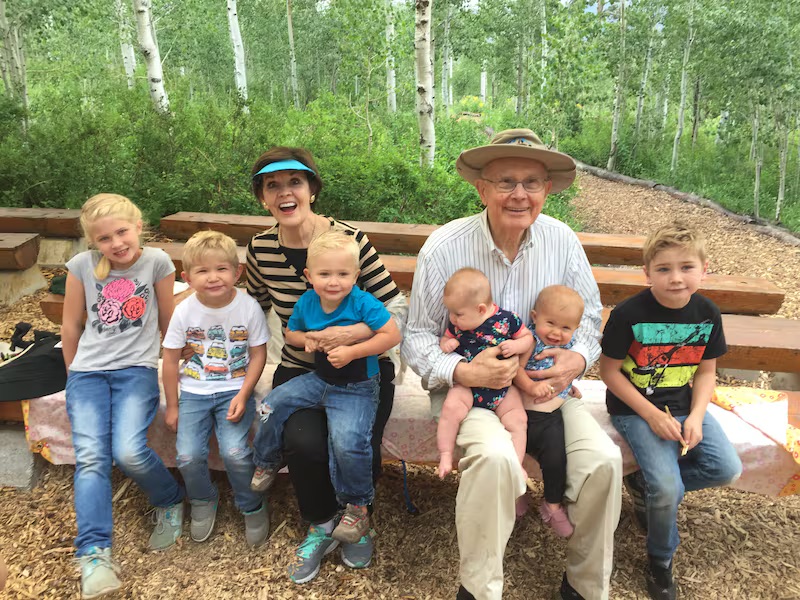
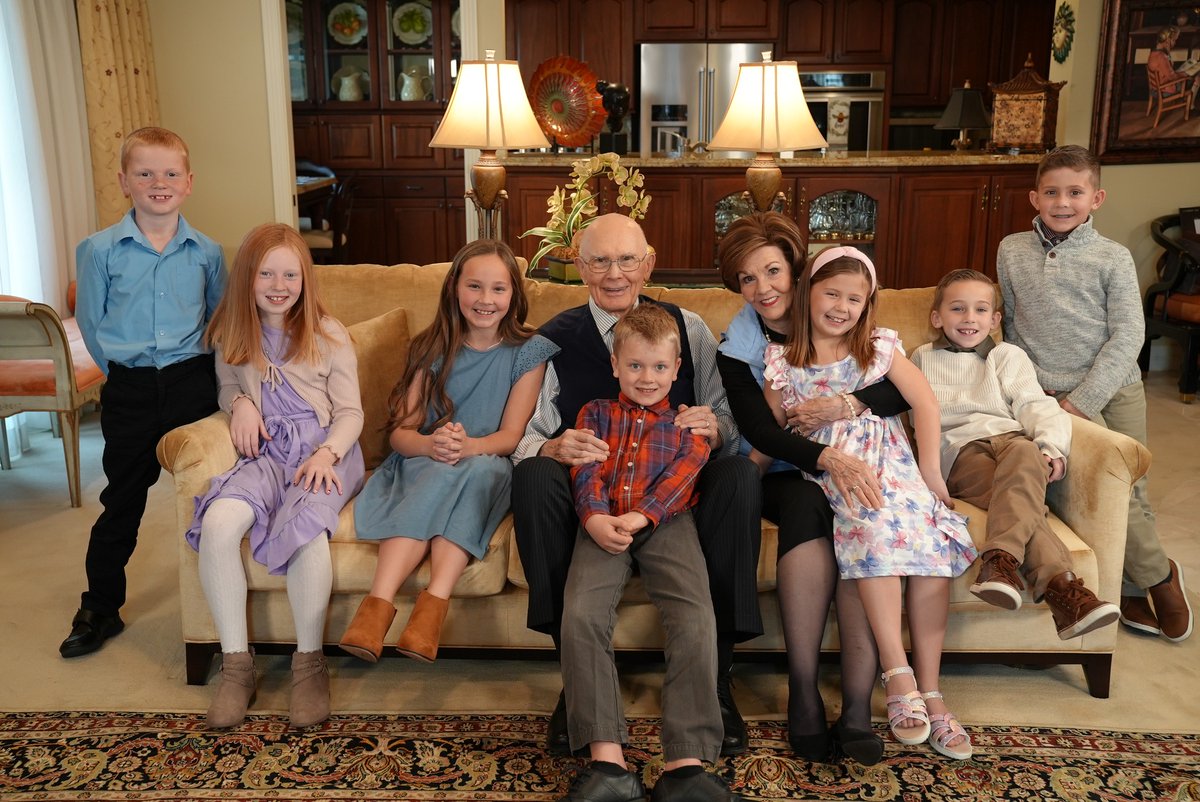
“I never ask myself, ‘When does the prophet speak as a prophet and when does he not?’ My interest has been, ‘How can I be more like him? My [philosophy is to] stop putting question marks behind the prophet’s statements and put exclamation points instead.”
Dallin H. Oaks may be the most prolific writer and speaker in the modern Church. Which is why dismissing his spiritual gifts takes a kind of willful ignorance.
Between one of the most decorated legal careers of his generation, serving as BYU president, sitting on the Utah Supreme Court, chairing the PBS board, sustained advocacy for religious freedom across multiple decades and multiple countries, and then four decades as an apostle and now president of The Church of Jesus Christ of Latter-day Saints. The man has spent a lifetime putting his convictions on paper.
Read his writings. Listen to his speeches. Watch the example of his life. Hold all of it against the backdrop of what the world is actually facing right now.
If you do all that and still don't walk away knowing he's a prophet, or at minimum a man who developed more genuine spiritual gifts in a single lifetime than most people will ever encounter, that's a skill issue.
I know beyond any certainty in my life that this is The Church of Jesus Christ of Latter-day Saints, restored with the fullness of the gospel that God has chosen to reveal in this dispensation of the fullness of time and led by prophets to the present day.
I respond with humility to the responsibility that God has placed upon me and commit my whole heart and soul to the service to which I’ve been called.
In our day, with social media, artificial intelligence, and all the technology of our modern age, it is very easy to be misrepresented or to misrepresent the intent of others.
Let us be determined to be completely honest and most generous as we speak of others.
With the rise of artificial intelligence, it is increasingly important to be certain that what we accept as truth is grounded in eternal principles.
My invitation for you is to choose truth when deception is easy. Slow down enough to listen to the Spirit and allow Him to direct you.
What your children really want for dinner is you!
In an age of constant online connection, we may need to disconnect from technologies and other distractions to truly reconnect with our families.
Families grow stronger when they set aside these distractions and spend meaningful time together—learning eternal values like the importance of marriage and children, the purpose of life, and the true source of joy.
Parents also have a duty to teach their children practical knowledge apart from gospel principles. Families unite when they do meaningful things together. Happy family experiences strengthen family ties. Camping, sports activities, and other recreation are especially valuable for bonding families.
Some may say, “But we have no time for any of that.” To find time to do what is truly worthwhile, many parents will find that they can turn their families on if they all turn their technologies off.
What those we love need most is simply time with us. Our Savior, Jesus Christ, is our ultimate role model. He will help us as we strive to build these family bonds.
Lebron on SportsCenter in 2002
“I heard from a NBA source this summer when he worked out with Michael Jordan the 2 best players in the gym were Penny Hardaway and LeBron James”
Our Savior Jesus Christ taught us how to relate to one another. The great commandments in the law, He taught, were to love—God and neighbor. (Matthew 22:37-39)
When it comes to how we treat others I'm reminded of a story from President Monson on how his wife refused to sign a petition criticizing how young boy was delivering news papers. After receiving the complaint from their neighbors the boy took his own life.
It can be easy to criticize and to use harsh and demeaning language but remember the teachings of our Savior:
"Ye have heard that it hath been said, Thou shalt love thy neighbour, and hate thine enemy.
But I say unto you, Love your enemies, bless them that curse you, do good to them that hate you, and pray for them which despitefully use you, and persecute you; That ye may be the children of your Father which is in heaven" Mathew 5: 43-45
"When Michael Jordan got old he got resentful, bitter, and teammates didn't want to play with him. But when Brady & LeBron got old they were energized by the young guys around them."
@colincowherd is amazed by Tom Brady & LeBron's career longevity
@collinsworth55 I’ve done a 5-day fast twice now. Everyone talks about the physical side, but for me, after 48 hours it became mostly mental. The body adapts, the mind takes over—and that’s when the real benefits hit: sharper focus, better control.
I know LeBron is an incredibly polarizing athlete, but even still
Seeing a guy still be so incredibly, top .01% explosive at age 41 is INSANE to me
We will never see something like this again https://t.co/xSLsZJH8k5
Stop Letting Youth Sports Control Your Sunday
In this powerful clip from Will Cain Country, David Pollack discusses the difficult choices parents face in the world of high-level youth sports. Pollack recounts telling a national travel ball coach that his family would not compromise on church, even if it meant his daughter lost playing time. He warns parents against the "busy, busy, busy" trap of the world and explains why it is essential to demonstrate to your children that faith always comes before the game.
Sharon Eubank says temples are the greatest poverty-alleviation system in the world. That claim has data behind it. Here it is.
Poverty research consistently shows that the strongest predictors of escaping poverty are family stability, social capital, and community trust. The temple system is built to produce all three.
Here is the mechanism, step by step.
Step 1: The problem with poverty isn’t money. It’s infrastructure.
William Easterly, a former World Bank economist and current professor at NYU, argued that large top-down aid programs often fail because they lack local accountability and feedback loops. The planners don’t live there. The money arrives, gets absorbed, and the people it was meant to help stay poor.
The Church’s model is the opposite. Individual. Family. Ward. Bottom-up.
Step 2: The temple is a sacred commitment device.
In behavioral economics, a commitment device is a tool that binds people to hard decisions before the moment of temptation arrives. The temple represents one of the strongest commitment mechanisms found in modern religious life.
Covenants made there are treated by participants as the most binding promises of their lives: fidelity, honesty, sobriety, care for neighbors. Any religion can encourage those behaviors. The temple makes them the subject of a sacred promise. A low-stakes promise produces low-stakes compliance. A covenant made in what the participant believes is the house of God produces something categorically different.
Step 3: Religious belief itself predicts economic outcomes.
Harvard economist Robert Barro studied religiosity and economic growth across more than 100 countries. His conclusion is that religion affects economic outcomes mainly by fostering beliefs that influence individual traits such as thrift, work ethic, honesty, and openness to strangers. These are not soft virtues. They are the precise inputs that economists identify as prerequisites for functioning markets and cooperative communities.
Baylor sociologist Byron Johnson has spent decades studying religion and social outcomes. His research consistently finds that participation in tight-knit religious communities with strong norms correlates with lower crime, stronger family stability, higher volunteerism, better mental health, and improved economic stability.
These outcomes are not mystical. They emerge from dense networks of trust, shared norms, and mutual accountability. The temple covenant is designed to produce exactly those norms.
Step 4: Those promises produce the behaviors poverty research says matter most.
Harvard economist Raj Chetty’s landmark research on intergenerational mobility found that high upward mobility areas have higher fractions of religious individuals and greater civic participation. The single strongest predictor of upward mobility he identified was family structure, specifically the percentage of single parents in an area.
Chetty’s research also shows that cross-class friendships are among the strongest predictors of upward mobility. Religious congregations are among the few institutions where people from very different socioeconomic backgrounds regularly interact and form those relationships. That is precisely what Eubank describes: people of all social classes entering the same building, making the same promises, and becoming accountable to one another.
Temple covenants call participants to form families within marriage and to remain faithful to those families. Melissa Kearney, a Notre Dame economist, shows married households have incomes 63 to 113 percent higher than single-parent households. Children of single mothers are five times as likely to be poor.
The temple does not passively attract people who already have stable families. It is the institution that produces the promises that create them.
Step 5: The ward runs on hyper-local feedback loops.
Robert Putnam of Harvard found that religious congregations generate a disproportionate share of America’s social capital and civic engagement. The ward that forms around a temple community is a high-trust, high-density network, but what makes it functionally different from a government program is its feedback loop.
The bishop knows who is hungry today. The Relief Society knows which family just lost an income. The distributors are volunteers who live on the same street. There is no application, no bureaucracy, and minimal administrative overhead. This is exactly what Easterly said top-down aid could never replicate: a system where the people delivering help are accountable to the same community receiving it.
Step 6: The safety net doesn’t require a temple recommend.
Does this system abandon people who can’t keep the rules?
It doesn’t. Church welfare is administered based on need, not temple standing. The temple is the aspirational goal, the capstone of the system. The ward is the safety net for everyone within its boundaries, regardless of where they are in their faith. Someone in crisis doesn’t need a recommend to receive food, housing assistance, or a referral to a self-reliance course. The commitment standard and the compassion standard operate on separate tracks.
Step 7: The self-reliance program converts the network into measurable outcomes.
Within six months of completing a Church self-reliance course:
41% improved their ability to provide for their families.
40% increased income.
61% started or expanded a business.
47% found better employment.
52% enrolled in further education.
Local. Accountable. Feedback-driven. Built on trusted relationships. This is the bottom-up model Easterly argued was the only approach that actually works.
Step 8: This scales globally, and works best where institutions are weakest.
In developed nations, secular institutions carry much of the trust infrastructure. In developing nations with weak rule of law and high corruption, they don’t. Religious trust networks are often the only thing that functions. Within the global Latter-day Saint community, a temple recommend signals adherence to behavioral standards—honesty, sobriety, and responsibility—to an entire global network that shares them. That matters most precisely where formal institutions fail.
What about the rest of the world?
You cannot export a culture of trust to the whole world at once. You build hubs, communities of high-trust behavior, that then spill outward. The Church logged 7.4 million volunteer hours and spent $1.58 billion in external humanitarian aid in 2025. That output doesn’t come from nowhere. It comes from the people the temple system produced. The temple creates the culture. That culture produces the people. The people go out and relieve the poor.
The full mechanism:
Temple covenant > binding moral commitment > stable marriage and family > cross-class trust networks > hyper-local welfare > self-reliance and capability building > exit from intergenerational poverty.
Every link in that chain is supported by independent, secular research. Easterly. Barro. Putnam. Johnson. Chetty. Kearney.
The world treats poverty as a liquidity problem, a lack of cash. The temple system treats it as an infrastructure problem, a lack of stable families and high-trust networks. One requires a check. The other requires a covenant.
The temple is not primarily a building. It is a commitment institution that produces the family stability, social capital, and moral accountability that social science repeatedly links to upward mobility. The data shows which one lasts.










![Ryan_DClark's tweet photo. “I never ask myself, ‘When does the prophet speak as a prophet and when does he not?’ My interest has been, ‘How can I be more like him? My [philosophy is to] stop putting question marks behind the prophet’s statements and put exclamation points instead.” https://t.co/Xct9cdZFeP](https://pbs.twimg.com/media/FAtOEi9UcAQhDBU.jpg)