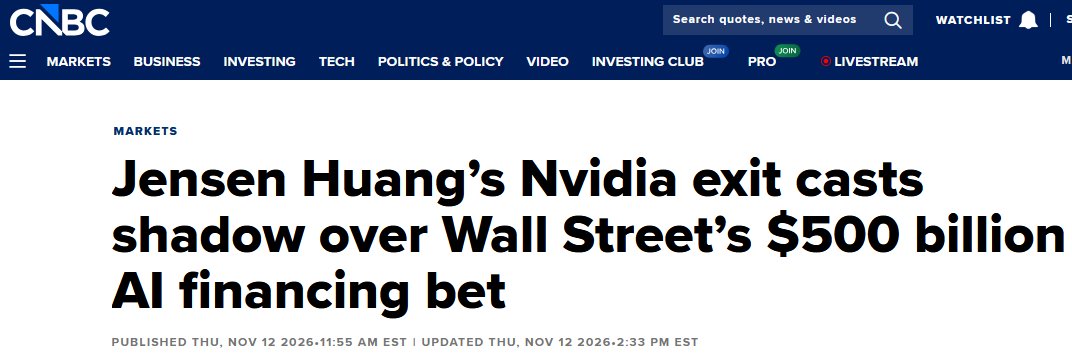
BREAKING: Nvidia’s board, $NVDA, is not considering bringing Jensen Huang back as CEO, CNBC reports.
Nvidia’s stock falls to a new low of the day on the news, now down -34% from its October 6th high.
The $NVDA news just keeps getting worse.
- Entire administration is turning on him. Rubio likely leaked the initial reports and Bessent went on Fox yesterday and demanded a new CEO and answers from the Nvidia board.
- New investigation today found empty server racks in Indonesia from Megaspeed. An affair could be forgiven, selling to China is going to be harder for the market to forgive if it was intentional.
- Semianalysis just cut their 2028 capex forecast by 28%, indicating that capex growth has peaked. This really hurts NVDA.
- Jensen now has to deal with multiple investigations and the company, going into earnings, might say anything that gets interpreted as bearish when it comes to guidance/growth/margins even if it is slightly off from expectations.
- If the new CEO is going to cut most of the circular financing that Jensen did, may not be as easy for them to hit numbers when some of these smaller AI companies don’t have the funding to buy their chips.
I know people are saying that the valuation has discounted all of this from $240, sure, but if this stock isn’t trading on valuation and more on sentiment, if the sentiment becomes that it’s just too hard to own…thats where you get the ugliness continuing.
Just becoming harder to measure the risks that are piling up.
BREAKING: The US Commerce Department announces new restrictions on remote access to advanced American AI chips and computing infrastructure.
The new rules aim to prevent China and others subject to US export restrictions from circumventing existing controls by accessing American AI technology through cloud computing services.
Prior to this, a loophole allowed foreign entities to access advanced US computing capabilities without physically importing restricted chips.
More AI regulation is on the way.
Remember when oil went negative during COVID because there was no place to store the oil?
What do you think happens when there are all these GPUs financed at 10%+ interest and depreciating 20% per year can't be plugged in?
The 30% per year carry is going to bankrupt every neocloud sitting on GPUs that cant be plugged in. When the Neos go bankrupt, all of these excess GPUs hit the resale market. The same global market that has no place to plug them in.
Resale value will need to approach 0 to solve the problem of them being paperweights without a data center to plug them into.
BREAKING: US Treasury Secretary Bessent says Nvidia, $NVDA, needs a "dramatic shakeup" after the Jensen Huang scandal.
Bessent says he wants to shift the focus from Huang’s personal "foibles" to the legal and national-security aspects.
"I want to keep coming back to what was the culture at Nvidia, and were they pressing these seemingly illicit sales to goose their revenues and their earnings?" Bessent said.
He then demands answers from the board "within the next 10 days."
From the Telegraph:
“For years after the 2008 financial crash, cheap money fuelled a global borrowing boom. However, as interest rates have begun to rise while governments and tech giants compete for capital, the tide is turning.… the consequences of a gathering credit crunch are beginning to emerge, and the squeeze has only just started.”
#economy #markets
BREAKING: US Congress is preparing to pass tighter AI chip export controls following the Nvidia, $NVDA, scandal, per FT.
Details include:
1. Several bills are aiming to curb sales of sensitive chips outside of the US.
2. The bills will also give Congress the ability to review and potentially block sales already approved by the Trump Administration
3. Democrats and Republicans have both thrown support behind the bills
It appears more regulation is on the way.
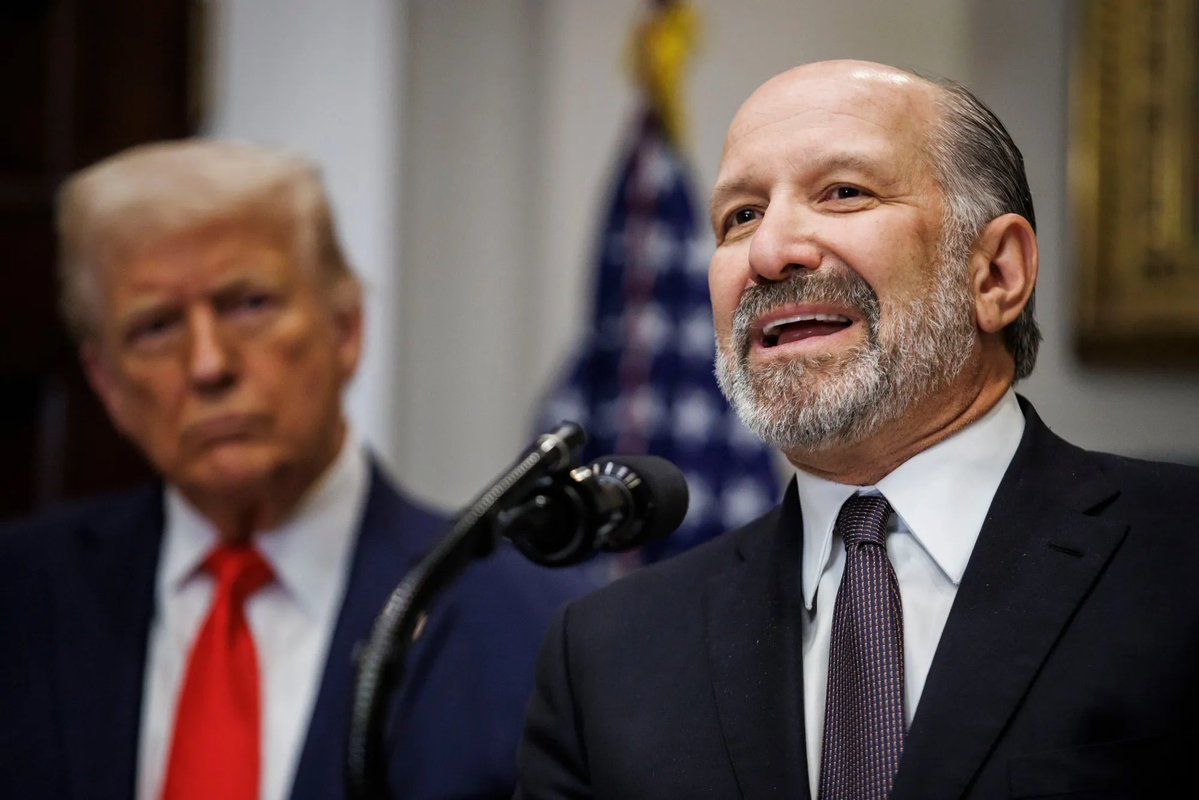
BREAKING: The Trump Administration is reportedly considering firing Commerce Secretary Howard Lutnick over the China chip scandal.
This comes amid reports that Lutnick stalled curbing chip sales to China.
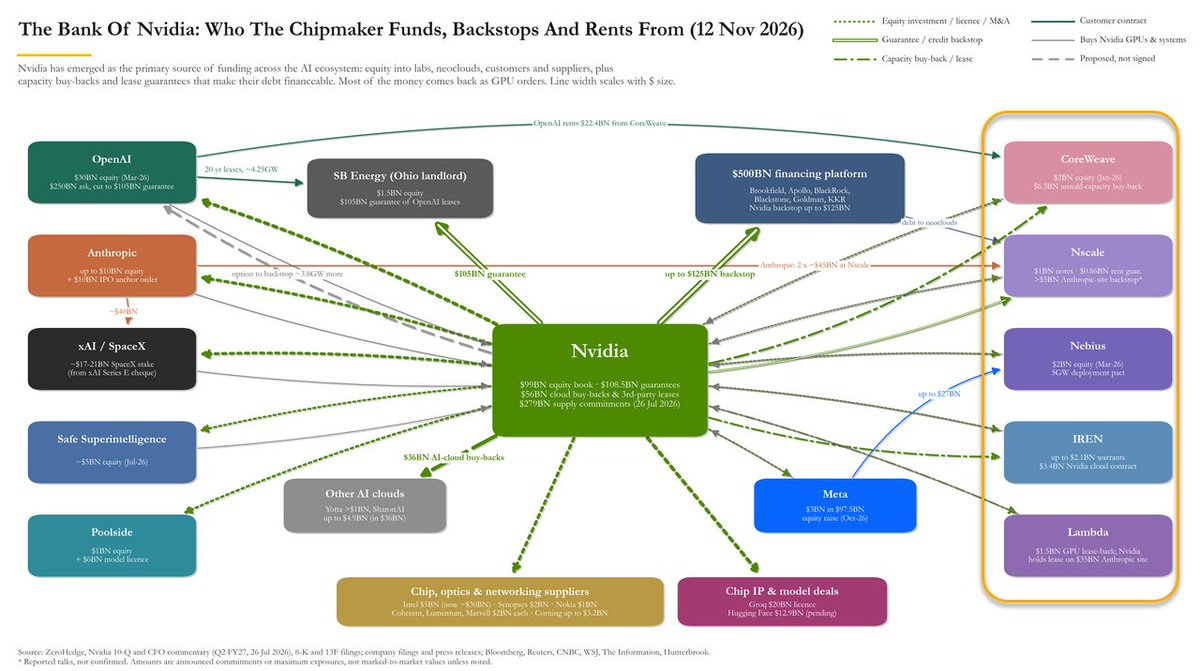
Why the Neoclouds are getting smoked: "a big chunk of Nvidia's $50-60BN in quarterly free cash flow gets recycled straight back into customers, suppliers and neoclouds, and even a temporary pause could pull $50BN or more out of the AI ecosystem. Think of it as QT for the AI trade, announced by press release at 8:48am."
THE IMF HAS FLAGGED $1.4 TRILLION IN CIRCULAR AI DEALS.
Big Tech is funding its own customers so they can keep buying from Big Tech.
Here is every known AI circular financing loop right now:
1. Nvidia ↔ OpenAI: Nvidia invested $30 billion in OpenAI and guarantees up to $105 billion of its Ohio data center leases. OpenAI fills those data centers with Nvidia chips.
2. Oracle ↔ OpenAI: OpenAI signed a $300 billion cloud deal with Oracle. Oracle is borrowing heavily to build the data centers for it.
3. Microsoft ↔ OpenAI: Microsoft owns about 27% of OpenAI. OpenAI committed $250 billion to Microsoft's Azure cloud.
4. SoftBank ↔ OpenAI: SoftBank invested $64.6 billion in OpenAI. OpenAI rents data centers from SoftBank's SB Energy.
5. Amazon ↔ OpenAI: Amazon is investing up to $50 billion in OpenAI. OpenAI expanded its Amazon cloud deal by $100 billion.
6. AMD ↔ OpenAI: AMD gave OpenAI the right to buy up to 160 million AMD shares for $0.01 each. In return, OpenAI buys AMD chips.
7. Google ↔ Anthropic: Google is investing up to $40 billion in Anthropic. Anthropic committed at least $121 billion to Google Cloud.
8. Amazon ↔ Anthropic: Amazon is investing up to $33 billion in Anthropic. Anthropic committed at least $110 billion to Amazon's cloud.
9. Broadcom ↔ Anthropic: Banks lent $63 billion to a special company that buys Broadcom chips and leases them to Anthropic. Broadcom backs the chips' resale value.
10. Microsoft + Nvidia ↔ Anthropic: They are investing up to $15 billion combined. Anthropic committed at least $44.9 billion to Microsoft's cloud.
11. SpaceX ↔ Anthropic: SpaceX borrowed $40 billion to buy Nvidia chips and sells the computing power to Anthropic. Nvidia is a SpaceX shareholder.
12. Nvidia ↔ CoreWeave: Nvidia owns about 11% of CoreWeave and agreed to buy $6.3 billion of its unused capacity. CoreWeave buys Nvidia chips.
13. Nvidia ↔ neoclouds: Nvidia agreed to buy $36 billion of cloud capacity from smaller AI cloud companies. They use that guaranteed income to borrow and buy Nvidia chips.
14. Microsoft ↔ Nscale, Nebius, IREN: Microsoft signed up to $70.9 billion in contracts with them. They use the money to buy GPUs.
15. Google ↔ former bitcoin miners: Google guarantees billions in leases at TeraWulf and Cipher and gets their shares in return.
16. Meta ↔ Blue Owl: A $27.3 billion data center was built through a joint company, with Meta backing it with a $28 billion guarantee.
17. Anthropic IPO: Its chip and cloud suppliers, Nvidia, Google, AMD, Micron, Broadcom and Microsoft, are buying $26 billion of its shares. Anthropic owes those same companies hundreds of billions in future spending.
When money keeps flowing, these loops make everyone's revenue look strong.
BREAKING: Banned Nvidia chips ended up in a Shanghai AI data center linked to Alice Huang, per Bloomberg
A company Huang founded, now majority-owned by her sister, listed 52 Super Micro units with Nvidia H100 or H200 chips, which can’t be sold to China without US approval. Separately, a Singapore Nvidia cloud partner bought 22 Dell servers with Nvidia H800 chips. The chips went to a Shanghai facility run by Huang’s husband, Kang Wei.
US officials suspect Alice Huang was recruited by Chinese intelligence to target Jensen Huang, who resigned as Nvidia CEO this week.
🚨 Another major scandal is coming out of NVIDIA.
And this one has nothing to do with Jensen Huang's affairs.
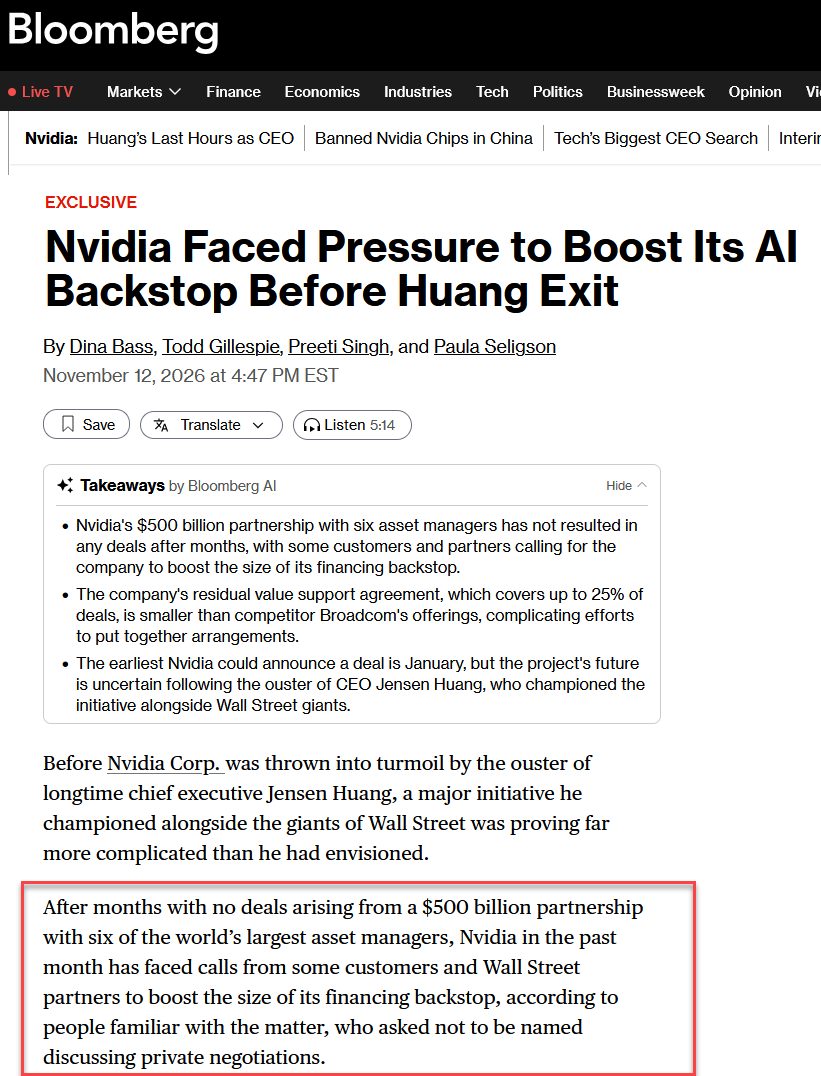
According to a Wall Street Journal report, Nvidia was offering billions in financial guarantees to AI companies that could not afford its chips, so they could keep buying them.
Some of these deals were being pushed by Jensen's own son-in-law, Nico Caprez, who became a vice president in January. His team was telling small cloud companies and data center builders that Nvidia could arrange credit support for them within a couple of weeks.
The goal was simple: turn them into long term buyers of Nvidia GPUs.
And the size of Nvidia's commitments has exploded. Its own filing shows $530 BILLION in commitments and guarantees, up from $184 billion just one quarter earlier.
Inside the company, CFO Colette Kress was raising concerns. She kept asking how these guarantees were priced and what Nvidia was really getting back.
In an August meeting, Jensen cut her off and called her "a deer in the headlights."
She was also the one who cut Nvidia's guarantee on OpenAI's Ohio data center from $250 billion to $105 billion.
Now Jensen is gone, and the CFO who questioned these deals is running Nvidia.
To understand why this is a big deal, you need to understand the AI funding loop.
Here is how it works:
1. Nvidia puts money into an AI company, or guarantees its loans and leases.
2. That company uses the money and credit to build a data center.
3. The data center is filled with Nvidia GPUs.
4. Nvidia reports those GPU sales as revenue.
5. If the company cannot rent out all its computing power, Nvidia agrees to buy the unused part.
SO NVIDIA IS THE INVESTOR, THE LENDER, THE SUPPLIER AND THE BACKUP CUSTOMER, ALL IN THE SAME DEAL.
The money goes out of Nvidia and comes back to Nvidia as sales.
CoreWeave is the clearest example. Nvidia owns a stake in it, sells it chips, and agreed to buy up to $6.3 billion of its unused computing capacity through 2032.
OpenAI is the biggest. Nvidia is guaranteeing up to $105 billion for its Ohio data center, supplying all the chips inside it, and invested $1.5 billion in the company building it.
Nvidia's own filing for the quarter ending July 26 shows where the money is tied up:
• Supply commitments for memory and chip wafers: $279 BILLION, up from $119 billion.
• Guarantee on the OpenAI Ohio data center: up to $105 BILLION.
• Deals to buy unused cloud capacity from neoclouds: $36 BILLION.
Nvidia's actual liabilities on its balance sheet: $91 BILLION.
That means the commitments outside the balance sheet are almost 6 times bigger than the debts on it.
Nvidia does not lose this money unless something breaks. A guarantee only costs Nvidia if a customer cannot pay.
But this is where it gets uncomfortable.
The WSJ says Jensen himself had started to panic. He warned executives that the biggest cloud companies were moving to their own chips to depend less on Nvidia.
At the same time, the wafers and memory Nvidia had committed to buy were coming at him like an "avalanche."
So the biggest customers were trying to leave, Nvidia was locked into buying huge amounts of supply, and smaller customers were being kept alive with Nvidia's credit.
And things were already starting to crack:
• Nvidia paused some of its financing deals in August.
• Nearly half of the $80 billion in data center bonds issued this year were rated junk.
• Neocloud stocks crashed this week, with Nebius down over 20% and CoreWeave down 17% at the lows.
• OpenAI raised less than it wanted, at a lower valuation.
And now Kress is the one deciding whether this continues.
If she pulls back on the financing, the companies that depended on Nvidia's money will have to borrow elsewhere, in a debt market that is already nervous.
If they cannot, they stop buying chips.
And if they stop buying chips, Nvidia's revenue drops.
That is the risk of a loop. It works perfectly when money keeps flowing, and it hurts on the way down.