If I took over a $2M home-service company tomorrow, I wouldn’t try to double the leads first. I’d try to make the existing leads worth more.
This is where I think people get growth completely backwards.
They immediately want:
More SEO.
More Google Ads.
More Meta.
More LSAs.
More leads.
But let’s say the company already generates 300 opportunities a month.
Before spending another dollar, I want to know:
How many book?
How many actually get estimates?
How many buy?
Average ticket?
Gross margin?
How many customers buy a second service?
How many disappear forever after the first job?
Because small improvements through that funnel compound.
Take 300 leads.
If 70% book and 50% of those buy, that’s 105 customers.
Get booking to 80% and close rate to 60%?
Now you’re at 144 customers.
Same 300 leads.
That’s 39 additional customers before I bought another click.
And I’ve learned this the hard way building my own service business over the last 12+ years:
Growth hides inefficiency.
You can keep pouring new revenue into a company and convince yourself you’re crushing it while money leaks everywhere underneath.
So if I took over a trades company, my first 30 days would be boring as hell.
I’d listen to calls.
Audit estimates.
Look at lost jobs.
Break down margins by service.
Look at financing usage.
Find abandoned leads.
Look at old customers nobody has contacted.
Then I’d fix the biggest leaks.
Acquisition gets all the attention because it’s sexy.
But sometimes the fastest way from $2M to $3M isn’t finding dramatically more customers.
It’s getting substantially more revenue from the demand you already paid to create.
If you run Local Services Ads and nobody answers the phone, Google can now charge you for that lead anyway.
This changed October 1st.
Google can now count certain missed LSA calls during business hours as valid, chargeable leads when the homeowner stays on the line for more than 20 seconds.
That’s a pretty important change for plumbers, HVAC companies, electricians, roofers and anyone else spending heavily on LSAs.
Because your cost per lead is no longer entirely a marketing problem.
It’s becoming an operations problem.
I’ve seen this disconnect for years.
The marketing team is judged on lead cost.
The office is judged on answering phones.
The sales team is judged on closing.
But it’s all the same system.
If you’re spending $15,000/month generating calls and your office regularly misses them, tweaking your ads isn’t where I’d start.
I’d pull the last 30 days of LSA calls and look at:
How many came in during business hours?
How many were answered?
How long until someone answered?
How many became booked appointments?
How many became sold jobs?
And now, how many missed calls did we actually PAY for?
Google is also testing larger LSA placements in Search, which could make them even more prominent.
So I wouldn’t be pulling money out of LSAs because of this change.
I’d make damn sure the operation behind them is ready.
If you’re paying Google to make your phone ring, answering the damn phone is officially part of your ad strategy.
Google just got another competitor for home service leads.
And it’s Amazon.
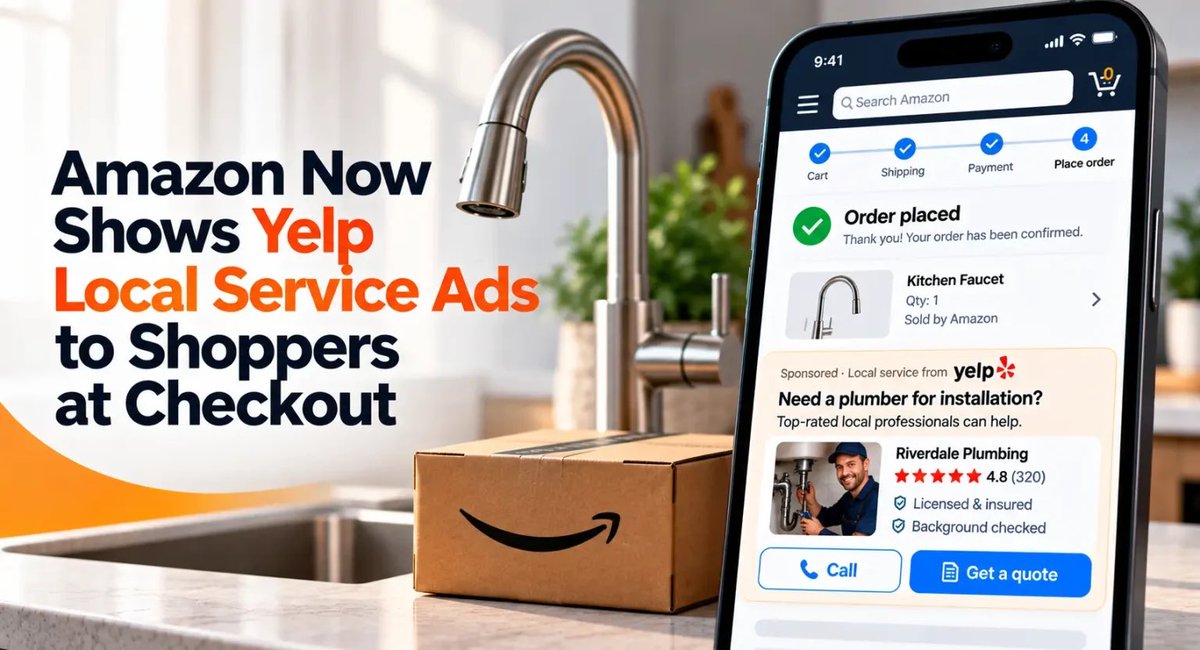
Amazon Ads just launched something called Sponsored Services with Yelp.
Here’s how it works.
Someone searches for or buys a kitchen faucet on Amazon.
Instead of waiting for that homeowner to go to Google and search:
“plumber near me”
Amazon can now put local plumbers directly in front of them.
On the product page.
On the order confirmation page.
Even on the package tracking page.
The homeowner can hit:
Call
or
Quote
And submit the lead without leaving Amazon.
Think about the difference here.
Google captures the homeowner after they decide they need a contractor and search for one.
Amazon potentially sees the event that creates the need in the first place.
You bought a faucet.
You probably need someone to install it.
You bought a ceiling fan.
You may need an electrician.
You bought something that needs professional installation.
Amazon already knows.
That’s an insane amount of purchase-intent data sitting upstream from the traditional home service search.
At launch, Amazon is using Yelp advertisers for eligible home and auto service categories in the U.S.
Plumbers.
Electricians.
Roofers.
Landscapers.
Cleaners.
Movers.
And this isn’t being built like some random display ad product either.
Amazon says Sponsored Services will use Cost Per Outcome bidding.
They’re building CRM lead delivery through webhooks.
Agencies will be able to manage campaigns through Amazon’s advertising infrastructure.
Amazon is basically taking this:
“I know what this homeowner just bought.”
And turning it into:
“I know which local service they might need next.”
I think that’s the bigger story here.
For years, home service marketing has revolved heavily around owning the search after demand already exists.
Google Ads.
Google Maps.
LSAs.
SEO.
Now companies with completely different datasets are starting to figure out how to identify the moment BEFORE that search happens.
Amazon has purchase data.
Meta has behavioral data.
Google has search data.
AI assistants increasingly have conversational intent data.
Those worlds are starting to collide.
Does that mean Amazon Sponsored Services will immediately become an amazing lead source?
No idea.
There isn’t enough performance data yet to say that.
Lead quality and cost will determine whether contractors actually care.
But I’d be paying very close attention to this.
Because the future of local lead generation may be a lot bigger than somebody typing “HVAC company near me” into Google.
Google just quietly took more control away from advertisers. If you’re running Search Ads, I’d be checking your account today.
Starting in September, Google began automatically moving eligible Search campaigns using certain legacy settings into AI Max.
And this matters a hell of a lot more than the name of some new Google feature.
AI Max can expand the searches you’re showing for, generate messaging, and decide which page on your website someone lands on.
Google says advertisers using the full AI Max suite have seen more conversions or conversion value at a similar CPA/ROAS in its internal data.
Great.
But after managing paid search for home-service companies for years, here’s the part I’d be watching:
More automation only works when you give the machine good inputs.
If you’re an HVAC company and Google can choose between 70 pages on your website, I want to know EXACTLY where it’s sending someone searching for an emergency furnace repair.
Not your homepage.
Not a blog from 2022.
Not some generic HVAC page.
The highest-converting page for that intent.
If this was my account, I’d check four things right now:
Search terms AI Max is finding.
Pages it’s sending paid traffic to.
What messaging it’s creating.
And most importantly, whether the additional conversions are turning into sold jobs, not just leads.
I’m not anti-AI Max.
I’m anti giving Google a credit card and saying “figure it out.”
Google’s automation is getting better.
Your oversight needs to get better with it.
You might be losing leads for one simple reason:
You’re trying to get them on the phone too fast.
Think about the homeowner on the other end.
They’re at work.
They’re picking up their kids.
They’re making dinner.
They’re in a meeting.
They need their furnace fixed, their roof looked at, or their plumbing issue dealt with.
But that doesn’t mean they want to stop what they’re doing and spend 10 minutes on the phone with someone they’ve never met.
So you call.
They don’t answer.
You call again.
Still nothing.
Then eventually you assume the lead was bad.
But the lead might not have been bad.
They might have just wanted you to text them.
That’s why I think every trade business should be giving people the option to communicate by SMS.
A lead comes in?
Send them a text right away.
“Hey Sarah, it’s Mike from ABC Heating. I just got your request. Happy to help. Do you want to text here or would you prefer a quick call?”
Now they’re in control.
They can answer when they have 30 seconds.
They can send you a photo.
They can give you their address.
They can tell you when they’re available.
You can confirm the appointment.
You can let them know when your tech is on the way.
And once you’ve built some trust and there’s actually a reason to talk?
Get them on the phone.
I’m not saying phone calls are dead.
They’re not.
There are plenty of jobs where a real conversation is necessary.
But you shouldn’t force every homeowner into a phone call just because that’s how your sales process has always worked.
Your customer wants convenience.
And the easier you are to communicate with, the easier you are to hire.
Sometimes you don’t need more leads.
You just need to make it easier for the leads you already paid for to do business with you.
If your home-service business can’t operate without you, you’re probably leaving millions of dollars of enterprise value on the table.
This isn’t motivational bullshit. It’s literally how these businesses are being valued.
I’ve spent 12+ years building a service business myself, and one of the biggest mistakes I made was thinking growth automatically meant I was building a more valuable company.
It doesn’t.
At one point Marvel had 21 people.
More people. More clients. More revenue. More complexity.
Today we’re a much smaller senior team, and I’ve become way more interested in the quality of the actual BUSINESS underneath the revenue.
I’ve also been looking seriously at acquiring service companies myself.
And once you start looking at businesses as a buyer instead of an owner, you notice something very quickly:
Buyers don’t just buy your profit. They buy the probability that the profit continues after you leave.
Look at what’s happening in the trades right now.
KKR agreed to acquire A1 Garage Door Service in a deal reported at roughly $2 BILLION this month. A1 started in 2007 and expanded into roughly 20 states. (Reuters)
Across home services, buyers are consistently placing more value on businesses with recurring revenue, management depth, diversified customers and less dependence on the founder. Current 2026 M&A data shows meaningful valuation differences between owner-dependent operators and businesses built to scale beyond the founder. (CT Acquisitions)
So if I owned an HVAC, plumbing, electrical or roofing company today, I’d be asking myself:
If I disappeared for 90 days, what breaks?
Sales?
Hiring?
Pricing?
Marketing?
Dispatch?
Customer relationships?
Financial reporting?
Every answer is something I’d start removing myself from.
Not because I’m planning to sell tomorrow.
Because a company that doesn’t need you is better to own even if you never sell it.
You get your time back.
You reduce risk.
And if somebody eventually puts a cheque in front of you, you’ve built an asset instead of a high-paying job.
That’s something I wish more business owners understood earlier.
Don’t wait until you’re ready to sell to start building something worth buying.
I used to think building a bigger agency meant building a better one.
More clients. More employees. More revenue. More scale.
I don’t believe that anymore.
I’ve built one agency over the last 12 years. At our largest, we had a 21-person team. Today, we’re down to nine senior people, and that was intentional.
For a while, I focused heavily on growth. More clients required more people, which created more layers and made quality control harder.
Eventually, I had to ask myself:
What am I actually trying to build?
A huge agency?
Or one that is exceptionally good at what it does?
Those aren’t always the same thing.
Starting an agency is relatively easy. Reaching six figures in annual revenue is achievable. Reaching seven figures is harder. Building a truly large agency while maintaining exceptional fulfillment is harder still.
As the client roster grows, it becomes more difficult to maintain senior-level strategy, attention to detail and accountability across every account. Systems can solve some of that, but not all of it.
I’ve seen large agencies whose machines became better at selling than delivering.
I didn’t want that.
So we changed our strategy.
We reduced the team, kept senior people, became more selective about the businesses we work with and limited the number of accounts we take on.
But we made another decision that was just as important:
We niched down.
After years of working with businesses across dozens of industries, I went back to what I was actually passionate about and what originally led me to start Marvel Marketing in the first place:
Home service trades.
It’s an industry I understand, enjoy working with and genuinely believe we can create an unfair amount of value for.
Instead of trying to be everything to everyone, we decided to become exceptionally good at helping a specific type of business grow.
That shift changed the way I look at scaling entirely.
I stopped obsessing over how many clients we could acquire and started focusing on how good the results could be for the clients we already have.
Could we build a 50- or 100-person agency? Probably.
But I’m no longer convinced that should be the goal.
For me, a smaller senior team, a limited client roster, a clear niche and exceptional fulfillment make a better business than chasing scale for its own sake.
Sometimes scaling means adding more.
Sometimes it means removing what was making the business worse.
And sometimes it means going back to why you started in the first place.
Google is about to make lazy contractors compete on price before they ever get the phone call.
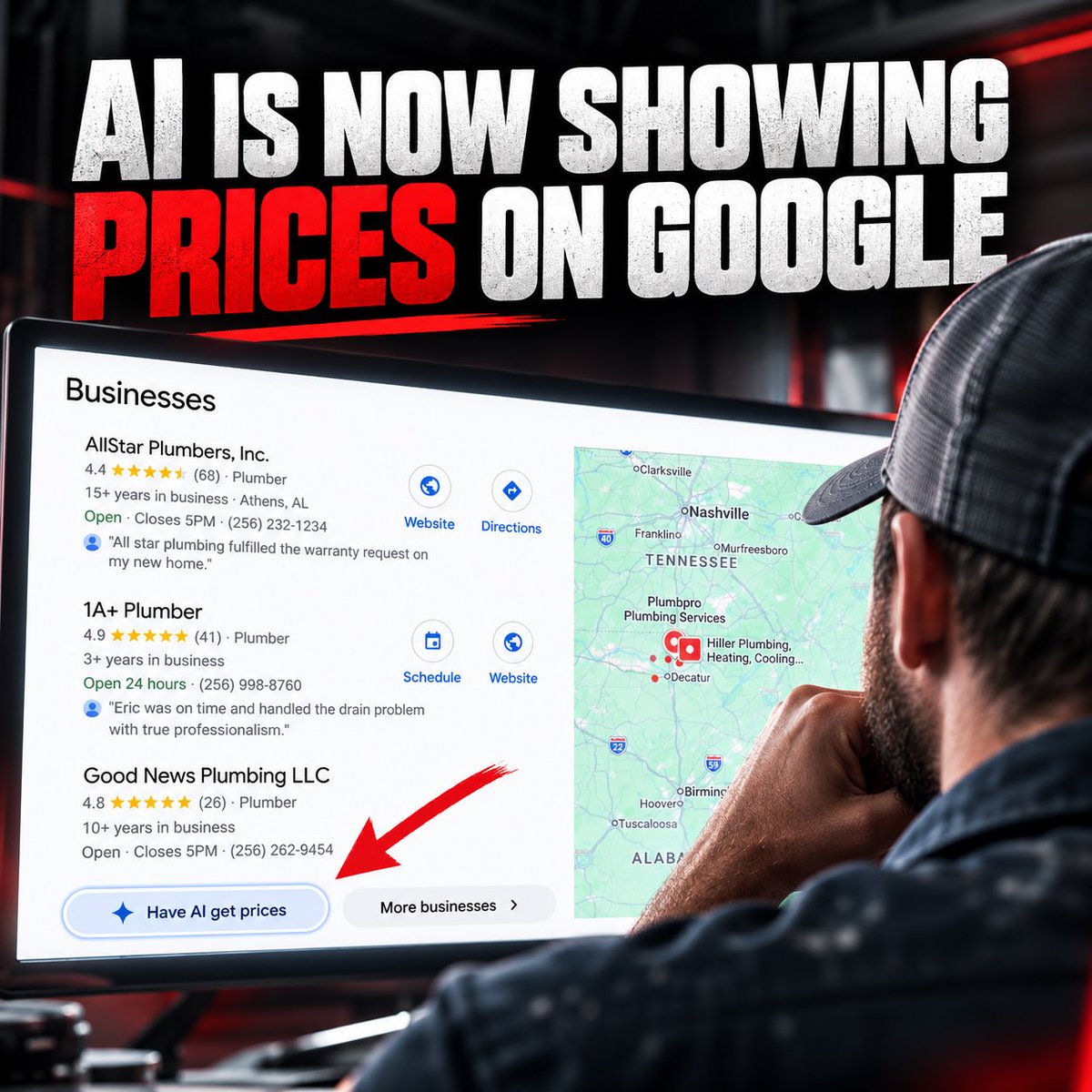
Look at this.
Google is showing a “Have AI get prices” button directly inside local business results.
Think about where this could go.
Instead of a homeowner:
Searching Google.
Opening five websites.
Calling three companies.
Waiting for callbacks.
Explaining the same problem over and over.
Google can potentially do more of that work for them.
And the contractor could get dragged into a comparison before they’ve even spoken to the customer.
That changes the game.
Because if Google starts making it easier for homeowners to collect pricing from multiple contractors, your marketing can’t rely on:
“We do quality work.”
“Family owned and operated.”
“Serving the community since 1998.”
Everybody says that.
You need an actual reason for someone to choose you.
Better reviews.
Better positioning.
Faster response times.
Better financing options.
Stronger guarantees.
Better follow-up.
A brand people already recognize before they start comparing prices.
And this is another reason I keep saying contractors need to stop thinking about Google as “just SEO” or “just ads.”
Google is getting closer to the actual transaction.
Search.
Maps.
Reviews.
Local Services Ads.
Booking.
AI answers.
And now AI-assisted price shopping.
The businesses feeding Google better information, responding faster, building stronger brands and giving homeowners a clearer reason to buy are going to be much harder to compete against.
The contractors still taking 45 minutes to call back a lead while their website says “Contact us for a quote” are going to have a problem.
AI isn’t only changing how people find contractors. It’s starting to change how they shop for them.
(This seems to only be in BETA atm)
I have helped businesses with growth and marketing for 16 years now. The top 3 constantly with the BEST net profits are:
1) Home Service Trades
2) Seniorcare Businesses
3) Healthcare Businesses
Yes, there are the odd businesses in different industries that do very well, but consistently time after time these 3, I see the best profit margins.
AI Search is going to expose home-service companies that don’t actually know what they’re known for.
Here’s what I mean.
Google Search can already use AI to contact local businesses on behalf of users in categories including home repair.
And this whole thing is moving toward AI doing more of the research BEFORE the homeowner ever talks to you.
So imagine someone asks:
“Who is the best company near me for replacing a 25-year-old furnace, offers financing, installs Carrier, and has a strong warranty?”
How confidently can an AI system determine that your company fits?
Go look at your website.
Most trades companies say:
Quality.
Integrity.
Professional.
Locally owned.
Great service.
That tells me absolutely nothing.
If this was my company, I’d make the specifics painfully obvious.
What do we specialize in?
What brands do we install?
What areas do we actually serve?
What warranties do we offer?
Do we finance?
What types of homes do we work on?
What makes our process different?
And most importantly:
What proof backs all of that up?
Google isn’t the only one reading your website anymore.
AI systems are increasingly interpreting your business for the customer.
So here’s the test I’d use:
Give your website to someone who knows absolutely nothing about your company.
Give them 60 seconds.
Then ask:
“What are we the best choice for?”
If they can’t answer…
I wouldn’t expect AI to magically figure it out either.