Apologies if this is a dumb question, but should it be concerning at all that a company like snowflake is not enforcing 2FA or requiring customers to use 2FA? Is it normal practice for a cloud-based data warehouses to not require this?
https://t.co/H2muGTSp0c
If a working man (who files 'married filing jointly' every year) has to completely start over, from absolute scratch, in saving for retirement, and draws a dual household income of $120,000 a year, is there even any way to do that and still retire at 70? Or is that impossible?
Got my @ClearPivot threads prepped for #inbound23. 🤘
If you'll be there, come find me! I'll be at the HubSpot Partner Hub on level 2 of the convention center.
Got my @ClearPivot threads prepped for #inbound23. 🤘
If you'll be there, come find me! I'll be at the HubSpot Partner Hub on level 2 of the convention center.
And because @ryanalanwright and I do this together, I also split up the process map with “swim lanes” - one for me and one for him. Any part of the process in Ryan’s swim lane is his responsibility, and any part of the process in my swim lane is my responsibility.
It’s hard to stop leads from falling through the cracks when there’s no process keeping them safe. What did it take to bring our client from business cards to a fully digital HubSpot CRM setup? Find out here.
https://t.co/sarK8eCpY2
In 1985, Nike held a 24-hour shoe design contest.
Nike was struggling. Their stock dropped 50%. They had to lay off people. Adidas, Converse, & Reebok were all selling more shoes.
So in a panicked attempt to find creative talent, Nike held a shoe design contest.
The winner was
A corporate architect named Tinker Hatfield.
"Two days after the competition," he said, "I wasn't even asked—I was told that I was now a footwear designer for Nike."
As he got to work on his first official shoe design, he thought about a building he had studied in architecture school: The Centre Pompidou in Paris.
The Centre Pompidou is an inside-out building, meaning that the structural, mechanical, and circulation systems are all exposed.
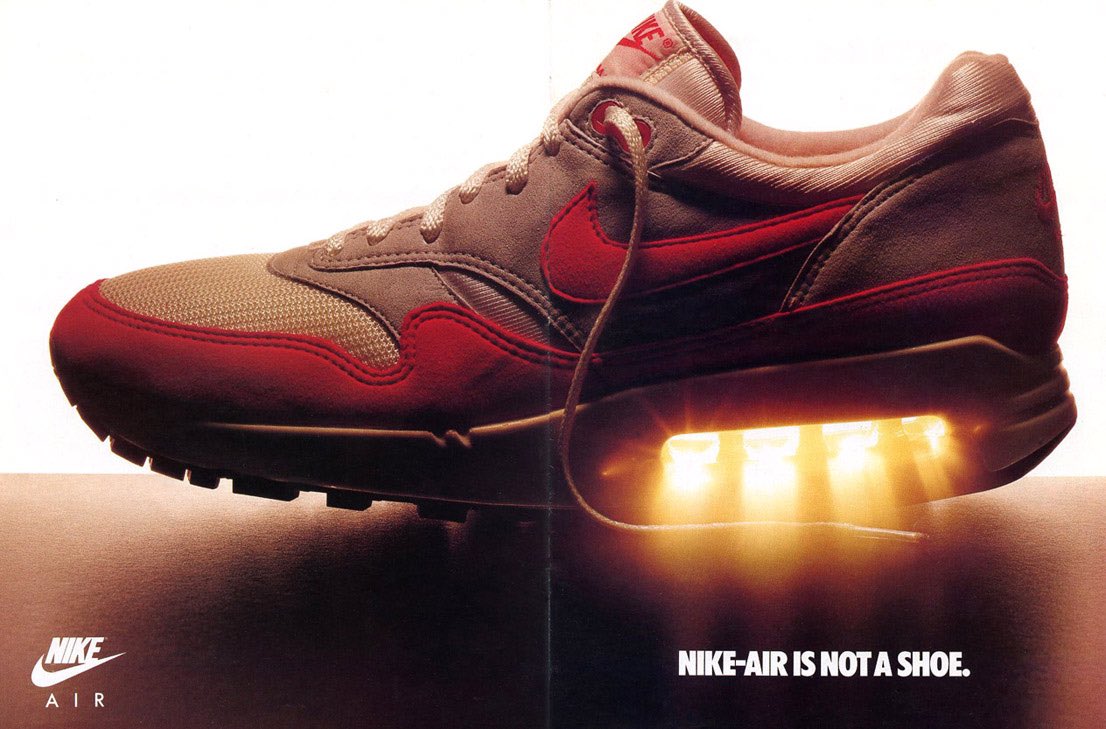
“That building,” Tinker said, “was describing what it was to the people of Paris. And I thought, ‘Well why not do that with a shoe? Let’s cut a hole in the side and show what’s in the shoe.’”
So Tinker designed an inside-out shoe:
The Air Max 1.
The Air Max 1 was a massive success, and it steered Nike's design direction from then on.
"To this day," Tinker says, "Phil Knight says I saved Nike."
Takeaway 1:
Had he not studied that building in Paris, Tinker says, he couldn’t have created the Air Max.
Creativity, he says, is a function of the “library in your head."
“When you sit down to create something...what you create is a culmination of everything you’ve seen and done previous to that point.”
Takeaway 2:
Tinker Hatfield went to architecture school and then he was a corporate architect for 4.5 years. Then, literally overnight, he became one of the best shoe designers in the world.
This makes me think of a counter-intuitive discovery made by psychologist Charles Spearman in 1904.
Before Spearman, the natural assumption was that the more you specialize in one thing, the worse you’ll be at other things.
Instead, Spearman discovered "the positive manifold" phenomenon.
He found that different abilities tend to be positively correlated. That the expertise gained through specialization is transferrable. That the cognitive and creative abilities cultivated as an architect could positively correlate with being a shoe designer.
- - -
"Creativity is a function of the previous work you put in." — Robert Greene
Follow @bpoppenheimer for more content like this!
"Now that there are 100+ public SaaS companies, we can finally answer a question — is it better to start a company that remakes an existing category, or that creates a new one?"
https://t.co/IxBGBLjzQB
It's about understanding why you should even be aligned around your revenue in the first place, and what your current state of operational affairs and operational behavior tells you about how you see revenue in relationship to the rest of the business.
...and managing the behavior of people during the sales process, and the movement/change of information throughout the process---took us years to get good at.
This episode is revealing! As I listened to it, I was reminded that this good sales process we now run---and that you ultimately designed---was not created overnight. Your own RevOps work in this area took iteration and years of practice.
Well no more! I think we run a pretty great sales process for ourselves at ClearPivot, so I recorded a podcast episode walking through all the steps in our own process from beginning to end.
Sure, some of the more simpler parts of this sales process can be put together by anyone who just looks at what others are doing (especially with HubSpot). BUT!...other things--like evaluating the efficacy of the stages (especially as time goes on), the nuances of handling....
100 percent, Chris. And I think the reason we weren't checking on their sales ops/efficacy is that it genuinely just wasn't a part of our focus at the time. But it is now! I assumed that they were handling it; taking adv of our pipeline creation work. But many times they were not
One of our biggest blind spots for many years in working with clients was neglecting to make sure that they were doing effective sales follow-up to go with our marketing campaigns. Many (most?) of them did not!
That CX and support are, at least in principle, multi-departmental, has been eye-opening to me. It's way more important than some companies realize, and, it takes a lot more time and critical thinking to provision the systems and processes for it than is commonly understood.
"Service" isn't really one function but rather an amalgamation of roles from a variety of other organizations [within the business]. -- from Revenue Operations by @Dioriostephen and @Hummel_Chris