New BPEA paper by @SVNieuwerburgh argues that AI buildout will cost $10.3T over next 8 years. Furthermore, to get a 10% return on this, those investing will need annual revenues of $3.7T by 2032! (Approx 9% of GDP!)
https://t.co/IzCUR2ZIEV
Artists: but I don't want to lose my job. I love it.
Mathematicians: but I don't want to lose my job. I love it.
Economists: LONG HAVE I AWAITED THIS HOUR! DESTROY ME, EFFICIENCY, AND LET UTILIZATION-ADJUSTED TOTAL FACTOR PRODUCTIVITY RISE ON THE WIND OF MY ASHES!
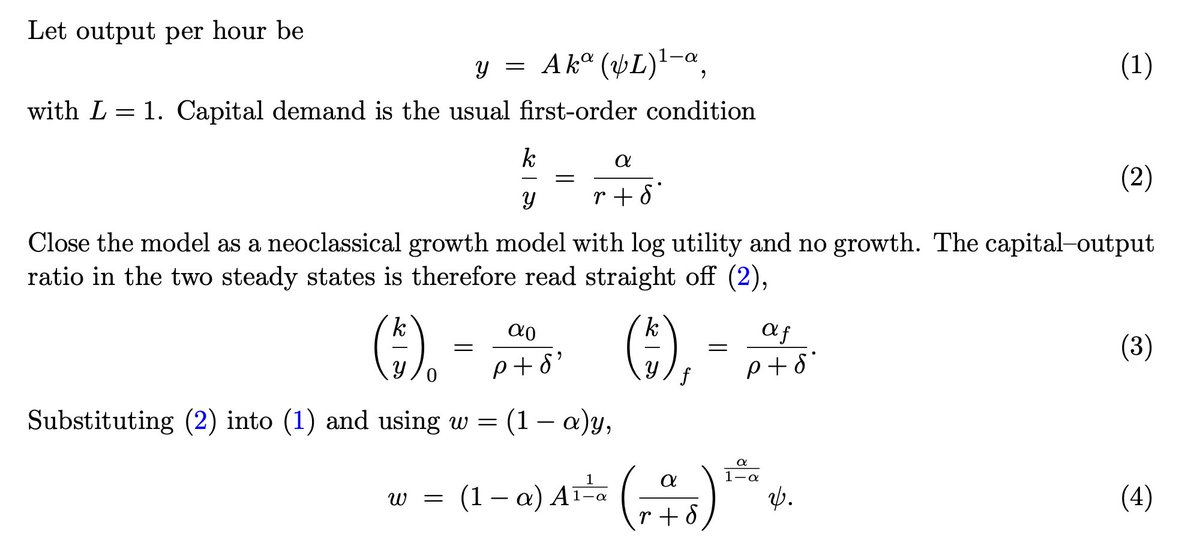
Hi @JesusFerna7026 -- I think the table below paints a somewhat overly optimistic picture for wages. Let me explain. (@JohnHCochrane@ben_moll)
I will work with a slightly more general Cobb-Douglas with A and psi:
I think this is a very difficult pill for many scientists and engineers to swallow: intelligence is not the biggest bottleneck in most of the world’s problems.
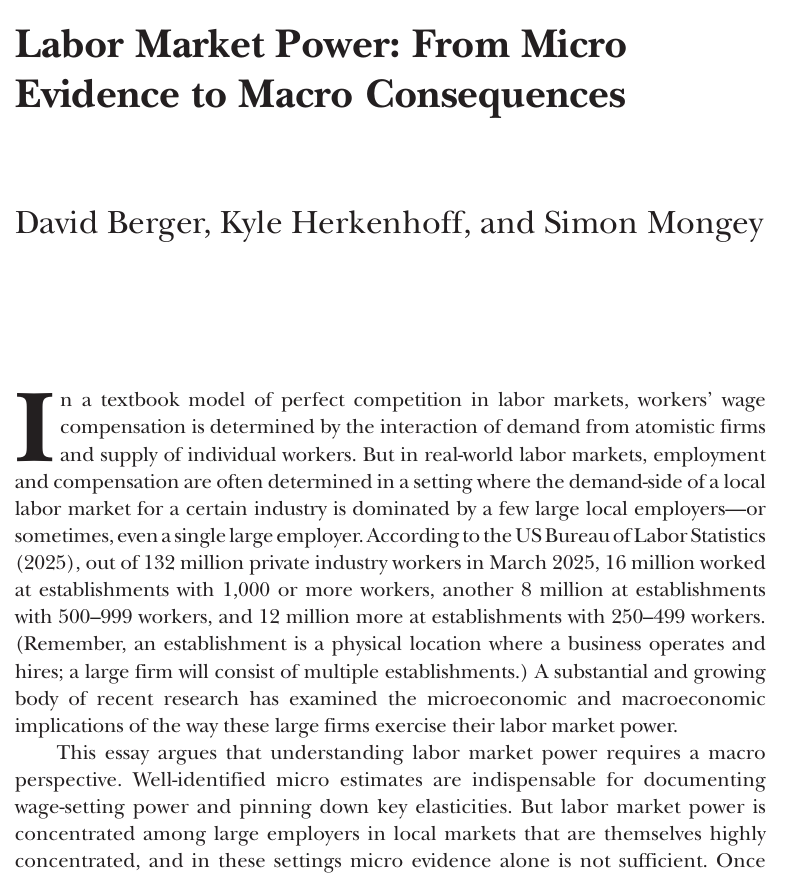
New essay on @alexolegimas's blog:
Will AI Soon Deliver Double-Digit Growth?
Probably not. Here is why.
https://t.co/PWlIyLgkxe
1. We outline the economics behind oft-discussed predictions that AI will soon deliver double-digit GDP growth in advanced economies. We list the assumptions that need to all hold in order for double-digit growth to happen and explain why we think they won’t.
2. To be clear: we are extremely bullish on AI and think the capabilities explosion predicted by technologists is already happening (e.g. yesterday's Navier-Stokes news!). But predictions of GDP growth in the 2030s of 15%, 30% or even 100% per year are off the mark. What we take issue with is the timeline. To paraphrase Milton Friedman's dictum on monetary policy, AI will affect GDP growth with "long and variable lags."
3. Start with some growth rate arithmetic. It is often much more useful to first think in levels rather than growth rates. Ask yourself: how much richer will we be in, say, 15 years? If you think twice as rich, that implies 4.7% annual growth, which would already be massive. Ten times as rich requires 16.6% per year; it would also imply that we are 100 times as rich 30 years from now! Asked in levels, we bet that most people would come up with much lower growth rates.
4. It's important to be clear: there is absolutely nothing in standard growth theory that constrains growth rates to be in the single digits. In fact, it's pretty easy to write down theoretical models that deliver explosive double-digit growth. We show this by writing down a standard textbook growth model of the type we routinely teach our undergrads (a souped-up Solow model), plug in some seemingly innocuous parameter values, and get AI-driven double-digit growth by the mid-2030s https://t.co/NgGmXqbHH4. The basic logic is that, by replacing labor with capital, automation alleviates / eliminates diminishing returns and removes labor as a bottleneck on growth. Fancier models, in which AI also automates R&D, deliver even wilder numbers.
5. But just because something is possible in theory doesn't mean it will happen in practice. The explosion rests on five assumptions, and each is unlikely to hold within the next 10-15 years. These assumptions are:
Assumption 1: Fast, economy-wide automation, with machines doing two thirds of all tasks by 2035. Historically, automation has proceeded at about 2% of tasks per year. Most work is physical, not cognitive. And politics will slow things down.
Assumption 2: People keep spending on whatever gets automated. They don't. As things get cheap, their share of spending falls, as it did for agriculture and manufacturing. Messy jobs, relational goods and scarce physical inputs like energy, chips and land become the new bottlenecks.
Assumption 3: Someone buys the new output and firms invest to produce it. Automation shifts income from workers to capital owners, who spend a smaller share so demand may not keep up with supply.
Assumption 4: No AI-driven cyber incidents destroying economic value. AI can also destroy output, and every incident slows deployment and investment.
Assumption 5: Explosive technology growth because AI automates R&D. The wildest scenarios in which the economy doubles each year all rest on this feedback loop. There is no evidence for it so far.
Why do many people who are closest to the technology (and who have been consistently right about the capabilities explosion) consistently predict double-digit growth? Our best guess: they extrapolate from their own sector to the rest of the economy. This reminds me of the 2022 German gas debate: industry insiders were right about their own firms and very wrong about the economy as a whole.
Our bottom line: a much more likely outcome is a large increase in the level of GDP spread over a decade or two, which is what 4-5% growth is.
If you remain unconvinced and still believe in double-digit growth, we are still looking for counterparties for our bet https://t.co/0HSCFGG315 😃
It’s funny how often economists are criticized for being closed-minded, with MMT usually offered as Exhibit A: "Why aren’t MMT people invited to your seminars"
Well, here’s why.
A lot of economists actually did take MMT seriously. They read it, engaged with it, and wrote detailed responses to its arguments just as economists routinely do when new theories or approaches appear.
And what happened? In many cases, the people who engaged seriously got invective in return. When they didn’t get invective, they got goalpost shifting: answer one claim and suddenly that wasn’t really the claim or; point out one inconsistency and the argument moves somewhere else. If it wasnt either of those, they got the "you should read this 700 pages treatise" (which will be changed to another if you do read it).
At some point, that kills conversation.
You can’t repeatedly respond to serious engagement with insults or moving targets and then complain that economists are refusing to engage with you. The profession was open to the conversation. If your response to criticism makes sustained intellectual exchange impossible, then you’re the one who closed it.
So, sorry, but I’m not taking "MMT isn’t invited into economics" very seriously as evidence that economics is closed-minded.
Beyond Albouy (2012), another AJR critique I’d appreciate more back-and-forth on as a reader:
Conley & Kelly (2025) argue that huge chunks of the history of econ development literature are over-rejecting the null by failing to adequately account for spatial correlation
Graduate students often mistake what the econ profession is. They think it's about "testing" various hypotheses
A typical well done paper is more: here is a collection of stories to interpret some set of (real or imaginary) behavior in the world
1/US Treasurys used to be expensive to close substitutes, like foreign government bonds. Below I do an apples-to-apples comparison of foreign yields to US Treasury yields. The US Treasury is now borrowing at a higher yield than other G-10 governments, at all tenors. (based on data generously provided by Wenxin Du and Jesse Schreger)
Last week I posted a new paper with Patrick Norrick: “Terra Incognita: The Economics of a Shrinking World.”
We chose the title deliberately. No society in history has experienced the fertility levels now seen in South Korea, China, Thailand, Colombia, Chile, and many other countries. Our knowledge of the causes (and of the economic consequences) remains far more limited than most public discussion acknowledges. Much of what we write is, at best, educated conjecture.
The paper also struggles against a space limit. We wrote 20,000 words, far from the 250,000 or so we would need to address some issues in more detail (if I had the time and resources to hide away for a year, I could do that, but not now). That means some ideas are only sketched.
Nonetheless, we emphasize several important points.
First, fertility has fallen very fast everywhere: rich and poor countries, east and west, north and south, conservative and liberal societies, religious and non-religious societies (with the exception of the Jewish population of Israel; fertility has also collapsed among the Muslim population within the pre-1967 borders), you name it. Even in sub-Saharan Africa we see fast and unprecedented drops in fertility (alas, from a high initial level).
Second, and this is really interesting, the fertility collapse has been concentrated in poor and lower-middle-income countries much more than in rich countries. By now, income per capita and fertility are positively correlated within OECD countries. We conjecture this will hold globally in a few decades.
Third, and related to the second point, the fertility collapse has been concentrated among poor and lower-middle-income women within countries. In countries such as the U.S., the rich and highly educated now have more children than the poor and less educated.
Fourth, we document why we do not understand the data from the U.N. World Population Prospects. See, for example, Tables A.1 and A.2.
Fifth, we explain why some proposed mechanisms struggle when confronted with the data.
A more subtle point is at work here. Many commentators do not seem to understand the difference between proximate causes and ultimate causes. Yes, births might have gone down because fewer women are in long-run relationships. That is the proximate cause. But you need to explain why fewer women are in long-run relationships (the ultimate cause), and saying that they spend more years in school, to take one example, does not get us very far. Why do they spend more years in school? Once you start down the whole chain of reasoning, things become much harder than they seem.
The paper can be found here:
https://t.co/VrCHr0lBPa
Comments always welcome!
Economist: So we created a godlike superintelligence available to everyone in their pocket 24/7
Guy living under rock: OK, I guess that's had a transformative economic impact then?
Economist: Actually, no.
Guy: Oh - why?
Economist: Ricardian comparative advantage
Guy: Ah. Of course.
Interesting discussion about the multiplicity of equilibria in financial markets, in particular in bond markets! I learned a lot from digging into the relevant papers.
I think I spot a big difference between macroeconomists and financial economists. I used to belong to the first tribe, but maybe not anymore :)
Financial economists price long-dated assets, like government bonds or corporate bonds, without worrying too much about which equilibrium bondholders are coordinating on. They basically just try to compute the present discounted value of the cash flows that have been promised as best they can. Bond investors who are pricing Microsoft's 40-year paper just project and discount the cash flows. They're not too worried about which equilibrium they're all going to coordinate on.
Take any valuation or asset pricing textbook, and I think you'd be hard-pressed to find anything about the multiplicity of equilibria other than maybe a discussion of bank runs. Read @JohnHCochrane 's Asset Pricing cover to cover (Darrell's book was too hard for me): no equilibrium selection anywhere, at least I don't recall seeing it. Finance doesn't treat it as first-order for valuing long-dated claims. (Of course, when John wandered over into macro, he spent a lot of time thinking about equilibrium selection, but that is consistent with the point I'm trying to make. )
Same goes for John Campbell's Financial Decisions and Markets. And Campbell is not a Chicago economist. He built the excess-volatility literature. Even when finance concludes prices deviate from fundamentals, we reach for discount rates, sentiment, limits to arbitrage. Not equilibrium selection.
The credit literature prices long-dated defaultable debt daily ( Merton, Duffie-Singleton, and Pan-Singleton on EM sovereign CDS ) with default intensities driven by fundamentals. No sunspots.
When financial economists do focus on self-fulfilling dynamics, it's mostly on funding and liquidity at short horizons, as in Brunnermeier and Pedersen.
Macroeconomists have a different tradition. The sovereign-debt literature has emphasized multiple equilibria going back to models like Cole-Kehoe (a great paper by 2 amazing economists, one of who is my long-time coauthor and mentor). That creates an important role for policymakers: eliminate the bad equilibrium and coordinate markets on the good one. (I secretly suspect that's why macroeconomists like this.)
In the Eurozone, the example that people always go back to is Mario Draghi's famous 2012 "whatever it takes" speech. All he had to do is speak those words and the Eurozone ended up in a virtuous equilibrium, where sovereign spreads were much lower. No bonds were ever bought under the OMT program. Costless equilibrium selection. Not quite.
Look at what actually happened over the following decade. The ECB ended up running a very large balance sheet and rolling out several programs with increasingly complicated acronyms, all of which helped sustain low sovereign funding costs in the supposedly virtuous equilibrium.
In the process the ECB was engineering was large cross-country transfers, transfers that I have documented in my work with Yili Chien and Zhengyang Jiang and Matteo Leombroni. https://t.co/AXwQ6Mio5y
So actually, if you look at the Eurozone evidence closely, you realize that the ECB re-engineered the underlying cash flows pretty dramatically. So not just a matter of picking a virtuous equilibrium, but actually a matter of reallocating resources across countries in state contingent ways. Draghi's announcement was a state-contingent promise of transfers.** Sometimes it's enough to just follow the cash flows.
Here's why I think this matters. The multiple equilibrium doctrine is part of the official line at the ECB which suppresses the price signals that would maybe force a country like France to actually implement serious fiscal reforms. It kills the only enforcement mechanism we have. If the ECB delivers low funding costs for all governments, that significantly reduces the probability of fiscal reform imo.
As Olivier pointed out, counting on the ECB to intervene would be unwise, but I do think the ECB has set some unfortunate precedents in this regard.
**Valentin Haddad, Alan Moreira, and Tyler Muir make this point about the Fed's 2020 corporate bond backstop ("Whatever It Takes? The Impact of Conditional Policy Promises"): prices jumped on announcement, purchases were trivial, and the response is what you get when the market prices a conditional promise; a put written on the bad states. You don't need equilibrium selection to explain announcement effects. https://t.co/7DdjYD2Sp8
Food for thought!
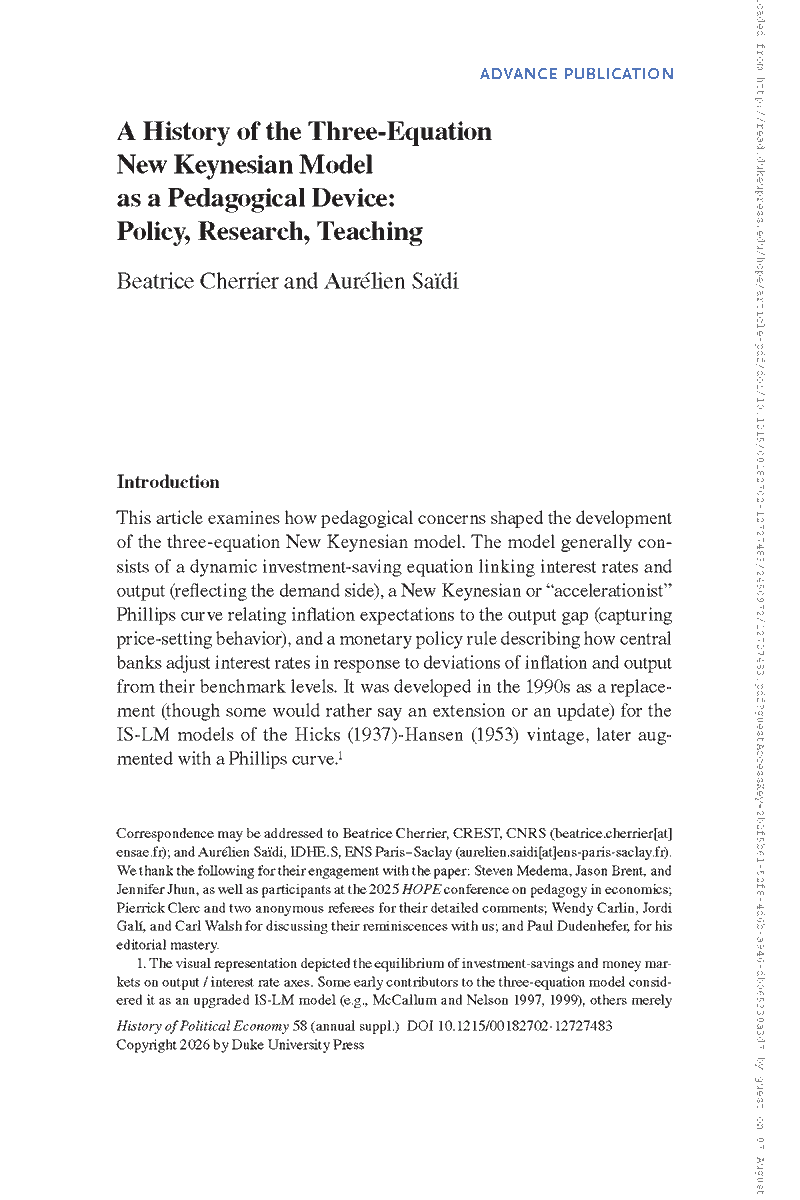
"A History of the Three-Equation New Keynesian Model as a Pedagogical Device: Policy, Research, Teaching" by Beatrice Cherrier and Aurélien Saïdi.
"This article examines how pedagogical concerns shaped the development of the three-equation New Keynesian model, which became the dominant framework for teaching and evaluating monetary policy from the 1990s onward. Contrary to the standard narrative, the model did not originate in classrooms or academic journals but in central bank workshops. We show that the many macroeconomists who proposed small models in the 1990s simultaneously targeted researchers, policymakers, and students, pursuing a common set of epistemic virtues: simplicity, realism, and consistency. They tried to accommodate recent advances in expectations modeling and price-setting modeling, to assess theoretically and empirically worldwide shifts in monetary policymaking, and to equip students with a sense of these mechanisms and dynamics. These virtues were negotiated differently across spheres, particularly in the transition from equation-based policy models to diagrammatic classroom representations, illuminating the porous boundary between education, research, and policymaking in modern macroeconomics."
https://t.co/VoxbdafuvM
Food for thought!
"Accounting for Credibility: Fiscal-Monetary Interactions and the Credibility of Central Bank Mandates" by Luigi Bocola, Gaston Chaumont, Alessandro Dovis, and Rishabh Kirpalani.
"We develop a model for fiscal and monetary policy determination in the tradition of Sargent and Wallace (1981). Ex-ante, the government has incentives to delegate monetary policy to a central bank with an inflation targeting mandate. Ex-post, however, the government faces temptations to revoke the mandate to generate seigniorage revenues. The likelihood that the government will adhere to its commitment depends on shocks to fiscal fundamentals and the costs of reneging on the mandate. The economy endogenously transitions between a “monetary-dominant” regime where monetary policy adheres to its commitment and a “fiscal-dominant” regime where the fiscal authority interferes with monetary policy. These two regimes sharply differ in their implications for the comovement of inflation and debt-to-GDP ratios. We use the model as a measurement device to interpret the fiscal and monetary history in Colombia, Chile, and the U.S."
https://t.co/A3fwWQBJZF