AI was supposed to give you your life back.
Instead, it gave you more work.
UC Berkeley tracked 200 AI enthusiasts for six months. These weren't skeptics—they were early adopters who loved the tools.
Result? They worked MORE, not less. Fewer breaks. Constant context switching. Full burnout in six months.
Here's the brutal math: Only 8% of AI-saved time gets reinvested in you. The other 92% becomes more tasks, more outputs, more work slop.
We're not protecting our zone of genius. We're building bigger cages.
I've sat across from founders running $10M+ businesses who are more exhausted than when they were broke. They all made the same mistake: They automated the wrong things.
They used AI for more emails, more content, more meetings, more decks. All transactional work that any well-prompted AI could do.
They never asked the question that matters: "What's the work only I can do?"
Your easy mode is where natural talent meets years of skill development. It's work that looks like cheating to everyone else. Where you look up and two hours have passed.
Most leaders operate in their easy mode less than 20% of the time.
That's the real problem.
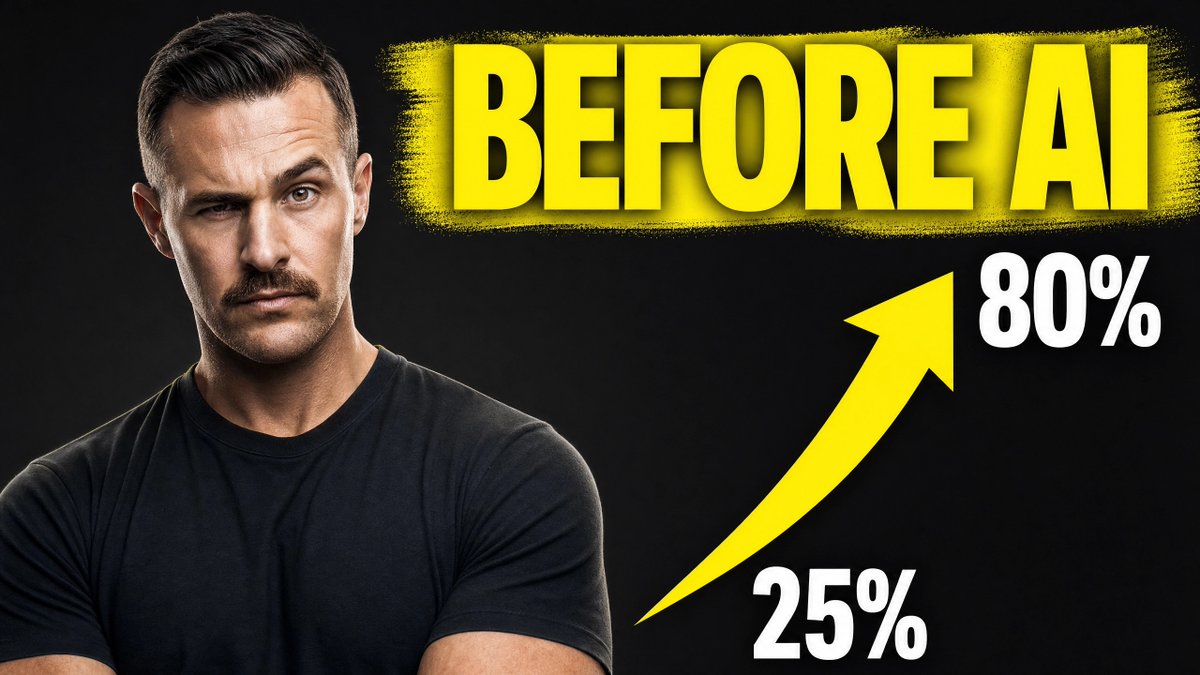
At Rogue Risk, we eliminated work slop and put our sales team back in their flow. Close rates went from 25-30% to over 80% on qualified leads.
They didn't get better at selling. They got more time to sell.
Stop asking AI to make you more productive. Start asking what AI can take off your plate so you can stay in your zone longer.
The 828% return is sitting there waiting. Most people never collect it because they're too busy being productive in the wrong direction.
👇👇👇
The doomers want you terrified of AI because fear is profitable.
While you wait for certainty that's never coming, your competitors are building compounding advantages.
Here's the cold data they don't want you to see:
👉 AI added 1% to US GDP in 2025 (Federal Reserve).
👉 Over 1,200 AI medical tools are already FDA-cleared.
👉 55% of Americans are actively using AI tools right now.
The pattern is always the same: fear followed by flourishing.
Electricity was going to destroy families.
Computers were going to make humans obsolete.
The internet was going to collapse society.
None of it happened.
What actually happens: human beings adapt. We've grown GDP per capita at 1.9% annually for 150 years through two World Wars, the Great Depression, and every "society-ending" tech shift.
AI isn't disrupting that trend. It's accelerating it.
Even Dario Amodei (CEO of the most safety-focused AI company) says most people are "underestimating just how radical the upside could be."
The man running the most cautious frontier model thinks we're not optimistic enough.
The choice is binary: engage with the most powerful technology in human history, or watch your competitors run away with the market.
There's no third option.
The waiting is the losing.
👇👇👇
The assumption does real work here.
If you start from 'this will probably fail,' your preparation reflects that.
You optimize for exit instead of execution.
Starting from 'this works' doesn't make you naive.
It just means your energy goes toward making it true instead of hedging against the alternative.
@gregisenberg The commodity curve accelerated faster than even the optimists projected.
Once models feel equivalent, the stack gets rebuilt.
Infrastructure becomes the new interface.
That's when the real winners emerge, and they're not the ones who picked the right model in 2024.
@naval The hard part is knowing which one you're participating in at any given moment.
Most people think they're reading the market when they're in the crowd.
The tell is whether your thesis requires everyone else to be wrong.
@chris_herd The ones who talk loudest about hustle are usually managing the gap between what they're doing and what they said they'd do.
Real output is self-evident.
@tferriss The willow metaphor works because it's about systems, not episodes.
Most people try to survive the wind.
They don't build something that eventually becomes a wall against it.
The difference is whether you're playing defense or compounding quietly.
@Codie_Sanchez The list is right but the sequence matters.
Most people try to think positively before they're moving.
Moving fast is what generates the feedback that makes positive thinking accurate instead of just hopeful.
The rest of the list follows from that.
The IPO filing is interesting not for the valuation.
It's for what the unit economics reveal about where value actually concentrates in the AI stack right now.
Model builders are capturing most of it.
App builders are following.
That dynamic will shift faster than people expect, but the revenue-per-employee numbers from companies like Anthropic force every other business to recalibrate their unit economics next quarter.
The real signal isn't confidence.
It's the ratio.
Most people can't reach frame (c).
The third one.
That requires a vision specific enough to sustain you over a decade, not just a goal with a finish line.
A vision absorbs setbacks.
A goal threatened by setbacks just looks like failure.
I built an insurance agency for four years and sold it to SIAA in 2022.
The hard problems didn't change between before and after.
The alignment did.
Same difficulty. Different mission.
Passive is just fear dressed up in grammar.
When someone writes "it was decided" instead of naming who decided, they're revealing the same hedging that shows up in their leadership.
Vague decisions.
Unclear feedback.
No accountability.
So forcing yourself to identify the actor in every sentence sharpens not just your prose.
It sharpens everything downstream.
The ROI isn't the fitness.
It's the evidence that you can override your own excuses.
The discipline rep is the rep.
The physical result is the receipt.
Because the specific skill—choosing discomfort when nothing external forces you to—transfers directly to every hard decision that isn't about your body.
That's why it compounds across domains.
Agree, but there's a missing line.
Knowledge doesn't compound by sitting there.
The compound effect kicks in when you're forced to apply what you know under conditions where you can't hedge.
You're wrong in real-time and you figure out why.
That discipline—absorbing feedback and fixing in live conditions—is what actually transfers to the harder problems down the line.
The gap isn't between knowing the protocol and not knowing it.
It's between knowing and actually showing up when nothing external forces you to.
Gear acquisition syndrome is real.
The people with the best long-term results are the ones grinding through workouts on Tuesday at 6am with zero accountability or stakes.
That's the rep that compounds.
The real crisis is that AI forces people to confront a question they've been able to dodge.
What work is actually mine to do?
Before, you could stay perpetually busy and never have to answer it.
AI strips away the busyness and leaves that question exposed.
Some people find their answer and thrive.
Most experience it as displacement because fixing meaning is harder than fixing a job.
The ratio is the signal. Not the valuation.
$9.4M per person means the old playbook is obsolete.
The one where you hire more to grow revenue.
When each person can accomplish what used to take ten, you stop looking like a traditional company.
Most organizations are still structured as if that's not true yet.
They're leaving massive leverage on the table.
The atrophy argument assumes people were exercising moral judgment in the first place.
Most organizations aren't.
They're running decisions through legal and PR filters.
The real risk isn't that AI makes better choices.
It's that better recommendations become a black box nobody bothers to understand.
Then the accountability dissolves.
The danger isn't that AI makes you dumber.
It's that the erosion is invisible.
You outsource the thinking, the productivity numbers look fine, and then one day you need to solve a real problem from scratch and there's nothing there.
Skill debt compounds the same way financial debt does.