i built out a $100M+ startup's entire gtm plan in 5 hours one evening because it was fun.
then they hired me to lead their ai strategy.
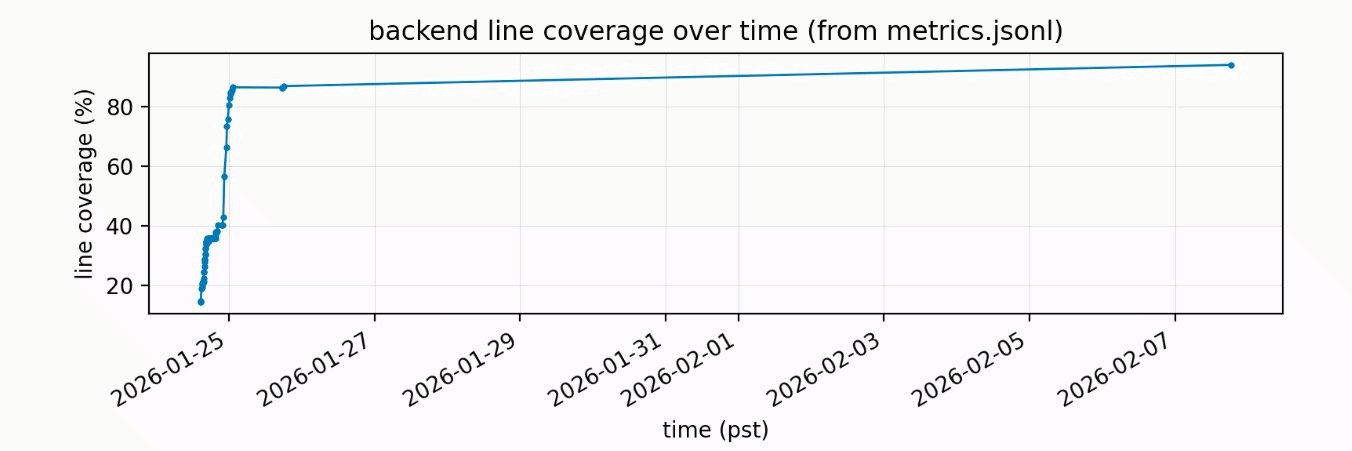
first month, i found THE constraint. 65k-line codebase — payouts and billing at scale — 7.87% test coverage. no ci/cd. engineering team scared to push to production. a year behind on their roadmap. shipping maybe 5-10 tickets a month.
took it from 7.87% to 94.14% in under a week. 260 bugs found. 5 stalled epics shipped that had been sitting in their backlog for over 6 months.
why test coverage? because that was the bottleneck. not the team. not the tools. not the architecture. nobody was looking there because everyone was too busy chasing "we need to ship faster" to see what was actually stopping them.
your constraint might be the same. it's probably something completely different. but there's a very good chance your entire team is incredibly busy, working extremely hard... on everything except the single focus point that will actually unlock what ai makes possible.
i find that focus point. 2 hours. your problem. my ai stack. written diagnosis + 30-day plan. $5k.
📅 book 15 minutes: https://t.co/E1WfIl19Te
a handy mental model heuristic is “at-the-limit thinking”
assume agentics trend towards infinite, what breaks? what holds?
simple example: assume agents eventually produce 10k, 100k, even 1mil PRs per day… how does code review which caps at maybe 20prs/human/day handle that?
I've added a new question to the list I consider during office hours with YC startups. As well as "Can we induce network effects?" and "Would it make sense to go full-stack?" I now ask "Can we make this AI-proof?" Can we ensure this company still exists if AIs do most work?
General and Operations Managers: Moderate AI task-overlap exposure (60th percentile of all occupations). Task overlap, not a prediction. — Singulariki https://t.co/sXb2HJQFyJ
i built maps. i built tools. i built agent systems. i built weird little proof machines. i built enough infrastructure to make myself slightly concerned about my own hobbies.
and now i'\''m trying to translate it back into human.
short normalcy. long weirdness.
the old game was production.
get good at a thing. find people who need the thing. exchange the thing for money. scale the exchange.
copy. code. design. consulting. strategy. media buying. whatever.
that game was hard, but it was legible.
the draft. the design. the analysis. the code. the brief. the plan.
not worthless. just no longer scarce.
the scarce thing is judgment under acceleration.
the scarce thing is taste with proof attached.