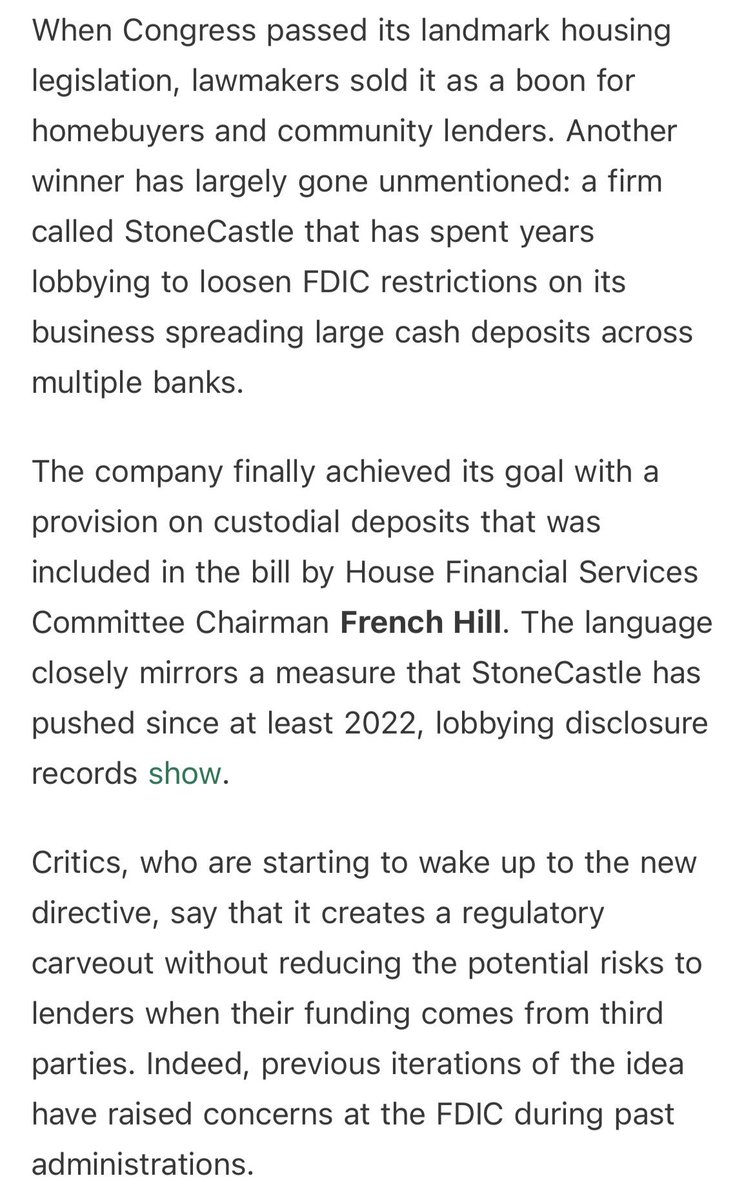
Fed's Waller this am: Hoping for a final rule on skinny master accounts "all done and ready to go by the end of the year."
"How much uptake there will be, I have no idea."
What's even more amazing about this history:
- The Fed was sued on interchange back in 2014 and the rule was upheld, citing Chevron deference.
- Yesterday, the appeals court said: No more deference, we look to Loper Bright. And threw out the rule.
It's a new world.
RED STATE CFPB: Dem AGs aren’t the only ones pursuing cases the Trump 2.0 CFPB has dropped. In recent weeks, GOP attorneys general have joined in two big-ticket settlements with Snap Finance and Credit Acceptance Corp., both sued by @ChopraUSA in cases that @russvought dropped.
CRYPTO GETS ITS WAY: The OCC's GENIUS Act Final Rule takes a laissez-faire posture on interest payments, reserve assets and other core areas where digital asset companies had demanded changes....
Much left to examiners’ judgment about individual firms.
-- Stress tests replace most quantitative requirements for reserve assets.
-- No "presumption" against paying yield. Case-by-case enforcement.
It's a win for industry, but is it durable?
The collapse of the Clarity Act marked a spectacular choke by an industry that had just recently begun reveling in its new lobbying clout, with President Trump in its corner.
With @dgtokar and @Vlajournaliste
https://t.co/oMEKx92y4Q
Here we go again! The WSJ is working on a story blaming Coinbase and me personally for the CLARITY Act not passing.
The Journal has repeatedly been hostile to CLARITY in its reporting, regurgitating bank lobby talking points, while I’ve spent years pushing for crypto legislation, but that’s not stopping them from trying to reverse the blame.
The boring TLDR: in January I opposed a draft of the bill going into a committee vote, because it needed a lot of work on DeFi, tokenization, CFTC authority, and stablecoin rewards. At the time, the bill had major issues that would have harmed crypto. Support was fractured, and it wasn’t passable. We worked with a number of parties who improved the bill and made it passable. All four of the items I called out were fixed in the draft that then went through the committee about four months later. I'm proud to have done it, and would do it again, because it helped create a better bill. One step of many along the way.
The final draft of CLARITY that went to the Senate was great, and I strongly supported it. I'll continue showing up for our customers and pushing for clear rules that treat crypto fairly, even if those who feel threatened by crypto try to plant false stories. It's a shame that the WSJ takes direction from bank lobbyists instead of reporting the truth, but luckily, people are smart enough to see through it these days, and it backfires on them every time.
Nice scoop by Andrew but why have we not seen the report today?
Step 1: Fed commissions a review independent of the parties involved.
Step 2: Fed announces the findings via a speech by one of the parties (Bowman). It does not let anyone read the independent report.
Huh?
SCOOP: Fed officials knew-or should have known-up to a year in advance that Silicon Valley Bank was vulnerable to a massive run, but were paralyzed by a "miasma of committees," according to people familiar with a new draft report commissioned by Fed governor Michelle Bowman.
Rather than targeting individual leaders, the review points to a long-standing culture of inaction.
So many of my kids' favorite books are ones they received from Dolly Parton's Imagination Library. My four year old lights up whenever a new book arrives. One of them has been required reading at mealtime for the past two months. Unmatched generosity. 🤍
@khaslett The contractor doing the review actually has talked to former SVB execs. Was part of our (admittedly paywalled) story on Starling a couple weeks back. Regardless of what else is in the report, that part should be very interesting.
Yesterday was my last day as Treasury Under Secretary for Domestic Finance and also the 10th anniversary of my public service. I’m grateful to the President and Secretary Bessent for the opportunity, and to my colleagues for their dedication. It was a great honor to serve.
CFPB Director Nominee Brian Johnson’s trip through the revolving door was always likely to draw scrutiny from Democrats and liberal critics. Now, the Capital One executive’s public ethics agreement is giving them another reason to raise questions about his ties to the bank....
The document, released by the Office of Government Ethics, shows that the firm has agreed not to claw back two bonuses that it paid Johnson in 2024 and 2025. His ability to keep the full payout was contingent on remaining with the company for two years (he started 11/24)