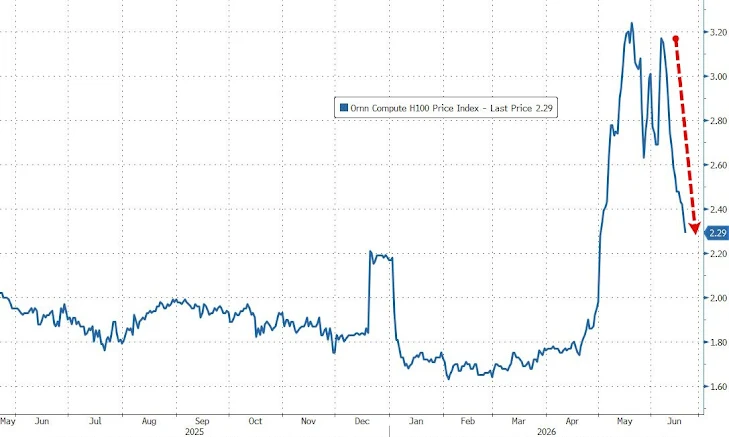
Goldman Delta 1 head Rich Privorotsky: “The market’s central premise has been that compute is scarce. If scarcity persists, prices should remain firm and justify continued capex. If supply rises and rental prices continue to drift lower, that is a direct challenge to the shortage narrative. The first place that pain shows up is hardware. ORNN H100 index rolling over last couple days worth watching. The beneficiaries are the companies selling the complete platform and monetizing usage rather than simply selling picks and shovels. My working conclusion remains that hyperscalers are the structural winners through this phase. The first moment they demonstrate they can deliver equivalent output with lower spend, the market will reward them. The bigger risk sits further upstream in the hardware and infrastructure stack where expectations remain built around persistent scarcity."
Lennar downgrades housing forecast AGAIN
Homes are NOW selling at lower prices than before the pandemic.
Lower than the should-have-been recession and housing bust of 2019
Home foreclosure starts skyrocket 26% year-over-year to the highest level since 2020.
Why 2020 specifically?
Because that is the last time the US Government really allowed foreclosures. They have been forced off market with time-after-time-after-time with payment deferrals and restructuring.
Every time making the borrower worse and worse off just to hide foreclosures and delay a housing market crash.
The outperformance of NDX vs SPX in both price and vol since March is incredible.
NDX adding SpaceX while SPX doesn’t could mark a more permanent divergence between the two…
h/t @zerohedge GS
The biggest price cut I've seen yet in this housing cycle.
This house sold near $388k in 2022.
It's now listed for $216k
That's a 45% loss in just four years, and the destruction of over $170k in equity.
This is happening more often than you think in a market like Texas.
I'm finding six-figure discounts like this almost every day.
For buyers, that's creating opportunities we haven't seen since before the pandemic.
According to the listing description, this may be a HUD foreclosure.
Markets across Texas and Florida are now seeing homes listed at prices that would have seemed impossible just a few years ago.
Check your ZIP code to see where prices are heading: https://t.co/50vYuH88dW
🚨 THE US REGULATORY SYSTEM JUST BROKE
In 48 hours, SpaceX goes public at $1.77 TRILLION - the biggest IPO ever
I've been trading for over a decade, and I have never seen them rewrite the rulebook like this
Nasdaq, MSCI, and the biggest brokers in America all bent their own rules for ONE private company
That doesn't happen by accident
Let me show you exactly what they did:
First, Fidelity dropped its minimum account size from $500,000 to $2,000
A 99.6% cut
Think about that:
The most exclusive door on Wall Street, thrown wide open to millions of small investors - days before the biggest debut in history.
Ask yourself one question
Why do they suddenly want YOU in?
Because somebody needs people to sell to.
SpaceX reserved 30% of the deal for retail
THREE TIMES the normal share
And even then, most people didn't get a full allocation.
So to grab more at Thursday's open, they're dumping everything else TODAY to raise cash.
That's half of the selling you're seeing.
The other half? The smart money front-running July.
Here's the trick:
SpaceX doesn't join the Nasdaq 100 on day one.
It joins 15 days later, because Nasdaq cut its own waiting period from 3 months to 15 days
Just for this.
The moment it joins, every QQQ fund on Earth is FORCED to buy.
$22–27 billion in automatic buying.
Translation: imagine 50 buses all forced to pull into the same gas station on the same morning.
The funds know the stampede is coming.
So they're selling now to free up cash for it. Retail selling. Institutions selling. At the exact same time.
THAT is your selloff.
Now here's the part nobody will say out loud:
When the most connected money on the planet builds a $1.7T exit door and hands the keys to the smallest investors in the market…
That's NOT generosity
That's distribution at the top.
We've seen this movie twice:
➮ 2000 Dotcom
➮ 2021 SPAC mania
Insiders cash out at insane valuations while the crowd chases the hype.
The math ain't mathing.
So you've got two choices in the next 48 hours:
Chase the most expensive IPO in history at the open…
Or read the prospectus and realize you might BE the exit.
The next few days will be INSANE, but don't worry - I'll break down every move as it happens, like I always do.
Like it or not, I called every major top and bottom of the last decade publicly. I'll call this one too.
Many people are going to wish they followed me before June 12, 2026.
Soon, you'll understand why.
The reason is quite hilarious 😂😂.
Microsoft put $50 billion into Anthropic.
FIFTY billion dollars.
they are a Project Glasswing partner. Fable 5 runs inside Azure. Microsoft sells Claude to its own enterprise customers through Microsoft 365 and GitHub Copilot.
and they won't let their own employees use it.
here's why.
under Anthropic's new Mythos-class data retention policy, every prompt you type and every response you get is stored for 30 days. automatically. no opt out.
if their safety classifiers flag anything in your session, anything, they keep it for up to two years.
you don't get told when that happens, what was flagged or who can see it.
Microsoft employees paste confidential contracts into these things. customer data. internal roadmaps. acquisition strategies. legal documents. source code.
all of it sitting on Anthropic's servers for 30 days minimum. flagged sessions for two years.
so the company that invested $50 billion looked at that policy and told its staff: actually hold on.
other Claude models still work internally. under Zero Data Retention rules. the normal ones are fine.
just not the most powerful one they helped fund.
and one more thing.
the Pentagon listed Anthropic as a supply chain risk in March and banned defense contractors from using its products.
Microsoft funds Anthropic. sells Anthropic's models. runs them on Azure. helped build the most powerful one.
won't let employees use it.
the Pentagon won't let defense contractors near it.
the safeguard that makes Fable 5 safe enough to release publicly is the same safeguard that lets Anthropic keep your data for two years.
the guardrail is a data retention policy.
but you can use it. it's in your browser right now. 🌚
have fun.
Citadel Securities just put institutional weight behind what the AI bulls won't say out loud.
In a new macro note titled "Tokenomics," Citadel makes the argument plainly: even the most powerful technology on earth still has to pass through the boring discipline of cost curves, capacity limits, and marginal returns.
The evidence is piling up:
– Amazon removed its token usage leaderboard
– Microsoft cancelled Claude Code subscriptions
– Multiple companies reporting unexpectedly massive token bills
Their conclusion is the part that matters.
Adoption is no longer about what AI can do in principle. It's becoming about the price and scarcity of the inputs needed to run it at scale. Compute. Power. Cooling. Memory bandwidth. Inference budgets. All real, all binding constraints.
And here's the kicker from the chart.
The Silicon Data LLM Token Expenditure Index, a benchmark for how much the market is actually spending on AI tokens, has started rolling over. Citadel reads it as a shift toward cheaper models. Companies substituting away from expensive frontier AI toward "good enough" alternatives.
That's economics 101 doing what it always does. When the price of something rises, people use less of it, or find a cheaper version.
Citadel sees a bifurcation forming. Frontier AI concentrated among a few firms with the balance sheets to absorb the cost. Everyone else quietly downgrading to simpler, cheaper models.
This is the part of every technology revolution the early narrative ignores.
The technology being real was never the question.
The question was always whether the economics could carry the valuations.
When one of the most sophisticated trading firms on earth starts writing about AI in the language of cost curves and rationing instead of limitless demand, the conversation has quietly changed.
The hype was about what AI could do.
The reckoning is about what it costs.
MICROSOFT JUST ADMITTED IT WAS WRONG — AND CANCELED EVERY SECRET NDA THEY SIGNED WITH YOUR LOCAL GOVERNMENT WORLDWIDE
Remember the story we told you about Meta hiding behind a shell company called “Balloonist LLC?” About mayors signing secret agreements? About communities finding out a billion-dollar data center was being built in their neighborhood only when the construction equipment arrived?
That story — which went viral across America — just produced the most remarkable corporate reversal in the entire history of the data center era.
On March 18, 2026 — two and a half months ago — Microsoft announced something no tech company has ever done before: they are canceling every single NDA — every single secrecy agreement — they have ever signed with every single local government in the entire world.
Not just new ones. Every existing one. Terminated. Gone.
And the reason they did it tells you everything about the power that communities have when they organize and fight back.
WHAT MICROSOFT ACTUALLY DID
Amid widespread blowback against the spread of data centers, Microsoft on March 18, 2026 announced it is abandoning its practice of secrecy with local governments when deploying new facilities worldwide. The company stated: “We’ve made the decision that being transparent with the communities where we operate or seek to operate is paramount. This shift is about strengthening public trust, enabling better dialogue, and ensuring that our growth is matched by meaningful engagement.” 
Abandoning its practice of secrecy. Those are Microsoft’s own words. An acknowledgment — quiet but unmistakable — that what they were doing was wrong.
Microsoft announced it will terminate any existing, active NDAs worldwide — coordinating with municipalities to end the agreements. Microsoft’s corporate vice president and general counsel of Infrastructure Legal Affairs, Rima Alaily, said: “Our neighbors deserve to know when we are coming to their community. They deserve transparency about what we are building and why.” 
Our neighbors deserve to know. Said by the company that was using shell companies and NDAs to make sure neighbors did NOT know. Said because the communities fought back hard enough that the alternative — continuing the secrecy — became more damaging than the transparency.
BUT HERE IS WHY COMMUNITIES ARE SKEPTICAL — AND RIGHT TO BE
Microsoft’s move won qualified praise from data center NDA critics. But environmental group Midwest Environmental Advocates captured the community mood precisely: “Companies typically don’t make announcements about building community trust unless those communities are already pushing back pretty hard.” 
They are right. Microsoft did not have a sudden change of heart. Microsoft did a calculation. And the calculation came out like this:
The secrecy is no longer working. Communities are finding the NDAs through FOIA requests. Wisconsin Watch is writing front-page stories about them. State legislators are introducing bills to ban them. And when communities find out they were deceived — as in Festus, Missouri — they vote out every politician who signed the deal.
Transparency became cheaper than secrecy. That is why Microsoft changed.
Wisconsin state Rep. Clint Moses — a Republican from Menomonie, where the city signed an NDA — put it bluntly: Microsoft “just realized that it’s not a successful formula when you come into a community under darkness.” But he also noted that his bill to ban data center NDAs stalled in the Wisconsin Legislature — meaning other companies can still use them. “Hopefully, the industry follows,” he said — but expressed doubt that it would without legislative mandates. 
Hopefully the industry follows. That is the hope. But hope is not a policy.
Amazon has not ended its NDAs. Meta — the company behind Balloonist LLC — has not ended its NDAs. Google has not ended its NDAs. Oracle has not ended its NDAs.
Microsoft made a move. The rest of the industry is watching. And communities should not mistake one company’s PR pivot for industry-wide reform.
THE COMMUNITIES THAT FORCED THIS CHANGE
Here is the story behind the story — the one Microsoft will never tell in its press releases.
The NDA terminations came after The Detroit News reported the existence of confidentiality agreements — obtained by filing public records requests with communities that had publicly fielded interest from data center developers. The News obtained copies of the agreements. Since reporting on four west Michigan communities’ confidentiality agreements with Microsoft, two more governmental bodies responded with copies of additional NDA agreements. The NDA scandal was spreading — and Microsoft knew it. 
Reporters. Filing public records requests. Obtaining the secret documents. Publishing them. That is what forced Microsoft’s hand. Not a change of heart. Not a new commitment to ethics. Journalists and community members armed with freedom of information laws.
Wisconsin Freedom of Information Council president Bill Lueders said data center developers’ use of NDAs in Wisconsin “did blow up in their faces” and contributed to projects facing increasing backlash. “Communities don’t like it when they find out that their public officials are meeting secretly with representatives of companies to change the character of their communities,” he said. “I’m also not surprised that a company like Microsoft would take a look at it and say, ‘Boy, that’s really not a good look.’” 
It blew up in their faces. That is the Freedom of Information Council’s official assessment. And it is exactly right.
Communities organized. Journalists filed records requests. Wisconsin Watch and the Detroit News and the Milwaukee Journal Sentinel published the documents. And one of the most powerful companies in the world had to stand up and say: we were wrong. We’re ending this. Worldwide.
AND HERE IS THE CATCH NOBODY IS REPORTING
While Microsoft is internally taking action to address community concerns — it was a key player in defeating Washington state legislation that would have mandated data center transparency and restrictions on environmental impacts. In other words: Microsoft ended its own NDAs voluntarily — while simultaneously working to block laws that would have forced the entire industry to do the same. 
Read that again. Microsoft ended its own NDAs. Then helped defeat the bill that would have required every data center company to end theirs.
They made the choice to be transparent. Then worked to make sure Amazon, Meta, and Google don’t have to make the same choice.
This is not a company that has seen the light. This is a company that is managing its reputation while protecting the industry’s ability to continue doing exactly what they were doing — just not Microsoft specifically.
Microsoft may still, in “certain limited circumstances,” share confidential trade secrets or “competitive sensitive information” about its data centers with local governments and will still try to protect that information from public records. The company’s corporate vice president acknowledged that land acquisition NDAs will continue — meaning the secrecy around purchasing land for data centers remains in place even as government NDAs end. 
Land acquisition NDAs continue. Meaning: the shell company phase — where Balloonist LLC buys land without anyone knowing it’s Meta — that can still happen. The NDA that covers the land purchase can still be secret. It’s only the government-level NDA — the one that binds your mayor — that Microsoft is ending.
The most important secrecy tool — buying land through disguised companies — remains intact.
THE BOTTOM LINE
Microsoft just did something no tech company has ever done: canceled every secret NDA with every local government in the world. Worldwide. All of them. Gone.
It happened because communities organized. Because journalists filed FOIA requests. Because Wisconsin Watch and the Detroit News published the documents. Because Festus, Missouri voted out every politician who signed a secret deal. Because the political cost of secrecy exceeded the commercial benefit.
That is how change happens. Not because corporations develop a conscience. Because communities force their hand.
But here is the truth that needs to be said plainly: Microsoft is one company. Amazon, Meta, Google, and Oracle are still using NDAs. The Washington state bill that would have mandated industry-wide transparency — Microsoft helped defeat it. Land acquisition NDAs — the tool that lets Balloonist LLC buy your neighbor’s farm without telling anyone — those continue.
One battle won. The war not over.
Share this for every community that fought back against the secrecy — and every community that is still fighting. Microsoft blinked. Now pressure the rest of them.
🎩 The StoicWay
📌 Source: GeekWire — “Microsoft nixes NDAs with local governments worldwide when deploying data centers” (March 18, 2026)
Read all about it! 😉
https://t.co/7IUMlrR15u
$GOOGL is dropping $180-$190B in capex this year and STILL just agreed to pay SpaceX $920M a month for ~110,000 NVIDIA GPUs, CPUs, and memory.
One of the biggest builders in tech exhausted its own buildout and had to rent.
Demand isn't cooling, it's overflowing the budget.
The AI capex cycle isn't slowing down. It's outrunning the people writing the checks.
The CPU socket is $NVDA's own Grace silicon (Arm-based) if these are GB200/GB300 racks, x86 if they're HGX hosts. The documented Colossus build runs Intel Xeon, so $INTC over $AMD.
It's a game of musical chairs! No one wants to be left without the chair! Still making money on the way up as SPY, QQQ, SMH makes new all time highs! No reason to fight it until something breaks!
@BenBSP This is what has created the biggest bubble in history. I’ve said it all month. Public companies just transferring cash to one another. 1 billion becomes 6 trillion lol… This only ends one way. Very badly! @petenajarian@ryanmastro5