Ten months ago, we launched the Vesuvius Challenge to solve the ancient problem of the Herculaneum Papyri, a library of scrolls that were flash-fried by the eruption of Mount Vesuvius in 79 AD.
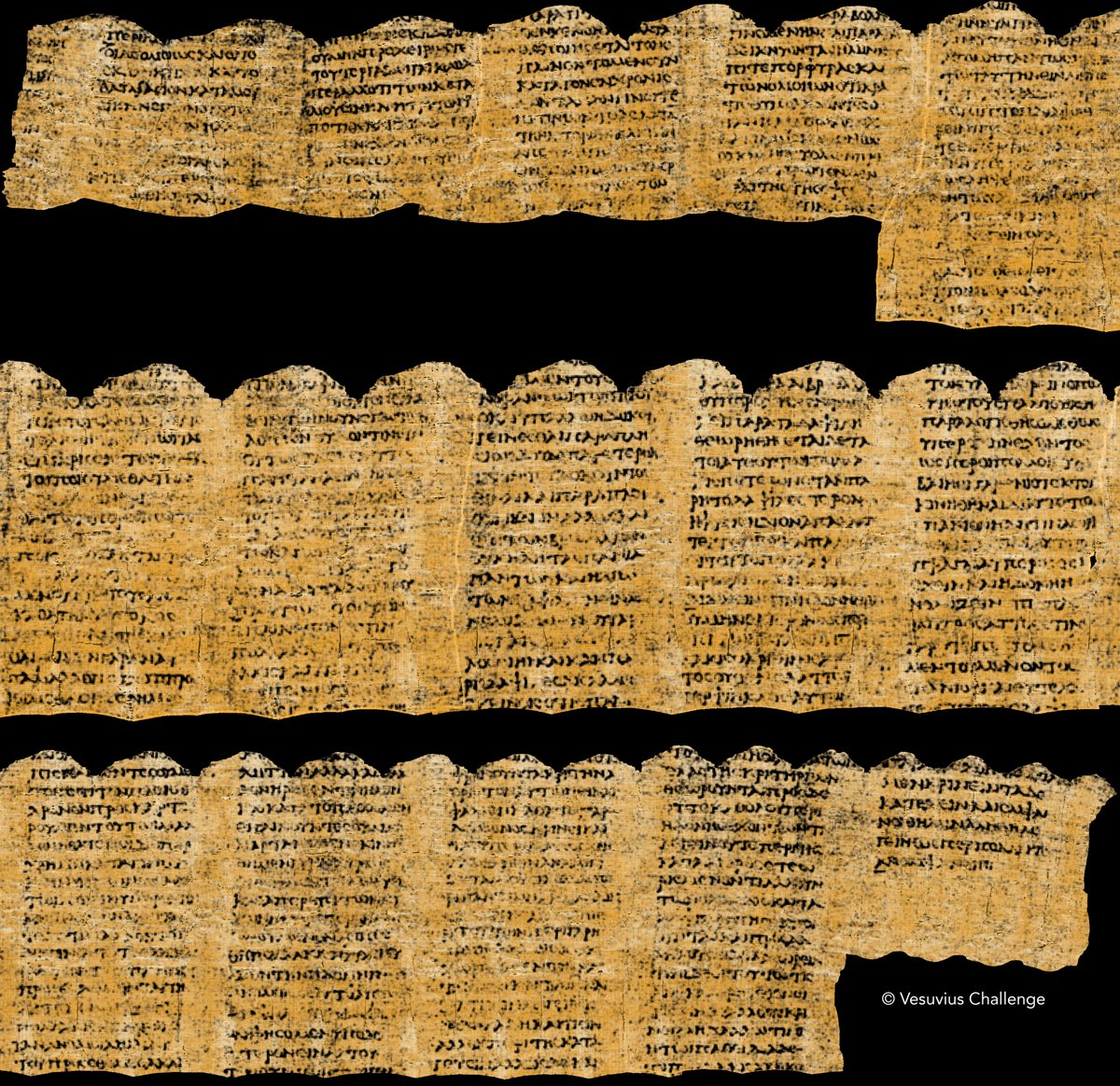
Today we are overjoyed to announce that our crazy project has succeeded. After 2000 years, we can finally read the scrolls:
This image was produced by @Youssef_M_Nader, @LukeFarritor, and @JuliSchillij, who have now won the Vesuvius Challenge Grand Prize of $700,000. Congratulations!!
These fifteen columns come from the very end of the first scroll we have been able to read and contain new text from the ancient world that has never been seen before. The author – probably Epicurean philosopher Philodemus – writes here about music, food, and how to enjoy life's pleasures. In the closing section, he throws shade at unnamed ideological adversaries – perhaps the stoics? – who "have nothing to say about pleasure, either in general or in particular."
This year, the Vesuvius Challenge continues. The text that we revealed so far represents just 5% of one scroll.
In 2024, our goal is to from reading a few passages of text to entire scrolls, and we're announcing a new $100,000 grand prize for the first team that is able to read at least 90% of all four scrolls that we have scanned.
The scrolls stored in Naples that remain to be read represent more than 16 megabytes of ancient text. But the villa where the scrolls were found was only partially excavated, and scholars tell us that there may be thousands more scrolls underground. Our hope is that the success of the Vesuvius Challenge catalyzes the excavation of the villa, that the main library is discovered, and that whatever we find there rewrites history and inspires all of us.
It's been a great joy to work on this strange and amazing project. Thanks to Brent Seales for laying the foundation for this work over so many years, thanks to the friends and Twitter users whose donations powered our effort, and thanks to the many contestants whose contributions have made the Vesuvius Challenge successful!
Read more in our announcement: https://t.co/rUlrdGXBMs
@paulg I recite his “Poem Beginning With A Line of Wittgenstein” to myself often. “The world is everything that is the case. / Now stop your blubbering and wash your face.”
I’ve heard it said that software engineering is inherently more complex than other engineering disciplines. Perhaps a better way to state this is that software can accrue complexity faster than any other medium. Easier to build a logical Rube Goldberg machine than a physical one.
What’s a term that describes the incredible ability some people have to comprehensively map a product/feature/topic in their head? It’s not raw knowledge, it’s the ability to speed run the conceptual graph, plot intersections, and detect places where ambiguity might remain.
@jkup I have a soft spot in my heart for CORS, as it’s trying its best to help us escape the clutches of the same-origin policy, but does so in sometimes baffling and cryptic ways. I wrote this up a few years ago after my own research: https://t.co/AhT8fGevgM.
@BoyanSlat My favorite fact in this vein: the Great Pyramid of Giza was more temporally distant from Julius Caesar (~2500 BC to 1st century BC) than Julius Caesar is from us.
When reviewing a pull request, do you solely review the code or do you try to exercise the new functionality as well? I’m surprised how rarely I see the latter. Especially when building something like a UI, can be hard to understand code without seeing it in action.
@brad_frost Mine is https://t.co/AhT8fGevgM. Forced myself to publish even though I was slightly disappointed in its quality. Woke up and it was trending toward the top of HN. Taught me to ship my work even when I don’t think it’s perfect.
A hard reality I've had to come to terms with recently is that, compared to @DuckDuckGo, Google search is magnitudes better at finding the perfect Stack Overflow answer for a given question. But still love @DuckDuckGo for just about every other purpose.
Looking back at the beginning of my developer career, I often conflated "writing software" with "solving the problem". The former is simply a means to the latter. It makes my day when I or a member of my team finds a simpler way to do something that doesn't involve code at all!