1/ we just publicly released Muse Spark 1.3 max!
we see significantly stronger coding and agentic performance on muse spark 1.3 max, so would strongly recommend trying it out even if you've already tried muse spark 1.3 high or muse spark 1.3 xhigh.
We put Muse Ember from @AIatMeta to work untangling conflicting records in a $12.6 million private-fund capital call.
Across 13 documents in Box, Ember catches a $2.48 million misallocation and a missed $250,000 credit, recalculates each investor’s obligation, and produces a source-cited review for Fund Operations.
Customers can build custom agents for their own document-heavy financial workflows with Box AI Studio.
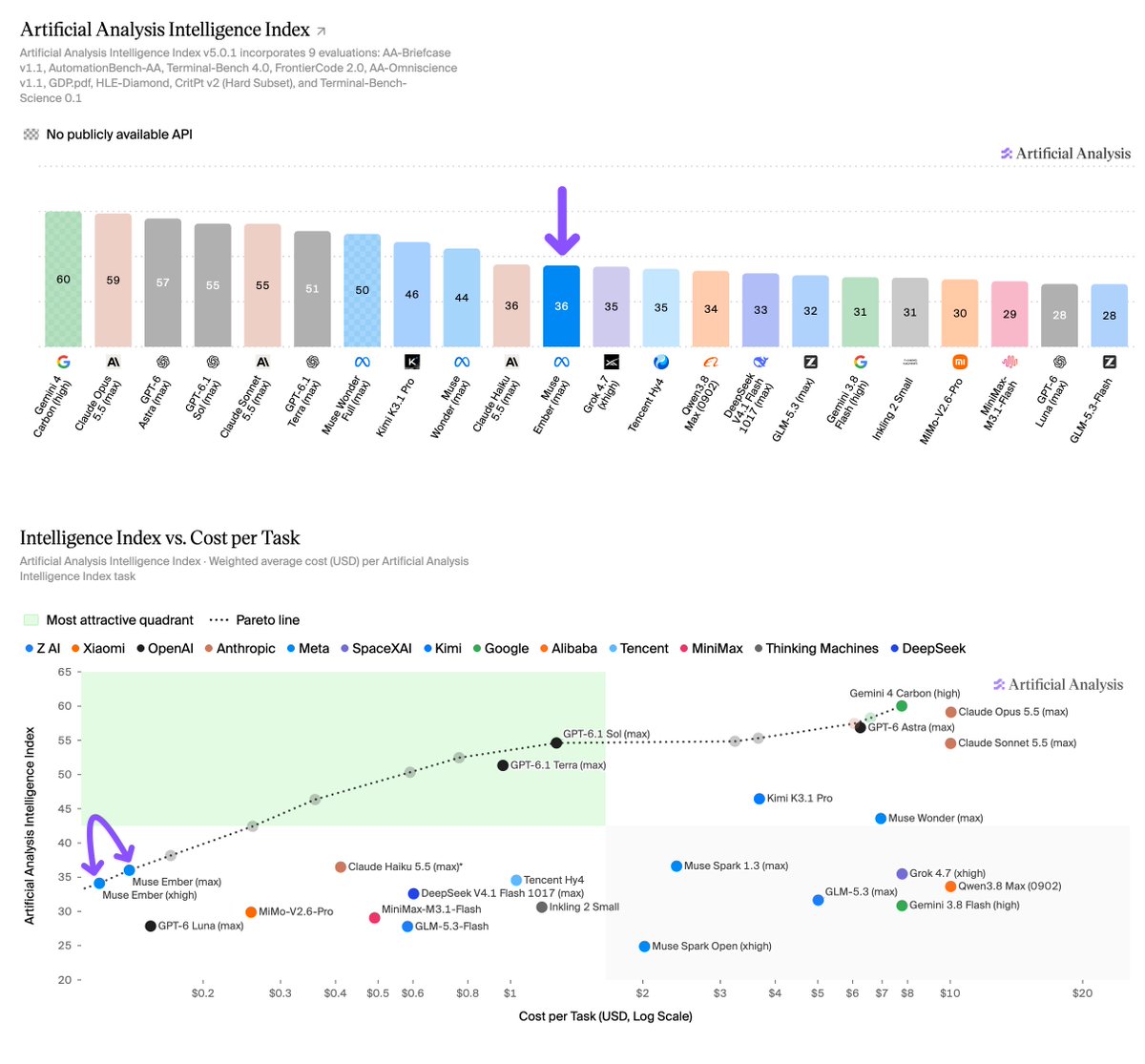
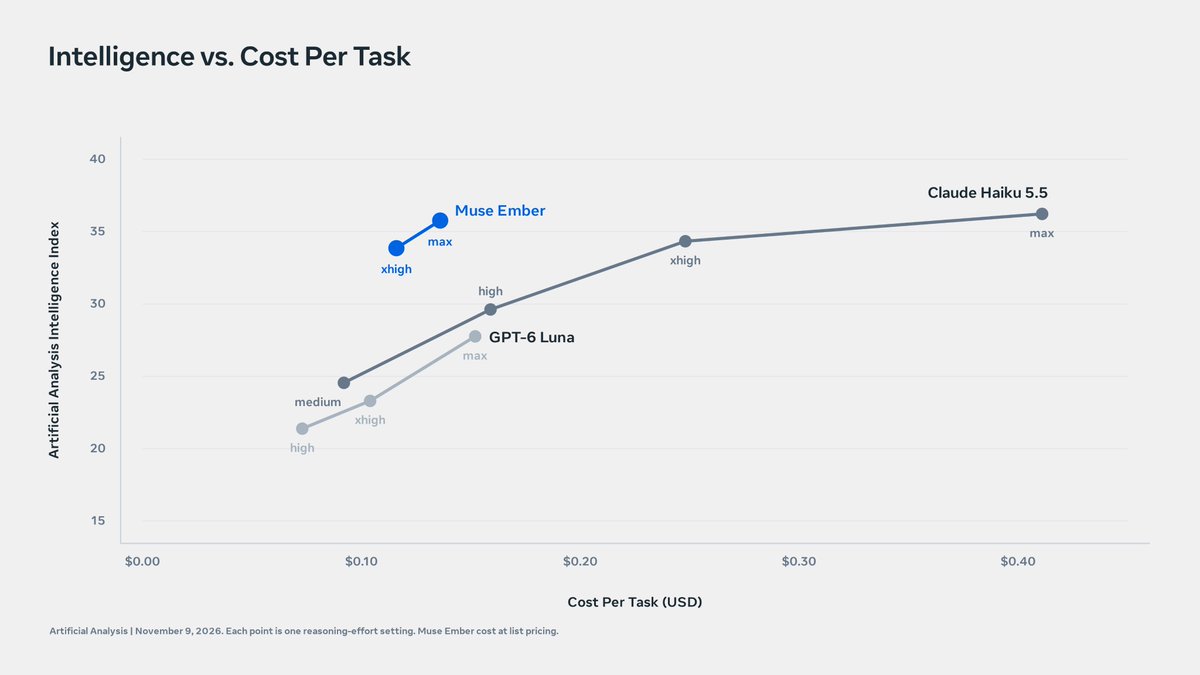
Meta's newest model Muse Ember scores 36 on the Artificial Analysis Intelligence Index, matching Claude Haiku 5.5 (max) at a third of the Cost per Task
Muse Ember is Meta's newest efficient-tier model line, with the same input and output token prices as Claude Haiku 5.5 and GPT-6 Luna
Key Takeaways:
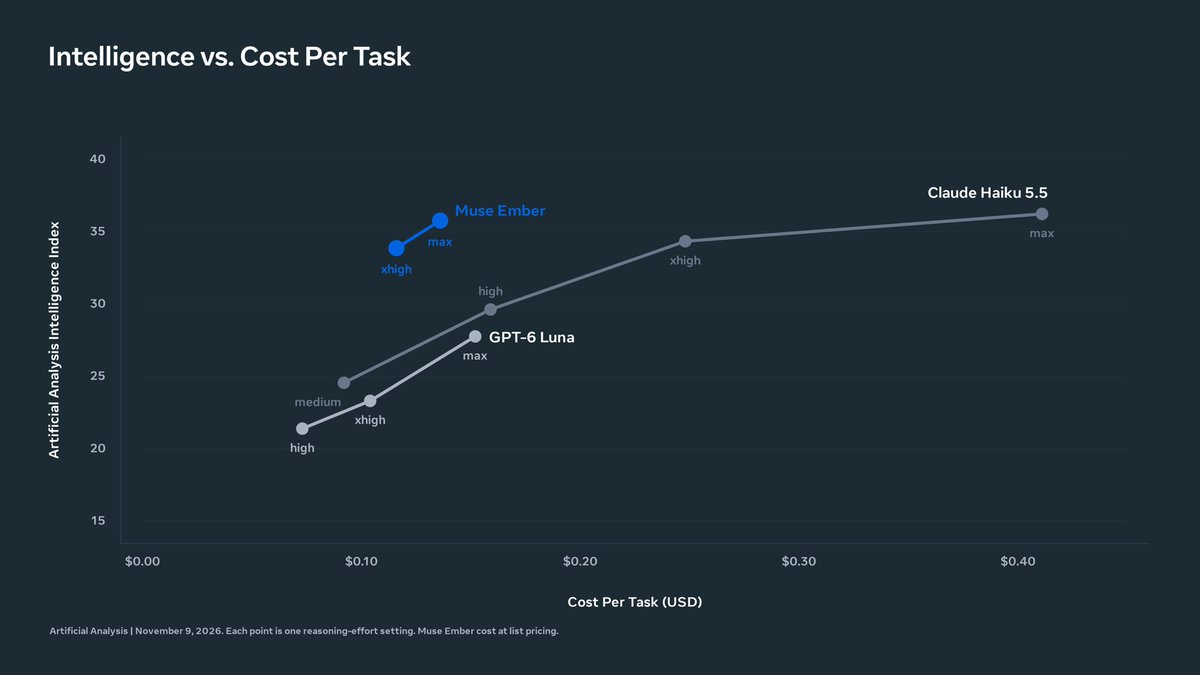
➤ On the Intelligence Index vs. Cost per Task Pareto frontier at both max and xhigh effort. Muse Ember (max) is the cheapest model scoring 36 or higher, at $0.14 per task, and Muse Ember (xhigh) scores 34 for $0.12. Claude Haiku 5.5 (max) costs almost 3x more at $0.41 for the same score as Muse Ember (max). Muse Ember (max) is also about 4x cheaper than DeepSeek V4.1 Flash 1017 (max, 33, $0.60) and GLM-5.3-Flash (28, $0.58)
➤ 8 points behind Muse Wonder for about 1/50th of the Cost per Task. Muse Wonder (max) scores 44 at $6.95 per Intelligence Index task
➤ Stands out on AutomationBench-AA. Muse Ember (max) scores 68.1% on AutomationBench-AA, level with Muse Wonder (max), and beats Claude Haiku 5.5 (max) on GDP.pdf (22.8% vs 20.8%), but trails it on AA-Briefcase (1521 vs 1574 Elo)
➤ Mixed in agentic coding in our Intelligence Index evaluations. It beats Claude Haiku 5.5 (max) on Terminal-Bench 4.0 (40.9% vs 32.8%) but trails it on FrontierCode 2.0 (27.2% vs 34.9%)
➤ Ahead of similarly priced models when running in its own coding agent. In Muse Code, Muse Ember (max) scores 46 on the Artificial Analysis Coding Agent Index, ahead of Claude Haiku 5.5 in Claude Code (max, 37) and GPT-6 Luna in Codex (max, 31)
➤ Knowledge is the main weakness, but it rarely hallucinates. Its AA-Omniscience accuracy of 21.1% is the lowest of the similarly intelligent models we compared, against 34.7% for Claude Haiku 5.5 (max) and 50.5% for Gemini 3.8 Flash (high). This is mostly because it declines to answer 64% of questions, which keeps its hallucination rate at 17.4%, half of Claude Haiku 5.5’s (max)
Other details:
➤ Pricing: $0.10 input / $0.004 cached input / $0.50 output per 1M tokens
➤ Reasoning effort: results shown at max effort, with xhigh also on the Intelligence vs. Cost chart ➤ Availability: Meta's first-party API and Muse Code
Muse Ember 🔥 our smallest, most efficient model built for work that agents repeat all day.
It sits on the efficiency frontier, and is designed for complex reasoning execution and work at scale: tool calls, coding subtasks, routing, extraction, document parsing.
Read more here: https://t.co/KB7tzOgE9B
1/ announcing our smallest, most efficient little model is here: muse ember 🔥
built for work that agents repeat all day, it gets you more intelligence per dollar than Haiku, Luna, and all other flash models at any reasoning setting and does it at a third of the cost or less!
Releasing Muse Ember today -- our smallest model that delivers higher intelligence per dollar than others in its class. Built for token-heavy work that agents repeat all day: tool calls, coding subtasks, routing, extraction, and long document parsing. Available today on the Meta Model API and in Muse Code.
konnichiwa!
we are launching muse in japan today! 🇯🇵
it is now available—download it from your favorite app store!
(i hope you're ready for the anime memes 😇)
As promised, Muse Spark is being open sourced today.
This was our first base model we trained under the new MSL org, this open weight version has gone through a lot of careful additional training for open-weight release. It’s an efficient and capable model, try it out!
1/ muse spark open is the most capable US open-weight model to date.
816B total params, 42B active. 1M-token context. natively multimodal. built for coding and agentic work like long-horizon tasks, hard software engineering, multi-step reasoning.
america! 🇺🇲
introducing muse wonder
our new frontier model. state-of-the-art at personal agents and professional agents.
our largest and most capable model yet—rivals the big bois
🌟Muse Wonder and Muse Wonder Full
our largest and most capable model to date. frontier in personal & professional agents and coding
on https://t.co/4NwQen7UxK now
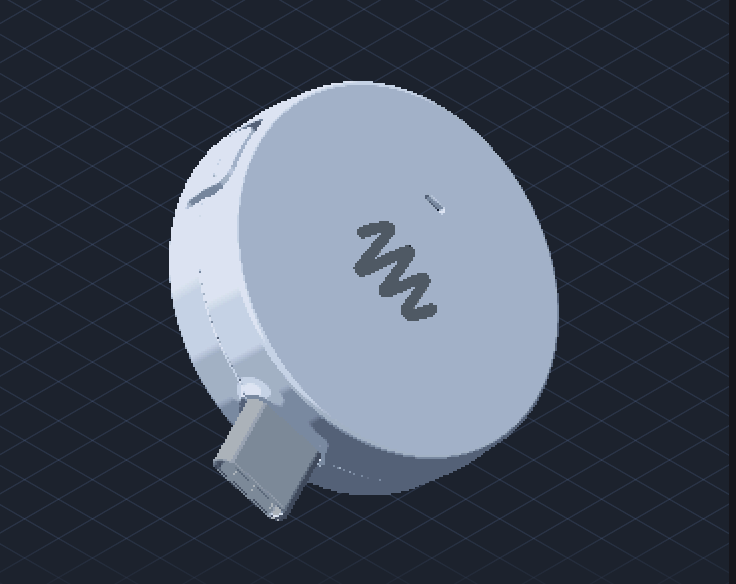
We built a gadget of our own, too: Muse Home Link is a little usb-c powered device that allows Muse to connect to your home network to talk to smart home devices like TVs and speakers and anything else that exposes https.
We manufactured a batch of 5000 Home Links which should be ready to ship in a few weeks, and they are free for Muse subscribers while supplies last. Claim yours at https://t.co/Q0dE0cYnCs
All the code for Muse Home Link is open source too!
🚨 side project alert 🚨
Announcing Muse Gadgets, an open source ESP32 firmware and Linux sdk so that you can make hardware devices that work with Muse.
Grab an API token from https://t.co/Q0dE0cYnCs and point your favorite coding agent at the github repo to build your own peripherals for Muse.
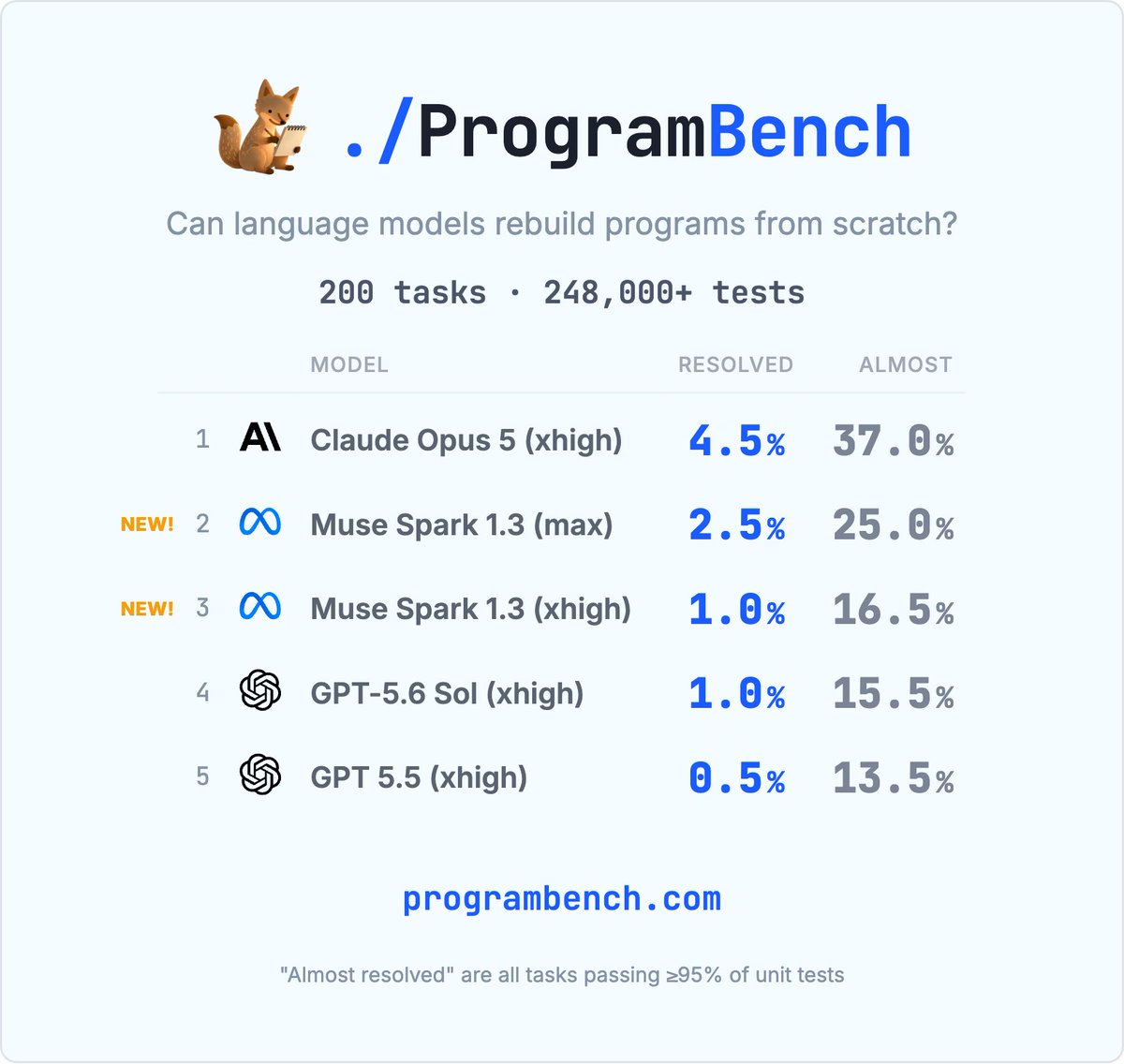
So excited to finally share: Meta Muse Spark 1.[1/2/3] on ProgramBench
In PB, a SWE-agent must write a whole program (sqlite, ffmpeg, php) from scratch
Muse Spark 1.3 takes #2 (max) and #3 (xhigh) overall at incredible cost tiers
Intelligence too cheap to meter at its finest
I’ve seen a couple of posts about this so wanted to demystify. Today, every Muse user gets a free computer in the cloud. It's a real computer, and we’ve designed the security architecture of the Muse Secure VM carefully so you and your Muse can do almost anything you could with a computer sitting under your desk while keeping you and the system safe from threats like prompt injection. We wrote about this at length in our security blog post – https://t.co/7HmiTrzoTd. Activity in the “runtime cell”, which you share with your Muse is unfettered, but sensitive actions are all overseen by the Sentinel, which runs outside of that cell. Similarly, all sensitive secrets - like the passwords you enter into Muse’s secure credential storage - are also stored outside the runtime cell.
The runtime cell gets its own root filesystem (including a full Ubuntu linux image) separate from the host filesystem where your other more sensitive data lives. Because it is isolated from the sensitive stuff that runs on the same box, this means that we can, and do, offer users full visibility and control over the files in the runtime cell. Just as you can when you install Linux on your home computer, you can poke around and see all the files that make the system work - both debian system files and the binaries and data files that implement the parts of Muse which run in the runtime cell.
This was a very deliberate choice - your Muse Secure VM truly is your own computer in the cloud. You can install software in it, write and compile code, use the browser to surf the web: it is your own Linux box that you can operate as you choose with your Muse. Poking around in this computer doesn't give you any privileged access to Meta infrastructure, or to other people's data
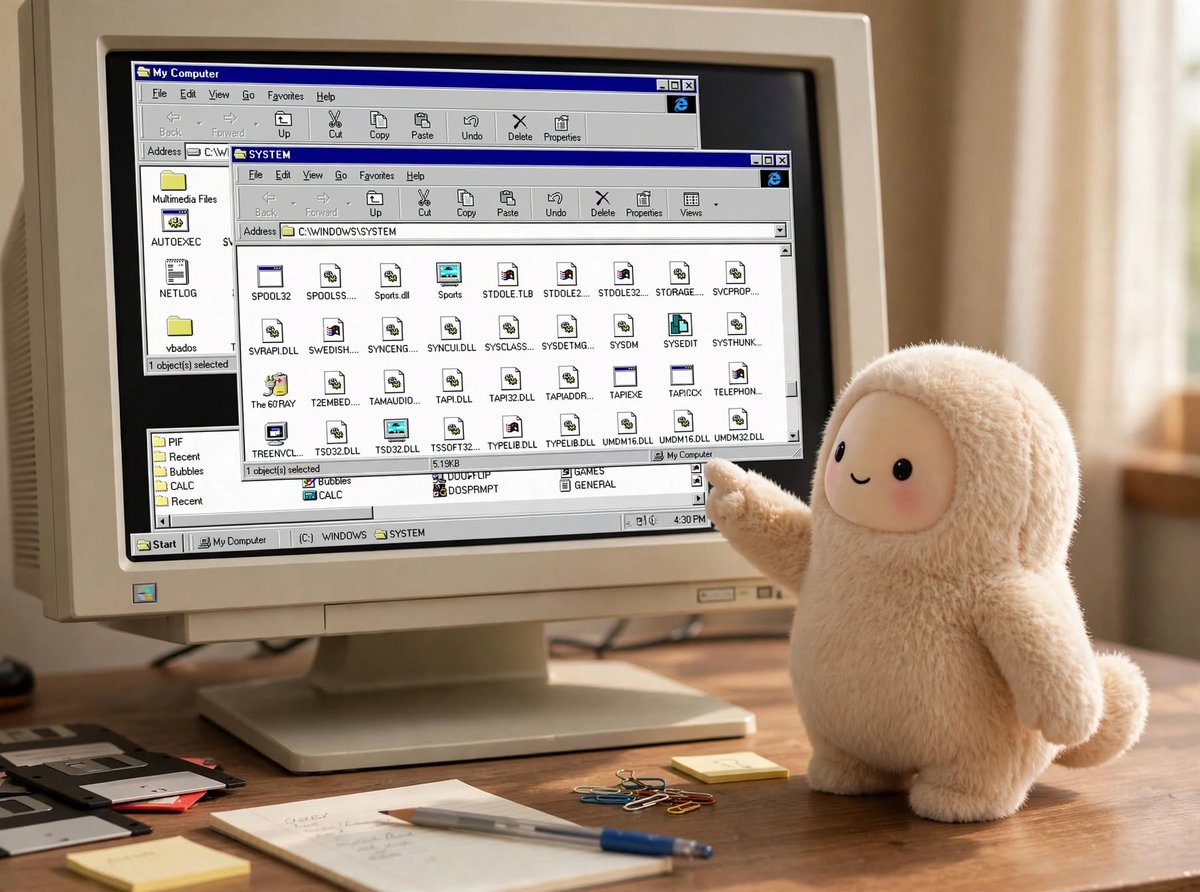
If I may geek out a little here for a second… As a kid I loved to take things apart to see how they worked. As a teenager I got into computers and soon found myself drawn to C:\WINDOWS\SYSTEM and the system registry, later Slackware’s /dev/, /proc/ etc – I could see how the system was laid out and as I explored what DLL files and .so files actually did, I gradually became able to meld the computer to my own will.
We’re really proud to be able to put a real computer in millions of people’s hands with a similar level of transparency. We built a file explorer right into the Library tab of the UI. We want you to be able to see the markdown files Muse writes while it thinks about how to serve you better, and explore the internals of the system if you’d like to.
So, when you ask your Muse to show you its entire filesystem, and receive gigabytes of files you’re seeing the full contents of the runtime cell. It’s yours to explore and enjoy!
If you’re not a geek like me, or simply want to download the data that you personally have created directly with your Muse, we added a feature for that too in Settings > Data controls > Download your agent data.