Estamos perdidos, Estados Unidos aprendió a jugar al fútbol. Es el fin del deporte tal como lo conocemos, quedan máximo 10 años sin que sean campeones de todo y cambien las reglas para que entren superheroes de Marvel a dar publicidades cada 15 minutos. Aguantamos lo que pudimos.
ARISE-FLUIDS has arrived and it's awesome 🥳
For over a decade, the Surviving Sepsis Guidelines recommended that septic patients get at least 30 cc/kg fluid. In the United States, these guidelines were weaponized into performance metrics, pressuring clinicians to prescribe arbitrary volumes to every patient.
Evidence-based clinicians have LONG known that this guideline lacked evidentiary support. For example, I've attached a picture of a blog I wrote about this back in 2017. Despite the lack of evidentiary support and some evidence of harm, the Surviving Sepsis Guidelines INSISTED on perpetually recommending 30 cc/kg fluid resuscitation.
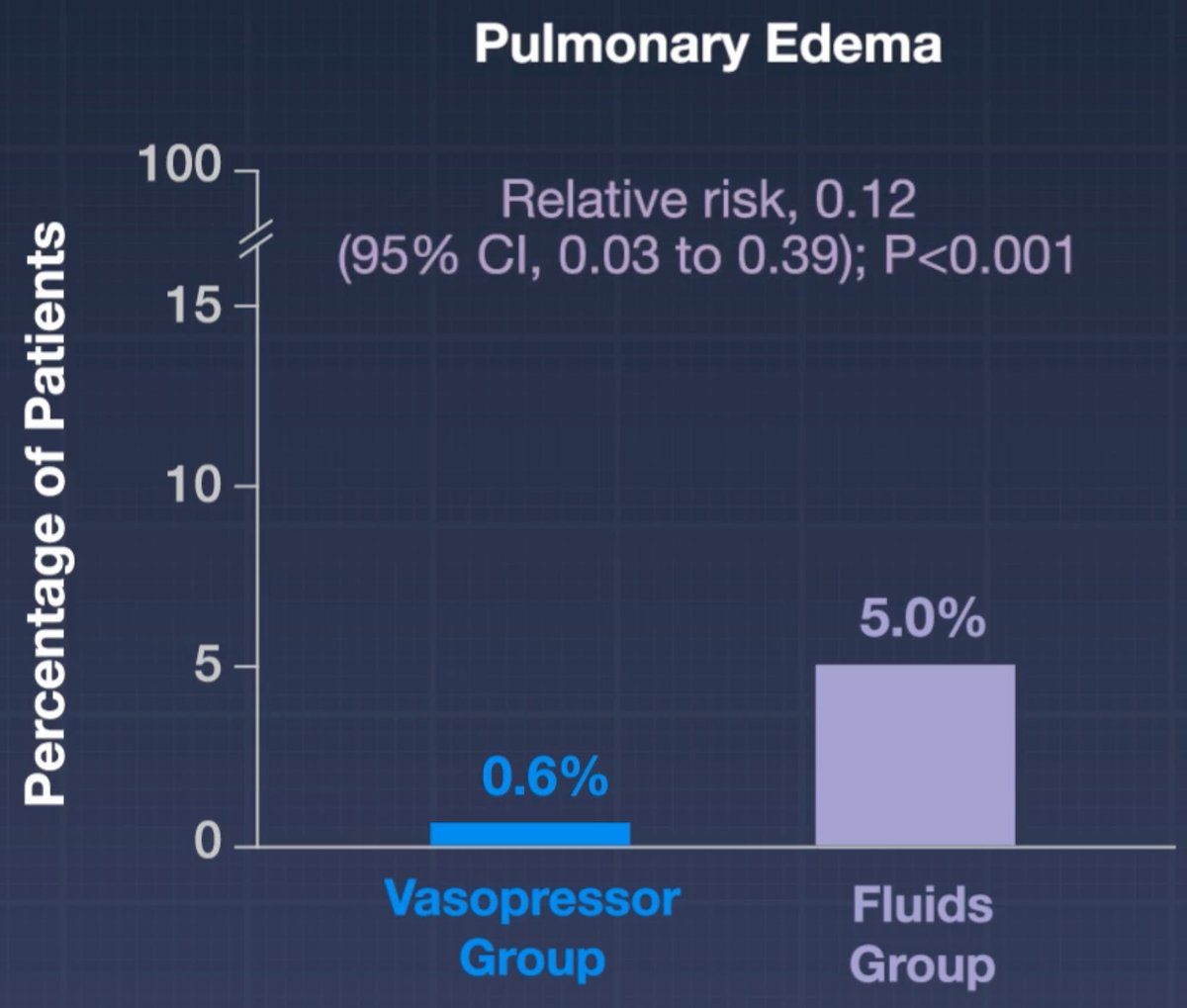
We finally have a prospective RCT demonstrating that mandating early administration of 30 cc/kg fluid (as compared to early vasopressors) doesn't help and may actually cause harm.
It's important to note that all of the hard endpoints in this trial were neutral (e.g., mortality, days free of organ support).
I still think that 30 cc/kg fluid is a pretty reasonable volume of fluid for *most* patients. But the study does suggest that giving too much fluid may promote edema - so we should be *thoughtful* about this intervention rather than mandating it for every septic patient.
Based on the subgroup analysis, the fluid-conservative strategy may have helped the subgroup of pneumonia patients the most. This is statistically nonsignificant but aligns with my expectation. ARDSy patients often don't respond well to fluid. (In contrast, I really doubt that a liter of fluids in either direction matters for most urosepsis patients.)
This is a great example of the over-reach of guidelines and protocoled medicine. People get all upset about practice variation, so sometimes they try to stomp it out using guidelines and protocols. But these guidelines are highly fallible, so what may occur is that you standardize care in a way that harms everyone equally. 🤦♂️
Lots of misunderstandings here.
First, this isn’t peer reviewed science. This is a press release. The level of evidence is essentially “trust me bro”
Second, sepsis early warning systems have been around for decades. This isn’t new. Most hospitals have systems like this.
Third, and most importantly, the way this intervention reduces the mortality *rate* probably isn’t actually saving any lives. What it’s doing is generating a ton of false positives. These people don’t need antibiotics but get them anyway, leading to side effects and resistance. But if you double the number of people with “suspected sepsis” in the denominator you make the mortality *rate* appear to drop. This is why in an actual published scientific paper we’d look at the number of deaths per year not just a rate. That’s also probably why this is press release and not an actual scientific publication…
Beef price discourse is spiraling and the screwworm theatrics are only going to make it worse.
The hype explosion in Texas barbecue over recent decades is built heavily on brisket. There are limited options to cook it, so it was cheap. A cheap, bulk cut that tastes great when smoked? Perfect for the basis of a barbecue menu. That was the genius of brisket. But there’s only one per animal and only so much to go around.
So when everyone opens up a barbecue restaurant and everyone wants to serve brisket, of course the prices are going to skyrocket, even apart from the general rise in beef prices.
The next phase of genius is making great barbecue without breaking the bank on brisket. Texas pit masters did it for decades. Brisket became the thing because people decided it was the thing.
Today, smart folks are experimenting with plenty of other cuts as a direct reaction to brisket prices. There’s so much you can do with beef beyond ground beef, grilling steaks, and smoking brisket.
Those folks deserve to be spotlighted, instead of just doom-and-gloom.
Fun fact: if SGA shoots 52 more free throws in the last 2.5 games here, he’d still have shot fewer free throws in this series than Wade did in the 06 Finals.
A lot of academics aren’t ready to hear this because it will hurt their precious little egos but:
Your students are apathetic about learning because you don’t integrate waterslides and waterparks. They don’t care about learning because they aren’t cascading down wet wet chutes
@BeggyScammy@johnloeber@shakoistsLog It’s apparently (and anecdotally) very location dependent, we see it in Houston frequently but colleagues from across the country that move here for work have often never seen it before
april fools Never made sense to me why would you start off a beautiful month with a day of trickery . Just makes no sense. Why not call it april loves. April joys. April smart person
A $2.5 billion robot has been alone on another planet for 13 years and is still doing science. The scale of that sentence gets worse the longer you think about it.
Curiosity landed in August 2012. Obama was president. Instagram had 80 million users. The iPhone 5 hadn’t shipped yet. The rover was designed for a two-year mission and 20 kilometers of driving. It’s now driven 35.5 kilometers, climbed over 327 meters up the side of a mountain, drilled 46 holes into Martian rock, and is currently running its fifth mission extension.
The computer running all of this has 256 MB of RAM and a 200 MHz processor. Your AirPods have more computing power. Every command sent from Earth takes 14 minutes to arrive. Every photo sent back takes the same 14 minutes. When Curiosity drills into a rock, the team in Pasadena won’t know if it worked for half an hour. They’ve been operating on that delay, every single day, for 4,846 Martian sols.
The power source is 10.6 pounds of plutonium-238 generating about 110 watts. Less than a ceiling fan. It will keep producing electricity for decades because the half-life of Pu-238 is 87.7 years. The rover will run out of moving parts before it runs out of power.
And those wheels. Machined from single blocks of aluminum, 0.75 millimeters thick. Half a dime. JPL watched them get shredded by Martian rock starting in 2013, rerouted the entire mission path, taught the rover to drive backwards, and kept going. The wheels look like they lost a fight with a can opener. The rover is still climbing a mountain.
Every iPhone you’ve owned since 2012 is in a landfill. Curiosity is on Mars, 140 million miles from the nearest repair shop, running on a ceiling fan’s worth of nuclear power, sending data through a 14-minute time delay, on shredded wheels, doing geology that rewrites what we know about whether life ever existed somewhere other than Earth.
We built that. With 0.01% of the federal budget.
people misunderstand the icarus story. the problem was not that he flew too high. it's that the wings were made of beeswax, which offered very little resistance to heating. with modern materials he would have had no problems. we can fly as close to the sun as we want now
Pretty astonishing. In Texas, between 10:00 am and 4:00 p.m., 80-90% of electricity comes from carbon free sources. And storage is already a significant contributor in the early morning and evening