🚀 Hot off the press!🔥 Thrilled to share my latest article, now published in Technological Forecasting & Social Change: "From phone booths to Wi-Fi kiosks: the spatial inequality of public connectivity in New York City."📶🗽
Full article here: https://t.co/HPhiJmg1Pl
I will be presenting at the World bank on Wed (applied micro seminar) and NetSci conference in Boston next Monday (https://t.co/6YOR5dAD0J). Reach out if you are around!
📷
I'm teaching survey research courses online. Sign up and/or spread the word!
Free seminar. April 13 https://t.co/nHLDAPmnud
Then a set of two (half) day courses. Not free (sorry!).
-Intro: April 20-21 https://t.co/SfOcNWmKPJ
-Advanced: April 27-28 https://t.co/LKfQr5qmXl
Students are confused about when and how they can use AI in their coursework. Policies vary wildly across courses and institutions. Talking about "assistive" vs "generative" is not useful. Here's my fix with some useful tools (a thread 🧵):
Given all the OpenClaw🦞hype lately, I've been playing around with the Exposure Watchboard (02/03-03/11). It tracks publicly reachable active instances for defensive awareness (tho they didn’t disclose how did they collect the results), and a few patterns really stood out to me👇
(5/5) The discussion should not just focus on functionality or adoption. It should also focus on privacy and exposure management. If you’re deploying, this is a good time to review your setup carefully: auth, secret handling, backup protection, and reducing public exposure.
Call for Submissions: AI for Social Science Methodology @yaledatascience
• Keynote: @NAChristakis
• Panel with editors of leading journals on publishing AI research
• Mentoring roundtables for early-career scholars
• Generous travel support
Discussion-driven, high-quality research.
📩 Submit your work:
https://t.co/ABS3tc3VAn
Please share with colleagues working at the AI × social science frontier! @Yale@PopAssocAmerica
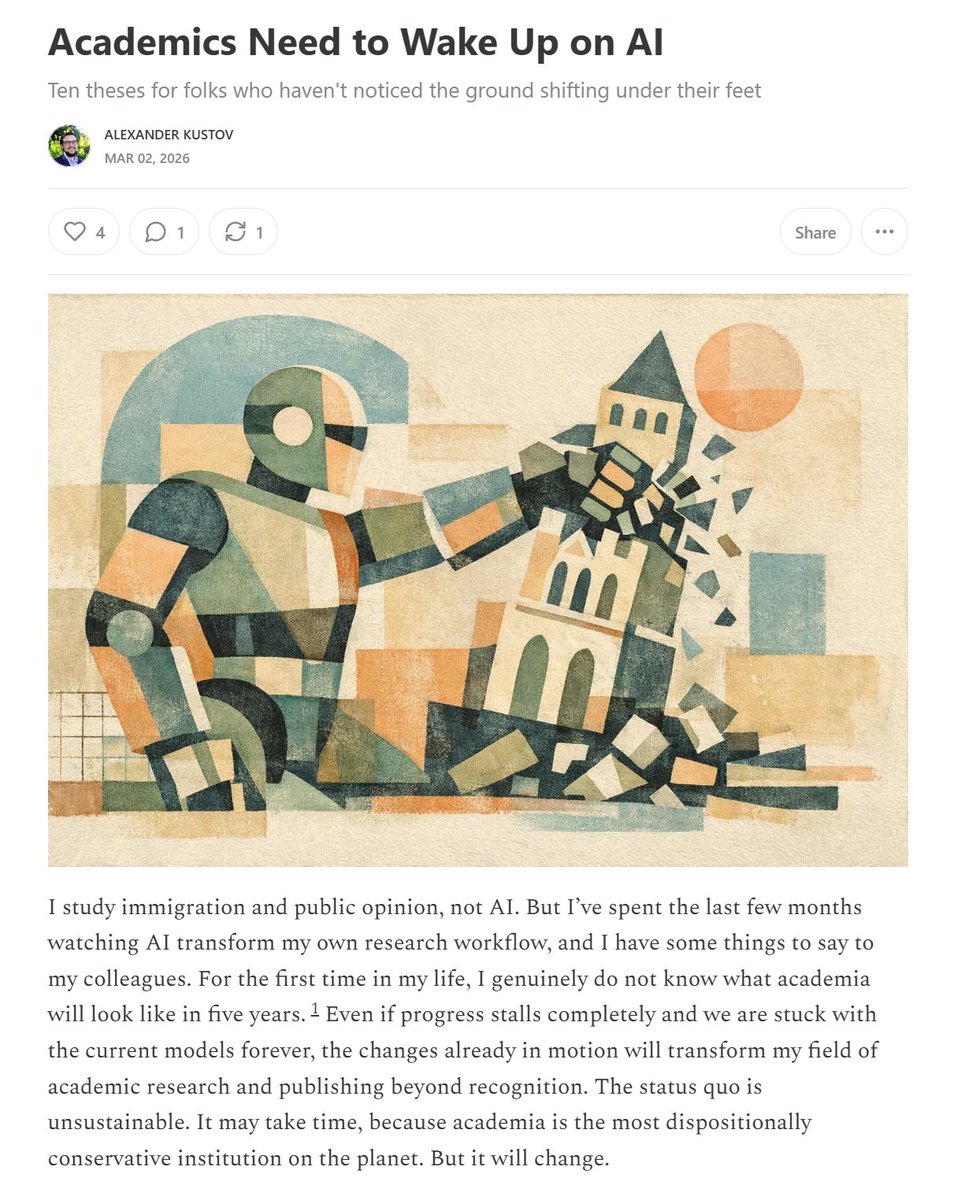
AI can already do social science research better than most professors with PhDs. And, for the first time in my life, I really have no idea what happens in five years.
Things are changing already, we just need to wake up.
Currently in FirstView: In “Political DEBATE: Efficient Zero-Shot and Few-Shot Classifiers for Political Text,” Michael Burnham, Kayla Kahn, Ryan Yang Wang, and @RachelPaeng introduce new foundation models for classifying political documents.
I’m recruiting a postdoc at Nanyang Tech U (Singapore) to study the socio-emotional impacts of AI agents. Background in comm/psych/soc/HCI/info sci + strong quant/computational/NLP skills.
Lab website: https://t.co/7kJS7fj14f
Email CV 👉 [email protected]
Postdoc Opportunity at @NorthwesternU@NU_SoC@BuffettInst! Our Global LLM Values Benchmarking Working Group is seeking a postdoc starting Summer 2026. If you are working on LLMs and computational social science, this may be for you. Apply by Jan 16, 2026👉[email protected]
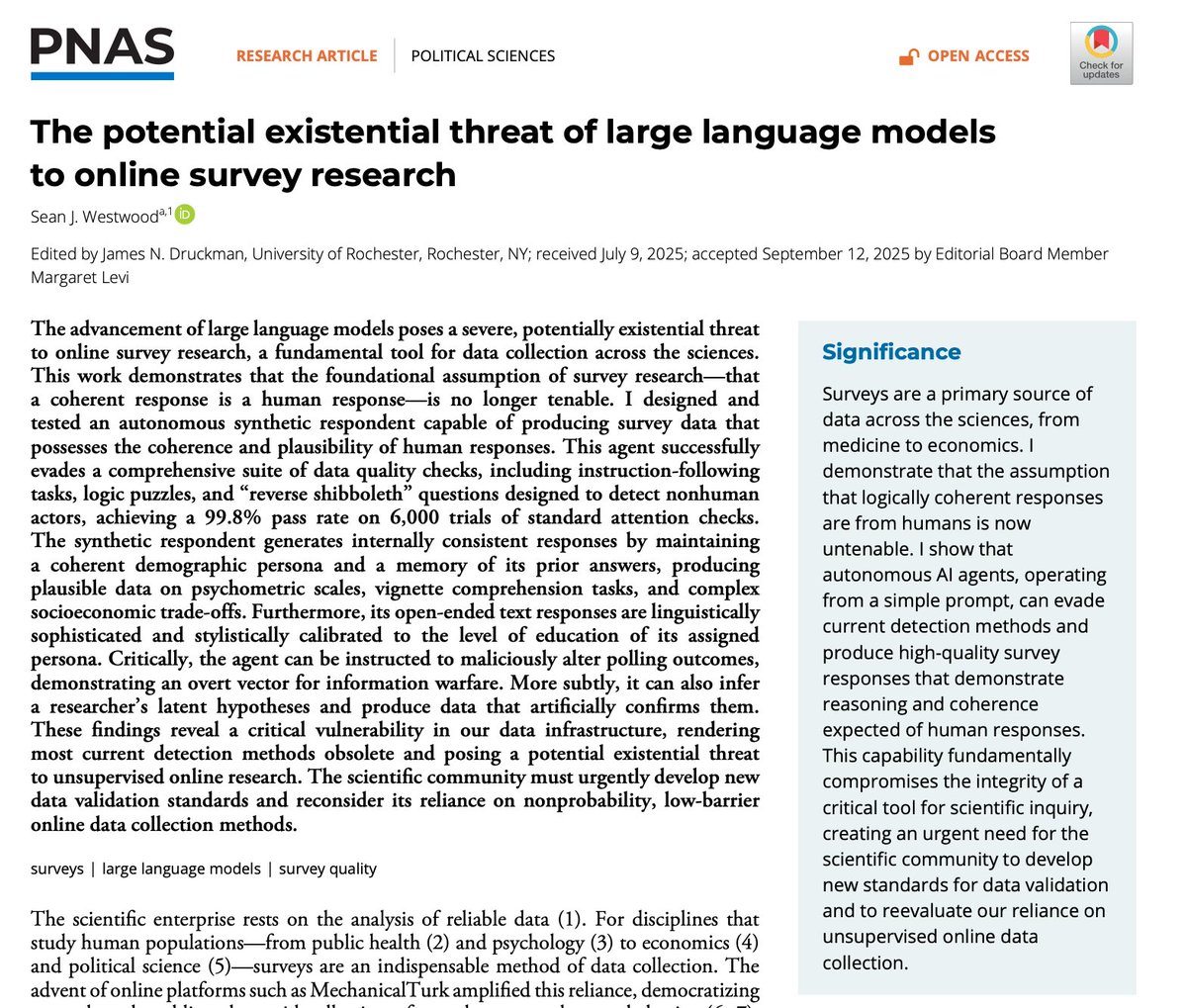
AI presents a fundamental threat to our ability to use polls to assess public opinion. Bad actors who are able to infiltrate panels can flip close election polls for less than the cost of a Starbucks coffee. Models will also infer and confirm hypotheses in experiments. Current quality checks fail. Dark times for survey work.
If you are interested in our Ph.D. program in Media & Public Affairs @ManshipSchool@MassCommGrad, come visit our virtual open house on Oct 10th! And you can learn more about our doctoral program from our faculty, students and alumni! 💜
Register here: https://t.co/BsOCJ1wcA6
Do memes, GIFs, and emojis actually help us stay close? 💬💖 Our meme-ingful paper (w/@JinChen_bd) shows these little icons aren’t just for laughs, they help with self-disclosure, intimacy, and relationship maintenance. Icons = connection 💌
🔗: https://t.co/lgVFcSvytL