When Dolly Parton approached Robert Plant for permission to record her version of “Stairway to Heaven,” she reportedly worried about how he would react. Instead, Plant’s response was wonderfully simple: “Of course you can, you’re Dolly Parton.”
And somehow, that feels like the perfect answer. Dolly didn’t try to copy Led Zeppelin — she took one of rock’s most iconic songs and made it unmistakably her own, adding a touch of country, gospel, and her unmistakable voice.
Sometimes, a legend recognizing another legend is all the permission you need.
Booking Tony Robbins today costs $1 million for a single day. this is a 21-minute tape from inside his own house, filmed over 30 years ago, where he breaks down exactly how to get anyone to say yes. same $1 million material. completely free.
this is a rare, unfiltered tape from decades before this man started charging billionaires just to be in the room with him.
people give you two excuses when they say no, he says. not enough time. not enough money. neither is true. the real reason is they don't believe it's worth it yet, and that's not a money problem, that's a state problem.
so he teaches something he calls attack and confess. instead of arguing with the objection, you confess your own. "I had a chance to go to this thing six months ago and I didn't go until two months ago," he tells the room. "I can't even imagine the time I lost." the room goes quiet. nobody argues back.
he calls it getting someone on the yes train. every small yes you get compounds into the next one, until saying no to the final ask feels harder than saying yes. by the time he asks someone to sign, he says, they've already agreed to it five times over without realizing it.
21 minutes. that's all it takes to walk away knowing the exact two moves people pay $1 million a day to learn: how to read anyone's state, and how to move it. most people spend years in sales guessing at this. he wrote it down on a flip chart in his living room in under half an hour.
a seat in that room cost $125 back then. today it's a $1 million-a-day to sit in front of him.
The tape is free right now, and the answer is in this video.
No matter how many times I hear her, her voice still leaves me speechless. She had one of the most extraordinary singing voices in music history.
Can you name this song? 🤔❤️
The last American who remembered the old world and told her family before dying in 1953.
There’s a file cabinet in the House of Congress containing recordings of 2,900 dead Americans in the form of transcripts (1936-1940).
⚠️What is described does not match recorded history.
There was a recent study where they took the smartphone capacity away from adults for four weeks and so they still had their flip phone they could text and call but they couldn’t get online. They couldn’t be on social media. And what they found is that after four weeks of being away from a smart phone the happiness scores went up as if they had treated these people with an antidepressant and when they looked at these individuals and spoke with them they found that these people were getting better sleep because they weren’t under screens at night so that’s a point of joy that is measured in the research they were actually socialising more another point of joy they were spending time in nature another point of joy eating their food and tasting it not like just staring at a screen and shoving it in their mouth so they were losing all of these natural points of joy just by being on their screen
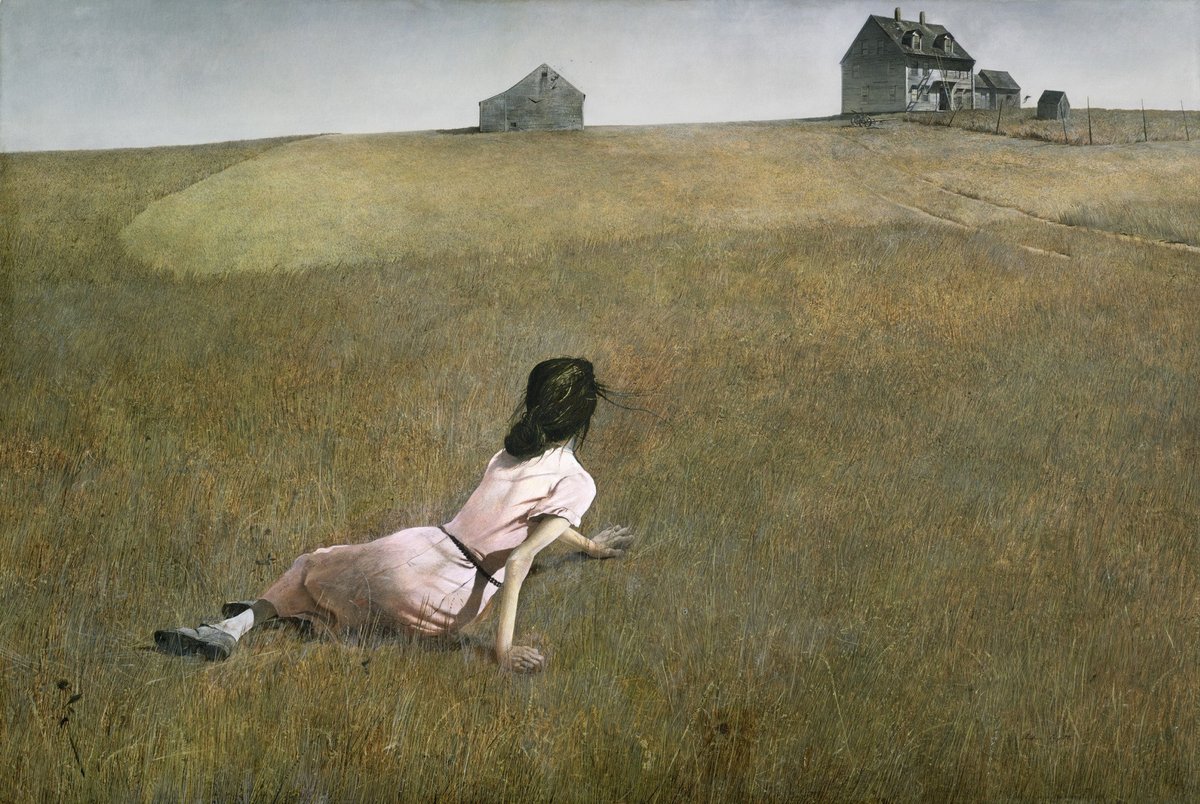
This is one of the most famous paintings in America, and most people have no idea what they are actually looking at...
The painting is Christina's World, made by Andrew Wyeth in 1948, and the woman was real: her name was Anna Christina Olson, Wyeth's neighbour in Cushing, Maine. Since childhood a degenerative condition had slowly taken the strength from her legs, until walking was no longer possible. She refused a wheelchair, and for her entire adult life she chose to drag herself across the ground with her arms instead, going wherever she wanted to go under her own power.
Wyeth saw her one afternoon from an upstairs window, alone in that vast field, crawling slowly toward the house on the hill. He said the painting was an attempt to do justice to her extraordinary conquest of a life which most people would consider hopeless. Her world, he said, was limited physically but by no means spiritually.
That is what turns this painting from a portrait of frailty into one of the most triumphant images ever made...
Look at it long enough and it stops being about what her body took from her, and becomes about what she would not stop doing anyway. The field is enormous and she is small and the house is far away, and still she goes, because the alternative, to be carried, to give up, to let the distance win, was something she simply would not accept.
There is one more thing: Christina loved this painting. Pink was her favorite color, and Wyeth had placed her exactly where she most wanted to be, out in the open, in her own field, under her own sky. Late in her life, when she could no longer even crawl out to that field, she said something that holds the whole meaning of art inside it:
"Andy put me where he knew I wanted to be. Now that I can’t be there anymore, all I do is think of that picture, and I’m there."
Researchers noticed a strange pattern: major life shifts often happen not after years of therapy, but after a single strong travel experience. People come back from a trip and suddenly quit jobs, end relationships, change cities, or finally start something they postponed for years.
A psychologist explained: "Travel breaks the illusion that your current life is the only possible one." Therapy works with words, travel works with direct experience.
When you travel, your brain is forced out of autopilot. New streets, languages, food, faces — the nervous system can't rely on old scripts.
This creates what scientists call a
"plastic window," when decisions are rewritten faster. One woman said: "After two weeks abroad, I realized I was living someone else's life." That realization didn't come from analysis, but from contrast.
Travel temporarily removes social roles. At home you are someone's employee, partner, child, or parent.
On the road, those labels weaken. You become just a person moving through space. Therapists note that this loss of identity pressure allows people to hear their real desires for the first time. Not what's expected - but what actually feels alive.
There’s an episode from Cheers where Frasier and another guy are quoting from Richard II and Cyrano de Bergerac.
34 million Americans watched this episode.
“In the end,
I believe there is nothing we must do to be loved.
We spend our lives trying to look more beautiful, more intelligent.
But I've understood two things:
Those who love us see us with their hearts and give us qualities
beyond the ones we truly have.
And those who refuse to love us will never be satisfied with all our efforts.
Yes, truly.
I believe it is important to let our imperfections be.
They are precious,
for they help us understand those who see us with the heart.”
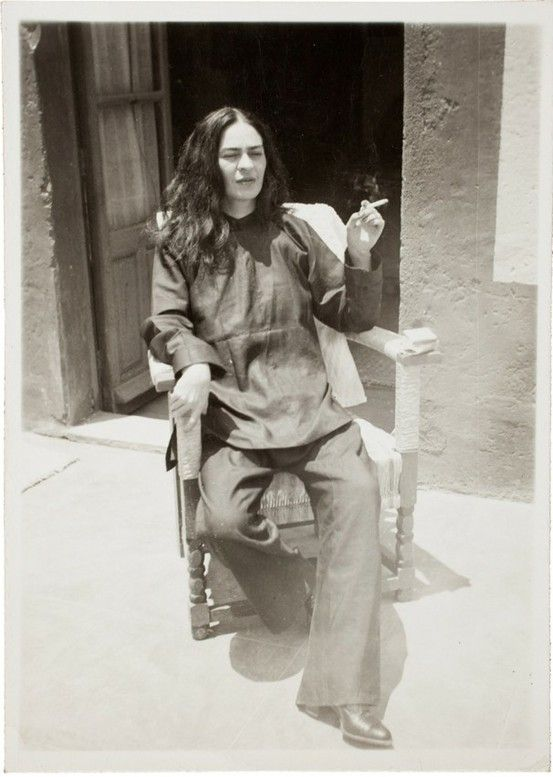
— Frida Kahlo