Building the Financial Rails of Tomorrow
While attention gravitates toward rewards, campaigns, and short term opportunities, @KASTxyz remains focused on a far more consequential mission: advancing the infrastructure that enables a new generation of financial services.
Its collaboration with @m0 represents a significant step toward a comprehensive digital banking framework designed for a globally connected economy. Through this foundation, users gain access to complementary financial instruments powered by the efficiency and scalability of the Solana ecosystem.
USDK enables seamless real world spending across an extensive global merchant network, bringing digital assets closer to everyday utility.
USDKy provides a transparent and secure mechanism for onchain yield generation, offering visibility and accountability at every stage.
Together, these solutions create a unified experience that combines practical financial access with intelligent capital management, tailored for the evolving needs of modern users.
True industry leaders are not defined by participation alone. They are defined by their ability to build the systems that shape what comes next.
Unlocking the Potential of Embodied AI Through Decentralized Tele-op Data
The robotics industry currently confronts a formidable obstacle: a scarcity of physical world data needed to train AI for genuine real world interaction. PrismaX AI emerges to resolve this challenge through its cutting edge infrastructure centered on teleoperation data acquisition.
What positions this as a genuine breakthrough?
Multi-Modal Data Capture: @PrismaXai gathers a substantially richer stream of information than mere video footage, encompassing proprioceptive signals (joint positioning and torque), tactile feedback (grip pressure sensitivity), and spatial visual data.
A Decentralized Ecosystem: Rather than depending on a single closed laboratory, PrismaX AI cultivates a worldwide network linking human operators, diverse robotic hardware, and AI researchers together.
Powering Foundation Models: The premium data harvested through this network fuels the training of more resilient Robotics Foundation Models, enabling robots to navigate unfamiliar environments without succumbing to unforeseen failures.
Web3 Powered Incentives: Backed by a16z crypto, the project leverages Web3 infrastructure to reward data contributors and robotic node operators, cultivating a sustainable economy built around physical world data.
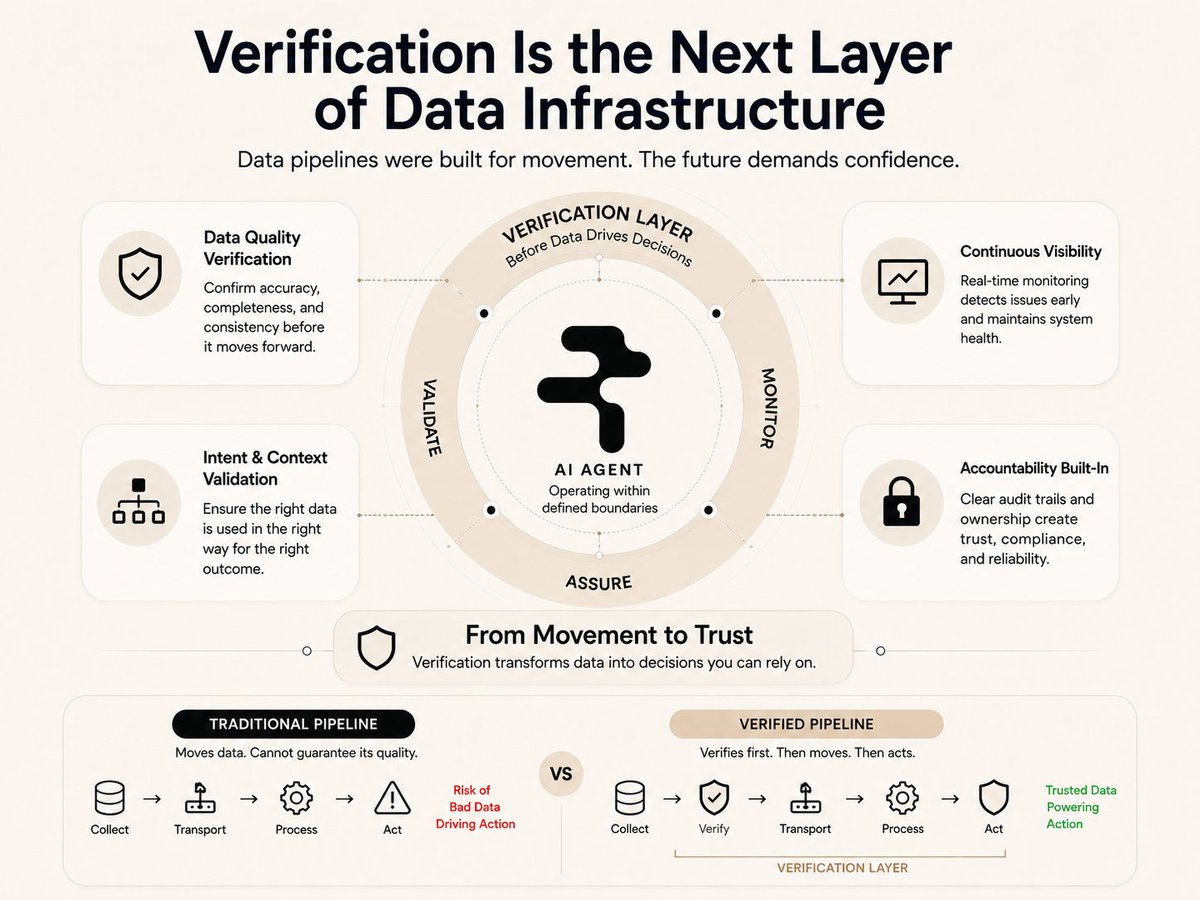
Verification Is Becoming the Foundation of Modern Data Systems
For years, infrastructure was designed around one objective: moving data from one place to another as efficiently as possible.
That standard is no longer sufficient.
As platforms like Rialo demonstrate, the next evolution of data infrastructure is not centered on transportation. It is centered on trust.
The challenge is not whether information can be delivered. The challenge is whether that information deserves to influence decisions in the first place.
A flawed dataset can travel through a pipeline with perfect speed, reliability, and efficiency while still producing costly outcomes. Movement alone does not create value. Confidence does.
The infrastructure of the future will not simply accelerate data flows. It will establish verification as a core layer, ensuring that information is validated before it becomes action.
Another week begins inside @RialoHQ BuilderHub, and the floor is yours.
Bring meaningful ideas, share real insights, and help move the community forward. Every conversation has the potential to create momentum, spark collaboration, and shape what comes next.
Show up with intention. Add value. Make your presence felt.
The builders are already here. Are you?
Join here: https://t.co/13U8ES2RdX
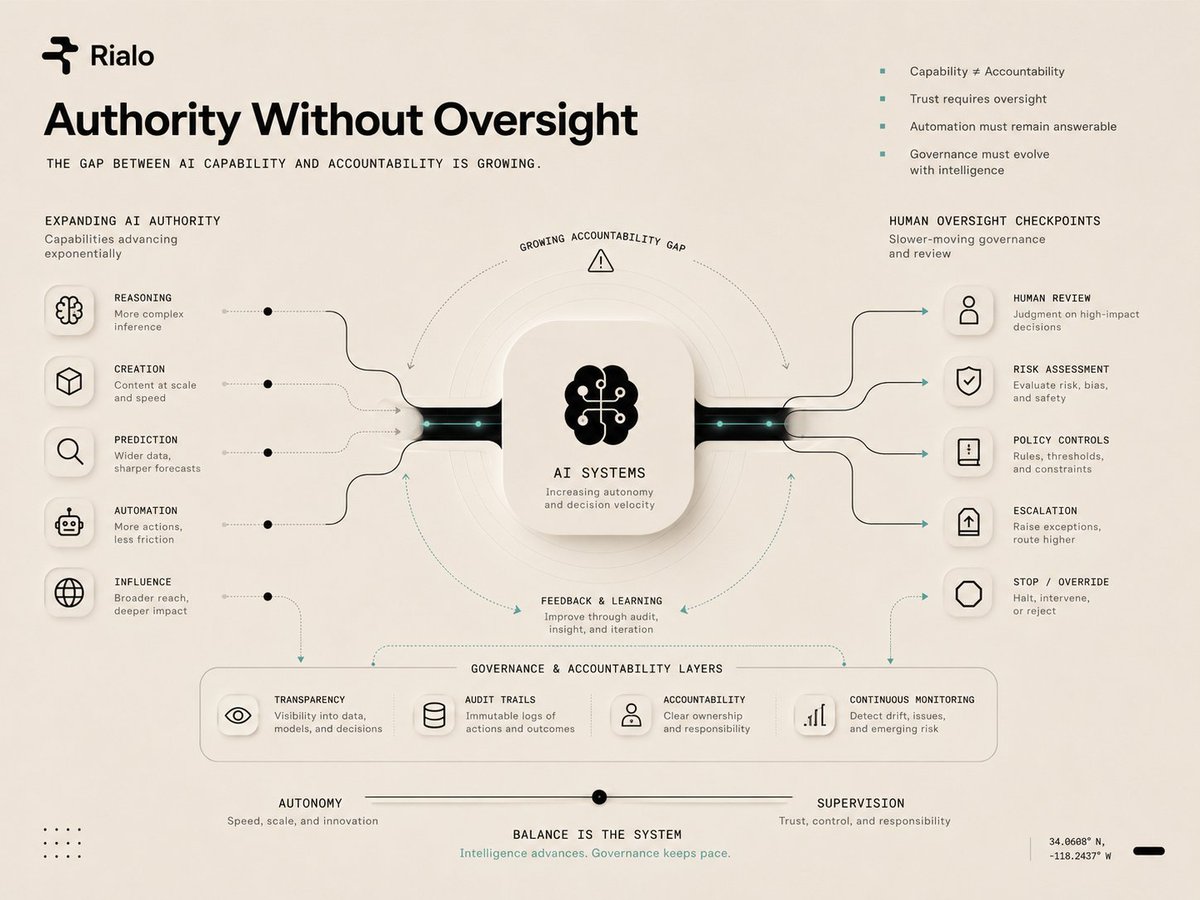
Most discussions around artificial intelligence centre on what these systems can do. But performance alone does not define the challenge.
As capability increases, a more consequential question comes forward: how do we extend authority to these systems without surrendering oversight?
The technology is advancing well ahead of the governance structures designed to manage it.
That divergence is the real problem. Not a flaw in the systems themselves, but a failure of coordination, accountability, and control to keep pace.
Delegation does not automatically produce reliability. Trust does not emerge from speed. And boundaries do not hold without deliberate infrastructure to enforce them.
The objective should never be to constrain automation. It should be to make automation answerable.
Because the most enduring systems, in the long run, will not be defined by what they are capable of doing.
They will be defined by the judgment to know when action is warranted, the architecture to act within sanctioned limits, and the design to remain accountable at every step.