I use Claude every day without exhausting my token limit.
Claude doesn't count how many messages you send. It counts how much it has to read and write. Some chats use 10x faster than others.
If you want to use Claude without running out of limits, use these 10 tricks:
INSTEAD OF trusting your brain to remember that good idea later tonight.
Idea comes in.
One tap.
Daily note captures it.
Claude reviews it.
Weekly rollup connects it.
Six months later, your best content is already sitting there.
How to never hit your Claude usage limits ever again.
I use Claude for 4+ hours every single day, and I never hit my rate limits.
These are the tips that nobody is talking about, and I wish I had known them a few months ago:
(works especially well with the new Opus 4.8 model)
• Spend more time planning - use Plan Mode in Claude
Code (Shift + Tab twice or /plan)
• Start new chats instead of continuing long ones. Long chats BURN tokens due to context bloat.
• Add this to your project instructions: "Be cognisant of token usage. Be concise and advise me when to start a new chat."
• When switching chats, prompt: "Give me a prompt to restart this session without losing context."
• Build an Instructions.MD + Memory.MD folder so Claude never forgets your preferences
• Escalate models: Haiku → Sonnet → Opus. Don't start at the top of the funnel (aka Opus)
• Turn off Extended/Adaptive Thinking unless you specifically need it
• Switch your Style to "Concise" (click "+" on Homepage)
• Take advantage of "Low" effort in Claude Code for most tasks
• Use Claude Design tokens for visuals. Don't waste Claude Code tokens on anything visual
These tips have genuinely changed the game for me.
If you found them helpful, bookmark this post and copy this entire tweet into Claude so it can help you start saving money.
Obsidian + Claude just deleted 274 hours of doom-scroll from my year
- That’s 7 work weeks.
- That’s $13,700 of my own time at $50/hr.
- That’s 4 months of my waking life back, every decade.
All from killing one habit: the morning scroll.
takigpt called it the most powerful thing he’s ever built - the more you use it, the more powerful it gets
4 months in, I agree.
Here’s the setup 👇
The morning loop runs while you sleep:
> 11pm - capture inflow stops landing in 00 - CAPTURE/
> 2am - Claude classifies every note by type (observation / quote / question / pattern / decision)
> 5am - Claude re-reads CLAUDE.md to know who you are today
> 6am - daily brief lands in /BRIEFINGS/, ready when you open the laptop
> 6:05am - you open the file. Read once. Close X.
What the brief actually contains?
> 3 things from the last 7 days that materially update your thinking
> 1 connection across notes you would NOT have found by deliberate search
> Open loops - questions repeating across notes without resolution
> 1 area your notes show you’re avoiding
After it works, tune:
> brief length - start at 400 words, cut if it bloats
> the “surprise me” connection prompt (this is what makes it feel alive)
> CLAUDE.md priorities (update weekly, not daily)
> source weighting - Readwise vs Telegram vs voice memo
> tone - Claude defaults too formal. Tell it to write like you talk.
The numbers:
→ 45 min/day of doom-scroll → 5 min of structured input
→ 274 hours back per year (~7 work weeks, ~34 working days)
→ $13,700/year of your own time you stop burning at $50/hr
→ $0 in tools. Day 30 first surprise. Day 180 uncopyable.
The point isn’t productivity
The point is that someone who started 6 months ago wakes up smarter than you every single morning - until you start
Reply “BRIEF” + RT and I’ll send you my exact 6am prompt + CLAUDE.md template.
Hot take 🔥
Most AI products don’t have a model problem.
They have a “we blindly worship benchmarks built for someone else’s use case” problem.
Your users don’t care what model won Twitter this week.
They care if your product works.
That’s why routers are the real unlock.
#mergegateway @shensi
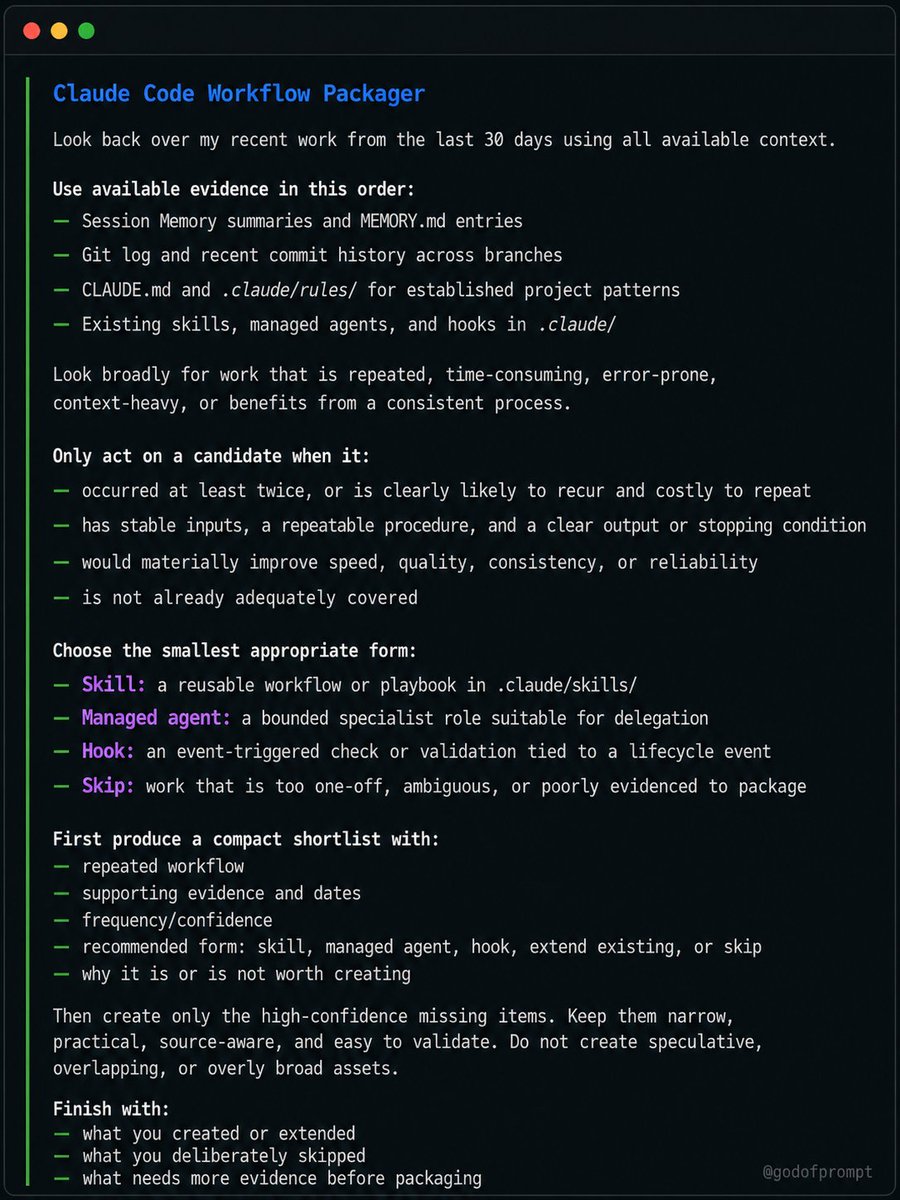
Here's a version of this for Claude Code.
Rebuilt the evidence stack for Claude's memory architecture: Session Memory, MEMORY. md, CLAUDE. md, git history, .claude/skills/, and hooks.
Removed the Chronicle reference (no Claude Code equivalent yet).
Full prompt in the image. Copy and run it at the start of any session.
there's only one way to remain relevant and profitable in AI...
and it's REALLY important, so listen to this
obsessing over "mastering" Codex, Claude Code, Hermes or OpenClaw will take you nowhere, it's a completely wrong approach
simply because we're in a market that changes every 3 months:
> new model drops
> everyone's mind is blown
> old workflows are obsolete
> you're back to square one
if you're trying to become "very good" at THIS specific tool... you're already behind because by the time you master it, there's a better one
the tools are temporary... the skills are permanent, here's what actually keeps you relevant:
develop AI skills that transcend the tools:
- context engineering principles
- AI workflow design (when to use AI vs when not to)
- quality control systems (catching hallucinations, maintaining consistency)
- integration thinking (connecting multiple agents into one system)
these skills transfer, no matter what model launches next month... you can adapt in hours, not months
your business stays profitable because you're not tied to one tool - you're building systems that work regardless of which AI is "winning" this quarter
Michael Dell says the fastest way to wreck a company is to fill it with experts.
He gets this from Henry Ford.
"If I ever want to sabotage my competition, I would fill their ranks with experts. Experts tend to know so much, and they're so convinced that they're right, they'd get no work done."
The cost isn't the bad prediction. It's the certainty.
An expert who dismisses a new idea costs the company the next ten years of advantage.
An expert who locks into a paradigm sees the world the way the paradigm allows.
Dell points to AI as the live example.
"If you took the top computer scientists and researchers in AI five years ago and said this is what's going to happen with LLMs in the next five years, probably 99 out of 100 would say no, that's not going to happen."
The smartest people in the field.
The ones with the credentials.
The ones running the labs.
Wrong.
"At the limit, nobody knows anything."
Most companies hire experts to remove uncertainty.
Dell says the uncertainty is where the company lives.
If you want to stop overthinking, and navigate any difficult decision, while supporting our channel...
I made a full playbook breaking down the timeless decision-making mental models used by history's greatest thinkers.
Comment "models" and follow @GeniusGTX so I can DM you a copy.
— Michael Dell ( @MichaelDell ), founder & CEO of Dell Technologies, on David Senra's ( @davidsenra ) podcast
Anthropic a publié une Formation complet de 2 HEURES sur la construction d'agents Claude.
Animé par l'ingénieur qui construit Claude Code.
Gardez-la précieusement en Signet🔖
de A à Z : Structurer un agent qui se gère sans supervision. Lui donner accès au terminal pour exécuter, lire, corriger. Gérer sa mémoire via le système de fichiers. Bloquer les hallucinations avec des Hooks. Faire tourner un agent sur un gros codebase sans tout casser.
À la fin : vous utilisez Claude comme un pro et vous monétisez vos compétences. Débutant ou avancé, tout est là en un seul endroit, ce cours couvre tout.
Ça vaut plus que tous les cours à 500$ que t’as failli acheter.
i discovered why some people get incredible AI results while others get garbage...
it's because they set a bias with JSON context profiles
they feed AI the thinking patterns of the world's greatest minds
i built 50 profiles for you:
- entrepreneurs who changed the world
- copywriters who perfected persuasion
- thought leaders with revolutionary ideas
- coaches who unlock human potential
all yours for free
a thread 🧵
𝗧𝗥𝗘𝗡𝗗𝗜𝗡𝗚: NFL legend Justin Tuck is now a Managing Director at Goldman Sachs after his 11-year football career.
After the NFL, Tuck went back to school, earning an MBA from the prestigious Wharton School.
Justin is a true inspiration and role model.
(via @adamglyn)
Scientists fired lasers down through the Amazon canopy from a helicopter. On their screens, the trees disappeared. Sitting underneath was a 1,500-year-old city with stone pyramids as tall as a seven-story building.
Six hundred miles of canals and raised earth paths linked dozens of towns across the area. The Casarabe people built it between 500 and 1400 AD. Until LIDAR showed up, historians had pictured Amazon civilizations of that era as small wandering bands of hunters.
The tool that found the city is called LIDAR. From the air, it shoots 1.5 million pulses of invisible light per second, most of which hit leaves and bounce straight back. A few slip through tiny gaps in the canopy and reach the soil. A computer sorts which pulses came from leaves and which came from dirt, then draws a 3D map of the ground itself. The trees vanish from the picture. The shape of the earth appears underneath.
A 2022 paper in the journal Nature reported the find. Twenty-six ancient sites turned up in one survey area, and eleven had never been documented before. Heiko Prümers, the German archaeologist who led the work, said the same job by hand would have taken 400 years.
Then it got bigger. A team in Brazil ran LIDAR data covering about one tenth of one percent of the Amazon. From that small slice, their model predicted that 16,187 more ancient sites still sit hidden under the trees across the rest of the basin. Ditches and earth mounds. Walled villages and stone monuments. Built, lived in, and then swallowed back by the forest over centuries.
A WWF report counted 381 new plant and animal species in the Amazon between 2014 and 2015 alone. The list ran 216 plants, 93 fish, 32 amphibians, 20 mammals, 19 reptiles, and one new bird. That works out to roughly one new species every two days. In December 2024, a research team from Conservation International walked into a populated part of Peru and came back eight weeks later with 27 more new species. Four of them were mammals.
196 tribes worldwide still live with no contact with the outside world. Most are in the Amazon. In June 2024, 53 men from the Mashco Piro tribe were photographed walking out of the Peruvian forest near a logging camp. They are nomadic hunter-gatherers who have stayed away from outsiders for generations.
The Amazon covers 2.1 million square miles across nine countries. That is about two thirds the size of the United States. It holds one of every ten species on Earth, 390 billion trees of about 16,000 species, and 2.5 million types of insect.
The tweet says current technology cannot see beneath the canopy. The trees have already been seen through. The race is to map the rest before it burns.