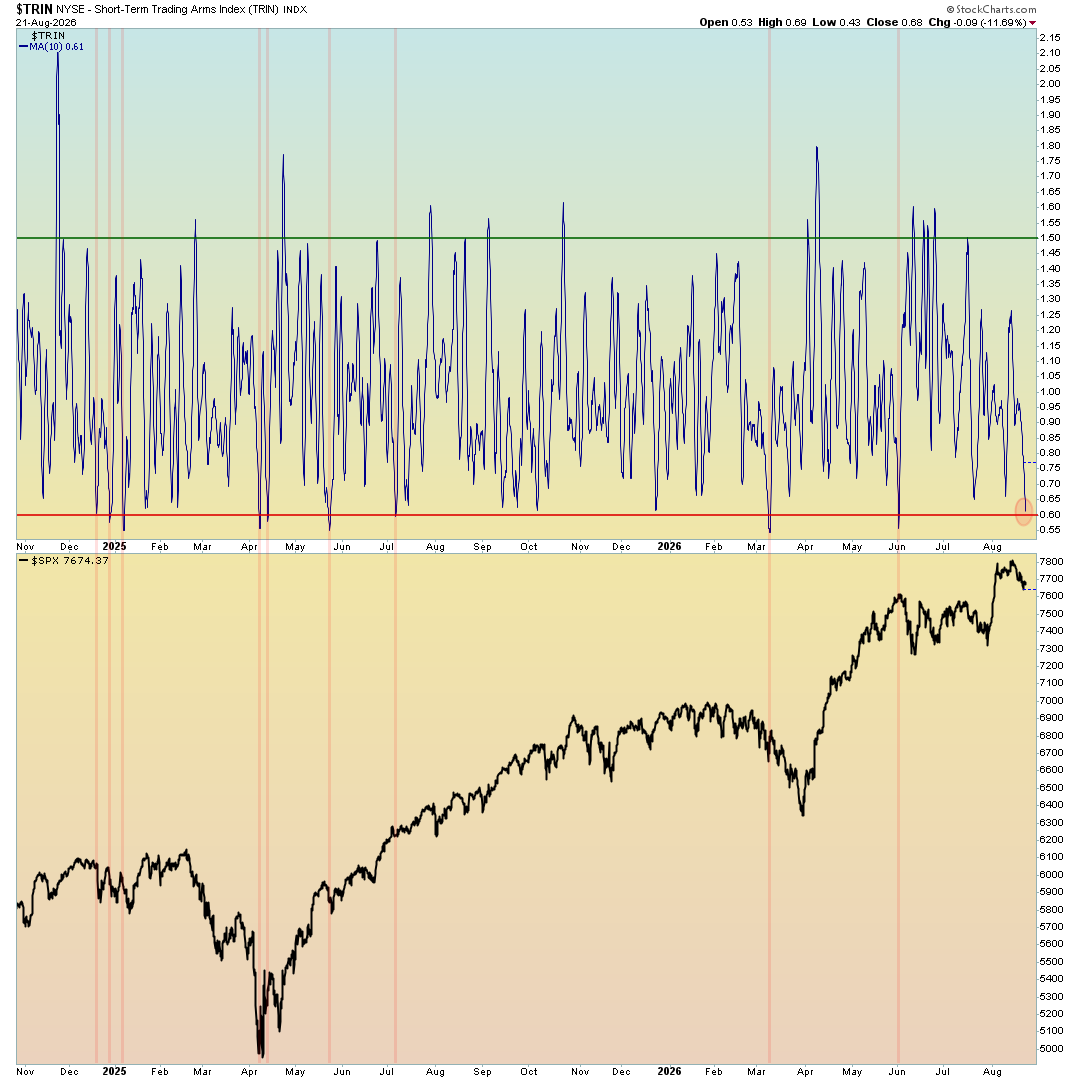
The Arms Index (TRIN) is one of the oldest breadth indicators out there. It compares two things: how many stocks are advancing vs declining, and how much volume is going into the advancers vs the decliners.
I like to use it on the 60 minute timeframe. Every once in a while I check in to see where the reading is sitting.
What I have found: when the 10 period moving average pushes down into the zone marked on this chart, there has often been weakness or a period of consolidation in the market shortly after. Every pink live is a prior instance. SPX below shows how it played out each time.
The 10 period MA just pushed near that zone.
There are no guarantees with any of this. I just try to do my best to find interesting signals most people miss.
Before a collapse, nothing looks wrong. The numbers are printing records, the money is flowing, and the people warning about it are laughed out of the room.
Last time it was housing. Today it's AI.
The fire doesn't start when the rally ends. It starts inside the climb. Here's how it happens.
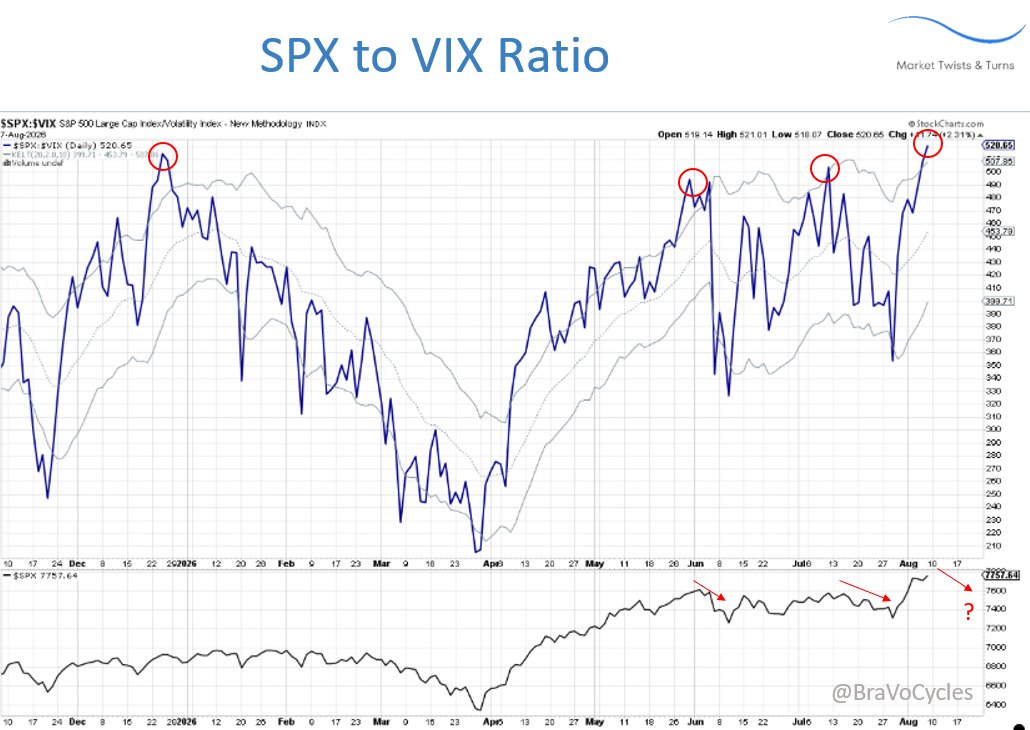
$SPX / $VIX ratio spiked over the Keltner channel.
This indicates that a potential reversal in $SPX is nearing, but it is not an accurate short-term indicator.
@FoFtyTrader Really enjoy your videos, thank you for making them. Here is an interesting view on what might be happening with the yen
https://t.co/DjzqlFKtLf
Is it popularly known that Japanese banks have seen very impressive growth in their offshore dollar-denominated loan books the past couple of years? And that these loans mainly service Asian markets that Chinese banks used to service?
The outcome: Japanese bank balance sheets are expanding just as Chinese ones are contracting.
Which is to say, as Chinese banks pull back from lending dollars to BRI markets in favor of RMB loans, Japanese banks are moving in to take advantage of that unserviced dollar loan demand.
This coincides with increasing Japanese bank profitability, and collapsing Chinese bank profitability.
One interpretation of the above is that the narrative around increasing RMB preference in the region is far from correct. It’s not that demand for dollar-denominated loans is falling in favour of RMB. It’s that Chinese banks can no longer lend dollars at a profitable rate in the region, and are thus trying to promote RMB loans instead (since they are cheaper to provide for them).
This is likely because China’s overall cost of capital is increasing as deflationary forces mount.
Japanese banks on the other hand stand on the opposite side of the cycle. They have very cheap capital costs in relative terms, including in USD. It thus makes sense for them to take advantage of the market opportunity that is presenting itself.
In fact the op may be so large that it’s prompting a rush into yen funded=> USD swapped loans, exacerbating the depreciation in the yen.
In that case, everyone may be missing that this isn’t an ordinary emerging-market style currency depreciation crisis. The cause has nothing to do with Japanese banks lacking sufficient dollars to cover their liabilities in a way that threatens their profitability. On the contrary the cause is likely a rush to acquire what dollars they can so as to better take advantage of the mega profit opportunity that might otherwise not be captured.
All in all, this is incentivising Japanese banks to sell dollars that they don’t yet have via swap markets (which is resulting in rapid yen depreciation) on the basis that the risk-adjusted profit of doing so is too attractive to ignore.
If I’m right this changes the calculus on what’s really going on with US yen intervention.
It’s not a bailout. It’s fuel to help Japanese banks keep stealing market share from Chinese banks in the region.
One last related note: Japanese banks have spent years diversifying their USD funding sources. Today they have very large and robust deposit franchises in the US and in dollar terms. This adds even more resilience.
All of which is a long way of saying: what we are seeing is a profit-motivated market mania not a crisis.
That, at least, is my hunch.