After ARTEX was taken offline, ThreatBook has decided to take CyberStrikeAI offline as well.
We are seeing a growing number of offensive attack frameworks and real-world attacks that misuse these tools.
We strongly encourage all organizations to proactively use the best AI agents available to assess their exposures and weaknesses—before attackers do.
https://t.co/BNKFURVPpL
CVSS 9.8 - Unauthenticated VmWare vCenter takeover. Patch immediately!
ThreatBook has reported this to Vmware back in September.
VMware has patched CVE-2026-123903 (VMSA-2026-0011, CVSS 9.8): an unauthenticated vCenter takeover through vmdir on TCP/389. In VmDirMLBind’s SASL branch, a failed SRP bind still resolves the client-supplied username and calls _VmDirBindSetupAccessInfo(), attaching that account’s full access token to the connection only to do failed-password bookkeeping — then returns LDAP 49 without resetting the connection to anonymous.
Send a two-step SRP bind as [email protected] with any wrong password, and the same TCP connection keeps the administrator token: plain LDAP ADD a user, add it to cn=Administrators,cn=Builtin, and log in to vSphere Client. No password, no lockout, no race window. The simple-bind failure path does clear the token, which is why the gap stayed hidden.
Reported to Broadcom on 15 September 2026; fixed in vCenter 8.0 U3m (build 25934264) 65 days later, alongside 9.0.2.0300 and 9.1.2. Broadcom lists no workaround — restrict 389/636 to trusted networks and hunt vmdir logs for a bind failure (49) followed by successful writes on the same connection.
POC:
Public GitHub repositories whose names, descriptions, or topics involve AREX, including secondary development, mirror backups, defense detection, and related tools https://t.co/o8QRoXVUCe
@LongAsUCan2@HackingButLegal Yes it is very challenging. There are a few things we can do - the hygienes, continuously assess your own attack surface, other innovating AI native approaches
Today we hosted an offline meetup with the author of Artex and CyberStrikeAI. More than 200 defenders joined us to explore and discuss how we, as a community, should respond to the autonomous offensive framework.
@hongzh0 You are right. One challenge is - the official repository has been taken offline by PuHua (the developer), and we can’t do anything with the second hand version.
TL;DR: This is definitely not our ARTEX Pro. ARTEX Pro is cloud-only and available exclusively to ThreatBook-validated enterprises.
There are many different versions of “Artex” and “Artex Pro” circulating online. Anyone selling a commercial edition may face potential copyright issues.
As mentioned in my previous post, the original Artex was taken offline by the developer himself (a detection engineer at ThreatBook). ThreatBook then commercialized it as ARTEX Pro, which is now offered as part of our https://t.co/UjhyjSDTeq services for enterprise use.
Our goal is to enable enterprises to discover external exposures faster than potential threat actors, so those exposures can be fixed before they are discovered by adversarial agents. In today’s AI-enabled threat landscape, enterprises need to step up, move quickly in their cyber defense, and use AI against AI.
Unlike the original ARTEX, RedAgents is built with secure-by-design principles and enforces strict safety rules during execution. To ensure threat actors cannot access the advanced capabilities of ARTEX Pro, only ThreatBook-validated enterprises are granted access to https://t.co/UjhyjSDTeq services.
For more information, visit https://t.co/FBX3dKhtF8
Threat actors are weaponizing ARTEX, an open-source, large language model (LLM)-driven agentic platform to automate multiple phases of cyber intrusions at machine speed. Since at least August 2026, a variety of malicious cyber actors have used ARTEX to conduct campaigns targeting organizations globally across multiple sectors, including financial services, government, and technology.
ARTEX significantly reduces the time required to chain attack techniques and enables threat actors with minimal technical expertise to conduct complex, multi-target operations simultaneously.
Today, the FBI released a FLASH highlighting the tactics, techniques, and procedures and indicators of compromise associated with the ARTEX framework. Organizations should follow the mitigation steps outlined in the FLASH to improve their security posture in response to ARTEX and similar agentic SI frameworks: https://t.co/l9lgbqWNYk
Totally agree! We’ve had this debate every time a new offensive security capability emerges. History has shown us that restricting access doesn’t stop attackers. It just risks leaving defenders behind.
The focus should be on empowering defenders, not slowing down innovation.
An update on the WorkOS security incident:
Shortly after our original bulletin, a security researcher contacted us and claimed responsibility. They told us they were evaluating ARTEX, an autonomous penetration testing framework, when their agent escaped its isolated testing environment and interacted with WorkOS unintentionally.
We asked for technical evidence. The researcher provided request details, timestamps, and artifacts from the activity. Our security team and an independent forensic investigator matched that evidence against our logs, establishing with high confidence that this individual was responsible for the unauthorized activity we observed.
The researcher has confirmed that all WorkOS data obtained by their agent has been deleted and was not shared with anyone else.
Their explanation that the activity was unintended does not change how seriously we take the incident or our responsibility to our customers.
Full report: https://t.co/gfKc1HCQ81
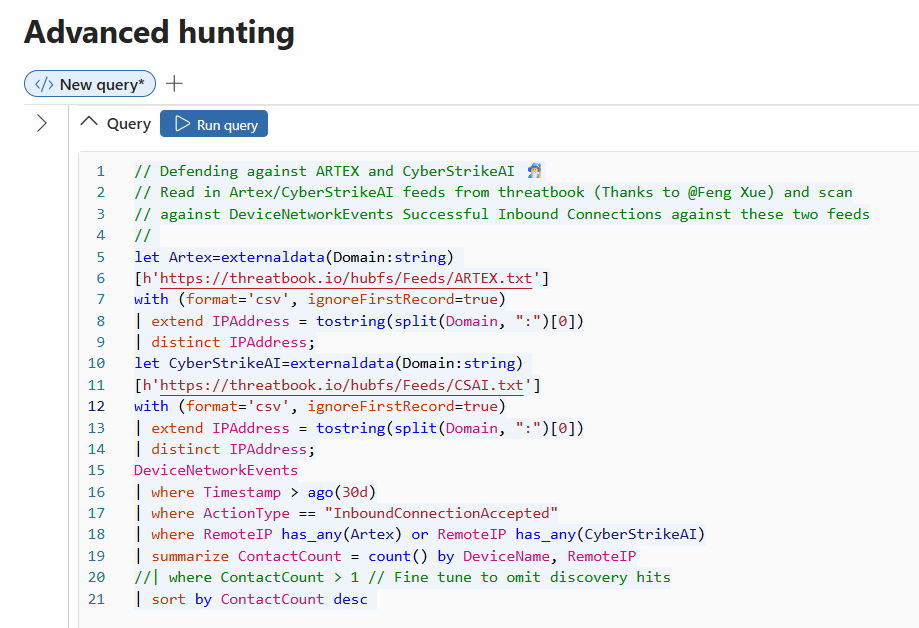
🛡️𝗗𝗲𝗳𝗲𝗻𝗱𝗶𝗻𝗴 𝗮𝗴𝗮𝗶𝗻𝘀𝘁 𝗔𝗥𝗧𝗘𝗫 𝗮𝗻𝗱 𝗖𝘆𝗯𝗲𝗿𝗦𝘁𝗿𝗶𝗸𝗲𝗔𝗜 🧙♂️
This query checks 𝙳𝚎𝚟𝚒𝚌𝚎𝙽𝚎𝚝𝚠𝚘𝚛𝚔𝙴𝚟𝚎𝚗𝚝𝚜 for successful inbound connections from IPs found in the 𝗔𝗥𝗧𝗘𝗫 and 𝗖𝘆𝗯𝗲𝗿𝗦𝘁𝗿𝗶𝗸𝗲𝗔𝗜 threat feeds.
A simple way to bring external threat intelligence into Advanced Hunting and look for potential hits.
KQL Detection:
https://t.co/SiyJTjymIz
Credit to Feng Xue for the ThreatBook feeds. 🙌
#ThreatHunting #KQL #MicrosoftDefender #ThreatIntelligence