@ice_blockchain At least it's nice to hear from you but the #Online+ is not working and nobody can move their coins because it shows zero balance. We all know that, the project is dead but at least the app should be able to allow people to transfer their coins. @ice_z3us@ice_blockchain
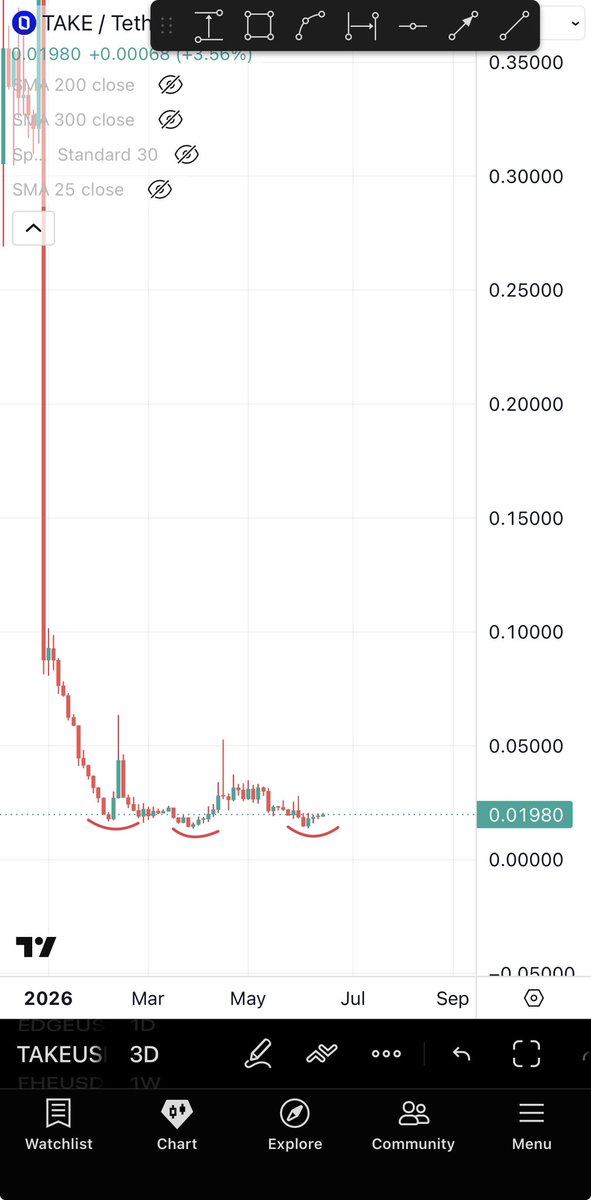
$TAKE x CLO Before pumping 450%.
Hard crash followed by a triple bottom on HTF Support & then the uptrend starts.
I gave you the CLO uptrend. Now am giving you $TAKE.
Adding more $FHE here. It already broke out on HTF & is currently retesting its major resistance as new support.
We saw this happen before last pump that I also called entry for previously.
As $BTC pushes towards 67k$, $FHE is repeating the exact same pattern it did before it exploded 23x last time.
Insane similarities.
Who’s ready to print ?
🚨BREAKING: The first image from the ongoing trial of Dr. Hussam Abu Safiya before Israel’s Supreme Court in occupied Jerusalem reveals a visibly weakened and exhausted man, bearing apparent signs of torture, abuse, and prolonged mistreatment during his detention.
Blonde-haired, blue-eyed white people from Ukraine were celebrated for making home-made Molotov cocktails to defend their land, but the brown Arab Muslim, the Iranian, the Afghan, is far too “uncivilised” to have the right to resist. Their resistance is “barbaric” because it comes from an inherently “violent” culture.
The selective application of international law and one’s right to defend themselves from illegal occupation and colonial violence has been revealed to be a complete contradiction in the west, and is no doubt infuriating.
But we need to also understand how these “resistance” narratives are processed in communities.
These narratives do not stay on our screens. They shape how entire communities see themselves.
When Indigenous, Black, and other racialised peoples repeatedly see their histories, struggles, cultures, and resistance framed as dangerous, irrational, or inherently violent, many begin to internalise those messages.
Some distance themselves from their own identities in search of safety, acceptance, or legitimacy.
Others carry a deep, unspoken rage born from exclusion, dispossession, and the constant demand to prove their humanity.
When people are disconnected from their roots, denied dignity, and taught to be ashamed of where they come from, they will still search for belonging. It’s a basic human need to feel a sense of community.
The question is whether we create spaces that nurture healing, identity, and justice, or leave them vulnerable to finding belonging in places that exploit their pain.