Sorry !
No DM ■
No Porn ><
No Sex ()
No Friends _/÷
Gdy moja żona dowie się że odpowiadam na prywatne wiadomości, zabije mnie na miejscu.
Ciebie też by chciała zabić
Tak już ma.
Ty masz szczęście.
Kilkanaście razy zaryzykowałem rozmowę.
Nie mów nikomu.
Życie jest zbyt cenne.
Hidden inside the chip factory SpaceX confirmed Thursday is a launch schedule. If you divide its 1 terawatt annual compute target by the 100 kilowatts of orbital compute per tonne in SpaceX's own offering materials and you get 10 million tonnes to orbit a year. That exact figure sits on Terafab's official website. At 100 tonnes per Starship V3 flight it means 100,000 launches a year, 274 every day, forever.
The chip target is already a launch target.
Terafab is not a chip factory serving a market. The 16.8 billion dollar first phase in Grimes County, Texas is the first machine in a closed industrial loop built to manufacture the civilisation that can consume its own output.
The official plan places four figures together. One billion Optimus robots. Ten million tonnes to orbit a year. More than one terawatt of solar power. One terawatt of chips a year. They are not four ambitions. They are four links in one recursion. Terafab makes chips. Better chips improve AI. Better AI improves the software running the factories, the robots and the rocket lines. Robots and Starship build and deploy more power and compute infrastructure. That infrastructure creates the socket, and the demand, for the next Terafab cohort.
The fab is meant to manufacture its own reason to exist!
It is also an energy machine. One terawatt running continuously consumes 8.76 petawatt hours a year, nearly twice all electricity generated in the United States in 2025. The factory does not draw that power by making the chips. One fully powered annual cohort does, and a second year adds another terawatt of load unless old hardware retires or utilisation falls. Earth has no spare socket at that scale, which is why the plan points most of it at orbit, where a future 200 tonne vehicle still implies 50,000 launches a year, 137 a day, before failures, reserves, solar arrays, radiators, structure and shielding.
The real product is not AI silicon. If you go real deep, it is a new terawatt of powered, cooled, networked compute sockets every year.
Inside the building, the smaller loop is mask, wafer, package, test, redesign, then another mask. SpaceX says logic, memory and advanced packaging will sit in one closed loop, and Elon says Terafab will technically be two fabs, each devoted to one design. That can compress logistics and organisational latency. It cannot repeal process physics. A new mask can be written quickly. A leading edge process still carries hundreds of steps, long wafer cycle times, defect learning, overlay control, metrology and yield ramps, which is exactly why Tesla is hiring across lithography, etch, deposition, implant, CMP and metrology.
The free electron laser is the most misunderstood part. Elon has endorsed it, and an industrial FEL could feed several EUV scanners with far more source power than today's tin plasma systems. It attacks one bottleneck inside a chain of them. ASML recognised revenue on just 48 EUV systems in all of 2025. Intel is the process partner, and SpaceX still tells investors it expects to source a significant share of compute hardware from outside suppliers. This is vertical integration, not instant independence.
One correction decides the interpretation. A terawatt is a power rating, not an intelligence metric. A wasteful 1 kilowatt chip counts twice as much as an equally capable 500 watt chip. The measures that matter are useful compute per joule, per dollar and per kilogram, with yield, uptime and time from mask change to qualified silicon.
In my opinion, if chips improve faster than robots, rockets, power and radiators can scale, Terafab builds inventory. If the loop closes, it builds something no factory has built before, the demand for itself.
Sabe.. as vezes a gente se vê perdido, sem saída, parece que seremos engolidos pelos problemas. Então eu digo, tenha fé em Deus! Se apegue com Ele com amor e confiança. Ontem eu tive mais uma resposta incrível e eu dou graças pois Deus é maravilhoso e jamais nos abandona.
🌿🌺🌿
🤍🖤🤍
Y decirte...
Bajito y al oído,
Te estoy eligiendo.
Ya no estoy buscando,
Ya te encontré,
Y si no eres tu,
Entonces prefiero el vacío,
Es, o tu o ninguna..."
.
It is as if you are punishing me for leaving you
did you not know that i loved you,you left me
suspended between a wish that wasn't going
to come true & a memory that won't ever fade
I can't reach you & nor can i forget you,have you
ever tried to search for me ?.🖤
“Read books. Travel when you can. Learn how to cook one meal exceptionally well. Sit in old bars and talk to strangers. Wear your best jacket to dinner. Appreciate good wine, good music, and good conversation. Do the right thing, even when no one is watching. Set the example for younger men who are watching you. Call your parents. Take long walks. Leave your phone behind sometimes. Become the kind of man people feel better after being around. Life is short, so live it well.”
-J.B. Lloyd
•
Your Rose Is Becoming Her Own Gardener
She no longer asks when the rain should fall. She buries the clock in soil, letting time along the roots turn into slow sugar.
Those stones that once caused her pain, she now stacks as borders of her bed - not to imprison herself, but to see clearly: all growth is a revolution starting from within.
At night, she counts her roots - each one leads to a tomorrow she has yet to name. She says: I am my own solar term.
•
In May, markets gave America's landmark crypto law an 80% chance of passing. Today they give it 16%, and the collapse traces to one line buried in the 616 page text: an ethics ban on the President that carries, in the bill's own words, "no force and effect on and after noon on January 20th, 2029." Under the Constitution, that is the exact minute this presidency ends.
The Clarity Act was meant to settle the oldest question in crypto, whether a digital asset answers to the SEC or the CFTC, and it has traveled further than any crypto bill in American history. The House passed it 294 to 134 a year ago. A Senate committee advanced it 15 to 9 in May with 2 Democrats crossing over. Yesterday at 5 in the morning, after an all night session, the Majority Leader filed the motion that starts the 60 vote clock, teeing up the first floor test when the Senate returns September 11, with 14 working days before the midterms swallow the calendar.
What froze it is not market structure. It is a problem no Congress has faced before, writing rules for a President who is personally in the market. His own financial disclosures, released in June, show more than 1 billion dollars of crypto income last year. So Republicans drafted an ethics ban, and the President personally signed off on the language. Then everyone read the design. It bars officials from issuing or sponsoring new tokens but expressly lets them keep holding and investing. It hands enforcement to the Justice Department alone, with state attorneys general barred by name. And it expires at that constitutional noon, which critics argue would leave a future Justice Department unable to prosecute anything done while the ban was alive. The sponsor's own fact sheet framed the sunset as proof this is a standard the President chose for himself, not one Congress imposed on him. Seven Democrats rejected it by nightfall. The bill needs exactly seven.
Underneath the deadlock sits a trap almost nobody has run to its end. Every week the statute stalls, crypto's rules get written anyway, by the SEC and CFTC chairs this same White House appointed. The senators blocking the bill to keep a President's crypto interests in check are, with each week of blockade, handing the rulebook to that President's own appointees, with no ethics title attached at all. The blockade is manufacturing the exact outcome it fears. And there is a deeper cost. A statute is a rule any citizen can hold every future government to. An agency rule is a promise that lasts one election. The industry that spent years lobbying for permanent law is drifting toward the most fragile version of clarity there is.
The honest counter is very real. Saturday's filing is the farthest this bill has ever moved. A September deal on enforcement or the sunset could send those odds soaring in a day, 2 Democrats have crossed once already, the ban does extend to spouses, which is a real expansion, and sunset clauses on novel restrictions are ordinary congressional practice. Crypto prices barely moved on the delay, which suggests the market stopped waiting for Congress months ago.
But the shape is hard to unsee. Crypto spent a decade asking Washington one question. Who writes the rules. By deadlocking over whether those rules may bind the man at the top, Washington has delivered the honest answer. Whoever already holds the pen.
Alphabet just reported $112 billion of quarterly profit and negative $5.9 billion of cash. Roughly $99 billion of that profit was unrealized gains on its stakes in Anthropic and SpaceX, per the earnings release.
The AI era's profits are increasingly paper marks on AI equity. The AI era's costs are cash. Same balance sheet, opposite directions.
Now widen the lens, because it happened to all of them in one season.
Alphabet's free cash flow went negative for the first time in its 22 years as a public company, after $44.9 billion of quarterly capex and a guidance raise to $205 billion, its third this year. Amazon flipped negative in the first quarter and analysts expect it to stay there all year. Meta held on by $784 million, down from an $8.5 billion quarter a year ago and a $12 billion average, with costs up 55 percent. And analysts surveyed by FactSet expect Microsoft to go negative in the fourth quarter for the first time since at least 2001.
Reuters, citing LSEG consensus, reports that Microsoft, Alphabet, Amazon, Meta and Oracle are on pace to spend more in capex than they generate in free cash flow by 2027.
For twenty years these were the greatest cash machines ever built. The model was simple. Software scaled for free, cash piled up, buybacks returned it. That model ended this earnings season, and the funding tells you it is not coming back soon. Alphabet bought back zero shares for a second straight quarter and has a $40 billion share offering pending. Meta's CFO says the company is deliberately moving toward a greater mix of debt. Meta and BlackRock are building a $14 billion data center in El Paso where BlackRock funds reportedly own 80 percent. The companies that used to retire equity are now issuing it, borrowing, and selling pieces of their own infrastructure to asset managers.
The treadmill is the reason. Microsoft disclosed in its own earnings materials that about two thirds of its capex goes to short-lived assets, primarily CPUs and GPUs, which will need replacing. Consensus puts hyperscaler capex near $682 billion this year and $878 billion next, more than $1.5 trillion in two years. Railroads depreciated over half a century. Chips depreciate in a handful of years. If Microsoft's ratio holds across the group, roughly a trillion dollars of the two-year plan is replacement-cycle silicon. The spend does not end when the buildout ends. It repeats.
The market has already changed how it grades this. Microsoft beat on Azure, held its capex flat, and opened up 14 percent. Alphabet grew cloud 82 percent with a $514 billion backlog and still fell 7 for the cash burn. Meta, with no cloud revenue attached to its spending yet, dropped as much as 10. Same line item, three verdicts, one rule. Capex with revenue attached gets paid. Capex on faith gets charged. SpaceX trades 18 percent below its June offer price under the same rule.
Watch one number through October. Free cash flow at the top five. The season Microsoft prints red for the first time in a generation is the season the market decides whether AI is an asset or a subscription the shareholders pay.
The cash machines still make money. They just stopped making cash.
🤡 Poland’s current borders are Stalin’s doing. Zakharova throws a tantrum over Nawrocki’s remarks on Russia
The outburst came after the Polish president said Warsaw wants Ukraine to keep Russia as far away from Poland’s borders as possible.
In response, Zakharova launched into a rant about hate speech, Russophobia and the Polish leadership’s “historical complexes.”
She also either reminded Poland — or threatened it — that Russia and Poland share a border and that “there is no Ukraine or Ukrainians between us.”
“Modern Poland within its current borders is the achievement of the ‘Soviets’ they hate and Comrade Stalin personally,” said Russian Foreign Ministry spokeswoman Maria Zakharova.
Vístete de luto Mujer,
Apúrate, tírate encima aquellos viejos trapos negros,
Derrama alguna última ácida lágrima, y vamos
Que hoy estamos de sepelio,
que hoy ha muerto la tristeza.
🖊️Luc.
📷Web
Ya no.
Ya no hay esclavos.
Ahora somos esclavos del desamor.
La vida es una jaula.
Nos negamos volar.
Ser esclavo es no poder
imaginar el cielo.
Escribonia✍️
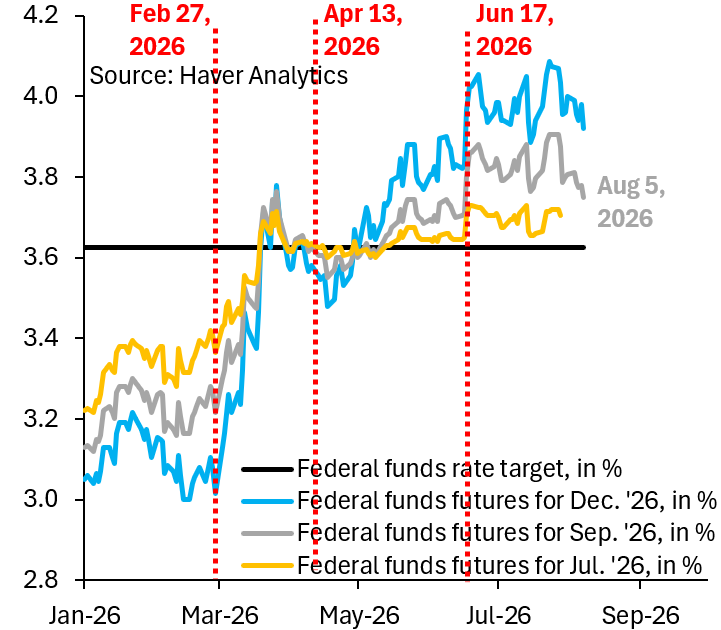
There was never a strong reason for the Fed to hike. All the excitement into the July FOMC was badly misplaced. Just imagine if the Fed had hiked right after very low CPI inflation and with today's weak payrolls. That really would be a credibility crisis.
https://t.co/RoMBTLEjb5