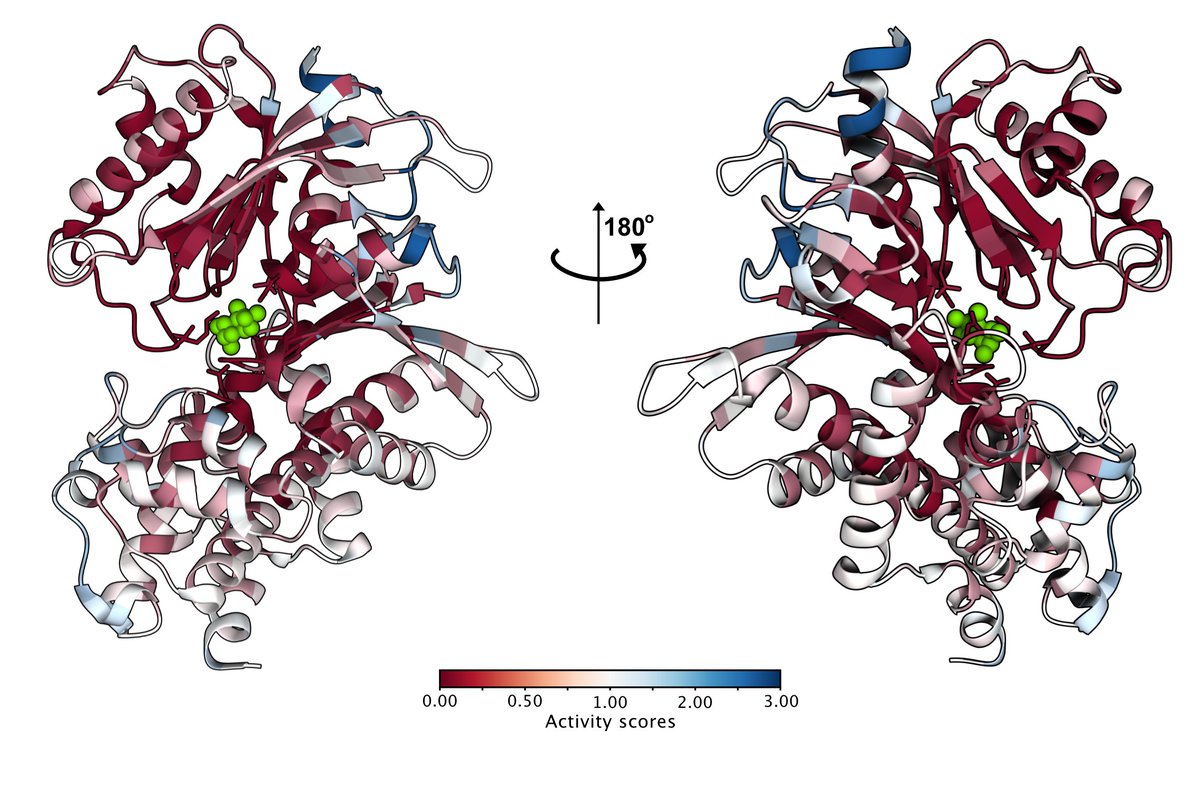
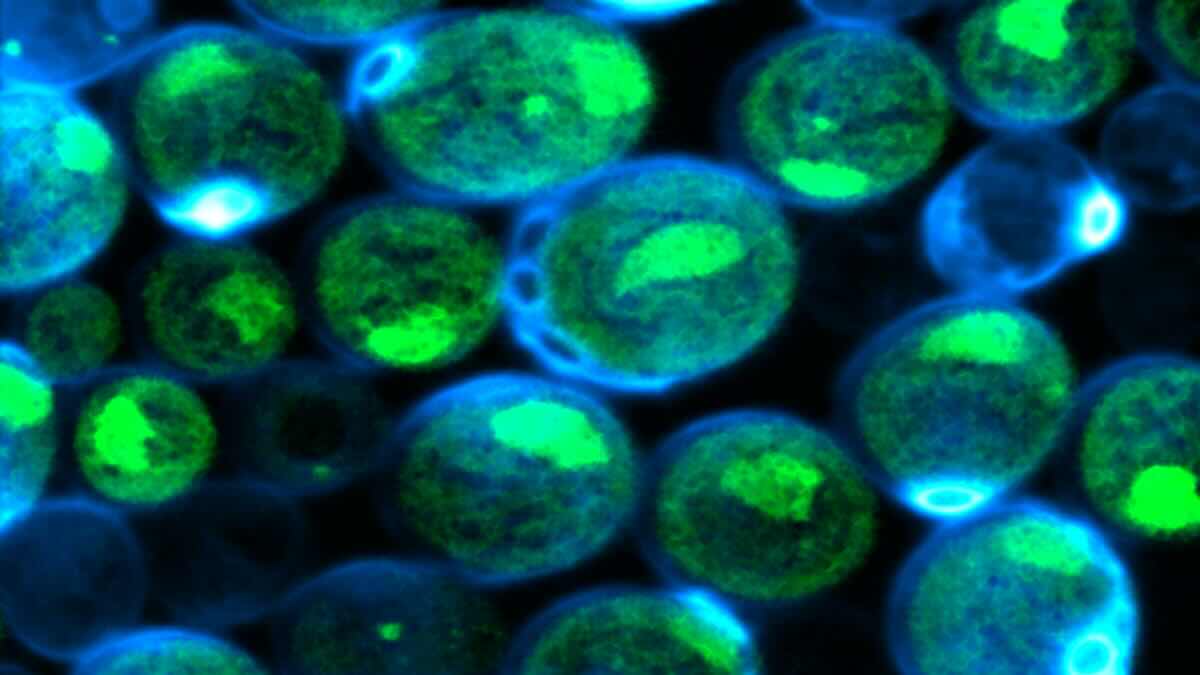
Happy to share our preprint on glucokinase variant activity. Using a yeast complementation assay, we assessed the activity of 97% of all missense and nonsense GCK variants, and find that ~50% of variants decrease activity and ~14% increase activity. 1/4
A multiplexed assay of human glucokinase reveals thousands of potential disease variants with both decreased and increased activity https://t.co/GhkmLzqA72 #bioRxiv
New work led by @s_gersing in @rasmushartmannp lab describes a multiplexed assay for variant effects on protein abundance for glucokinase, that together with her earlier work on GCK activity helps explain mechanisms for GCK gain & loss of function variants
https://t.co/z4G4t9pV8X
In a new preprint we explore the mechanistic basis of why missense variants in GCK cause loss of function and GCK maturity-onset diabetes of the young
Work led by @s_gersing in @rasmushartmannp lab & w @TKSchulze, @CagiadaMatteo, @_amelie_rocks & @FPRoth
https://t.co/Qxcy7gNbrE
New research from @s_gersing @rasmushartmannp @LindorffLarsen @FPRoth & co. providing a comprehensive map of human glucokinase variant activity, thereby facilitating variant interpretation & diagnosis & informing development of GCK-targeted therapeutics
https://t.co/VlijFUzc6X
@ArthurZalevsky GCK is quite special in that way, as it is finely tuned to maintain appropriate blood glucose levels. Activating mutations are therefore also pathogenic.
Happy to share our preprint on glucokinase variant activity. Using a yeast complementation assay, we assessed the activity of 97% of all missense and nonsense GCK variants, and find that ~50% of variants decrease activity and ~14% increase activity. 1/4
A multiplexed assay of human glucokinase reveals thousands of potential disease variants with both decreased and increased activity https://t.co/GhkmLzqA72 #bioRxiv
Our work may aid in interpreting variants to diagnose GCK-MODY and refining drugs targeting GCK through an increased understanding of the allosteric activator site. 3/4
Excited that our paper on ASPA C152W is finally out in @PLOSGenetics! This project was a great learning experience for me - looking forward to learning a lot more!
Our paper on mapping the degradation pathway of a disease-linked variant in aspartoacylase is now out in @PLOSGenetics 🎉 The work was led by @s_gersing in Rasmus Hartmann-Petersen's lab https://t.co/pJoWoiZwef 1/n
New preprint on the chaperone-mediated proteasomal degradation of a Canavan’s disease-linked variant of aspartoacylase (ASPA). Work lead by @s_gersing from Rasmus Hartmann-Petersen’s lab, and also with other members of our @novonordiskfond funded #PRISM centre. Comments welcomed.