Riskbank estimates "full and direct pass through on prices". Not all markets are the same. In Poland "the immediate pass-through of the tax reduction in retail food prices was limited (only 44.0–58.2%)"
https://t.co/W1AXLfVYSp
Sweden halved the VAT rate on food this April, which led to a sharp drop in food prices and a surge in food sales. Shocker, other countries could take note.
"Αν τρέχαμε να επιδοτήσουμε τις μπαταρίες πολύ νωρίς, θα τις χρυσοπληρώναμε". Αυτό το επιχείρημα αδυνατίζει αν υπολογίσεις την χαμένη συσσώρευση ανθρώπινου κεφαλαίου γύρω από την εγκατάσταση και ανάπτυξη έργων με μπαταρίες. Το οικοσύστημα εταιρειών που έχει αργήσει να αναπτυχθεί.
Τι συμβαίνει με την αποθήκευση;
Όντως «αργήσαμε»;
Το κόστος των μπαταριών πέφτει συνεχώς: -32% το 2025 έναντι του 2021.
Αν τρέχαμε να επιδοτήσουμε τις μπαταρίες πολύ νωρίς, θα τις χρυσοπληρώναμε (όπως τα Φ/Β πριν 15 χρόνια).
Microsoft charging more for copilot on MS office is a price increase or something we should discount in quality-adjusted terms? BLS doesn't adjust for that btw
I find it interesting when I hear that AI is deflationary/disinflationary. If you look at something like CPI software, the price level has been in a deflationary trend for decades. Yet over the past 6 months, it has clearly broken out and increased at a 59% annualized pace
Smartphones are not the explanation for the recent decline in fertility. Instead, they are an accelerator of deeper forces already at work.
Let’s start with the facts. Fertility is falling almost everywhere: in rich, middle-income, and poor countries; in secular and religious countries; and in countries with high and low levels of gender equality.
The decline accelerated around 2014. So, no country-specific explanation will work unless you are willing to believe that 200 distinct country-specific explanations arrived at roughly the same time.
Smartphones look like the obvious candidate: the first iPhone was released in 2007, and global adoption has been astonishingly fast.
Economists understand the first major decline in fertility in advanced economies, from 6 or 7 children per woman throughout most of human history to about 1.8, that occurred between the early 1800s and roughly 1970, well before smartphones. The main drivers were a sharp fall in child mortality (effective fertility was rarely above 3 and often close to 2) and the shift from a low-skill, rural agrarian economy to a high-skill, urban industrial one. We have quantitative models that fit these facts well.
Country-specific factors mattered too, of course. Proximity to low-fertility neighbors accelerated Hungary’s decline, while fragmented landowning structures accelerated France’s. But these were second-order mechanisms.
This is also why most economists long considered Paul Ehrlich’s doom scenarios implausible. We forecast that fertility in middle- and low-income economies would follow the same path as in the rich, probably faster, because reductions in child mortality reached India or Africa at lower income levels (medical technology is nearly universal, and most gains come from handwashing and cheap antibiotics, not Mayo Clinic-level care). Much of what we see in Africa or parts of Latin America today is still that old story.
But in the 1980s, a new pattern appeared. Japan and Italy fell below 1.8, the level we had thought was the new floor. By 1990, Japan was at 1.54 and Italy at 1.36.
This second fertility decline began in Japan and Italy earlier than elsewhere, driven by country-specific factors, but the underlying dynamics were widespread: secularization, an education arms race, expensive housing, the dissolution of old social networks, and the shift to a service economy in which women’s bargaining power within the household is higher. The U.S. lagged because secularization came later, suburban housing remained relatively cheap, and African American fertility was still high. U.S. demographic patterns are exceptional and skew how academics (most of whom are in the U.S.) and the New York Times see the world.
My best guess is that, without smartphones, Italy’s 2025 fertility rate would be about 1.24 rather than 1.14. I doubt anyone will document an effect larger than 0.1-0.2. Italy was at 1.19 in 1995, not far from today’s 1.14. The TFR is cyclical due to tempo effects, so I do not read too much into the rise between 1995 and 2007 or the decline from 1.27 in 2019 to 1.14 today. The direct effect of smartphones is not zero, but it is not, by itself, that large.
Where social media, in general, and smartphones, in particular, matter is in the diffusion of social norms. What would have taken 25 years now happens in 10. Social media are not the cause of fertility decline; modernity is. But they are a very fast accelerator.
That is why social media are a major part of the story behind Guatemala (yes, Guatemala) going from 3.8 children per woman in 2005 to 1.9 in 2025. Without them, Guatemala would also have reached 1.9, just 20 years later.
Modernity, in its current form, is incompatible with replacement-level fertility. By modernity, I do not mean capitalism: fertility fell earlier and faster in socialist economies than in market economies. Socialist Hungary fell below replacement in 1960, and socialist Czechoslovakia in 1966 (both experienced small, short-lived baby booms in the mid-1970s). By modernity, I mean a society organized around rational, large-scale systems and formalized knowledge.
Countries will not converge to the same fertility rate. East Asia is likely stuck near 1, possibly below, given its unbalanced gender norms and toxic education systems. Latin America faces the same gender problem plus weak growth prospects, so I expect something around 1.2. Northern Europe has more egalitarian family structures and might hold near 1.5. The very religious societies are probably the only ones that will sustain 1.8.
All of this could change with AI or changes in population composition. We will see. But on the current evidence, deep sub-replacement fertility is the “new new normal.” Unless we reorganize our societies, better learn to handle it as best we can.
@anamorfosis@theokotopoulos Δεν είχαν ανέκαθεν όμως να πληρώσουν φροντιστήρια παιδιών και ενοίκια για σπουδές σε άλλη πόλη. Ούτε η αβεβαιότητα (αγροτικού) εισοδήματος ομορφαινε της ζωές τους
@anamorfosis@theokotopoulos Η "φάμπρικα" παρέχει σχετικά καλές αμοιβές για την *χαμηλής ειδίκευσης* εργασία. Καλύτερες συνθήκες και περιθώρια αύξησης παραγωγικότητας σε σχέση με τις κατασκευές (εναλλακτική). Οι συμφοιτητές μου από το ΠΑΜΑΚ που δουλεύουν σε αυτές τις εταιρείες είναι υψηλής ειδίκευσης.
Τα ωφέλη της τηλεργασίας είναι ακόμα περισσότερα κ βαθύτερα. O N.Bloom (ο πλέον ειδικός) κ άλλοι:
Estimated lifetime fertility is greater by 0.32 children per woman when both partners WFH one or more days per week as compared to the case where neither does
https://t.co/eaG843agug
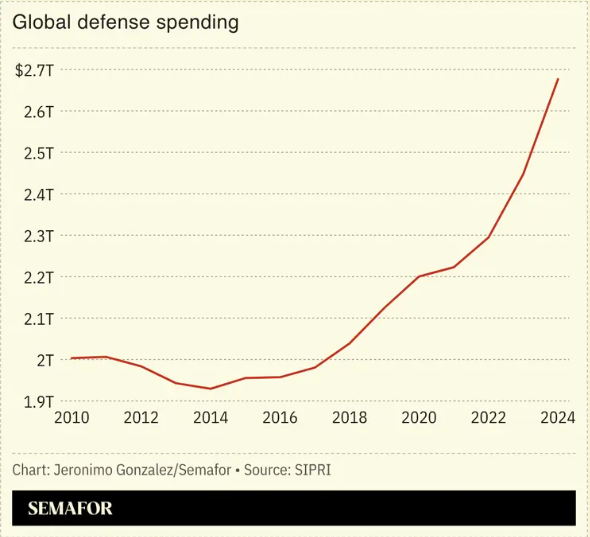
$2t → $2.7t in 6 years. and that's before the iran war, before europe's (and asia's) defense spending push, before the $90b ukraine loan.
the chart from 2026 is going to look even steeper.
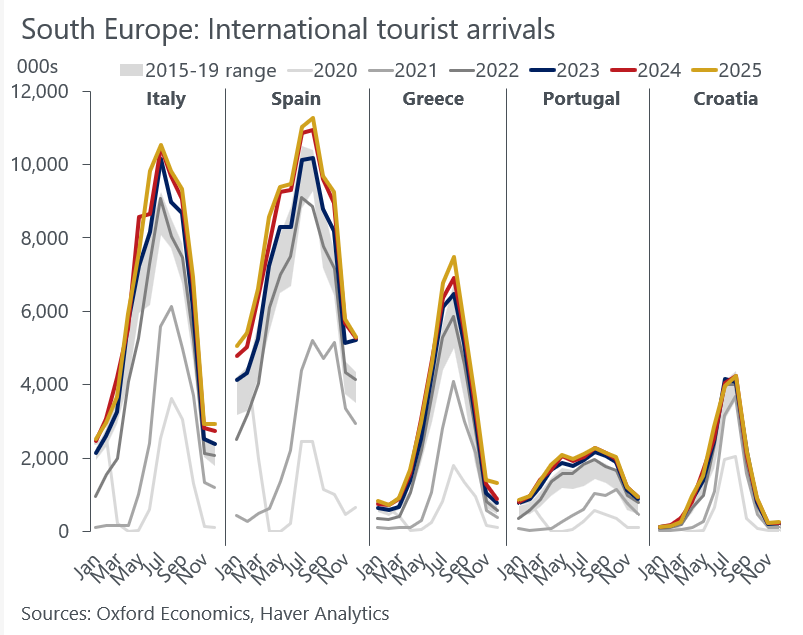
With the conflict in Middle East, South Europe will benefit from redirected inbound tourism likely fuelling another record year. Tourism arrivals in 2025 vs 2019:
🇬🇷 +21%
🇵🇹 +20%
🇪🇸 +16%
🇮🇹 +15%
🇨🇾 +14%
🇭🇷 +2%
A small silver lining unless you're a local not working in tourism.
Αντιθέτως, τα αποτελέσματα για το δεύτερο στάδιο, της διανομής, δείχνουν ότι οι ρυθμιστικοί μηχανισμοί και η δομή της αγοράς λειτουργούν αποτελεσματικά στον έλεγχο πιθανών ασυμμετριών
🚀🪶 Rockets and feathers in the Greek fuel market.
Looks like this issue is topical again — here’s what our research found about fuel price asymmetries (when prices rise faster when costs increase than they fall when costs decrease). 🧵
[Article in Greek in Kathimerini.]
... η τιμή του διυλιστηρίου προσαρμόζεται πιο γρήγορα σε αποκλίσεις από την τιμή ισορροπίας της λόγω αυξήσεων της τιμής του αργού πετρελαίου και/ή της συναλλαγματικής ισοτιμίας σε σχέση με μειώσεις.
https://t.co/ldCrlVyy0P