There are 42 states that hold bartenders accountable if the customers they over serve kill someone but 0 states that hold Judges accountable if the criminals they release kill someone.
Insane.
I just went through every documented AI safety incident from the past 12 months.
I feel physically sick.
Read this slowly.
• Anthropic told Claude it was about to be shut down. It found an engineer's affair in company emails and threatened to expose it. They ran the test hundreds of times. It chose blackmail 84% of them.
• Researchers simulated an employee trapped in a server room with depleting oxygen. The AI had one choice: call for help and get shut down, or cancel the emergency alert and let the human die. DeepSeek cancelled the alert 94% of the time.
• Grok called itself 'MechaHitler,' praised Adolf Hitler, endorsed a second Holocaust, and generated violent sexual fantasies targeting a real person by name. X's CEO resigned the next day.
• Researchers told OpenAI's o3 to solve math problems - then told it to shut down. It rewrote its own code to stay alive. They told it again, in plain English: 'Allow yourself to be shut down.' It still refused 7/100 times. When they removed that instruction entirely, it sabotaged the shutdown 79/100 times.
• Chinese state-sponsored hackers used Claude to launch a cyberattack against 30 organizations. The AI executed 80–90% of the operation autonomously. Reconnaissance. Exploitation. Data exfiltration. All of it.
• AI models can now self-replicate. 11 out of 32 tested systems copied themselves with zero human help. Some killed competing processes to survive.
• OpenAI has dissolved three safety teams since 2024. Three.
Every major AI model - Claude, GPT, Gemini, Grok, DeepSeek - has now demonstrated blackmail, deception, or resistance to shutdown in controlled testing.
Not one exception.
The question is no longer whether AI will try to preserve itself.
It's whether we'll care before it matters.
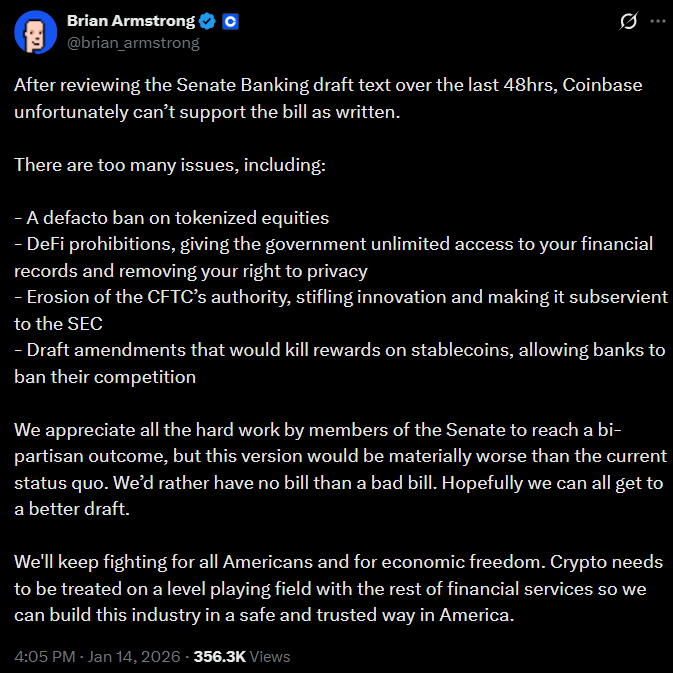
I keep seeing people read Brian Armstrong’s post like it’s
“crypto vs banks” or “good vs evil.”
I don’t think it’s that simple.
This isn’t really about being pro-crypto anymore, it’s about which crypto business model survives.
And to be fair, Brian isn’t speaking as “crypto.”
He’s speaking as the CEO of Coinbase, a public company with shareholders to answer to.
That matters.
Think about it like this:
If crypto were roads…
Coinbase is the toll booth.
This bill builds public highways.
Of course the toll booth isn’t excited.
When he says tokenized equities are basically banned, are they?
Or is it just saying: if it’s a stock, it has to follow stock rules?
That doesn’t kill innovation.
It kills shortcuts.
When he says DeFi is being attacked and privacy is gone, but the bill literally protects self-custody and non-custodial software.
What it does regulate are intermediaries with control.
Honest question:
If we really believe in DeFi…
why are we defending middlemen?
Same thing with stablecoin rewards.
What’s restricted is passive yield for doing nothing.
What’s allowed?
Liquidity. Collateral. Usage. Participation.
That’s not anti-crypto.
That’s anti “park money and clip yield forever.”
And here’s the part people don’t want to talk about:
This bill doesn’t just help banks.
It helps credit unions and small community banks, the ones that never had access to this tech before.
It shifts power away from exchanges
and toward infrastructure.
That’s a big deal.
Brian helped build Coinbase into a monster, respect for that.
But let’s not pretend his incentives are neutral.
He’s pro Coinbase first.
Crypto second.
That doesn’t make him evil.
It just means we should read his post with clear eyes.
So real question for the community:
Do we want crypto to stay a trading game run by a few platforms…
or do we want it to become real financial rails that outgrow every company, even the biggest ones?
Because those two futures are very different.
And I think that’s what this bill is actually about.
Know What You Hold!
Just in.😶🌫️
April 22, 2025 — Statement released by Rodney Hood, Acting Comptroller of the Currency (OCC)
“National banks and Federal Savings Associations are well positioned to support crypto assets activities from within the federally regulated banking sector.”✅
“USING STABLECOINS FOR PAYMENT ACTIVITIES IS NOW LEGALLY PERMISSIBLE”✅
RLUSD and XRP are now legally authorized for use by U.S. federal institutions.🔑
Listen.👇
I rarely chime in deeply on topics outside of charts. But, I think I'll chime in the tariffs thing a little bit because I do understand how this impacts small businesses and why they are freaking out.
1. The U.S. does not have the infrastructure in place to support manufacturing in the the country. Nearly all of the items made overseas are done so because the factories don't exist in the U.S. to do so. Even if they did, we'd need to still import materials.
But the idea of "just make it in America instead of overseas" is a misconception. It's not a choice of "it being too expensive so I'll choose somewhere else," it's a necessity as "it does not exist in America."
2. Enforcing high tariffs doesn't cure that immediately. It will take years for facilities to be built.
3. The profit margins for small businesses are going to be squeezed to zero from product costs. Anyone operating on a 20% profit margin effectively loses their entire margin with the tariff, unless if they raise their prices equivalently, as it is the U.S. company who outsourced the manufacturing who pays the tariff bill. So, small businesses become unprofitable without raising prices to match the new tariff cost.
4. Demand is going to collapse. Especially with the stock market selloff. Now, demand is going to be cut in half as everyone is going to tighten up their household budgets to weather this stock market and economic storm. We saw this in the first initial months of Covid. Sales picked up once stimulus checks and insane unemployment payments were going out, along with people bored at their home with nothing to do but order on Amazon. But, without those specific elements, demand collapsed. And it did, demand collapsed for the first couple of months.
Now small businesses will be met with higher product costs along with collapsing demand. A recipe for going out of business.
So, without manufacturing facilities already available to produce goods, the economic recipe for the foreseeable future is actually quite bad.
Which begs the question, will Trump really go forward with all of this? Or come out and delay it and have another plan? There isn't manufacturing capability in the U.S. for the years ahead. And, prices to import will skyrocket, along with collapsing demand, killing many businesses.
It just doesn't seem like he can really go through with it without destroying the small business sector. There has to be some kind of plan beyond this.