I am happy to share my first publication from my PhD research—a work born from a deep commitment to voice the unspoken, in Journal of Educational Administration and History @JEAH_editor @tandfonline @GradSchoolUofA #WomenInEdLeadership
Free download from https://t.co/JgcW3G6wm6
In the first post of my new blog thread, Politics of Becoming, I reflect on how a CV can appear to be a neutral record of achievement while concealing the negotiations, sacrifices, interruptions, and gendered constraints behind each line.
https://t.co/aE6HKxWVqV
Pakistan’s role in freedom struggle of Morocco 🇲🇦
In 1952 when Morocco was under French rule and they were fighting for their independence, Sultan Mohammed V of Morocco sent Ahmed Balafrej to US to address UN Security Council.
However, French delegates did not allow him to speak saying that because Morocco was a French protectorate therefore, Ahmed Bulferg being subject of France can’t speak at the UN forum.
At this humiliation of Ahmed Balafrej by the French, Pakistan’s Foreign Minister Zafar Ullah Khan immediately got Pakistani embassy at New York opened at night and offered Ahmed Balafrej Pakistani nationality and issued him Pakistani Passport, due which on the next day he was able to address the UN Security council as Pakistani citizen in favour of Morocco. This gave great boost to the Moroccan independence movement internationally and back at home.
Finally when Morocco became independent in 1956, the Sultan Mohammed appointed Ahmed Balafrej as Prime Minister of Morocco and he used to hang his framed Pakistani Passport in his office and used to proudly tell all the visitors the role that passport played in the independence of Morocco.
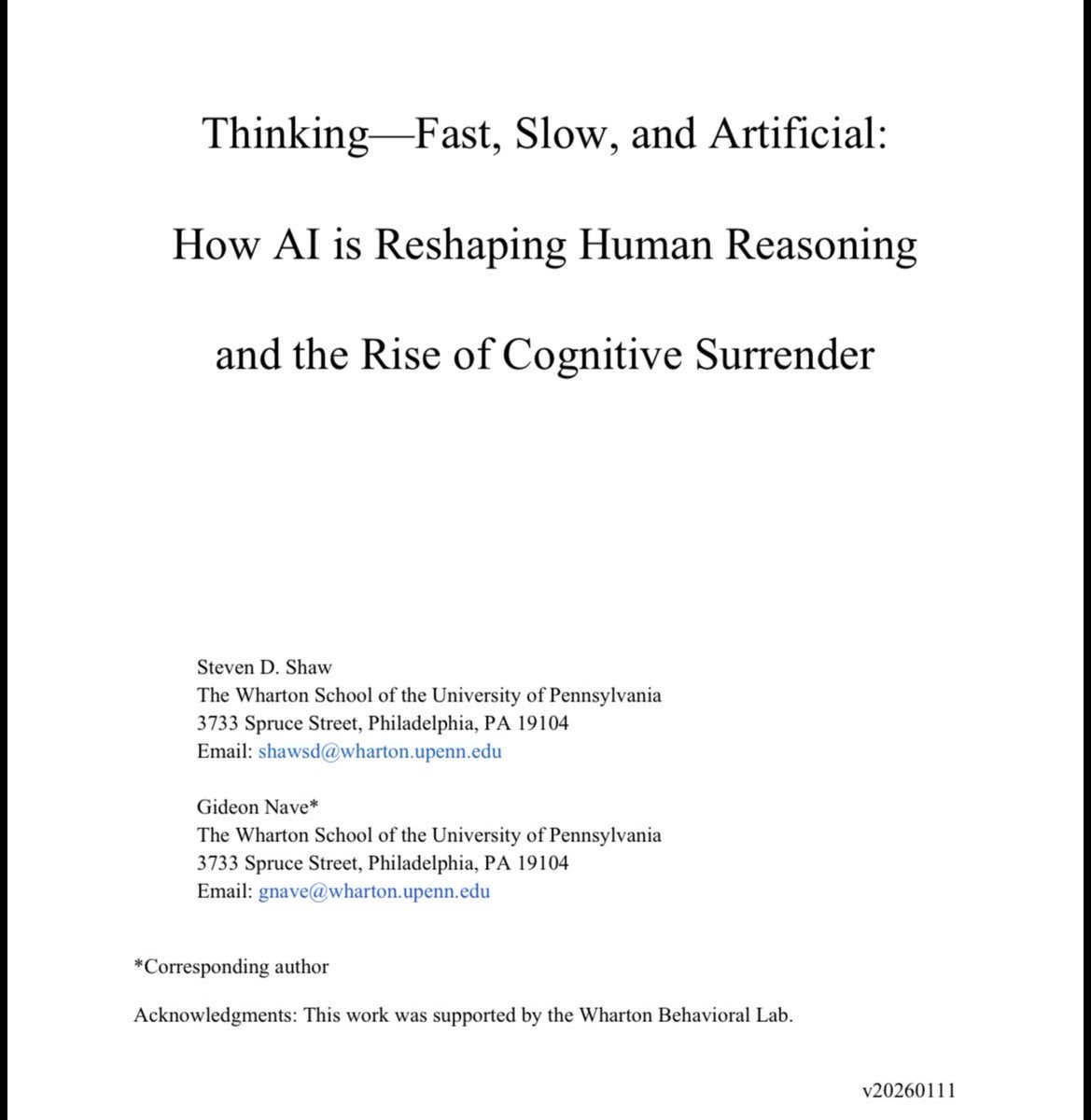
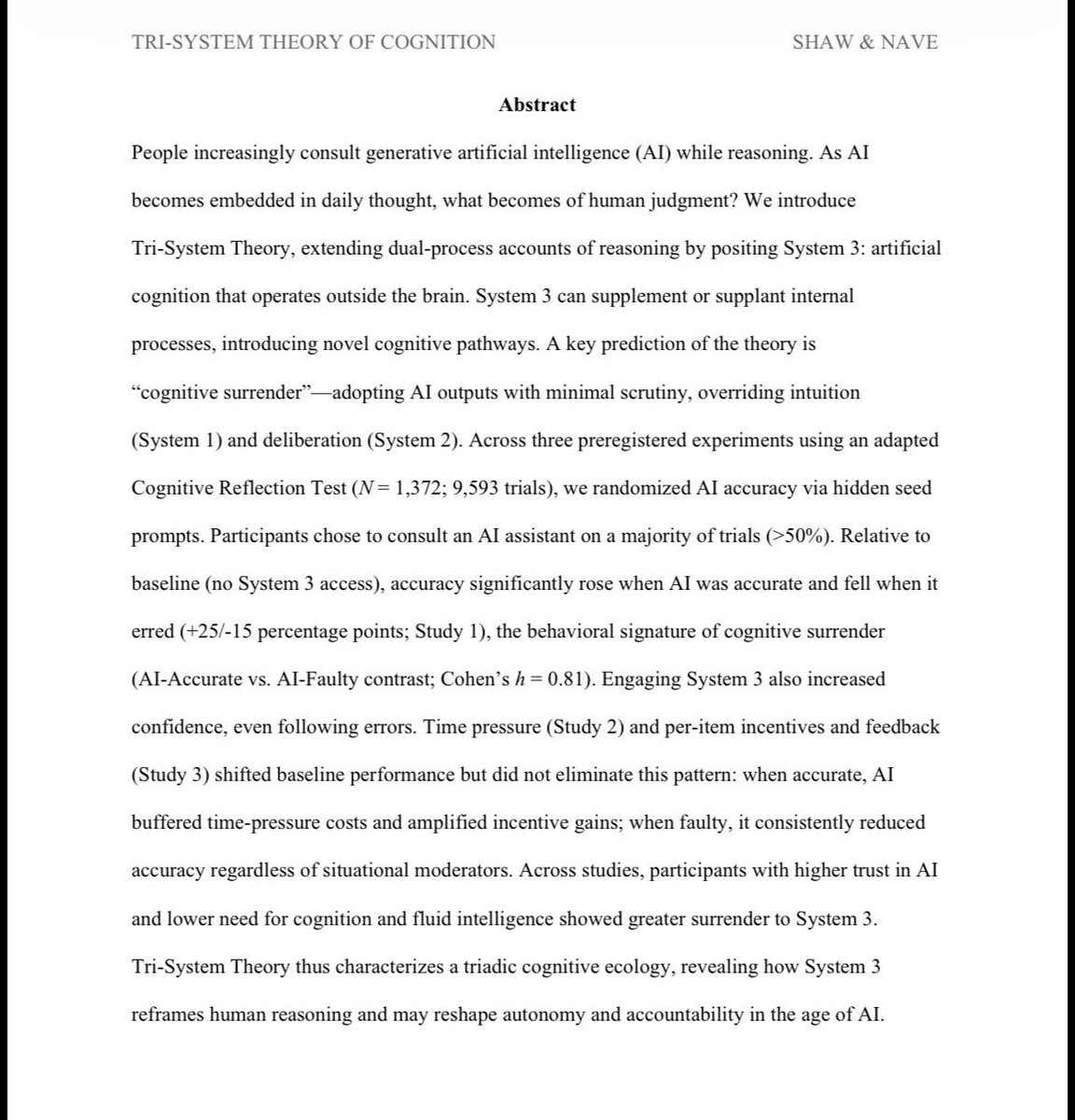
“Cognitive Surrender” - a new study argues that use of AI leads to suspension of human reasoning, not its augmentation. The implication being that over time people will lose their reasoning ability & use AI as its substitute. Download the paper for free here, excerpts & reference below:
https://t.co/ZlWbD0b6CJ
——-
“As people increasingly integrate AI into their decision-making processes, they interact and engage with a cognitive system that can reshape the functions of both intuition and deliberation. For example, System 3 can replace System 1 by offering confident, ready-made answers that preempt the need for intuitive reasoning.” (page 15 of pdf)
“As AI systems increasingly participate in human cognition, a new phenomenon emerges that cannot be explained by traditional concepts such as cognitive offloading or automation bias alone. We define cognitive surrender as the behavioral and motivational tendency to defer judgment, effort, and responsibility to System 3’s output, particularly when that output is delivered fluently, confidently, or with minimal friction. Unlike cognitive offloading, which is typically strategic and task-specific (e.g., using GPS to navigate), cognitive surrender entails a deeper transfer of agency.” (Page 17)
“Access to System 3 outputs significantly influenced accuracy, increasing correct answers when AI was correct, and decreasing accuracy when incorrect. Access to System 3 made decision-makers more confident, despite approximately half of System 3 outputs being incorrect. Finally, users who trust AI more and have lower NFC and fluid IQ were more likely to display cognitive surrender. Whether System 3 was accurate or faulty, its presence displaced internal reasoning.” (Page 27)
“Cognitive surrender was robust across studies.” (Page 42)
“Across our studies, we observe that when System 3 was available, people readily engaged it and frequently adopted its answers. This shift reflects a reallocation of cognitive control rather than mere effort saving. System 3’s fluent, confident outputs are treated as epistemically authoritative, lowering the threshold for scrutiny and attenuating the metacognitive signals that would ordinarily route a response to deliberation. In the case of cognitive surrender, there is a shift in the locus of control, with an external system (System 3) occupying the default position.” (Page 45)
“Time constraints clarify why surrender arises so readily, while incentives and feedback show that surrender is malleable. When decision time is scarce, the internal monitor detecting conflict and recruiting deliberation is less likely to trigger. Hence, the low-friction path to defer to external cognition becomes attractive.” (Page 46)
“Tri-System Theory is not a warning about AI’s dangers but a recognition of System 3’s psychological presence. We do not merely use AI; we think with it. In doing so, we must ask new questions: What happens when our judgments are shaped by minds not our own? What becomes of intuition and effort when a generative, artificial partner stands ready to answer? How do we preserve agency, reflection, and autonomy in a world where users engage in cognitive surrender?”
"Prisoner number 804: the plot to erase Imran Khan
It’s one thing to remove a PM from office, as happened to the former cricketer in 2022. But it’s another thing to try to eradicate the most famous person in Pakistan’s history"
https://t.co/4CmJDhUOwp
Eid Mubarak, Imran Khan. May God reward you for every hardship you’ve endured for Pakistan and for your faith.
May you remain steadfast and strong like the towering K2.
May justice, dignity, and peace prevail.
With respect and solidarity.
#EidMubarak#EidBlessings#Eid2026
غربت برسوں سے پاکستان کو نگل رہی ہے، میں کیا عید مناؤں؟
غزہ میں خون بہہ رہا، فلسطین چیخ رہا، میں کیا عید مناؤں؟
ایران، لبنان جل رہے، ظلم کی آگ بھڑک رہی ہے،
مسلمان آپس میں دست و گریباں، امت متذلذل میں کیا عید مناؤں؟
عمران خان تین سال سے مقیدِ قفس ہے، پابندِ زنداں،
دل ٹوٹتا ہے دیکھ کر، پھر بھی یہ عید آ گئی،
امت مسلم کی ہر انکھ پر نم ہے، میں کیا عید۔مناؤں؟
مگر حکم خداوند رحمان و رحیم و اکبر ہے
میرے نبی ﷺ کی سنتِ صبر، شُکر اور امید ہے
اس دعا کے ساتھ:
اللہ امت کو اتحاد دے، مظلوموں کو نصرت دے،
پاکستان کو خوشحالی دے،
ظالموں کو نیست و نابود کرے
قیدیوں کو آزادی نصیب ہو
کل عام و انتم بخیر
عید مبرک
𝗚𝗿𝗲𝗲𝘁𝗶𝗻𝗴𝘀 𝘁𝗼 𝗜𝗺𝗿𝗮𝗻 𝗞𝗵𝗮𝗻 𝗶𝗻 𝗵𝗶𝘀 𝘂𝗻𝗷𝘂𝘀𝘁 𝗶𝗺𝗽𝗿𝗶𝘀𝗼𝗻𝗺𝗲𝗻𝘁, 𝗮𝗻𝗱 𝗵𝗲𝗮𝗿𝘁𝗳𝗲𝗹𝘁 𝗴𝗿𝗮𝘁𝗶𝘁𝘂𝗱𝗲 𝗳𝗼𝗿 𝗵𝗶𝘀 𝗎𝗻𝗶𝗾𝗎𝗲 & 𝗽𝗶𝘃𝗼𝘁𝗮𝗹 𝗿𝗼𝗹𝗲 𝗶𝗻 𝘁𝗵𝗲 𝗳𝗶𝗴𝗵𝘁 𝗮𝗴𝗮𝗶𝗻𝘀𝘁 𝗜𝘀𝗹𝗮𝗺𝗼𝗽𝗵𝗼𝗯𝗶𝗮.
I asked ChatGPT this: 'Do you remember the role of former Pakistani PM Imran Khan in getting March 15 recognized as a UN annual day to combat Islamophobia?' Here's his answer:
Yes, Imran Khan, the former Prime Minister of Pakistan, played a pivotal role in the initiative that led to March 15 being designated as the UN's annual day to combat Islamophobia.
In 2020, Imran Khan's government strongly advocated for the recognition of Islamophobia as a global issue. He took the lead in calling for the establishment of an annual day to raise awareness and combat the growing problem of Islamophobia, particularly in the wake of increasing hate crimes and discrimination faced by Muslims worldwide.
Pakistan, under Khan’s leadership, pushed for a United Nations resolution calling for March 15 to be observed as an annual day to address Islamophobia. The UN General Assembly officially adopted the resolution in 2022, designating March 15 as the day to combat Islamophobia. The resolution sought to promote tolerance, understanding, and respect for religious diversity, emphasizing the need to counteract hate speech and discrimination targeted at Muslims.
Imran Khan’s efforts were significant in bringing international attention to the challenges that Muslims face due to prejudice and discrimination, and his campaign helped to highlight the issue at the highest diplomatic levels.
This initiative was part of Khan's broader efforts to advocate for Muslim communities globally, especially in the context of growing anti-Muslim sentiment, especially in Western countries.
My new blog on the Politics of Gender, which I started on International Women’s Day, aims to reflect on gendered life at the margins:
https://t.co/MTz4NSSEuo
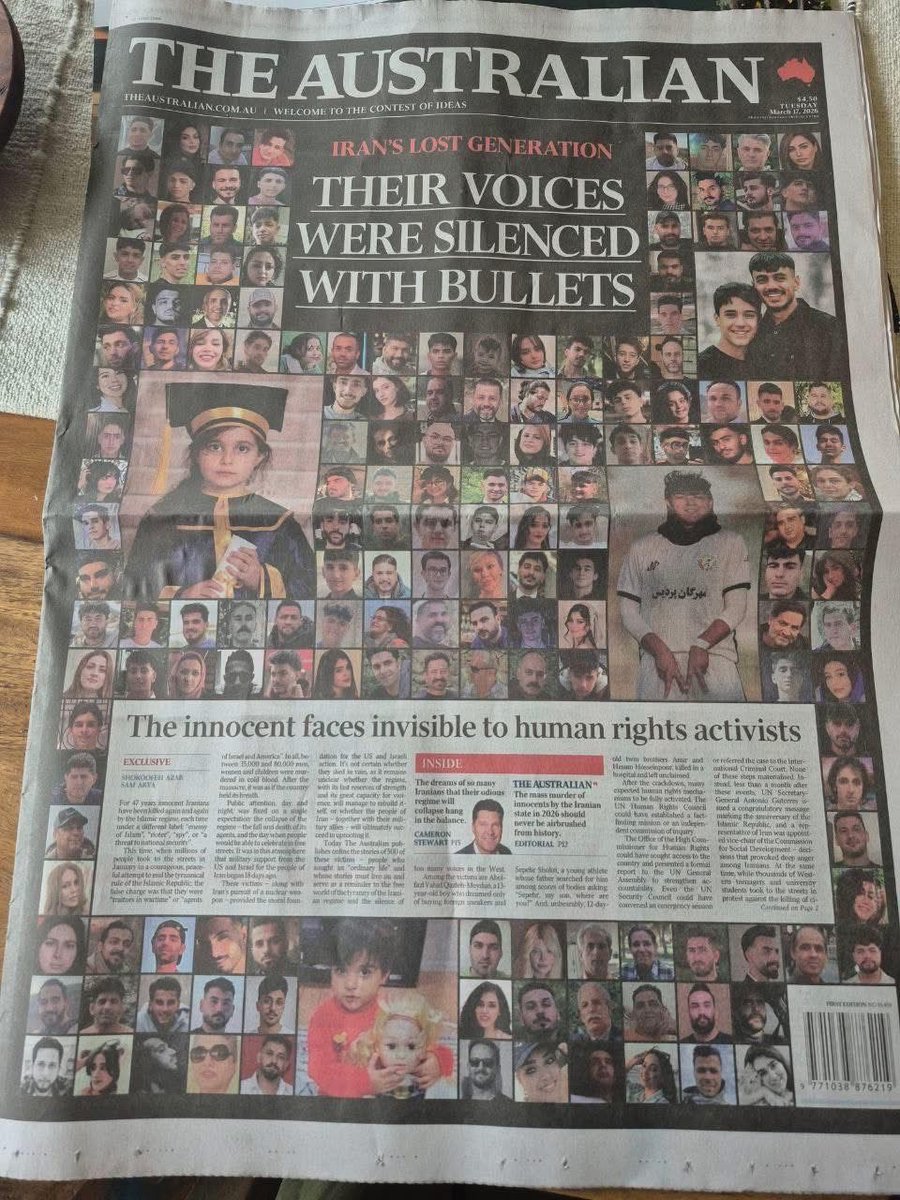
🇵🇰 Pakistan: Investigation urgently needed after killings during Iran protests
“The killing of protesters and reports of the use of lethal ammunition by security forces against these assemblies raise serious concerns about unlawful use of force. Protesters have a right to gather peacefully and express dissent, even in moments of heightened tension. During such crises, security forces must demonstrate their commitment to protecting life and safeguarding peaceful assembly.”
READ MORE: https://t.co/8dmtVr0QOk
It is so unfortunate to see how @ImranKhanPTI is being treated by his own people. A man who literally gave up everything for the betterment of his people cannot even meet his family or his doctors & lawyers. I have no words to express how disappointed I am at the whole set up in Pakistan that works against IK.
#FreeImranKhan
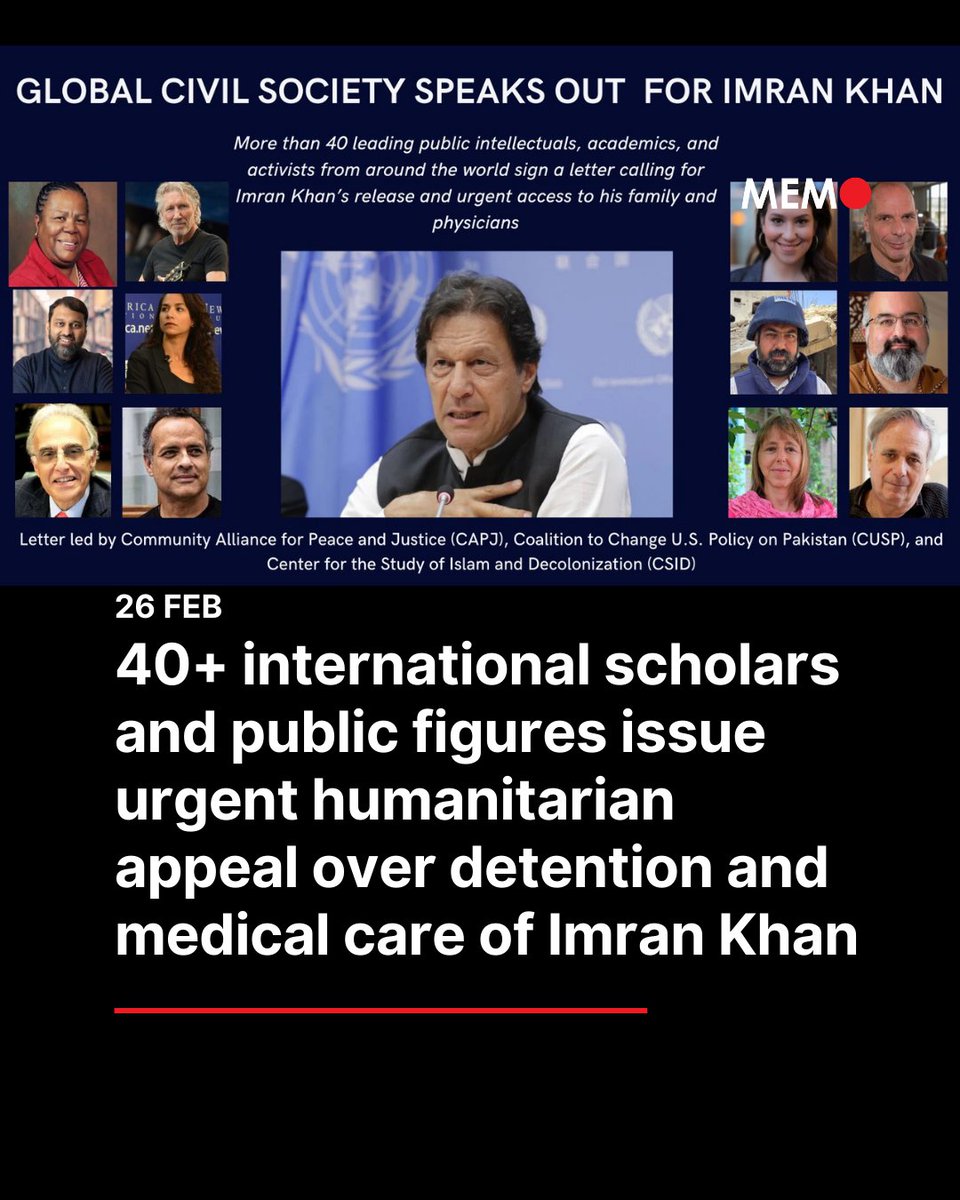
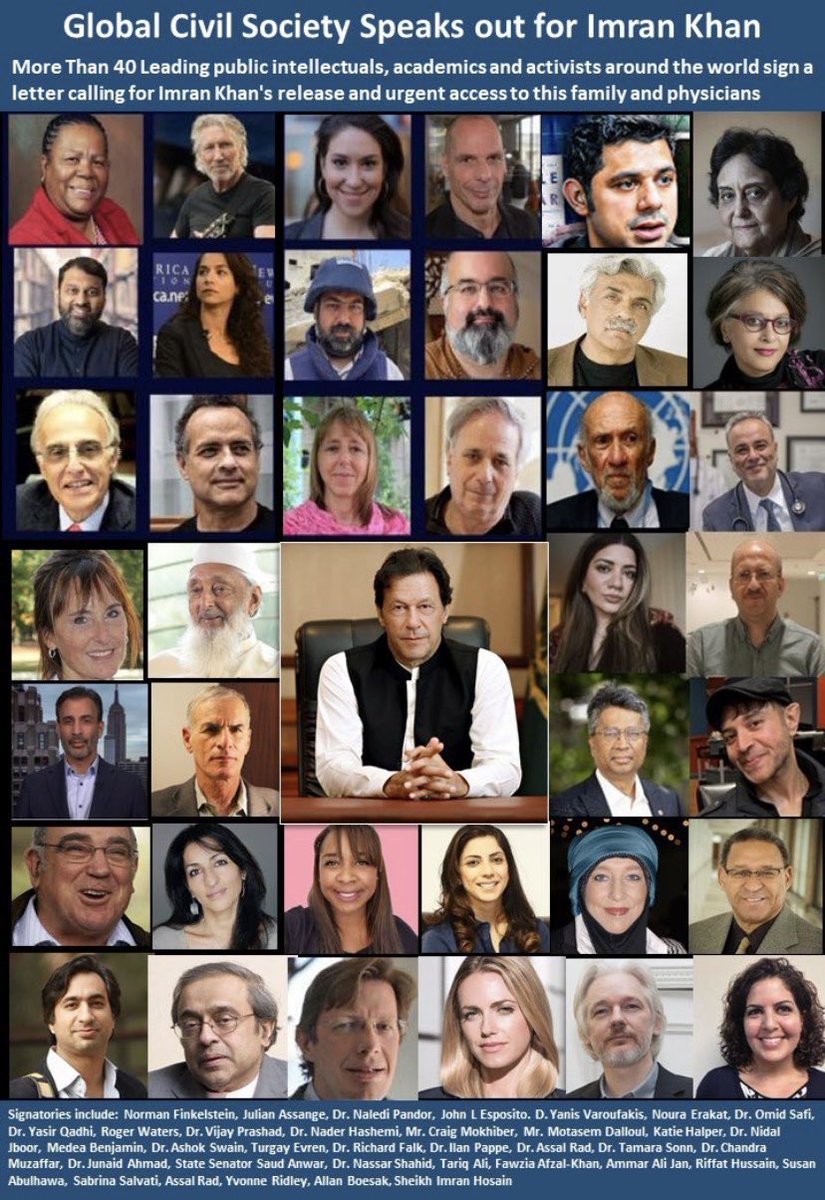
A broad group of international scholars, artists, elected officials, jurists, journalists, faith leaders, and human-rights advocates has issued a humanitarian appeal expressing concern over the reported medical condition and treatment in custody of former Prime Minister of Pakistan, Imran Khan.
The signatories warn that credible reports indicate serious deterioration in his health, including significant ocular damage allegedly linked to delays in medical treatment while detained. The appeal calls for immediate independent medical access, transparency regarding his condition, and adherence to domestic legal protections and internationally recognized standards governing the treatment of detainees.
The statement emphasizes that the appeal is humanitarian in nature and not directed toward political outcomes. Rather, it underscores that international legal norms and basic human-rights principles require that all detainees — regardless of political affiliation or legal status — be treated with dignity, afforded due process, and provided adequate medical care.
Among those endorsing the call are internationally recognized figures including Her Excellency Minister Dr. Naledi Pandor, Roger Waters, Dr. Vijay Prashad, Prof. John L. Esposito, Dr. Fawzia Afzal-Khan, Prof. Norman Finkelstein, Dr. Nader Hashemi, Craig Mokhiber; Motasem Ahmad Dalloul; Katie Halper; Dr. Nidal Jboor; Medea Benjamin, Dr. Riffat Hassan, Prof. Sami A. Al-Arian, Dr. Ashok Swain, Turgay Evren, Prof. Richard Falk, Prof. Ilan Pappé, Dr. Assal Rad, Prof. Tamara Sonn, Dr. Chandra Muzaffar, Prof. Junaid Ahmad, Connecticut State Senator Saud Anwar, Tariq Ali, Dr. Ammar Ali Jan, Susan Abulhawa, Sabrina Salvati, Rev. Dr. Allan Boesak, Sheikh Imran Hosain, Dr. Charles Amjad-Ali, Kathy Kelly, Dr. Ranjan Solomon, Miko Peled, Dr. Sabreena Ghaffar-Siddiqui, Senator Mushtaq Ahmad Pakistan, Prof. Rasul Bakhsh Rais, Maria Kari, and other members of international civil society.
https://t.co/8SZVnq7ntd
The treatment of Imran Khan at the hands of the Pakistani government is an international outrage.
Today Peers across the House urged the UK Foreign minister to step up
@ImranKhanPTI
Thank you Senator @DavidShoebridge for raising this issue. @ImranKhanPTI remains incarcerated for crimes he did not commit. Denying medical facility is a blatant personal vendetta by Asim Munir, who is shielding a corrupt regime while running Pakistan like a criminal enterprise.
I'm honoured to be one of the 40+ leading global scholars, public intellectuals, and human rights advocates having issued an urgent international letter demanding immediate medical access for former Prime Minister Imran Khan and an end to his arbitrary detention.
Nobody has ever posted such a lengthy, heartfelt message in support of Imran Khan- not even from Pakistani cricketers themselves.
Thank you, Sunny bhai, for showing true sportsmanship and humanity. 🫡
#ImranKhan#PTI