Wintermute is literally paying $10M a year to legally front-run everyone on Hyperliquid and it’s completely destroying altcoin liquidity
Bloomberg finally exposed what HFT desks have been screaming about for weeks. Hyperliquid’s gossip priority auctions let top funds see incoming orders 50–60ms before anyone else on the network
Look at how completely broken this setup is:
-> One Wintermute wallet won ~76% of the top slots last month, burning ~$26k every single day just to starve out competition
-> HL claims the auction is open to everyone. Complete BS. You only get that 60ms head start if you have direct peering with Foundation nodes, which requires 0.5% of total maker volume and 10k HYPE staked ($700k+)
-> Smaller MMs are getting sniped nonstop and just unplugging their bots on alts
-> Retail gets stuck with the bill: across 86 altcoin pairs, order book depth on HL imploded by 82% while spreads blew out from 2.13 to 3.55 bps
Honestly, I don't even blame Wintermute. If I had their balance sheet, I would milk this exact loophole until someone forced me to stop
The blame sits 100% on the protocol design. Burning auction fees is cool for $HYPE holders, sure, but letting one fund buy a monopoly on data speed turns a decentralized exchange into a rigged casino
Scrap read-priority auctions completely or make the slots equal, because right now altcoin execution on HL is absolute garbage
Today, Solana changes forever
Introducing Solana Privacy Rings - encryption at the speed of Solana
Rings are programmable, onchain environments for encrypting money, markets, and finance - without ever leaving Solana
Now live on mainnet.
Heute vor genau 2 Jahren habe ich Deutschland verlassen.
Kein neuer Wohnsitz in Deutschland. Kein Auto. Kein Haus. Kein Plan, irgendwann wieder in den deutschen Alltag zurückzukehren.
Nach über 30 Jahren hatte ich genug.
Genug von einem Land, in dem man für fast alles einen Antrag braucht.
Irgendwann hatte ich das Gefühl, nur noch eine Melkkuh des Staates zu sein.
Arbeiten. Steuern zahlen. Gehorchen. Und bloß keine Fragen stellen.
Ich habe mich zunehmend wie ein Steuersklave gefühlt.
Jeden Tag arbeiten, um ein System zu finanzieren, mit dem ich mich immer weniger identifizieren konnte.
Milliarden für Bürokratie, politische Fehlentscheidungen und Kriege, die ich niemals unterstützen wollte.
Aber mitentscheiden, wofür mein hart verdientes Geld ausgegeben wird? Fehlanzeige.
Und wenn du etwas vom Staat brauchst, musst du Geduld haben.
Wenn der Staat etwas von dir will, gibt es eine Frist.
Immer neue Gesetze. Immer neue Vorschriften. Immer neue Formulare. Immer neue Abgaben.
Ein politisches System, das aus meiner Sicht immer komplexer wurde, während mein persönlicher Handlungsspielraum immer kleiner wurde.
Ich wollte keine weiteren Formulare ausfüllen.
Ich wollte nicht noch mehr Regeln lernen, um herauszufinden, was ich überhaupt noch darf.
Ich wollte nicht mehr Geld verdienen müssen, nur um immer höhere Kosten und Abgaben zu finanzieren.
Ich wollte weniger Staat in meinem Leben. Weniger Abhängigkeiten. Weniger Komplexität.
Ich wollte Simplizität.
Ein Leben, in dem ich morgens aufwache und selbst entscheide, was ich mit meiner Zeit anfange.
Ohne den ständigen Druck, immer mehr besitzen, verdienen und leisten zu müssen.
Irgendwann stellte ich mir eine ganz einfache Frage:
Warum verbringe ich eigentlich mein einziges Leben damit, ein System aufrechtzuerhalten, in dem ich mich selbst immer weniger frei fühle?
Und noch wichtiger:
Wer sagt eigentlich, dass ich das muss?
Also habe ich eine Entscheidung getroffen.
Ich gehe.
Nur ein Rucksack und der Wunsch nach Freiheit.
Was danach passiert ist, hätte ich mir früher kaum vorstellen können.
Natürlich ist auch in El Salvador nicht alles perfekt. (Wo ich aktuell bin)
Aber ich habe in den letzten zwei Jahren etwas verstanden:
Freiheit bedeutet nicht, dass man in einem perfekten Land leben muss.
Freiheit bedeutet, dass man die Möglichkeit hat, selbst zu entscheiden, wo und wie man leben möchte.
Ich brauche keinen großen Besitz.
Kein Haus. Kein Auto. Keine Statussymbole.
Mein Leben passt in einen Rucksack.
Und trotzdem fühle ich mich heute reicher als jemals zuvor.
Heute weiß ich: Ich habe damit nicht meine Heimat verloren. Ich habe meine Freiheit neu entdeckt.
Und das Verrückteste?
Ich hätte diesen Schritt wahrscheinlich schon viel früher machen sollen.
Die größte Gefahr ist manchmal nicht, alles zu verlieren. Sondern sein ganzes Leben an einem Ort zu bleiben, an dem man längst nicht mehr sein möchte.
I don't recommend anyone scramble to move their funds to new wallets today. But we should take the risks to cryptography from AI-accelerated math seriously, and minimize our exposure to not just quantum-vulnerable cryptography, but also potentially AI-vulnerable cryptography.
The core new area of risk from this viewpoint is, unfortunately, ML-DSA / FHE / lattices.
(and it's also another reason, along with quantum, why ECDSA might fall even faster than expected, hence the "fresh address" recommendation)
So far most people have been in the mode of thinking "elliptic curves broken, hashes safe, lattices safe". But there is a good chance that the concrete security of lattices will take serious hits from the next two years of AI math.
The basic threat model is: factoring is something that naively takes 2^(n/2) time, but over decades smart people have found and optimized number field sieves, and degraded that to 2^O(n^(1/3)), which is why RSA keys and signatures need to be ~400 bytes (and not 64 bytes). What if there are skeletons in the closet like that, both for elliptic curves and lattices, that we are simply not smart enough to discover - but bots soon will be?
This is a major part of the reason why for the past year ethereum's lean roadmap has been going in the "hash-only" direction: no lattices, no ML-DSA, no Falcon, no lattice-based commitments inside ZK proofs, etc. Signatures in lean ethereum are all hash-based, either WOTS or SPHINCS-.
For signatures and proofs, we already know how to go hash-only. The bigger challenge is for *public-key encryption* - and this goes far beyond blockchains. Secure communication, anonymizing protocols, lots of things need public-key encryption.
And unfortunately there are long-standing mathematical theorems showing why public-key encryption cannot be done with hashes alone. You have to have some kind of trapdoor object that has at least one form of usable "structure" - either group theory (incl. isogenies) or lattices or code-based or potentially in the future even more newfangled and spooky things (local mixing?). But for anything that has structure, you should assume that AI will make at least some progress in breaking that structure. Here, one reasonable inference is that if you want to make something plausibly long-term secure, multiply the key sizes by 10.
To me that's a very plausible world and something not at all extreme to predict. If AI will bring us 50 years of math in 2 years, then that 50 years of math may very plausibly include a "naive factoring -> GNFS" level of improvement to our ability to break lattices. In that world, lattices will still exist, but they will have to be significantly bigger to guarantee the same level of safety.
And at those new larger sizes, hash-based constructions will beat lattice-based constructions on concrete efficiency in every use case where hash-based constructions are possible at all.
Theoretically, of course it's possible that hashes are broken too (eg. P = NP would imply that). But I think P = NP is very unlikely. And intuitively, it's much more likely that a mathematical object has exactly no exploitable structure (like hashes are intended to), than that a mathematical object has exactly ~3 forms of exploitable structure (for elliptic curves: associativity, Schoof, pairings) and not some secret fourth form of structure we have not yet discovered that greatly degrades its security (for elliptic curves, ECDLP and pairing security). Similar for LWE, SVP, RLWE and the zoo of lattice problems.
For this reason, we do not yet see any reason to worry and start padding the byte size of hashes (if we start to worry more, we would pad the round count first before doing anything to the byte size).
Concrete TLDR, my own personal views:
* Hash-based > lattice-based, in those situations where hash-based is possible at all
* For anything lattice-based, be much more paranoid on param sizes. Remember that blockchains are only a small portion of the cryptography story; this point goes far beyond blockchains and applies to eg. access to websites, secure messaging, Tor / VPNs ...
* For privacy protocols, strongly favor NOT putting encrypted notes onchain. Instead, send them offchain through some third-party mechanism.
* If it's not difficult for you, keeping your funds in addresses which have not yet been used to make a transaction is a good idea. If it's easy for you, do it. **But be careful about migrations; I personally have lost more money in botched migrations than I have lost in all hacks combined**.
* For multisig wallets, doing confirmations offchain is better than onchain, because this way the signatures of signer wallets do not get exposed to the public, so if ECDSA falls to AI much faster than expected, at least the multisig "gracefully degrades" to a 1-of-1 where the 1 is whoever was gathering the signatures - a much better place to be than "anyone can take the money"
https://t.co/oVjwZog2lL
you do not need anything else other than an internet connection & an iphone to make $1,000,000+ over the next 12 months
tokenization supercycle + 24/7 perps + social trading emerging seriously for the first time as a global metagame is going to give insane opportunities to those terminally online that learn how to trade attention & virality
Our third-party e-mail provider has been breached. Please be aware that the email named ‘Critical Security Alert: STM32 Entropy Vulnerability’ is not coming from us, and it’s a phishing attempt. Do not click on any link.
We have taken down the domain, and we are investigating the situation, including how the hackers got access to our legit domain.
Robinhood chain went down.
Robinhood transactions are slow af and expensive. It’s a horrible experience.
It simply isn’t built to scale and people are going to realize that the hard way.
The good news is that Solana will be there to welcome everyone back.
AFTER 500 CALLS IN THE PAST FEW HOURS WE GOT ALL THE VOTES IN THE LAST SECONDS AND PASSED THE DISINFLATION PROPOSAL BY A LITERAL HAIR
THANK YOU TO EVERYONE WHO WAS OPEN TO CHANGING THEIR MIND
LETS GOOOOOOOOOOOOOO WE DID IT
SOL $1,000
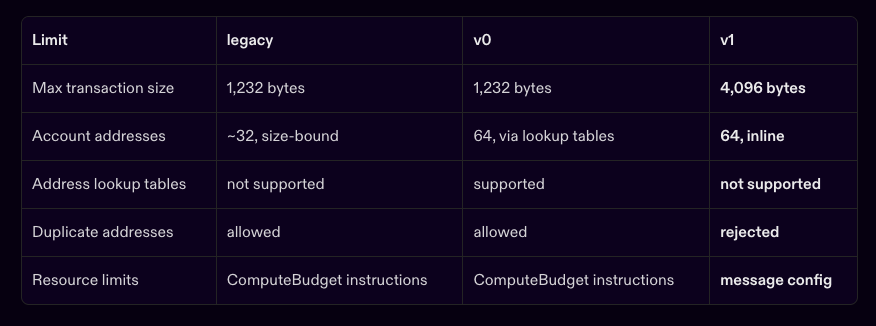
V1 Transactions are coming to @solana and they are really cool! They will go live in a couple of weeks.
Max transaction size goes from 1,232 → 4,096 bytes. Compute budgeting moves out of instructions and into the transaction itself.
There are a few small breaking changes you need to be aware, and you can start testing locally today. 🧵
the vote to speed up solana disinflation is LIVE
this is the most common feedback I've gotten in my time on Solana, so now's the time to vote on it
if you are staking SOL, you can go on this site and vote now https://t.co/W49vti9PXG
vote is only live for a few days so be fast
Here’s to the crazy ones. The traders. The creators. The builders.
The ones that bought when everyone said crypto was dead. The ones that posted when the algo was cooked. The founders that shipped when there were no users.
The ones who see things differently.
They’re not fond of rules. And they have no respect for the status quo. You can quote them, disagree with them, glorify or vilify them. About the only thing you can’t do is ignore them.
Because they change things. They push the human race forward. And while some may see them as the crazy ones, we see genius.
Because the people who are crazy enough to think they can change the world, are the ones who do.
.@MeteoraAG is the liquidity infrastructure behind Solana DeFi.
Every swap runs through a liquidity pool, and Meteora has quietly become one of the largest pieces of it. More than $300B in volume. Over $1.6B in fees paid to the everyday users who supply the markets.
You've probably used it. You just didn't know it.
If you ever lose money just remember that SBF’s $500 Million investment in Anthropic would be worth $76 Billion today but instead he’s zero’d and in jail for another 20+ years
when i started in crypto my goal was never a lambo. never bottles in the club. never a rolex.
i can afford all of that now. but i don't do any of it
because that was never the point. when i was 15, sitting in my room at 3am watching charts, the dream wasn't stuff. the dream was freedom. waking up whenever i want. working on whatever i want. spending a random tuesday afternoon doing absolutely nothing because i can. not answering to anyone. not asking permission for anything. not needing the next paycheck to survive
that's it. that was the whole dream. and somehow along the way the trenches convinced everyone that the goal is the watch, the car, the bottle, the table at the club. like making it has to look a certain way or it doesn't count
i know people with lambos who are miserable. who check their portfolio every 4 minutes because the car payment depends on the next trade. who can't enjoy the dinner they're at because the chart is red. who bought the lifestyle before they secured the foundation
and i know people who made it and you'd never guess. they sleep 8 hours, they don't check charts all day, they haven't worried about money in years, and the people around them have no idea they're sitting on millions. those are the happiest people i know in crypto. not the loudest ones. the quietest ones
freedom means different things to different people. for me it means: i can fly home to see my family whenever i want. i can take a week off without asking anyone. i can say no to a deal that doesn't feel right without worrying about rent. i can sit in a cafe for 3 hours reading something that has nothing to do with crypto. i can be bored on a tuesday and that boredom is a luxury most people don't have
none of that requires a lambo. none of that requires bottles. none of that shows up on a timeline. but all of it feels better than any material thing i could buy
the day i realized that was the day i actually made it. not the day the portfolio hit a number. the day i understood that the number was never the goal: the life the number enabled was the goal. and that life doesn't look like what CT tells you it should look like
if you're in the trenches right now grinding at 3am, ask yourself what you're actually grinding for. if the answer is a car or a watch, you'll buy it and feel empty in a week. if the answer is freedom (real freedom, the kind where your time belongs to you) then you're grinding for something that actually lasts
protect your capital. don't perform wealth. don't buy the lifestyle before you've secured the foundation. and when you make it, remember that the goal was never to look rich. the goal was to feel free
i started in crypto when i was a kid. i'm still here. i can afford the lambo and the bottles and the watches. i don't want any of them. i just want to keep waking up with nothing i have to do and no one i have to answer to
that's the flex. and it's the only one that ages well