Rates in DeFi are too low for the level of risk
$11.7B sitting in Morpho vaults today at 2-4% APY. retail is funding these markets via exchanges thinking it's a savings account. it's not. they're taking real credit risk on crypto-collateralized lending
no institution accepts near risk-free rates to come on-chain
not all vaults are created equal. same 2-4% yield but completely different risk profile (different curators, collateral, LLTVs). retail picks the highest number. farmers will farm
back in the day >100% APYs in DeFi made sense. you were compensated for the risk you were taking.
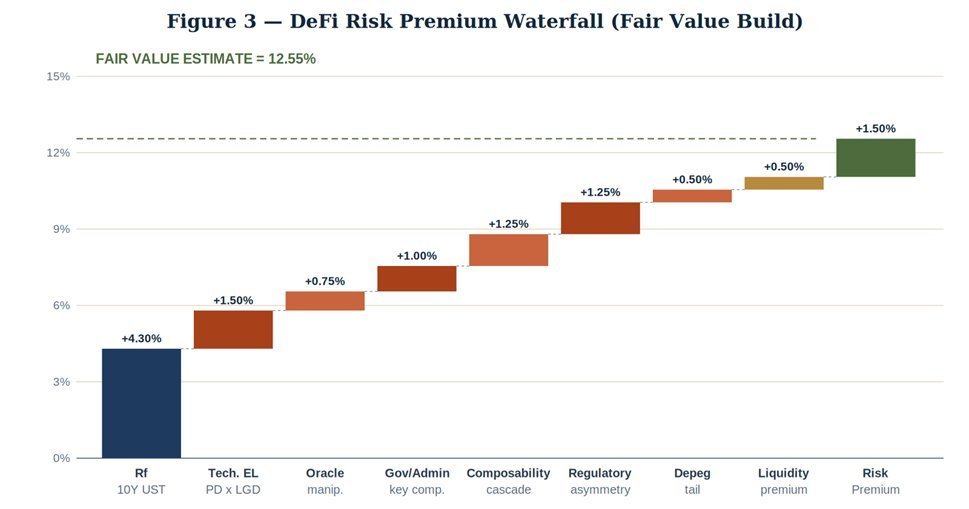
DeFi is a different animal today but vol, historical dislocations, and looping strategies on crypto collateral still demand at least 300-400 bps above risk-free. we're nowhere near that.
@LucaProsperi ran the math (see below). tldr - fair value spread on ETH/BTC-collateralized lending is 250-400 bps above risk-free. observed rates are a fraction of that
last cycle we saw a lot of retail pour savings into algo stablecoins promising "risk free" yield. this cycle vaults have a lot of demand but they are mispriced for the level of risk. you're trusting someone to LP into vaults and trust the manager will manage position
at least private credit earned you 12-16%
go read this: https://t.co/TpzY7yOLJo
“What happens when someone inside one of the most iconic retail platforms of the last cycle sees its limits up close?”
@kenzimoriyama speaks with @jayendra_jog, Co-Founder of @SeiNetwork, to trace the path that took him from the early days of @Robinhood in Palo Alto — through hypergrowth, the IPO era, and the shock of the GameStop moment — to building in crypto.
They discuss how witnessing the mechanics and constraints of traditional financial infrastructure firsthand reshaped his thinking, why the suspension of buys during one of retail’s most defining episodes left such a lasting impression, and how that experience ultimately pushed him toward systems designed to be more open, more resilient, and less dependent on centralized control.
“High-performance infrastructure only matters if it expands what users can actually do onchain — and makes that experience accessible at scale.���
@sachikagetsu sits down with @jayendra_jog, Co-Founder of @SeiNetwork, to examine why parallelized execution is becoming increasingly important for the next generation of onchain applications.
From trading and DeFi to high-frequency user activity that simply breaks in low-throughput environments, they discuss how lower fees and greater execution capacity can fundamentally reshape the user experience — especially for smaller participants who are otherwise priced out.
They also explore how this plays out in practice through projects like Bancor’s Carbon DeFi, where Sei has emerged as the ecosystem driving the strongest activity and volume, underscoring how performance advantages translate into real adoption.
“Virtual machines are like cities — once they reach critical mass, they become magnets that are incredibly hard to displace.”
@dikshaksagar catches up with @jayendra_jog, Co-Founder of @SeiNetwork, to unpack this idea at a deeper level — why systems with flaws can still dominate simply because that’s where the activity, liquidity, and people already are.
From New York and San Francisco to onchain environments like the EVM, they explore how network effects compound over time, why newer ecosystems struggle to pull users away even with better tech, and what it actually takes to break that inertia.
This week’s episode features Jayendra Jog (@jayendra_jog), Founder of @SeiNetwork.
We dive into Jay’s journey from traditional finance at @Robinhood to building Sei Network, and unpack how his view of markets, users, and product feedback shaped the way he thinks about blockchain infrastructure.
The conversation explores the parallels between established cities and virtual machines: why dominant systems like the EVM are so difficult to displace, what makes developers stay, and what it actually takes for a new ecosystem to earn attention.
We also dig into the need for higher throughput in Web3, how parallelization can help solve today’s performance limits, and why scalability matters if crypto applications are going to serve real users at a much larger scale.
Jay also reflects on the role of memecoins, not just as speculation, but as community-driven movements that can reveal how culture, attention, and network effects form onchain.
Selling crypto to cover expenses hurts: you trigger taxes and lose exposure.
DeFi borrowing fixes both. Instead of selling your ETH, lock it as collateral, borrow USDC instantly onchain, spend like cash, and stay long — no taxable event in the U.S.
And now, do this directly through Coinbase👇
~~ Analysis by @KenziMoriyama ~~
This is an integration I can happily recommend to my family and friends, as @coinbase is one of the most trusted and easy-to-navigate crypto exchanges, while @Morpho is one of the most proven and dependable DeFi lending protocols.
With this integration, you can now borrow against your ETH without leaving the comfort of the Coinbase app. Assuming you already have some ETH holdings on Coinbase, you just:
1. Click on your ETH balance to bring up your Ethereum dashboard.
2. Scroll down to the "Borrow" tab and press "Start."
3. Review the primer info—your Borrow up to amount (based on your ETH deposited to Coinbase), the Variable rate (the fluctuating interest Morpho will charge on your loan), and the Liquidation LTV (the "loan-to-value" point at which your underlying ETH could be liquidated for repayment)—and then press "Continue."
4. Input the amount of USDC you want to borrow, then click "Review loan."
5. Check that your loan details are satisfactory. When ready, press "Borrow now," then "Accept and continue." Your loan will be submitted, though it may take a minute or two to finalize in Coinbase's UI.
That's all it takes to get started!
If you open a loan, navigate to your Coinbase "Cash" tab and in the "Borrow" section you'll see a "Manage Loans" button. Go here for the "Repay" option to pay back the USDC you borrowed over time.
These ETH-backed loans have a flexible term, so you don't have to pay back specific amounts per a specific schedule. Just repay whenever in whatever amounts suit you, though keep a close eye on your loan health to avoid liquidation.
Also, keep in mind that USDC borrowed on Coinbase can't be used for buying crypto on Coinbase, so this particular avenue is meant for cashing out and spending.
As far as DeFi onramps go, this integration is about as simple and safe as it gets. If you or someone you know hasn't gotten around to borrowing against ETH yet, this is certainly a good place to start.
It's been one month since Hyperliquid's HIP-3 went live, letting anyone stake 500K $HYPE can now launch custom markets backed by the platform’s deep liquidity.
The result is an exchange where you can long or short anything: stocks via Trade or Felix, commodities, bonds via Aura, pre-IPOs via Ventuals, even Pokémon cards via Trove.
Learn how HIP-3 works and how it make impact Hyperliquid 👇
~~ Analysis by @DikshaNanduri ~~
The upgrade works like this: a deployer stakes 500K
$HYPE (~$19.3M at time of writing). They can then list three markets for free before entering an auction process to secure additional slots.
For each market they launch, the deployer sets leverage limits, configures the oracle, and manages key technicalities. To ensure acceptable standards, deployers risk having their stake slashed, though Hyperliquid notes this mechanism is temporary and expected to fade as standards and tooling improve.
Once live, the deployer earns 50% of the fees from their markets, with Hyperliquid taking the other half. To balance revenue, HIP-3 market fees are set at double those of standard markets, keeping @HyperliquidX's take roughly equivalent.
While most deployers are still building, early activity from just one HIP-3 market already live — to the tune of $1.3B in volume — paints a positive picture that the upgrade's potential may match its hype.
What Will the Impact of HIP-3 Be?
As a result of how it's designed, HIP-3 introduces new supply crunches on $HYPE, additional revenue for buybacks, and potentially increases rewards earned by stakers and traders.
➢ Locking up
$HYPE: Each deployer must stake 500K $HYPE, effectively removing that amount from circulation. The result is persistent buying pressure as new deployers acquire $HYPE to secure their slots. For example, Trove raised $20M to purchase $HYPE for its launch. Further, Hyperliquid Digital Asset Treasuries (DATs) like @HyperionDeFi and @HypeStrat have already begun exploring how to get involved in HIP-3, alleviating the threat of these vehicles dumping their tokens as we're seeing more DATs do.
➢ Additional revenue for buybacks: The 50/50 fee split on HIP-3 markets provides a new inflow to the protocol Assistance Fund, which uses 97% of all fees to buyback its token. Because HIP-3 market fees are set higher than standard ones, this stream will not be reduced by the split in fees with the deployer, potentially offering a significant source for $HYPE buybacks if even a handful of markets achieve sustained volume.
➢ Incentive Wars: A likely next phase is direct competition among deployers for trader flow, especially given the success of @tradexyz's XYZ100 HIP-3 market, which generated $100K in fees before it even reached two weeks. Expect escalating incentive programs — liquidity mining, fee rebates, staking boosts — as providers fight to draw and retain users. These will likely extend to $HYPE stakers too as validators vie for stake to participate in secondary economics like "exchange-as-a-service" models, where staking providers like @kinetiq_xyz essentially crowdsource $HYPE to lower the cost of launching a market.
Together, these dynamics tighten HYPE's supply, expand its buyback base, and create new competitive layers across the ecosystem.
How Could HIP-3 Fail?
HIP-3's success will depend on two things: quality markets launching, and those markets generating sustained demand.
Permissionless listings don't guarantee quality. A HIP-3 market is only as strong as its deployer — how they configure leverage, oracles, and risk parameters. Deploying non-crypto or thinly traded assets like stocks or bonds requires continuous data and stable pricing. Without that, markets face thin liquidity, wide spreads, and erratic execution that will quickly drive traders away.
Oracle providers like @redstone_defi are building hybrid systems that blend onchain and offchain data, maintaining live pricing even when the base asset isn't trading. HIP-3's architecture allows deployers to implement proper oracles into individual markets and tailor risk parameters accordingly.
But demand remains the harder part. As @felixprotocol's founder Charlie (@0xBroze) notes, the lion's share of Hyperliquid's volume comes from five markets, mostly composed of major assets like $BTC, $ETH, and $SOL.
Smaller assets tend to be left with little natural flow, meaning nascent, niche assets launched via HIP-3 will face a cold-start problem. Without early liquidity, traders hesitate; without traders, liquidity providers leave.
If simply introducing novel markets isn't enough to spark activity, deployers will need to experiment with market structures and pairs, introducing new collateral for perps or unique pair-markets like $BTC / $GOLD. Incentive programs should help smooth the initial launch, but in the end, these markets will have to stand on their own.
Ultimately, HIP-3's trajectory depends on the competence of its deployers. The framework is in place, but its outcome will hinge on whether deployers can build markets that trade well and sustain activity.
Final Thoughts
HIP-3 represents another structural bet on decentralization — a next step for Hyperliquid shifting responsibility for growth from the protocol to its participants.
Whether it succeeds will come down to the quality of the markets that launch, the liquidity they attract, and the flywheel effects that follow. If deployers can navigate those early hurdles, HIP-3 could define the next phase of onchain market design.
It doesn't need scale in the traditional sense to succeed. As Charlie noted, just a few high-performing markets could validate the model and materially impact both Hyperliquid's growth and $HYPE's price, with one firm,
@FalconXGlobal, estimating $.8B in additional fees if HIP-3 captures less than one percent of Mag7 derivatives trading.
For the platform that keeps defying expectations, rising from a fully-bootstrapped team to become a protocol responsible for earning 35% of all blockchain revenue some months, the success of HIP-3 wouldn't be something I bet against.
After 7 years, Aztec’s Ignition mainnet is live.
Yet zero transactions or apps work yet. The chain is deliberately empty – because true protocol-level privacy can’t be rushed.
Here’s how this phased, decentralization-first launch positions Aztec as the leading private L2 on ETH👇
~~ Analysis by @SachiKagetsu ~~
What's Actually Running
Think of Ignition like Ethereum's beacon chain from 2020. The governance and consensus infrastructure is operational, but the execution layer remains offline. The team is running what amounts to a live stress test with real money on the line.
Each sequencer staked at least 200K $AZTEC tokens to participate. They're producing blocks, provers are generating validity proofs, and the whole system is settling on Ethereum, just without any transactions.
The goal of running Ignition with real economics for 2-3 months will (hopefully) surface any remaining issues before transactions go live in early 2026, while setting the network up to be decentralized from day one.
The Decentralization Push
In Aztec's eyes, launching an L2 with a centralized sequencer from the get go rarely translates to decentralization down the road.
Centralized sequencers generate $40-150M annually in fees. Once you're locked into those cash flows, decentralization means making transactions slower and more expensive. The tension never resolves.
Instead, @aztecnetwork will launch fully decentralized from day one across three dimensions:
➢ Ownership is decentralized through $AZTEC token holders who control network parameters, fee schedules, and protocol upgrades.
➢ Block Production runs through 617 decentralized sequencer nodes using proof-of-stake. These nodes order transactions and produce blocks. To prevent any single party from gaining control, a small committee of sequencers is randomly selected to validate blocks before they are submitted to Ethereum.
➢ Proving is permissionless from the get-go. Provers generate the zero-knowledge proofs that cryptographically confirm all transactions in a batch are valid. They aggregate blocks and submit a single, final proof to Ethereum for verification, guaranteeing the integrity of the entire rollup.
When transactions go live, Aztec will qualify as a Stage 2 rollup, the highest decentralization tier for L2s. Most chains have pushed boundaries in one direction. Hitting all three pillars simultaneously is rare.
In Aztec's eyes, decentralization isn't optional for privacy. Centralized sequencers would face pressure from governments to install backdoors. Privacy requires cryptography plus decentralization, not one or the other.
What Happens Next
There are two major upcoming events, one technical and one token-related.
On the technical side, Ignition will remain live for 2-3 more months with sequencers producing empty blocks while the team monitors for issues. Early 2026 is when transactions flip on. Users will be able to send payments, deploy smart contracts, and interact with applications. By the end of 2026, block times should drop from the current 36-72 seconds down to 4 seconds, faster than Ethereum's 12-second blocks.
On the token side, the pre-allocation for the $AZTEC token sale is currently live, with the sale beginning December 2nd and running for 4 days. The sale uses @Uniswap's continuous clearing auction mechanism, meaning if you bid early, part of your bid clears at early prices and part clears later. This levels the playing field between early and late participants while letting price discovery happen naturally. When the auction ends, it automatically creates a Uniswap V4 liquidity pool at the final clearing price.
To participate in the sale, you must register prior to December 2nd.
For compliance, Aztec is using @ZKPassport, enabling people to prove cryptographically that they're from allowed jurisdictions and not on sanctions lists without traditional KYC. The sale is open to US retail and nearly every country worldwide, with the exception of sanctioned countries on the standard OFAC list.
The current 500 sequencers already staked $AZTEC tokens they purchased in a whitelisted genesis sale. They're earning rewards in $AZTEC right now. However, all tokens, whether from the genesis sale, the current public auction, or insider allocations, are non-transferable until Token Generation Event (TGE).
There is no set date for when TGE occurs, rather the community votes on it. However, the earliest date it can go live is February 11th, 2026. Once TGE happens, tokens purchased in the public auction unlock 100%.
7 Years in the Making
Overall, Ignition and the $AZTEC token sale demonstrate both the complexity of successfully executing privacy, as well as the extent to which Aztec is going to get this right.
First you have the need for decentralization from the get-go to ensure privacy endures, a feat unaccomplished by countless L2s launched so far. Then you have the tension between privacy and compliance, which the token sale's integration with ZK Passport helps solve.
Regardless of how mainnet goes, and I'm hopeful all goes well, this launch process shines as a testament to diligent design, demonstrating that forces like decentralization, privacy, and compliance can all coexist
“Bitcoin was the first distributed systems paper I read with an economic layer built into it — and that changed everything.”
@kenzimoriyama catches up with @averyching, Co-Founder & CTO of @Aptos, to trace his journey from high-performance computing and supercomputers, to scaling data infrastructure at Meta, to discovering Bitcoin and realizing that crypto was distributed systems with incentives natively embedded — the insight that ultimately led him to co-found Aptos Labs.
“We focused on four core areas: finance, gaming, social, and entertainment — but DeFi on @Aptos has seen the strongest traction.”
@sachikagetsu sits down with @averyching to unpack Aptos’ real-world use cases and why DeFi has emerged as the breakout category: the safety of Move, the composability that allows products to plug into larger protocols, and an ecosystem that is now beginning to hit meaningful momentum.
“What inspires you to get up and build every day? For me, it’s pushing Web3 forward — making blockchain a true public utility for everyone.”
@dikshaksagar sits down with @averyching (Co-Founder & CTO of @Aptos) to talk about what drives him: building the next era of the internet where blockchain brings ownership back to users and enables permissionless, trustless transactions that connect people globally.
New episode out today featuring @AveryChing - Co-Founder & CTO of @Aptos.
We explore the intersection of crypto and Al, Aptos' fundraising journey, how the network compares to other Layer 1s such as Solana and Ethereum, and what lies ahead for the Move programming language.
Avery also shares his perspective on decentralized use cases, Aptos' long-term ambitions, and how more than a decade spent scaling distributed systems at Meta — including his work on the Diem blockchain — continues to shape his vision for the future of Web3 infrastructure.
Great move on the side of EF
- reduces the strain on the market
- without doing any kind of bailout or backstop in the situation EF had no role in creating
0/ Today, the Ethereum Foundation completed a bilateral swap of ~21,269 aWETH to wstETH, coordinated with @LidoFinance and @mellowprotocol as part of their ongoing deleveraging work.
Aave is my life's work and we're working nonstop to find the best possible outcome for users.
I’m personally contributing 5000 ETH to DeFi United as we continue working together with partners on formalizing more commitments. I’m working to see this resolved and market conditions normalized as soon as possible.
DeFi United.
holy fuck, a hair dryer at a Paris airport broke Polymarket weather markets & made someone $34,000 richer
- polymarket was settling Paris temperature bets on a single Météo France sensor sitting near the Charles de Gaulle runway perimeter - basically unguarded
- the guy bought the long-shot outcome (like "22°C" when everyone expected 18°C) for pennies, since nobody thought it'd hit
- then he walked up to the probe and briefly heated the air around it with a portable heat source, spiking the reading just long enough to register as the daily max
- temperature snapped back to normal in minutes, the market resolved in his favor, and he cashed out - twice, on April 6 and April 15, before Météo France caught on and filed charges
hyperstitions.
Very sad to see the recent Drift and KelpDAO security incidents. These were hard blows for DeFi.
In the last 2 days alone, DeFi TVL shrank by almost $15 billion.
But it makes me relate even more to what @santiagoroel has been preaching over the last few weeks:
The risk reward ratio of DeFi simply isn't attractive enough anymore.
Don't get me wrong, I am a big DeFi fan and a strong advocate for the entire financial industry moving onchain. But what you get right now from DeFi are unexciting yields for an insane risk profile. And the cherry on top is just horrible UX.
Not much can be done on the yield side in my opinion. UX is already being worked on. But personally, I think where we are lacking the most is making the risk profile more attractive.
DeFi was actually supposed to eliminate the risk of a middleman and make finance more secure by letting you take control of your own assets. But it feels like we've achieved the exact opposite.
The main reason for this, in my opinion, is that we have always massively neglected security in this industry. Most people ignore it and everything is fine, just until it's too late and the damage is done. We've seen this countless times already.
At the same time, security is probably one of the most underfunded and least exciting verticals to work in. And there is massive discouragement for teams like the @ethereumfndn itself, who choose the slow but secure path instead of quick iterations with the corresponding tradeoffs.
I noticed it myself recently when I was thinking about putting aside some of my fiat savings to put them to work. I chose TradFi bonds over DeFi yields. For those exact reasons.
If I as a crypto native already think this way, how can we expect conservative investors and retail to bring their assets onchain?
We need more support, funding and in general incentives for security again, so more top tier talent starts working on these problems and we can build a reliable foundation to truly bring the financial world onchain.
As long as this doesn't change, the majority of people will always choose banks instead.
We need to do better.
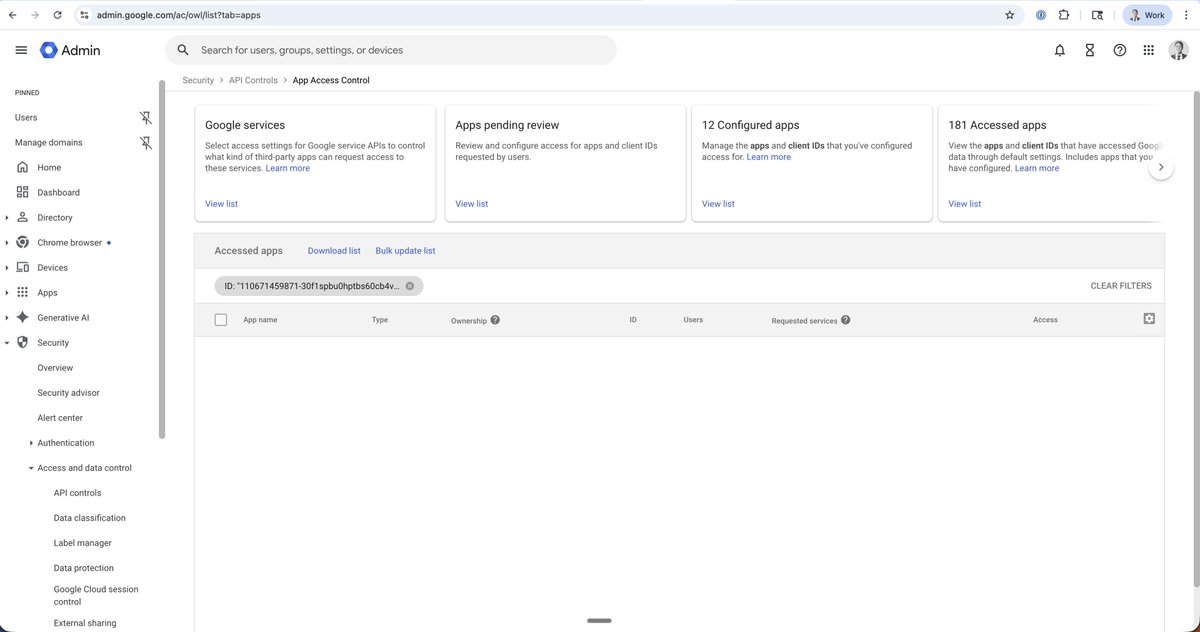
To check if your Google Workspace has been compromised by the same tool that compromised Vercel:
1. Go to https://t.co/TpuIOW5Fwg
- This is Google Admin Console > Security > Access and Data Control > API Controls > Manage app access > Accessed Apps
2. Filter by ID = https://t.co/uqJnCqp5Ah
- This is the ID of the compromised OAuth app
If you see an app after filtering, you have potentially been compromised
My biggest takeaways from @rabois:
1. The team you build is the company you build. Founders get distracted by markets, customers, and technology. If you have the right people, those problems get easier. If you have the wrong people, none of those things save you.
2. Build your company on undiscovered talent. The only way to scale an organization against incumbents with infinite budgets is to find talent that large companies’ hiring machines will misprocess. In practice, this often means skewing younger—not because young people are inherently better but because they have fewer data points, which means typical evaluation systems can’t categorize them accurately. This is where the alpha often is.
3. Hire more “barrels,” not “ammunition.” A “barrel” is someone who can take an idea from zero to outcome without hand-holding. Most companies have only a handful of these people. Hiring more people without expanding the number of barrels doesn’t increase output; it increases coordination tax and creates drag. The ratio of barrels to ammunition is what determines the number of important things a company can pursue simultaneously.
4. CMOs are becoming the #1 consumer of AI tokens. At a few of Keith’s top portfolio companies, the heaviest user of AI is the chief marketing officer. These CMOs are running analytics, shipping campaigns, and generating insights that previously required entire teams of deputies.
5. The three signs a company will win: operating tempo, internal talent development, and “the relentless application of force” from the top. Keith identifies a consistent pattern across his best portfolio companies. First, operating tempo: Ramp shipped physical cards in three months when the industry standard was 9 to 12. Second, talent development through internal promotion rather than senior external hires; the CMO at one of his top companies was the previous chief of staff. Third, the CEO’s willingness to push harder as things improve, not less. Mike Moritz told a friend of Keith’s that the most common trait of the best CEOs is “the relentless application of force.” Complacency is the natural by-product of success, and the CEO’s job is to offset it.
6. For consumer products, talking to customers is not just unhelpful; it’s actively harmful. Keith refuses to let companies he advises conduct consumer research. His argument: Consumer decisions are subconscious. Ask any Porsche owner why they bought the car, and 99% will cite every reason except the real one. Once misleading customer feedback enters the organization, it locks into people’s brains and distorts every subsequent decision.
7. Keith believes the PM role may not survive the AI era. Taking customer inputs, building a sequential year-long roadmap, and coordinating between teams are structurally incoherent when AI capabilities change weekly. The skill that matters now across all three roles—PM, designer, engineer—is business acumen: understanding the company’s equation and knowing what to build next.
8. Great hiring comes from great referencing. Run at least 20 references, and keep going until you hit negative feedback. Ask specific, forward-looking questions (e.g. “Would you start a company with them?”). If every reference is positive, you haven’t gone deep enough.
9. Use a 30-day feedback loop to sharpen your hiring instinct. Thirty days after every hire, ask: would I hire this person again? This is as predictive as waiting years, and dramatically faster for improving your judgment. Make this a habit, and your hiring quality will compound.
10. Criticize in public, not private—it optimizes for the system. Keith endorses a management practice that most people find confrontational: delivering negative feedback in front of the team, not behind closed doors. Private criticism optimizes for the individual, but the rest of the company doesn’t know the issue is being addressed, which breeds anxiety and suspicion. Public criticism lets colleagues see that leadership is aware, creates opportunities for others to volunteer help, and turns feedback into a team-building exercise.
Full conversation: https://t.co/5MI134kdx5