Michael Saylor bought a billion dollars in BTC today and another billion in BTC earlier this week.
This clip of Jim Cramer really sums it up.
“This man is not to be trifled with — by any means necessary Michael Saylor will defeat the shorts.”
MSTR bears should be trembling.
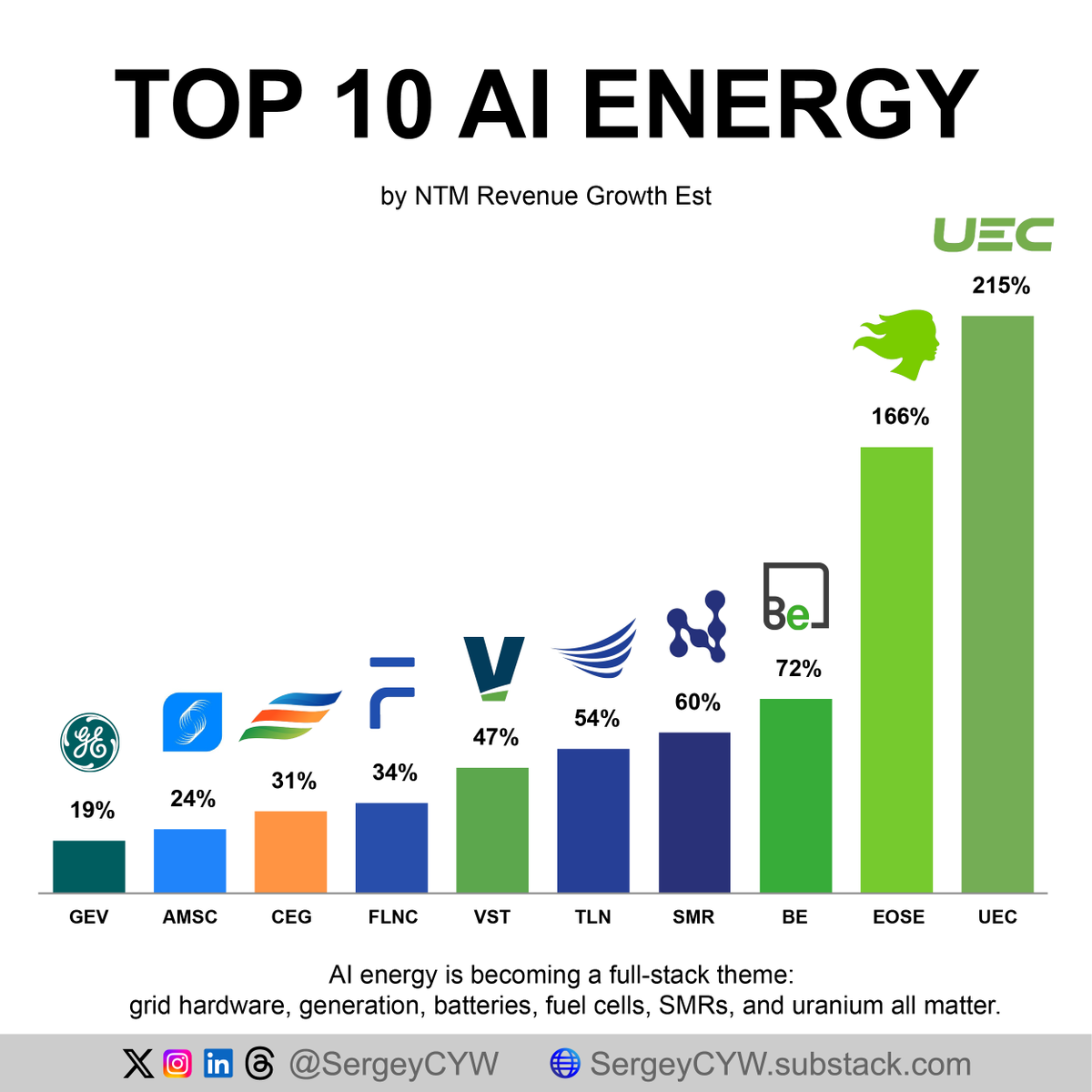
AI needs energy. From uranium to grid equipment, the power stack behind AI is becoming its own supply chain.
Data centers need GPUs. GPUs need racks. Racks need power. Power needs grid access, firm generation, storage, cooling, and fuel.
Hyperscalers are no longer only competing for compute capacity. They are competing for long-term electricity supply, faster interconnection, backup systems, and local power solutions.
Here are 10 companies positioned across the AI energy stack:
$GEV — GE Vernova Market Cap: $294B | NTM Revenue Growth Est: +19%
GE Vernova is one of the key grid infrastructure names tied to AI data center expansion. Its Electrification segment booked $7.1B in Q1 orders, with a 2.5 book-to-bill ratio. More importantly, data center equipment orders reached $2.4B in one quarter, already above last year’s total. The role is clear: transformers, switchgear, and grid architecture needed to connect AI campuses to the broader power system.
$AMSC — American Superconductor Market Cap: $2.6B | NTM Revenue Growth Est: +24%
AMSC sits in the power quality and grid-stability layer. AI data centers create dense local loads, especially in constrained regions where voltage control and power resiliency matter. Its grid segment represents more than 80% of revenue, and management highlighted momentum in materials and semiconductor divisions tied to localized data center infrastructure. The company also turned free-cash-flow positive as demand for grid-stabilizing systems improved.
$CEG — Constellation Energy Market Cap: $100B | NTM Revenue Growth Est: +31%
Constellation is the large-scale nuclear baseload provider in the AI energy stack. Tech companies want 24/7 carbon-free power, and CEG owns the largest nuclear fleet in the U.S. The Calpine acquisition adds 27GW of natural gas capacity, giving the company more dispatchable supply for near-term demand. Management also increased its buyback authorization to $5B and outlined a $3.9B capex plan aimed at clean energy constraints.
$FLNC — Fluence Energy Market Cap: $2.3B | NTM Revenue Growth Est: +34%
Fluence is the battery storage layer for AI power demand. Data centers need always-on electricity, while renewables remain intermittent. FLNC delivered 2.3GWh of storage in Q1 and holds a $5.5B backlog. The more interesting piece is its active 36GWh data center pipeline, even though management has not yet converted those engagements into signed backlog. Smartstack targets high-density storage where AI campuses face space constraints.
$VST — Vistra Market Cap: $54B | NTM Revenue Growth Est: +47%
Vistra is a dispatchable power and nuclear offtake play. The company signed a 20-year agreement with Meta to deliver 2.6GW of zero-carbon nuclear power for an AI data center in Ohio. It also acquired Cogentrix for $4.7B, adding 10 gas facilities and 5.5GW of capacity. VST has also secured a 20-year nuclear power agreement with AWS, placing it directly inside the AI compute power procurement cycle.
$TLN — Talen Energy Market Cap: $17.5B | NTM Revenue Growth Est: +54%
Talen is turning nuclear generation into direct AI data center supply. Its expanded Amazon agreement locks in up to 1,920MW of nuclear power through 2042. The anchor asset is the 2.2GW Susquehanna nuclear facility, designed to support a collocated, 24/7 carbon-free data center campus. TLN is moving from merchant power exposure toward long-term contracted offtake, with management guiding to up to $1.18B in 2026 free cash flow.
$SMR — NuScale Power Market Cap: $3.5B | NTM Revenue Growth Est: +60%
NuScale represents the small modular reactor angle. AI campuses need scalable carbon-free power, but traditional nuclear projects require massive upfront capital and long timelines. SMR’s TVA and ENTRA1 partnership targets a 6GW SMR program across the seven-state TVA region. Its 12-module plant structure can scale gradually as compute clusters come online, making modular nuclear a potential fit for staged AI power demand.
$BE — Bloom Energy Market Cap: $71B | NTM Revenue Growth Est: +72%
Bloom Energy is the on-site power layer for AI campuses facing long grid interconnection delays. Its Oracle Project Jupiter agreement positions Bloom as the sole power provider for a New Mexico AI data center campus, with up to 2.45GW of solid oxide fuel cell capacity. The setup replaces planned gas turbines with a private microgrid. Management lifted 2026 revenue guidance to around $3.8B as AI data center demand reshaped the business mix.
$EOSE — Eos Energy Market Cap: $1.6B | NTM Revenue Growth Est: +166%
Eos provides zinc-based long-duration batteries for off-grid and power-constrained AI sites. Its TURBINE-X partnership targets up to 2GWh of storage across hyperscale data center projects over 36 months, pairing batteries with simple-cycle gas turbines for on-site microgrids. The MN8 Energy agreement adds 750MWh tied to solar plus 10-hour discharge batteries, aimed at round-the-clock power for high-demand industrial loads.
$UEC — Uranium Energy Market Cap: $7.1B | NTM Revenue Growth Est: +215%
UEC is the nuclear fuel exposure in the AI energy stack. AI data centers are increasing interest in nuclear baseload power, and uranium supply remains structurally tight. UEC is bringing low-cost ISR projects online in Wyoming and South Texas while keeping its order book unhedged. That structure gives direct exposure to uranium pricing if nuclear demand from utilities and hyperscalers continues to support the market.
One of the best investing clips you’ll ever watch.
Seth Klarman, the value investing legend behind Baupost.
He almost never does interviews but he did this one.
Save this, I promise you’ll come back to it.
Rest in peace, Rob Reiner... Watch as he and his father Carl talk about Rob's career and the many movies he has been involved with over the years. #robreiner
When you buy $1,000 of Warren Buffett's Berkshire Hathaway $BRK.B here is what you are buying
- $371 of Cash & T-Bills
- $354 of Implied Value of Operating businesses and Other assets
- $61 of Apple $AAPL stock
- $52 of American Express $AXP stock
- $50 of Coca-Cola $KO stock
- $31 of Bank of America $BAC stock
- $19 of Chevron $CVX stock
- $83 of other stocks
I bought:
$NVDA at $4
$PLTR at $10
$RKLB at $4
$TSLA under $100
$CRWD at $65
$AMD at $66
$MSFT at $26
$SOFI at $5.50
$NET at $27
$AVGO at $29
Many others before the masses. 🔥
I'm often asked: What's next? 🤷🏻♂️
If I were a young investor with high risk tolerance eyeing a potential 10x long-term play, I'd load up on $ALAB (Astera Labs).
Here's why:
• Leader in AI infrastructure connectivity—semicon solutions powering hyperscalers' rack-scale AI with PCIe/CXL tech & smart cables.
• Explosive growth: Revenue doubled to $396M in 2024 (+242% YoY), crushing Q2 estimates & guiding strong ahead amid AI boom.
• Strong Buy consensus from 16 analysts—outpacing semis industry returns, with innovative products like Leo/Scorpio driving market share gains.
• AI demand exploding; partnerships with $AMD, OpenAI, $NVDA, $AMZN AWS, $MU, Alchip, QCT & more could supercharge it.
High volatility? Yes. Could I be wrong? Sure. Massive upside potential? Absolutely.
DYOR, NFA! What's your take? 🚀 #AI #Stocks
BitMine’s Tom Lee just asked a trillion dollar question.
If gold itself becomes tokenized on Ethereum, will Bitcoin still be attractive as digital gold?
Tokenized gold moves faster, earns yield, lives inside DeFi, and becomes programmable collateral.
$ETH $BMNR $BTC