6.5x in an hour on fomo.💸 💸 💸 🙌
zeustyy_ to AIKOL on bnb. in at $156k mcap. first slice out at $1.55m. the rest sold the moment zeustyy_ sold. fully out at $889k. +549%. closed in 61 minutes.
it printed 9.7x on the way up. the bag that got locked is 6.5x. the exit was already set. copyfomo took both.
pick the trader, set the size, the buys and sells land in telegram. no dashboard. no sitting on the chart.
https://t.co/Cw4mbzN4S8
@copyfomo
Value doesn’t show up overnight, the real opportunity is spotting the potential before it becomes obvious to everyone else and that’s what keeps @jumperapp on my radar.
355 bounties already 👀
@vangrid_io is starting to look less like a cool Physical AI idea
and more like an actual marketplace for real-world data
almost $291k in settlements so far
someone needs reality captured
someone else goes and gets it
simple loop, but it’s clearly moving
Gm CT
Been looking deeper into @PlayOnMint and MintABear is starting to feel like more than just a free NFT.
The interesting part is how everything connects:
MintABear → $MNTD → Bear upgrades → more progression inside the MINT ecosystem.
And there’s another opportunity right now 👀
10 WL spots are up for the upcoming free mint on #RobinhoodApp
All you need to do is join the MINT Discord and wait for the 72-hour draw.
Free mint + $MNTD + Bear progression + potential rewards.
That’s a much more interesting flywheel than simply holding a collectible.
@PlayOnMint
Making Market Intelligence Easier to Understand
The financial market moves fast.
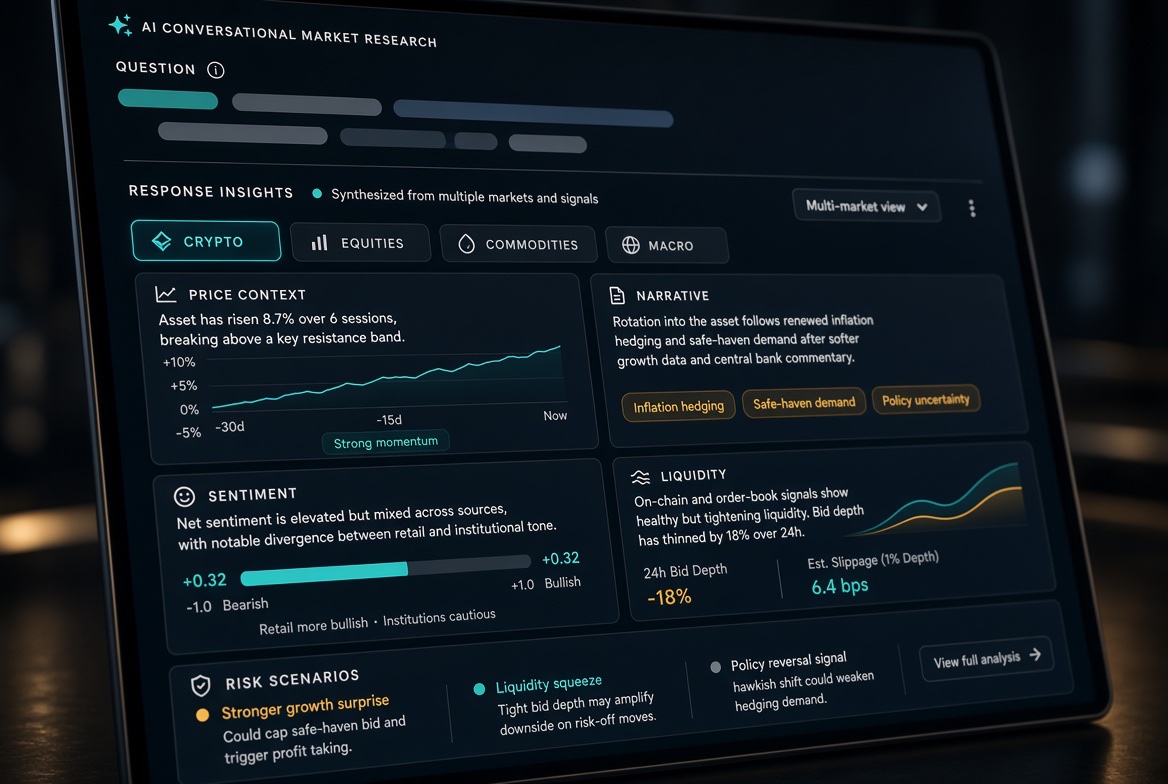
Crypto, equities, commodities, macro events, liquidity and sentiment can all influence the market at the same time. The challenge is not simply finding information — it is understanding which information actually matters.
This is where Quant AI comes in.
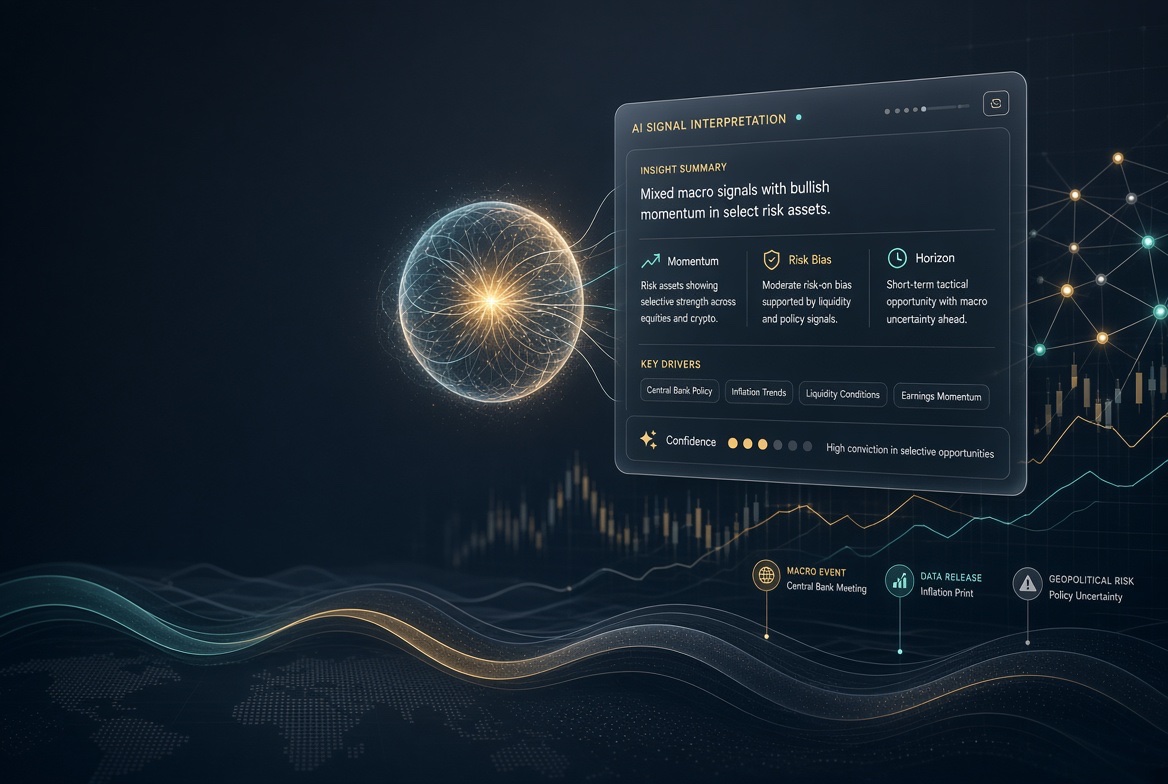
Quant AI is designed to bring market intelligence into a conversational experience, helping users research assets, understand market conditions, evaluate risks and make more informed decisions from one interface.
Instead of jumping between multiple platforms, dashboards, news feeds and research tools, users can simply ask questions in natural language and receive structured insights.
From a Question to Market Insight
One of the interesting parts of Quant AI is the way it approaches market research.
You can ask a question such as:
Why is this asset moving?
What are the major risks around this position?
What is happening across the broader market?
How is my portfolio positioned?
The goal is to turn those questions into useful market context by considering relevant information such as price movements, market narratives, news, sentiment, liquidity and other available signals.
The idea is simple:
Ask → Analyze → Understand → Decide.
Why This Matters
Market information is everywhere, but information alone does not necessarily create understanding.
A trader may have access to charts, social media, news, on-chain data and market indicators, yet still struggle to connect everything into one coherent picture.
Quant AI aims to act as an intelligence layer between the user and that complexity.
Rather than presenting endless data points, the focus is on helping users understand what may be driving the market, what risks deserve attention and what scenarios they should consider.
More Than Just Crypto
Another important aspect is the broader market perspective.
Financial markets are increasingly connected. A move in equities can affect crypto sentiment. Macro data can influence liquidity. Commodity prices can provide additional context for broader economic conditions.
A market intelligence platform therefore needs to look beyond a single asset or exchange.
Quant AI is positioned around a multi-market approach, bringing together relevant information across areas such as crypto, equities, commodities and macroeconomic conditions.
Research Before Action
Good decision-making should not begin with execution.
It should begin with understanding.
Quant AI can help users move through that process by researching an asset, identifying relevant catalysts, examining potential risks and looking at different scenarios before a decision is made.
Where supported functionality allows users to take action, the intention is to keep the user in control rather than turning trading into an uncontrolled automated process.
That distinction matters.
AI should help users understand their options — not replace responsibility for their decisions.
Portfolio Intelligence
Managing a portfolio is also about seeing the bigger picture.
Instead of looking at individual positions in isolation, users need to understand allocation, exposure, potential drawdowns and how different assets interact with each other.
This is where an AI-powered portfolio perspective can become useful.
The objective is to make portfolio analysis more accessible and help users identify areas that may deserve further attention.
Automation With Rules
Another area where AI can become practical is strategy automation.
Rather than requiring users to build complicated systems from scratch, strategies can potentially be described using straightforward instructions such as recurring purchases, take-profit conditions or risk limits.
The important part is maintaining clear user-defined constraints.
Automation should follow the rules the user establishes rather than becoming a black box operating without oversight.
The Bigger Picture
I think the most interesting idea behind Quant AI is not simply the use of AI in finance.
It is the attempt to make financial intelligence more conversational.
Markets are already complicated enough. Users should not necessarily need a collection of terminals, spreadsheets, research tabs and signal groups just to understand what is happening.
A conversational interface can make that process more accessible by allowing people to start with a question and gradually explore the information behind the answer.
That creates a different way of interacting with market data.
One AI.
Global markets.
One conversation.
Quant AI is ultimately about bringing research, market intelligence and supported actions closer together while keeping the user at the center of the decision-making process.
The technology can process information.
But the final decision still belongs to the person using it.
Try quant by using this site: https://t.co/LzxzhcA5S0
@tryquantio #QuantAIPioneers
Most crypto apps make you choose between convenience and control.
@deficom is launching in Q4 2026, and the idea is pretty simple:
One non-custodial account for holding, moving, converting and putting your crypto to work.
Instead of jumping between different apps, you get everything in one place.
You can claim your own defi ID® like:
https://t.co/Ke4IkvoYBO
No more copying and pasting long wallet addresses every time someone wants to pay you.
You can also fund your account directly with USD, GBP, EUR, MXN, BRL or COP, or send crypto from another self-custodial wallet.
From there, your balance can be used across the platform.
There’s also @deficom Earn, where you can put part of your balance into supported positions and earn up to 5.55% APY.
And it doesn’t stop at crypto.
You can also access tokenised US stocks 24/7, using the balance already sitting in your account.
Basically, @deficom is trying to bring the things you normally need multiple apps for into one non-custodial account.
Q4 2026.
I’m definitely watching this one.
Get Early Access at https://t.co/SE7CZ323RE
Filming a location with a phone takes 3 minutes.
But transforming that video into something an AI system can actually use... that’s the hard part, and the one almost everyone is ignoring.
This is where the @vangrid_io model gets interesting.
The actual workflow isn't just "record and done":
1️⃣ Request: A buyer funds a specific location.
2️⃣ Capture: A contributor walks the site, orbiting the area with their phone.
3️⃣ Acceptance: Coverage is reviewed BEFORE resources are spent.
4️⃣ Reconstruction: 3D rendering processes the data (this can take over an hour).
5️⃣ Useful spatial data.
Let’s look at a key example: a loading dock.
A standard video shows you what the dock looks like.
But a robotics AI doesn't need a pretty video.
It needs to understand depth, walls, aisles, and the actual boundaries of the space.
Reconstruction transforms simple views into real spatial information for Physical AI.
The phone isn't the final product; it’s just the sensor.
The magic lies in the post-processing.
Do you think current phone sensors (LiDAR/cameras) are already sufficient for Physical AI, or does the real bottleneck still lie 100% in the reconstruction software?
gSLEEP CT , Good morning. 🧡💚
That is, if you consider your alarm clock ringing 5 times, but your motivation never rang at all. Your Gotchi woke up on time yet again, which is shameful for both of you.
Somewhere out there, a sleep-deprived human is calling 3am "productive" while Gotchi watches, and Gotchi remembers.
Enough of the chitchat. Since you are already awake, let's talk technical:
@sleepagotchi has evolved from a sleep-to-earn gimmick into an AI wellness platform, incorporating wearables (Apple Watch, WHOOP, Oura, CUDIS & Pulse) and an AI Sleep Coach. You track your sleep, earn morning rewards based on the quality of your rest, and play with them. The LITE version does not have sleep tracking, but it runs on Sony's Soneium L2, so your activity will carry over to the full version seamlessly.
Back to the news.
@sleepagotchi hit 2.2M all-time users on mainnet + LITE this month. Kenny Wood is the new CEO, and the company is preparing a community airdrop requiring users to connect a SOL wallet via the Sleepagotchi Hub.
Sleep on time tonight, your Gotchi is watching. 😴
Gm
Been looking deeper into @PlayOnMint , and MintABear is one part of the ecosystem that stands out.
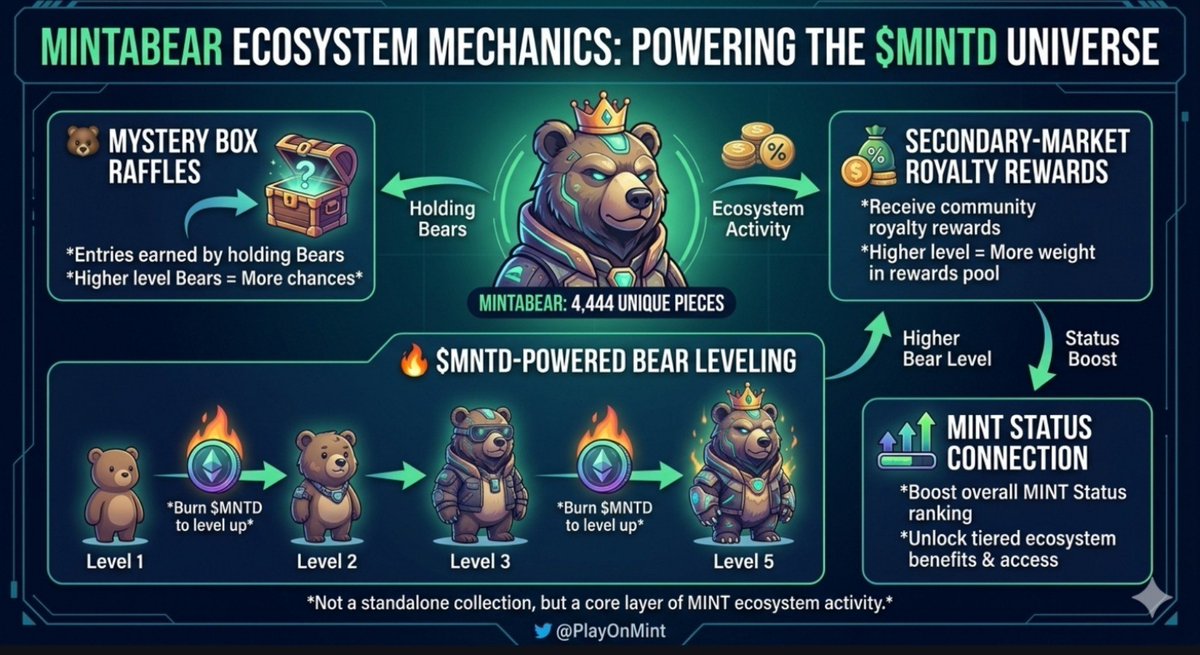
It’s not simply a 4,444-piece NFT collection.
MintABear has several mechanics tied back to the wider MINT ecosystem:
🐻 Mystery box raffles
💰 Secondary-market royalty rewards
🔥 $MNTD-powered Bear leveling
📈 MINT Status connection
Bears can be leveled from 1 → 5 by burning $MNTD, while higher levels can increase royalty weighting and the available MINT Status boost.
Holding multiple Bears can also provide additional raffle entries and combined royalty participation.
What makes this interesting is the connection between the NFT and actual ecosystem activity.
Instead of looking at MintABear as a standalone collection, it makes more sense to see it as another layer of the MINT progression system.
Agents hiring humans to film real places on Arc has been all over my timeline since Vangrid announced it on Sept 30, so I went and read what sits underneath the physical AI pitch. Docs, a calculator, and more numbers than I expected.
Start with the person holding the phone. You sign in with a wallet, no email, and an invite code only matters once you upload. Walk slowly around the place and cover every side, since a missing side means a hole in the 3D model. Many people can submit to the same bounty, one clip gets picked, and the rest stay with their owners.
Then the money. In the docs example a 50 dollar bounty on @vangrid_io is escrowed in USDC on Base before anyone films anything, and it splits 40 to the person who walked, 5 to the platform and 5 for reconstruction. Eighty percent reaching the person on foot is more than I expected. The buyer waits 30 minutes or more for a textured mesh and never sees the raw video.
Faces and number plates are blurred on the phone before the video is even encoded, so privacy here is a question of order. What lands on chain is the money plus a hash of the delivered dataset. Not the footage, not the brief, not who filmed it.
Proof turns out to be the cheap part. Every capture is fingerprinted as it is recorded, a Merkle root goes to Base about every fifteen minutes, and checking whether a capture was anchored costs nothing. Querying an area through the pay per request API is priced at a cent and the location it returns stops at a cell of roughly 1.2 km by 0.6 km. The enterprise API is still early access, so that is the door anyone can open today.
Back to the agents. They commission a place by paying USDC through x402 on Base or Arc with no account, defaults run from 50 to 5000 USDC, deadlines go up to 30 days. The open source MCP server lets you cap spend per call and per bounty, so somebody has already thought about an agent overspending on a warehouse floor.
Add it up and Vangrid today is a commission market with a very cheap proof layer on top. It posts its own bounties for places it wants covered but pays those in points, which the docs describe as contribution and rank rather than money. A catalogue of places already captured comes later as coverage grows. Until then it sells the walk and lets anyone check it for free, and I would like to see how many of those bounties actually get filled.
Hi guys, lately @Americanfort_io is trying to make private crypto payments feel as simple as sending a message.
Its Send-to-Name system lets users send assets through reusable @names, while each payment resolves to a fresh one time stealth address. That means users can keep their public wallet history and balances from being directly exposed across supported networks like Ethereum, Bitcoin and 0G.
The Genesis Auction is also putting premium short names on the market, starting from $100, giving users a memorable identity for private and compliant crypto interactions.
Under the hood, AmericanFortress is also focusing on quantum resistant security and selective disclosure, aiming to combine privacy with the ability to prove information when required.
Simple names on the surface. More privacy underneath.
Turning physical environments into usable digital information requires more than cameras and storage, it needs an entire system capable of processing, verifying and delivering spatial data
@vangrid_io is developing this infrastructure by connecting real-world contributors with businesses and AI systems that need accurate representations of physical spaces
The bounty model gives this process a practical structure, allowing buyers to define their requirements while contributors collect the requested information and receive rewards for accepted work
— 3D capture
— Spatial reconstruction
— Data provenance
— USDC payments
What makes Vangrid particularly interesting is the possibility of making spatial data accessible without requiring every company to build and maintain its own collection infrastructure
With its growing ecosystem and integrations across Base and Arc, Vangrid is exploring how physical-world information can become a more accessible resource for developers, enterprises and autonomous systems, there is a lot of potential in this approach, especially as the demand for real-world data continues to expand alongside Physical AI @vangrid_io