The new App Planning Phase feature in Pi App Studio allows creators to develop their ideas with the help of AI before App Studio generates the app.
For example, App Studio may ask for more detail about the app’s:
- Main idea
- Goal
- Design
- User experience
This helps guide creators from an initial idea toward a more complete app concept in a more interactive and dynamic way.
Watch the video walkthrough to learn how the planning process works!
Pi App Studio backend support has been enabled!
Backend capabilities begin with persistent storage for newly created App Studio apps, allowing apps to save and retrieve user-specific data across sessions.
Creators can now build App Studio apps with user experiences that continue even after users leave and return.
For example:
- Game apps can remember a user’s high scores
- Productivity apps can remember a user’s to-do lists
- Note-taking apps can preserve notes automatically
Before, Pi App Studio apps were largely limited to frontend-only, single-session experiences, where app data such as preferences or progress would disappear if users left the app.
Adding backend support is a significant App Studio platform milestone because it expands what AI-created apps can practically do on Pi Network. Persistent storage is the first capability built on this foundation, enabling a broader range of useful, everyday applications.
Learn more and create apps with this new feature in Pi App Studio today!
https://t.co/UlKKz3ZcjG
Pi App Studio has released two updates to help creators build more engaging and useful app experiences.
1. Backend support enables persistent user experiences for newly created App Studio apps: Apps can save and retrieve user-specific data across sessions, enabling experiences that continue even after users leave and return.
2. AI-assisted App Planning Phase: Creators can develop their ideas with the help of AI before App Studio generates the app. This helps guide creators from an initial idea toward a more complete app concept in a more interactive and dynamic way.
Go to the Pi mining app to learn more, and create new apps with these features today!
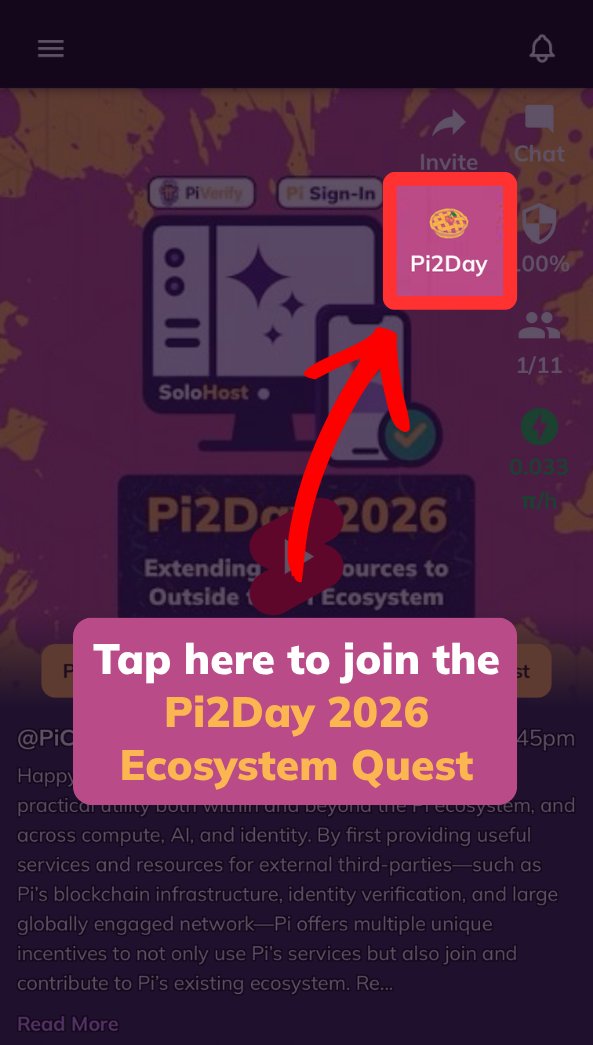
Take on the Pi2Day Ecosystem Quest to celebrate new feature releases and receive a special in-app badge!
The Ecosystem Quest guides Pioneers to complete activities to discover new apps, test ecosystem features, and understand how Pi’s infrastructure supports utility creation across compute, AI, and identity.
Certain steps in the Quest require completing a quiz, so remember to pay attention to the updates! You can show-off your in-app badge in Pi Chats, Fireside Forum, and Pi Social Profiles.
Participate in the Ecosystem Quest by tapping the “Pi2Day” icon on the top right of the Pi mining app home screen. The event will end on July 13.
New to Pi? Download the Pi mining app and get started here https://t.co/sHTvwa8Vt7
Strategic Predictive Analysis: ::
Pi Network Integrated with the Docker Ecosystem
( The Separation of Engine and GUI, and the Technical Reality of a Global Distributed Orchestration Infrastructure )
[[[ This article includes Predictive & Technical Analysis and may differ from actual outcomes ]]]
[[[ The Convergence of the Docker Daemon and Pi Control GUI: Revolutionizing Server/Client Architectures ]]]
[[[ Hermes Agent Expansion and the Dynamic Pulse of Millisecond Container Scheduling ]]]
[[[ Bypassing Reinvention: Absorbing the Entire Docker Open-Source Ecosystem as a Planetary Infrastructure ]]]
[[[ Beyond Kubernetes: Protocol-Level Auto-Deployment and Self-Healing via a Globally Distributed Swarm ]]]
1. Introduction: Separation of Technical Layers and the Structural Reality of Metamorphosis
For a long time, discourse surrounding Pi Network has been heavily skewed toward its monetary valuation or alternative payment utility. However, the most disruptive innovation occurring within the technical backstage is the absolute integration of the Pi Desktop App with the global virtualization standard: the Docker community infrastructure.
The structural reality of the Pi Desktop App aligns flawlessly with the classic Server/Client (C/S) architecture found in high-availability media streaming and video recording server infrastructures, where the encoding engine and the control GUI are strictly separated. The Docker Daemon serves as the background 'encoding engine (server)'—handling heavy-duty computational tasks and strict sandboxed isolation—while the Pi Desktop App operates as the 'control GUI (client)' that monitors and orchestrates resource distribution. This absolute coupling redefines the Pi Desktop App from a passive interface into a living, planetary-scale distributed hypervisor CMS.
-----
2. Technical Mechanism: Hermes Agent and the Dynamic Spawning of Fractional Containers
From an engineering standpoint, the most profound spectacle is the sheer dynamism occurring within the Docker main container dashboard, where containers constantly spawn and destroy in real time. The Hermes Local Agent, initially deployed with a 127.0.0.1 loopback IP, is a masterpiece of proactive sandbox isolation designed to protect the host machine during development phases.
The moment this port control mechanism is expanded at the protocol level to local networks, static server IPs, and wider routing ranges, Pi instantly unlocks a global, High-Availability (HA) Distributed Virtual Cloud. When a decentralized application (dApp) or a micro-computation task is requested via the protocol, the Docker engines of hundreds of thousands of active nodes respond synchronously. They spawn dedicated utility containers for fractions of a second, execute the localized task, and dissolve them seamlessly without leaving a trace on the host OS.
While the Root Virtual Distributed CPU Container (the consensus node) maintains the immutable spine of the network, the underlying utility containers capture and consume idle local CPU cycles, RAM, and storage with zero percent allocation waste. The entire pipeline represents a fully automated orchestration environment capable of protocol-driven deployment, isolation, and self-healing.
-----
3. Strategic Foresight: Infinite Runtime Territory Expansion via Docker Standardization
The core engineering team’s most brilliant strategic move was refusing to reinvent the wheel. Instead, they fully integrated the existing global standard of the Docker community infrastructure into the bedrock of the platform. Because the Pi Desktop CMS strictly adheres to 100% Docker-standard specifications, it inherits the entire Docker Hub repository. This means millions of pre-verified open-source images, databases, and AI models created by the world's elite developers can be pulled and run atop Pi's distributed infrastructure with zero porting or code modifications.
Furthermore, the system creates a flawless, All-in-One Pipeline development hub via the built-in 'App Studio'. The moment a developer codes a Soroban (Soroban/Rust-based) smart contract or dApp, the protocol automatically handles the DevOps stress, instantly deploying it across isolated container layers globally. An enterprise-grade computing architecture is thus transformed into a global public utility, managed by an automated decentralized playground.
-----------------------
4. Conclusion: A Self-Evolving Digital Organism Beyond Kubernetes
-----------------------
While centralized tech monopolies continue to sink astronomical overhead into maintaining massive, centralized data centers (AWS, Google Cloud) wrapped in administrative and security vulnerabilities, Pi Network has executed an architectural counter-move: deploying a globally unified infrastructure that breathes natively through the Docker community.
The hyperactive flickering of containers spinning up and terminating inside the Docker dashboard is not mere log output. It is the rhythmic heartbeat of a planetary distributed supercomputer computing real-time workloads. By elegantly fusing proven technical standards with ironclad sandbox isolation and protocol-driven orchestration, this infrastructure stands prepared. As elite developers and superintelligent AI agents begin to utilize this frictionless, zero-marginal-cost ecosystem to unleash millions of high-utility apps, the technical monopoly of legacy web infrastructure will be permanently rewritten. The tipping point has passed; the technical shift is already active.
Pi2Day 2026 reflects how Pi’s utility continues to grow through infrastructure and participation.
- Through SoloHost, Pi Desktop and Nodes can support new local AI app and compute use cases
- Pi Sign-in can help connect those experiences across users, devices, and services
- PiVerify can extend Pi’s real-human verification capabilities to third-party clients.
Together, these releases point to a broader direction for the ecosystem: Pi products are built both for the Pi ecosystem and to extend Pi services and resources to the external world. This, in turn, enriches and strengthens the Pi ecosystem.
Pi’s practical utility is built not only by product releases but by the Pioneers, Node operators, developers, KYC validators, app teams, merchants, and third-party services that use them, test them, and build on them.
Read the Pi2Day 2026 blog to learn more
https://t.co/5hkl8TAxxQ
SoloHost expands the utility of Pi Nodes beyond just blockchain validation.
Released in Beta on Pi2Day 2026, SoloHost on Pi Desktop gives Pioneers new ways to use their computers to run local apps, AI utilities, distributed computing, and other compute-based use cases.
Pioneers can also remotely engage with the corresponding app through mobile devices on Pi Browser.
SoloHost also lets developers build and list these local apps through an open, permissionless framework to reach the over 420,000 Pi Node operators who are already running Pi Desktop.
Local is key. With SoloHost streamlining access to local applications through Pi Desktop, people can benefit from AI while keeping their data on their own devices, not third-party remote servers.
This means:
- More privacy.
- More control.
- Less reliance on cloud services
Learn more at https://t.co/lMgJBEMbYj
Pi Sign-in allows supported third-party websites and apps to offer Pi accounts as a sign-in or sign-up option.
It helps provide the infrastructure that allows applications and services to recognize, connect, and serve users across and outside the ecosystem.
This means Pioneers can access supported services with their Pi account instead of creating a new account or password for every app.
Why would third-party services or websites want to integrate Pi Sign-in? Pi Sign-in creates a simpler way to connect them with Pi’s large user base and bring Pi users into their own product experiences. It also gives Pi more presence in third-party contexts while offering a way to tap into the additional benefits and resources of Pi Network, besides user traffic.
Learn more about the Pi2Day 2026 release at https://t.co/lMgJBEMbYj
PiVerify is a KYC identity verification service available to third-party companies, making Pi’s real-human verification capabilities available outside the Pi ecosystem.
With PiVerify, external platforms can verify their users, reduce fake or duplicate accounts, and support compliance-related identity workflows.
For businesses and platforms, the need is straightforward: many digital services need to know whether users are real people. Verified identities are needed for any meaningful transactions, especially in real-world economies.
PiVerify services are also paid for in Pi, which increases Pi utility.
By making this infrastructure available to third parties, the Pi2Day 2026 PiVerify release extends the utility of Pi’s verified identity technology and resources beyond Pi’s own apps and services.
Learn more at https://t.co/azUeoeGENF
The three key Pi2Day 2026 releases extend Pi’s services to businesses and developers outside the Pi ecosystem, while inviting them to join Pi Network and take advantage of Pi’s unique benefits and resources.
Read the full Pi2Day blog to learn more about the SoloHost, Pi Sign-in, and PiVerify releases.
https://t.co/lMgJBEMbYj
Strategic Predictive Analysis :::
Pi2Day 2026: Advancing External Expansion and Practical Utility Through the Convergence of Compute, AI, and Identity
( Pi2Day 2026: Advancing Utility and External Access Through Compute, AI, and Identity , https://t.co/zE89KMhn07 )
[[[ This article includes Predictive & Technical Analysis and may differ from actual outcomes ]]]
[[[ The Dawn of Next-Generation Distributed Computing: SoloHost Framework and the Diversification of Node Infrastructure ]]]
[[[ Data Privacy Innovation in the AI Era: Local AI Agents and Seamless Cross-Device Authentication ]]]
[[[ Scaling Global Identity Infrastructure: Advancing External Platforms via PiVerify Identity Solutions ]]]
[[[ Utility-Driven Token Economics: Sustaining Long-Term Value Circulation Through External Capital Inflow ]]]
1. Computer Science & Distributed Architecture: Evolving into a Decentralized Compute Layer via SoloHost
The most significant technological shift unveiled in the Pi2Day 2026 announcement is the fundamental elevation of the Pi Node and Desktop environment from a standard blockchain ledger infrastructure into a highly practical **Distributed Computing Layer.
1). Introduction of the SoloHost Framework:
The newly launched SoloHost provides an open, permissionless environment within Pi Desktop where third-party developers can seamlessly build and list applications or node utilities without having to manually configure complex server environments or Docker instances. This effectively transforms a Pioneer's computer into their own self-hosted server.
2). Synergy with Local AI Agent 'Hermes':
Released as an open-source utility on SoloHost, the 'Hermes' AI agent runs and stores all its data locally on the user's computer. By computing directly on the owner's hardware rather than routing through remote cloud servers, it natively resolves the critical data privacy anxieties of the AI era, ensuring absolute user data ownership.
3). Commercializing Distributed Computing for High-Performance Nodes:
An upcoming distributed computing application will soon deploy, specifically coordinating available computing resources from the top ~100 Node operators. This automation scales previous proof-of-concept projects into production-level utility, aggregating the collective power of over 420,000 Nodes to handle intensive AI tasks for external clients.
-----
2. Innovative Business Model & Competitive Advantage: Outward Expansion and Seamless Integration
Breaking out of the traditional Web3 limitation of a closed ecosystem, Pi Network has implemented robust interfaces designed to export its infrastructure directly into the wider internet and third-party commercial applications.
1). Cross-Device Access and External Authentication via Pi Sign-in:
Pioneers can now use their verified Pi accounts to sign into supported third-party apps and websites outside the Pi Browser. Strategically, this acts as a gateway for SoloHost; users can seamlessly authenticate, remotely access, and control their locally running desktop AI agents directly from their mobile devices without complex networking configurations.
2). Monetizing Identity Infrastructure through PiVerify:
Pi Network's hybrid AI-and-human KYC infrastructure—which has validated over 18 million real humans across more than 200 countries—is now commercially available to external enterprises via **PiVerify**. Digital services, fintech platforms, Web3 applications, and AI networks struggling with Sybil attacks, duplicate accounts, and compliance workflows can now leverage Pi’s turnkey solution to verify their own user bases.
-----
3. Economic Mathematics & Tokenomics: External Capital Inflow and Sustainable Value Cycles
Rather than relying on speculative peer-to-peer trading characteristic of legacy crypto markets, the structural architecture outlined in this release introduces a **non-speculative value cycle** driven directly by actual enterprise demand from the external tech sector.
1). Inflow of External Enterprise Capital:
When third-party clients and digital platforms integrate the PiVerify KYC API to audit their users, or enlist high-performance Pi Nodes to process heavy AI workloads, the service fees must be settled in **Pi**. This creates a constant mechanism for external fiat-backed liquidity to be converted into Pi, underpinning the network's intrinsic utility.
2). Compensating Node Operators as Compute Providers:
The Pi revenue paid by external corporate clients is dynamically distributed as compensation to the participating Node operators providing their processing power. This transitions Node operators from mere blockchain consensus verifiers into commercial infrastructure suppliers for the global AI market, establishing a self-sustaining financial model.
-----------------------------------
4. Global Geopolitics & Future Outlook: The Definitive Infrastructure Backbone of the AI Era
-----------------------------------
The global digital landscape is undergoing an unprecedented geopolitical and technological transition, defined by a massive supply shortage of computing power for expanding AI models, and tightening compliance regulations requiring airtight identity verification for digital transactions.
Through this comprehensive release, Pi Network has strategically positioned itself as a dual-engine utility provider capable of exporting both **Compute** and **Identity**—the two absolute pillars of the AI era—to the external world.
As enterprises worldwide are forced by regulatory and privacy demands to filter out automated bots and protect consumer data, they will naturally migrate toward Pi’s ready-made, highly scalable infrastructure. By extending these critical resources to the external internet, Pi Network has successfully solidified its position as a global utility empire, using outside commercial demand to enrich and fortify its internal ecosystem.
Pi2Day celebrates double Pi Day — June 28th — because one day a year isn't enough to celebrate the Pi community.
Watch the video below and head to the Pi mining app to learn more about Pi2Day 2026’s key releases: SoloHost, Pi Sign-In, and PiVerify!
Strategic Predictive Analysis :::
Pi Network—The Completion of a Sovereign, Ownership-Based Economy and Dream Distributed Utility Platform Built Through Collective Community Effort
[[[ This article includes Predictive & Technical Analysis and may differ from actual outcomes ]]]
[[[ Dismantling Technological Barriers: One-Click Virtualization and the Democratization of Decentralized AI for Everyday Users ]]]
[[[ The Era of Zero Network Configuration: Account-Based Cryptographic Tunneling and Seamless P2P Remote Control ]]]
[[[ Decentralizing the Big Tech Cloud Monopolies: DePIN-Driven Tokenization of Idle Resources and the Economics of Distributed Utilities ]]]
[[[ The Inception of a Consumer-Sovereign Economy: Direct Reinvestment of Corporate Fee Reductions Back to the Global Community ]]]
1. Eliminating Technical Barriers: Securing AI Sovereignty for Everyday Users via "One-Click Virtualization"
The most monumental computer science achievement of the 2026 Pi2Day upgrade is the complete abstraction of complex blockchain and containerization architectures into an interface accessible to everyday individuals, effectively leveling the barrier to entry for modern technological civilization.
1). Complete Abstraction of Engineering Hurdles: Historically, for an individual to operate a local Large Language Model (LLM) without compromising data privacy, they were forced to navigate extreme technical hurdles—such as purchasing specialized high-end hardware, configuring local Python environments, and manually executing complex Docker commands.
2). One-Click Sovereign Data Privacy: The newly upgraded Pi Desktop client addresses this by immediately soldering the user's sovereign Pi account authentication directly to the underlying Docker virtualization layer the moment "SoloHost Integration" is selected. Much like using a standard mobile app store, everyday users can deploy five distinct high-end AI models—ranging from the efficient SmallLM2 to the robust 26B Gemma 2—with a single click. This architecture guarantees absolute data privacy, ensuring that personal photos, documents, and sensitive financial logs never leak to remote external servers.
-----
2. Networking Infrastructure Innovation: Standardizing Flawless E2E Tunneling via "Remote Access"
The distributed platform engineered by Pi Network delivers uncompromised mobility and cross-device connectivity, allowing everyday individuals to seamlessly access their local computing utilities anytime, anywhere.
1). The End of Complex Network Configurations: The obsolete Web2 requirements of purchasing static IP addresses, managing router port-forwarding, or troubleshooting legacy Dynamic DNS (DDNS) configurations to connect to a high-performance home PC while traveling or working remotely are now completely eradicated.
2). Cryptographic Routing via Perpetual Account Sync: This fluid experience is possible because the desktop node architecture and the mobile Pi Browser remain perpetually synchronized via the exact same identity ledger. When a user inputs the standardized access link generated within the Pi Browser, account-based cryptographic routing instantly penetrates firewalls, establishing a private, end-to-end (E2E) encrypted tunnel directly to the home desktop without routing through a single centralized corporate data center.
-----
3. Economic Mathematics & Business Model: Infrastructure Self-Sufficiency Through DePIN Tokenization
The newly aligned Storage, Compute, and Utilities categories structuralizing the desktop interface represent a clear economic blueprint detailing how collective community efforts translate directly into a massive Decentralized Physical Infrastructure Network (DePIN).
1). Disrupting Centralized Data Center Cost Margins: While centralized Big Tech conglomerates hemorrhage tens of billions of dollars annually on cooling grids, energy bills, and hardware upkeep to sustain remote cloud clusters for AI execution, Pi securely ties the idle CPU/GPU processing power and unutilized storage capacity of over 420,000 active nodes directly into the core token utility.
2). An Alternative Economy for Non-Technical Users: Everyday consumers who lack hardware literacy or systems engineering skills are no longer held hostage by the expensive, predatory subscription models of corporate AI monopolies. Instead, they can affordably purchase native utility tokens to rent secure, distributed computing power maintained by node operators globally, establishing a symbiotic, self-sustaining financial framework.
--------------------------
4. Civilizational Shift in Daily Life: True Financial Democratization Atop an Ownership-Based Economy
--------------------------
True technological revolutions do not succeed by forcing the masses to study complex backend engineering; they materialize when the general public intuitively recognizes that a platform is drastically cheaper, inherently more secure, and infinitely more convenient. While legacy crypto markets collapse under the weight of speculative trading bots and wash-trading syndicates, Pi’s localized infrastructure branches directly out into practical, real-world utility for everyday humanity.
As massive global e-commerce networks and enterprises inevitably migrate toward Pi’s low-cost settlement rails and enterprise identity auditing services (PiVerify) to eliminate predatory credit card transaction fees, the resulting economic windfall flows directly back to the sovereign ecosystem participants.
Everyday individuals do not need to understand the underlying cryptographic architecture; they simply occupy the peak position of this newly formed "Ownership-Based Economy," using the integrated Pi Browser to organically harvest optimized discounts, decentralized applications, and localized AI utilities. Through collective community dedication, Pi Network has broken the structural capital bottlenecks of centralized Big Tech, successfully finalizing a dream distributed utility platform capable of welcoming the mass migration of global humanity.
Happy Pi2Day 2026 Pioneers!
Pi Network is celebrating Pi2Day with new releases advancing Pi’s practical utility both within and beyond the Pi ecosystem, and across compute, AI, and identity.
By first providing useful services and resources for external third-parties—such as Pi’s blockchain infrastructure, identity verification, and large globally engaged network—Pi offers multiple unique incentives to not only use Pi’s services but also join and contribute to Pi’s existing ecosystem.
Head to the Pi mining app and read the Pi2Day announcement to learn more about the new SoloHost, Pi Sign-in, and PiVerify releases today!
Also, take part in the Pi2Day Ecosystem Quest to learn more about the new releases, test features, and earn a special in-app badge to commemorate Pi2Day 2026—and show it off!


![applekhankorea's tweet photo. Strategic Predictive Analysis: ::
Pi Network Integrated with the Docker Ecosystem
( The Separation of Engine and GUI, and the Technical Reality of a Global Distributed Orchestration Infrastructure )
[[[ This article includes Predictive & Technical Analysis and may differ from actual outcomes ]]]
[[[ The Convergence of the Docker Daemon and Pi Control GUI: Revolutionizing Server/Client Architectures ]]]
[[[ Hermes Agent Expansion and the Dynamic Pulse of Millisecond Container Scheduling ]]]
[[[ Bypassing Reinvention: Absorbing the Entire Docker Open-Source Ecosystem as a Planetary Infrastructure ]]]
[[[ Beyond Kubernetes: Protocol-Level Auto-Deployment and Self-Healing via a Globally Distributed Swarm ]]]
1. Introduction: Separation of Technical Layers and the Structural Reality of Metamorphosis
For a long time, discourse surrounding Pi Network has been heavily skewed toward its monetary valuation or alternative payment utility. However, the most disruptive innovation occurring within the technical backstage is the absolute integration of the Pi Desktop App with the global virtualization standard: the Docker community infrastructure.
The structural reality of the Pi Desktop App aligns flawlessly with the classic Server/Client (C/S) architecture found in high-availability media streaming and video recording server infrastructures, where the encoding engine and the control GUI are strictly separated. The Docker Daemon serves as the background 'encoding engine (server)'—handling heavy-duty computational tasks and strict sandboxed isolation—while the Pi Desktop App operates as the 'control GUI (client)' that monitors and orchestrates resource distribution. This absolute coupling redefines the Pi Desktop App from a passive interface into a living, planetary-scale distributed hypervisor CMS.
-----
2. Technical Mechanism: Hermes Agent and the Dynamic Spawning of Fractional Containers
From an engineering standpoint, the most profound spectacle is the sheer dynamism occurring within the Docker main container dashboard, where containers constantly spawn and destroy in real time. The Hermes Local Agent, initially deployed with a 127.0.0.1 loopback IP, is a masterpiece of proactive sandbox isolation designed to protect the host machine during development phases.
The moment this port control mechanism is expanded at the protocol level to local networks, static server IPs, and wider routing ranges, Pi instantly unlocks a global, High-Availability (HA) Distributed Virtual Cloud. When a decentralized application (dApp) or a micro-computation task is requested via the protocol, the Docker engines of hundreds of thousands of active nodes respond synchronously. They spawn dedicated utility containers for fractions of a second, execute the localized task, and dissolve them seamlessly without leaving a trace on the host OS.
While the Root Virtual Distributed CPU Container (the consensus node) maintains the immutable spine of the network, the underlying utility containers capture and consume idle local CPU cycles, RAM, and storage with zero percent allocation waste. The entire pipeline represents a fully automated orchestration environment capable of protocol-driven deployment, isolation, and self-healing.
-----
3. Strategic Foresight: Infinite Runtime Territory Expansion via Docker Standardization
The core engineering team’s most brilliant strategic move was refusing to reinvent the wheel. Instead, they fully integrated the existing global standard of the Docker community infrastructure into the bedrock of the platform. Because the Pi Desktop CMS strictly adheres to 100% Docker-standard specifications, it inherits the entire Docker Hub repository. This means millions of pre-verified open-source images, databases, and AI models created by the world's elite developers can be pulled and run atop Pi's distributed infrastructure with zero porting or code modifications.
Furthermore, the system creates a flawless, All-in-One Pipeline development hub via the built-in 'App Studio'. The moment a developer codes a Soroban (Soroban/Rust-based) smart contract or dApp, the protocol automatically handles the DevOps stress, instantly deploying it across isolated container layers globally. An enterprise-grade computing architecture is thus transformed into a global public utility, managed by an automated decentralized playground.
-----------------------
4. Conclusion: A Self-Evolving Digital Organism Beyond Kubernetes
-----------------------
While centralized tech monopolies continue to sink astronomical overhead into maintaining massive, centralized data centers (AWS, Google Cloud) wrapped in administrative and security vulnerabilities, Pi Network has executed an architectural counter-move: deploying a globally unified infrastructure that breathes natively through the Docker community.
The hyperactive flickering of containers spinning up and terminating inside the Docker dashboard is not mere log output. It is the rhythmic heartbeat of a planetary distributed supercomputer computing real-time workloads. By elegantly fusing proven technical standards with ironclad sandbox isolation and protocol-driven orchestration, this infrastructure stands prepared. As elite developers and superintelligent AI agents begin to utilize this frictionless, zero-marginal-cost ecosystem to unleash millions of high-utility apps, the technical monopoly of legacy web infrastructure will be permanently rewritten. The tipping point has passed; the technical shift is already active.](https://pbs.twimg.com/media/HMKsaouasAAUuRr.jpg)


![applekhankorea's tweet photo. Strategic Predictive Analysis :::
Pi2Day 2026: Advancing External Expansion and Practical Utility Through the Convergence of Compute, AI, and Identity
( Pi2Day 2026: Advancing Utility and External Access Through Compute, AI, and Identity , https://t.co/zE89KMhn07 )
[[[ This article includes Predictive & Technical Analysis and may differ from actual outcomes ]]]
[[[ The Dawn of Next-Generation Distributed Computing: SoloHost Framework and the Diversification of Node Infrastructure ]]]
[[[ Data Privacy Innovation in the AI Era: Local AI Agents and Seamless Cross-Device Authentication ]]]
[[[ Scaling Global Identity Infrastructure: Advancing External Platforms via PiVerify Identity Solutions ]]]
[[[ Utility-Driven Token Economics: Sustaining Long-Term Value Circulation Through External Capital Inflow ]]]
1. Computer Science & Distributed Architecture: Evolving into a Decentralized Compute Layer via SoloHost
The most significant technological shift unveiled in the Pi2Day 2026 announcement is the fundamental elevation of the Pi Node and Desktop environment from a standard blockchain ledger infrastructure into a highly practical **Distributed Computing Layer.
1). Introduction of the SoloHost Framework:
The newly launched SoloHost provides an open, permissionless environment within Pi Desktop where third-party developers can seamlessly build and list applications or node utilities without having to manually configure complex server environments or Docker instances. This effectively transforms a Pioneer's computer into their own self-hosted server.
2). Synergy with Local AI Agent 'Hermes':
Released as an open-source utility on SoloHost, the 'Hermes' AI agent runs and stores all its data locally on the user's computer. By computing directly on the owner's hardware rather than routing through remote cloud servers, it natively resolves the critical data privacy anxieties of the AI era, ensuring absolute user data ownership.
3). Commercializing Distributed Computing for High-Performance Nodes:
An upcoming distributed computing application will soon deploy, specifically coordinating available computing resources from the top ~100 Node operators. This automation scales previous proof-of-concept projects into production-level utility, aggregating the collective power of over 420,000 Nodes to handle intensive AI tasks for external clients.
-----
2. Innovative Business Model & Competitive Advantage: Outward Expansion and Seamless Integration
Breaking out of the traditional Web3 limitation of a closed ecosystem, Pi Network has implemented robust interfaces designed to export its infrastructure directly into the wider internet and third-party commercial applications.
1). Cross-Device Access and External Authentication via Pi Sign-in:
Pioneers can now use their verified Pi accounts to sign into supported third-party apps and websites outside the Pi Browser. Strategically, this acts as a gateway for SoloHost; users can seamlessly authenticate, remotely access, and control their locally running desktop AI agents directly from their mobile devices without complex networking configurations.
2). Monetizing Identity Infrastructure through PiVerify:
Pi Network's hybrid AI-and-human KYC infrastructure—which has validated over 18 million real humans across more than 200 countries—is now commercially available to external enterprises via **PiVerify**. Digital services, fintech platforms, Web3 applications, and AI networks struggling with Sybil attacks, duplicate accounts, and compliance workflows can now leverage Pi’s turnkey solution to verify their own user bases.
-----
3. Economic Mathematics & Tokenomics: External Capital Inflow and Sustainable Value Cycles
Rather than relying on speculative peer-to-peer trading characteristic of legacy crypto markets, the structural architecture outlined in this release introduces a **non-speculative value cycle** driven directly by actual enterprise demand from the external tech sector.
1). Inflow of External Enterprise Capital:
When third-party clients and digital platforms integrate the PiVerify KYC API to audit their users, or enlist high-performance Pi Nodes to process heavy AI workloads, the service fees must be settled in **Pi**. This creates a constant mechanism for external fiat-backed liquidity to be converted into Pi, underpinning the network's intrinsic utility.
2). Compensating Node Operators as Compute Providers:
The Pi revenue paid by external corporate clients is dynamically distributed as compensation to the participating Node operators providing their processing power. This transitions Node operators from mere blockchain consensus verifiers into commercial infrastructure suppliers for the global AI market, establishing a self-sustaining financial model.
-----------------------------------
4. Global Geopolitics & Future Outlook: The Definitive Infrastructure Backbone of the AI Era
-----------------------------------
The global digital landscape is undergoing an unprecedented geopolitical and technological transition, defined by a massive supply shortage of computing power for expanding AI models, and tightening compliance regulations requiring airtight identity verification for digital transactions.
Through this comprehensive release, Pi Network has strategically positioned itself as a dual-engine utility provider capable of exporting both **Compute** and **Identity**—the two absolute pillars of the AI era—to the external world.
As enterprises worldwide are forced by regulatory and privacy demands to filter out automated bots and protect consumer data, they will naturally migrate toward Pi’s ready-made, highly scalable infrastructure. By extending these critical resources to the external internet, Pi Network has successfully solidified its position as a global utility empire, using outside commercial demand to enrich and fortify its internal ecosystem.](https://pbs.twimg.com/media/HL89wgVboAAdHfF.jpg)
![applekhankorea's tweet photo. Strategic Predictive Analysis :::
Pi Network—The Completion of a Sovereign, Ownership-Based Economy and Dream Distributed Utility Platform Built Through Collective Community Effort
[[[ This article includes Predictive & Technical Analysis and may differ from actual outcomes ]]]
[[[ Dismantling Technological Barriers: One-Click Virtualization and the Democratization of Decentralized AI for Everyday Users ]]]
[[[ The Era of Zero Network Configuration: Account-Based Cryptographic Tunneling and Seamless P2P Remote Control ]]]
[[[ Decentralizing the Big Tech Cloud Monopolies: DePIN-Driven Tokenization of Idle Resources and the Economics of Distributed Utilities ]]]
[[[ The Inception of a Consumer-Sovereign Economy: Direct Reinvestment of Corporate Fee Reductions Back to the Global Community ]]]
1. Eliminating Technical Barriers: Securing AI Sovereignty for Everyday Users via "One-Click Virtualization"
The most monumental computer science achievement of the 2026 Pi2Day upgrade is the complete abstraction of complex blockchain and containerization architectures into an interface accessible to everyday individuals, effectively leveling the barrier to entry for modern technological civilization.
1). Complete Abstraction of Engineering Hurdles: Historically, for an individual to operate a local Large Language Model (LLM) without compromising data privacy, they were forced to navigate extreme technical hurdles—such as purchasing specialized high-end hardware, configuring local Python environments, and manually executing complex Docker commands.
2). One-Click Sovereign Data Privacy: The newly upgraded Pi Desktop client addresses this by immediately soldering the user's sovereign Pi account authentication directly to the underlying Docker virtualization layer the moment "SoloHost Integration" is selected. Much like using a standard mobile app store, everyday users can deploy five distinct high-end AI models—ranging from the efficient SmallLM2 to the robust 26B Gemma 2—with a single click. This architecture guarantees absolute data privacy, ensuring that personal photos, documents, and sensitive financial logs never leak to remote external servers.
-----
2. Networking Infrastructure Innovation: Standardizing Flawless E2E Tunneling via "Remote Access"
The distributed platform engineered by Pi Network delivers uncompromised mobility and cross-device connectivity, allowing everyday individuals to seamlessly access their local computing utilities anytime, anywhere.
1). The End of Complex Network Configurations: The obsolete Web2 requirements of purchasing static IP addresses, managing router port-forwarding, or troubleshooting legacy Dynamic DNS (DDNS) configurations to connect to a high-performance home PC while traveling or working remotely are now completely eradicated.
2). Cryptographic Routing via Perpetual Account Sync: This fluid experience is possible because the desktop node architecture and the mobile Pi Browser remain perpetually synchronized via the exact same identity ledger. When a user inputs the standardized access link generated within the Pi Browser, account-based cryptographic routing instantly penetrates firewalls, establishing a private, end-to-end (E2E) encrypted tunnel directly to the home desktop without routing through a single centralized corporate data center.
-----
3. Economic Mathematics & Business Model: Infrastructure Self-Sufficiency Through DePIN Tokenization
The newly aligned Storage, Compute, and Utilities categories structuralizing the desktop interface represent a clear economic blueprint detailing how collective community efforts translate directly into a massive Decentralized Physical Infrastructure Network (DePIN).
1). Disrupting Centralized Data Center Cost Margins: While centralized Big Tech conglomerates hemorrhage tens of billions of dollars annually on cooling grids, energy bills, and hardware upkeep to sustain remote cloud clusters for AI execution, Pi securely ties the idle CPU/GPU processing power and unutilized storage capacity of over 420,000 active nodes directly into the core token utility.
2). An Alternative Economy for Non-Technical Users: Everyday consumers who lack hardware literacy or systems engineering skills are no longer held hostage by the expensive, predatory subscription models of corporate AI monopolies. Instead, they can affordably purchase native utility tokens to rent secure, distributed computing power maintained by node operators globally, establishing a symbiotic, self-sustaining financial framework.
--------------------------
4. Civilizational Shift in Daily Life: True Financial Democratization Atop an Ownership-Based Economy
--------------------------
True technological revolutions do not succeed by forcing the masses to study complex backend engineering; they materialize when the general public intuitively recognizes that a platform is drastically cheaper, inherently more secure, and infinitely more convenient. While legacy crypto markets collapse under the weight of speculative trading bots and wash-trading syndicates, Pi’s localized infrastructure branches directly out into practical, real-world utility for everyday humanity.
As massive global e-commerce networks and enterprises inevitably migrate toward Pi’s low-cost settlement rails and enterprise identity auditing services (PiVerify) to eliminate predatory credit card transaction fees, the resulting economic windfall flows directly back to the sovereign ecosystem participants.
Everyday individuals do not need to understand the underlying cryptographic architecture; they simply occupy the peak position of this newly formed "Ownership-Based Economy," using the integrated Pi Browser to organically harvest optimized discounts, decentralized applications, and localized AI utilities. Through collective community dedication, Pi Network has broken the structural capital bottlenecks of centralized Big Tech, successfully finalizing a dream distributed utility platform capable of welcoming the mass migration of global humanity.](https://pbs.twimg.com/media/HL9LI0bbUAAZto7.jpg)


