The Chair furthers dialogue for peace in the Middle East and abroad, bridges the gap among academic and policy worlds and maintains a rigorous research agenda.
Thank you to Professor Antoine Banks @antoinebanksumd, special guest at the last Sadat Book Chat of the semester! Professor Banks shared insights and took questions on his excellent book with Ismail White, The Anger Rule: Racial Inequality and Constraints on Black Politicians.
“Pressures faced by Middle East scholars are not abstract. Respondents to our survey share wide range of accounts of talks and events being canceled, institutional pressure to be silent or cautious, and appalling campaigns against them by external actors" https://t.co/5Ij3jdSckL
Biden administration’s Gaza policy gets failing grades from polled ME scholars: More than three-quarters say Biden’s policy negatively impacts prospects of peace in Israel/Palestine, US interests in the Middle East, and America’s standing in the world. https://t.co/lSw4mI2xFd
Few Middle East experts believe that a two-state solution is realistic in the foreseeable future, and most think the war will lead to large-scale, long-term displacement of Palestinians from Gaza & the West Bank, write @ShibleyTelhami and Marc Lynch: https://t.co/93FJPcxDeJ
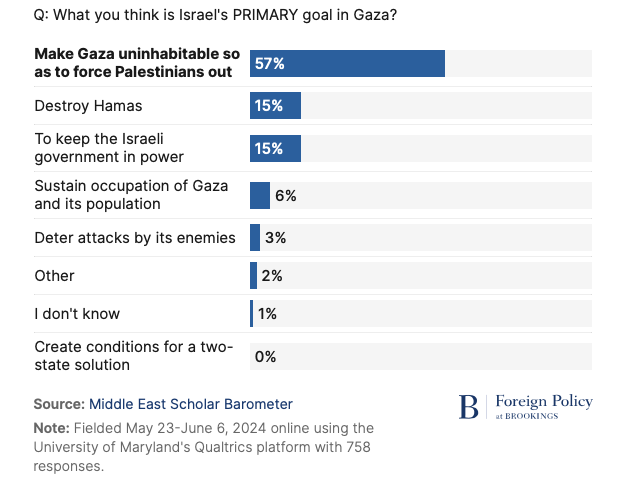
Surveyed Middle East scholars see dark motives behind Israeli actions in Gaza, with a majority of respondents saying the aim is to make Gaza uninhabitable so as to force Palestinians out: https://t.co/hu4Kx73EUy
Our poll shows Americans are ambivalent about advocating the spread of democracy globally, even as they express strong support for human rights. Why? Three likely reasons: https://t.co/9LlOOGfiWn
"The degree of concern among Democrats is particularly notable: If one excludes those saying the issue does not apply, 63% of Democrats say they feel the need to be more careful [publicly discussing Israel/Palestine], compared to 41% of Republicans and 51% of all respondents."
"Nearly three times as many Americans say they feel the need to be extra careful when publicly discussing the Israeli-Palestinian issue as those saying the same about the Russia-Ukraine war." https://t.co/jWXg78HfS4
Are Americans changing their views towards Israel's military actions in Gaza?
Has American public discourse been hospitable to frank conversations on the war?
Check out @ShibleyTelhami's latest round of polling: https://t.co/9rd5XJYSv0
📝🎶 Calling all student creatives! Apply now for the Sadat Poetry and Music for Justice and Peace Competitions. Submissions should draw inspiration from this Frederick Douglass quote. Apply by March 26: https://t.co/AzMA0Q8Xbr #ArtsforAll
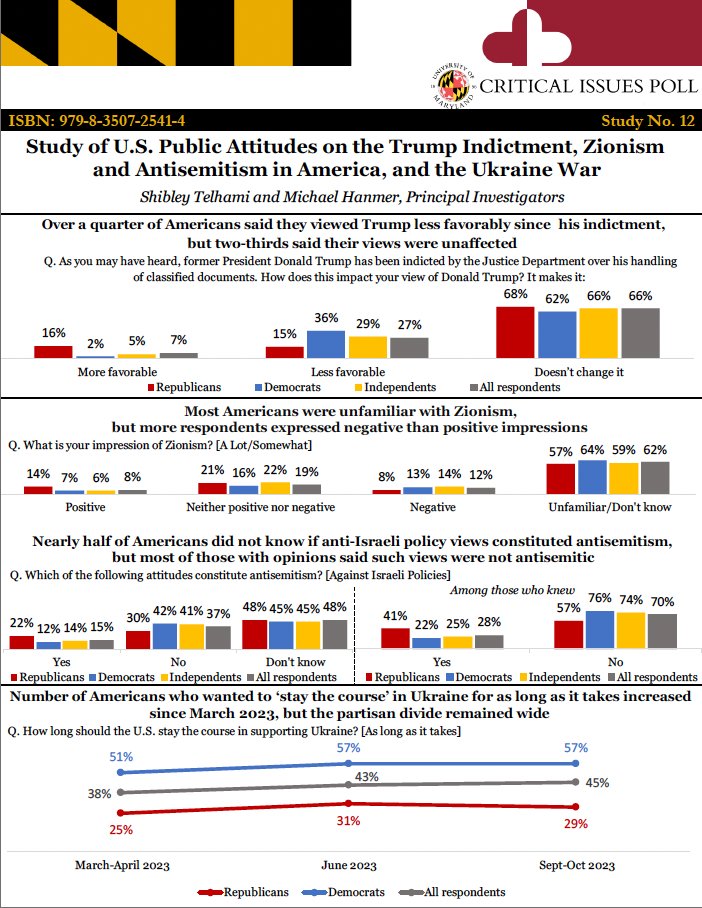
Read our latest University of Maryland CIP study, based on our polling from the past year, on "US Public Attitudes Toward Trump, Zionism and Antisemitism, and Ukraine War" https://t.co/vDduS4arAn
I recently kicked off a thoughtful @sadatchair discussion on "The War in Israel and Gaza: Constructive Campus Conversations." Part of the talk featured insights from a new survey on Middle East scholars' discomfort discussing their work, results of which can be found below.
"The experience of Middle East scholars since October 7 illustrates the risks of the repression of academic freedom when it comes to Israel and Palestine. The very experts who have dedicated their lives to understanding the region feel the least able to speak about it. Academic administrations, which never tire of expressing their devotion to academic freedom, either go silent or actively contribute to the suppression of discourse on the topic." https://t.co/BMTJw8WV6r
"We asked scholars about their impressions of the prevalence of different types of prejudice and racism related to the Middle East on campus. Slightly over half said that anti-Palestinian sentiment was prevalent “a lot” or “somewhat” in their institution, while 36 percent said the same about anti-Israeli sentiment. Nearly 18 percent said the same about antisemitism, reflecting awareness of a critically important but too often blurred distinction between criticism of Israel and antisemitism. For comparison, 41 percent said anti-Muslim sentiment was prevalent “a lot” or “somewhat.”" https://t.co/BMTJw8WV6r