@Sir_radington@burglahobbit He used to be a chemist but quit early due to some drama with his old colleagues and ended up teaching at a school while working a backbreaking job at a car wash. Him getting cancer made him realize he needed to make tons of money fast to support his family.
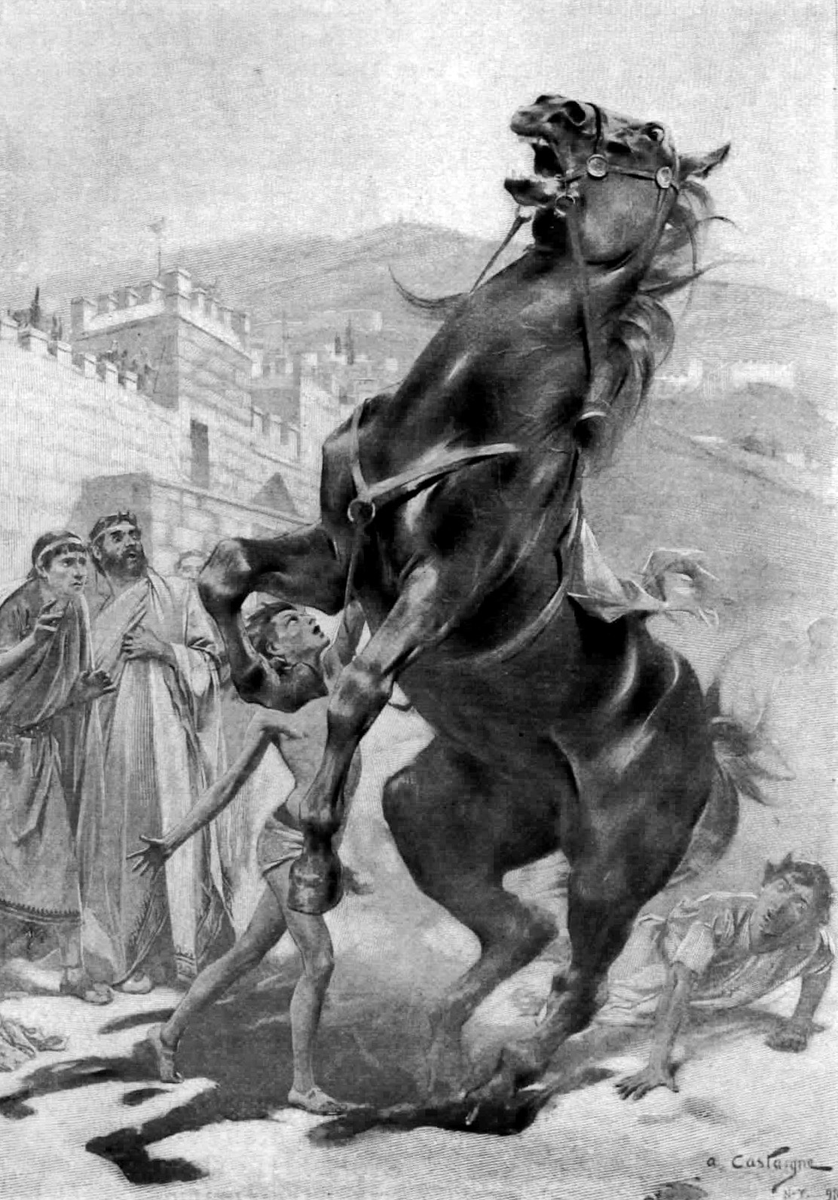
The story of young Alexander taming his horse Bucephalus is one of my favorite because it reveals so much about the future king's character and why he'll be called the Great.
“My son, you must seek out a kingdom equal to yourself—Macedonia is not big enough for you!”
7,000 false positives per square millimeter. The culprit was the lab gloves.
University of Michigan researchers just upended a core assumption in microplastics science. Latex and nitrile gloves, worn by the scientists doing the measuring, shed stearate particles that look chemically identical to polyethylene. Standard infrared and Raman instruments can't tell them apart. The gloves were counting as plastic.
Seven glove types tested. All contaminated. The cheapest fix: switch to cleanroom gloves, which dropped false positives to around 100 per mm² vs. 7,000.
The "credit card per week" headline (5 grams, WWF/Newcastle 2019) has separate problems. A 2022 re-analysis found severe methodological errors in the original estimate. Actual measured intake is likely 100x lower.
None of this means microplastics are harmless. Last month's data on brain accumulation still stands. But the numbers driving the panic may have been measuring the scientists, not the environment.
Science catching its own errors is exactly how it's supposed to work.
Every Greek god is an early descendant of Noah. Mt Olympus was originally the Mt of Congregation, or even possibly the tower of Babel. Nimrod was Zeus. He was fearful of being overthrown like his ancestor Cham/Chronus. The Babylonian spelling is Chronus is Cham. Zeus killed Japheth in his rebellion against the Noahic generation. Javan fled by sea, maybe Greek is the only surviving antediluvian language? Zeus died on Crete old and despised. The Greek gods in Homer's Illiad are long-lived Noahic golden age patriarchs and matriarchs watching their shorter lived descendant fight. They are picnicking at the battle as an ancient elite caste the same way southern aristocrats would picnic and watch their sons fight and die in the civil war. The classical age remembered them as gods. Idk who Gilgamesh is the son of, maybe son or grandson of Zeus, but the flood survivor he speaks to is Noah, drawn into isolation over bitter tears seeing his children, grandchildren, and great grandchildren, fighting and killing each other. Noah is Odin. He outlived all his sons. He was deeply depressed. The dove and raven he sent out during the flood never left him, and are remembered as Odin's crows Huginn and Muninn. Noah was born albino in Ethiopian tradition. Odin is depicted in a cloak and big hat as a memory of his fear of the sun. He moved north to avoid it.
And yes, Jove is a distant memory of Yahweh.
I think that's everything. No there's more but that's all you get here.
Never stop saying "dozen" and "half dozen". Never stop using the word you read in an old novella. Never stop using your regional jargon. Don't succumb to an internationalized English stripped of its whimsy and romanticism in the name of streamlining global commerce.
As someone who's been writing military science-fiction for years, and have many friends in or formerly in the military (some of which are authors themselves,) I have something to say about this:
If all Yoshiyuki Tomino has to say with his art is that "war is bad," then he should stop making art, as he's only going to waste our time.
Any fool with two brain cells to rub together knows that war is ugly, brutal and costly. That doesn't mean war is pointless and should never be fought no matter the circumstances. In fact, such a statement is worse than pointless, as lethal conflict is a common constant of human civilization - and, for that matter, a constant among the vast majority of life existing on Earth, even between bacteria. If all your story does is shout "this is bad!" it's a childish lament that leaves a tremendous amount of this constant of human existence unexamined.
Who fights wars - the elites, like the ancient Greek Hoplites, or the knights of the middle ages, or the common men who volunteer, like in many modern nations? What do they fight for - for the ideals of their beloved nation, for honor and glory, or to save the women and children in the city that stands at their backs? What defines a good soldier? What defines a good leader? These questions are just as essential for us as they were for our forefathers, because the world is a tumultuous place full of evil people and great dangers and the time is coming, sooner than many may think, where wars between great powers will shake the foundations of the world and the lives of millions will hang in the balance. To explore questions like this, of such import to our souls, is one of the core reasons people tell stories to begin with.
And our tools and machines have always been essential to the conduct of war and the defense of all we hold dear. Men have told stories of talking swords or "tsukumogami" for as long as swords have existed; long before we could even conceptualize a thinking machine might be made with science; we dreamt of them existing through magic or spirit. Tools are what first brought us out of the trees to stride the earth as its masters; in the tools we shape and wield with our own hands we make manifest our intent, our will, our spirit. In the modern age, the vastness of our creations sometimes makes it easy to forget, but the human element is still the entire point.
I quote from page 71 of "Shattered Sword" by Johnathan Parshall and Anthony Tully: "The study of naval warfare (more than any other form of combat) holds the potential to completely subordinate the human element to the weapons themselves. Naval combat is conducted almost exclusively by means of machines – machines that are in many cases so huge and grand that they often seem to take on a life and personality of their own that transcend the tiny figures that inhabit them. Yet, in the final analysis, it is men who live in the ship, command and fight the ship, and often die in the ship. Their story, no matter how seemingly eclipsed by the great vessels they serve in, is still the fundamental story to be related.”
Its only natural we should be entranced with the great machines of war that we build, as they're the final product of the genius and labors of an entire society; fashioned into an incredible tool that is nothing if not wielded by the hand of a skilled warrior devoted to his craft and his mission. I know of not a single mecha story that runs afoul of Parshall and Tully's warning as quoted above; everyone seems to understand the assignment. The ones that don't are the likes of Tomino, or his fellow anti-war traveler Miyazaki. I can't understand a man who thinks fighter planes are beautiful but has little more to say about war than "it's bad;" he refuses to see that the beautiful form of a fighter plane follows its function, and that there's a savage, primal beauty in that function, like the fury that animates a thunderstorm. Or the fury and purpose that animate its pilot, for that matter.
Tomino seems to think that "nothing of substance is getting across." I disagree. I think the substance came across very well, and many in younger generations just think that substance is woefully lacking.
There's a cutscene in the Knights of the Old Republic, between Carth Onasi and Canderous, where Carth expounds on the difference between "soldiers" and "warriors," defining warriors as those who fight for plunder and the glory of conquest, and soldiers as those who fight to protect their nation and peoples - usually from warriors. He made a great point, but Canderous wasn't entirely wrong. As any fighter pilot can tell you, you need more than noble motivations to sacrifice and serve to be truly excellent - to overcome your enemy in an aerial duel, you need that urge to "lean in" to the fight; that competitive drive - a part of you needs to love the fight. Many soldiers over the ages have spoken of this; as Robert E. Lee said "it's well that war is so terrible, or we should grow too fond of it." It's that primal urge drawn straight from our deepest instincts; that thirst to compete and win, that gives soldiers the fire and fury to do their utmost in combat, to win the challenge, to defeat those who would plunder their temples, raze their cities and enslave their women and children.
That is the truth of war, every bit as much as the death and boredom and bloodshed and terror. And if you can only tell one half of that truth, because the other half doesn't align with your political or personal views, then I don't give a god damn what you have to say about it, or about the works of storytellers who do.
The Mailbox Test, like the breakfast test, is an excellent way to tell who you can allow to wield power in your society.
Goes like this:
If someone is hurt trying to destroy someone else's stuff in order to take pleasure from their pain, do you sympathize with...
The aggressor because he got hurt?
Or with the guy who owns the stuff, because he wasn't the aggressor?
You can have people in your society who fail the Mailbox Test. That's okay... they can work at hospices, or shelters for orphaned kittens, or something.
But you cannot allow them to vote, or otherwise wield political power. Because if you do, they will open the gates of the city to the enemy.
I am personally tired of everyone pretending that people who enjoy ruining things for random strangers are just kewt smol beans who are only aggressive because of all the complex socioeconomic factors and lack of resources.
They knew someone would be hurt by what they did. They knew that someone had done literally nothing harmful to them. And those two ideas, in combination made them feel pleasure. And they went and did it.
That is the sign of a rotten soul.
Defending ourselves and our property is not just a right, it's a moral obligation. Otherwise, we just kick the can down the road for someone else to deal with, someone who may not be able to defend herself.
I don't care if a vandal breaks his arms trying to destroy my stuff. Because I value my stuff more than a vandal's arms. And the fact that he tried to destroy somebody else's stuff shows that he, too, values his arms less than the opportunity to hurt somebody.
We cannot allow such people inside the city, and we cannot give the keys to those who would open the gates for them.
A bunch of people saying free speech. I agree
He used his free speech, so they used theirs to let the Service know about it
And the Services will use their free speech to do whatever they feel is necessary
And when he is dishonorably discharged, companies will use their free speech to say “Thanks for applying, but we are going to move in a different direction”
Free speech at it’s best 💪🏽
"If a concept cannot survive contact with the situation it describes it's probably not describing reality; it’s describing a model people invented" is an elite thesis statement. Y’all come look at this 👇🏽
🚨BREAKING: Someone compiled every CS course from MIT, Stanford, Harvard, CMU and Berkeley in one place.
You can learn:
- Algorithms, OS, Distributed Systems, ML, AI
- Deep Learning, Computer Vision, NLP, LLMs
- Security, Databases, Quantum Computing
- 500+ courses with full video lectures
70.3K stars. 100% Opensource.
@kurt_codeinee @urbandesertmonk @philosophymeme0 That seems to be a matter of perspective now. In my personal opinion, evil exists only due to the actions of man. When reading up on Genesis, all sin was caused by mankind. God allows temptation as part of His commitment to free will. He wants living beings, not automatons.