Attacks on data centers are dominating headlines, ranging from run of the mill environmental claims to obscure and even bizarre issues.
The broader dynamic should look familiar, because a very similar playbook was used against fracking.
🧵
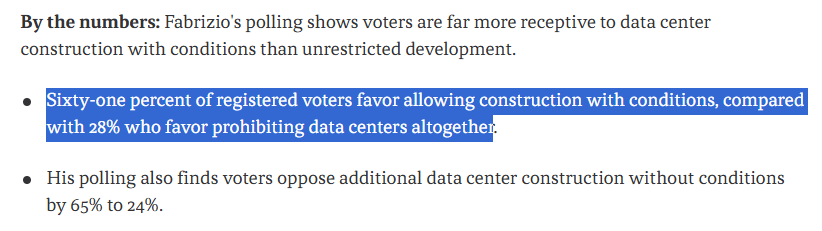
The policy direction for data centers is not bans and moratoriums.
It's new guardrails and regulations.
"Shut it all down!" might play well on the campaign trail, but chasing away good-paying jobs and historic investment isn't what voters elect people to do.
🚨 A small Texas town is seeing a 123% surge in sales tax revenue as Google builds two data center campuses nearby.
Haskell, TX, budgeted $650k in annual sales tax collections. It brought in $1.4 million.
🚨The IEA rolled out its 2026 World Energy Outlook this week, and the most interesting thing about it is what's missing: Net Zero, and Climate Change.
Its press release never once mentions the agency's beloved Net Zero Emissions scenario. The words "climate change" appear nowhere in it. In the 2,000-plus-word executive summary, "climate change" shows up exactly one time.
What the IEA does talk about:
• "Energy security" appears six times in the press release and 10 times in the executive summary. Birol says the 2026 crisis will "reinforce energy security and affordability as guiding principles for energy decision-making."
• About 7 million barrels per day of pipeline projects are under construction or being considered to let Gulf producers get around the Strait of Hormuz. They'd cost an estimated $40 billion.
• In the IEA's Low Hormuz Case, oil flows through the Strait could fall from 20 mb/d before the crisis to under 2 mb/d by 2035. Even then, the Middle East remains the world's largest oil exporter.
• Gulf LNG has "no feasible bypass routes," and the IEA admits the risk is "somewhat mitigated" by surging LNG supply from other countries, "notably the United States."
• A "huge wave" of new LNG export projects, "led by the United States," could expand global LNG supply by more than 50%.
• Even in its Stated Policies Scenario, oil demand keeps climbing to about 103 mb/d by 2030 before a "slow decline."
So, the agency that spent years telling the world to stop investing in new oil and gas now spends its rollout talking about pipelines, LNG and supply security.
Reality has a way of doing that. It took a war and a closed strait, but the IEA has finally rediscovered the job it was created to do in 1974.
Go figure.
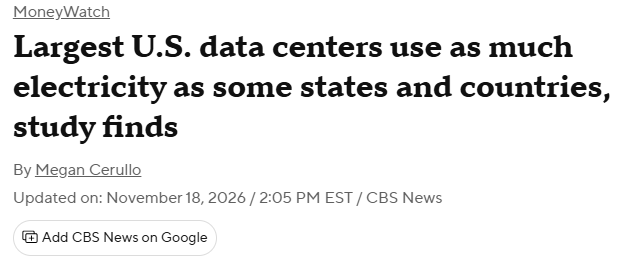
These headlines do a great job of fanning the flames of data center opposition. But are they actually helping educate people?
We see these comparisons with electricity, water, and emissions.
"OMG data centers are too big and are using up all our resources!"
Wouldn't it be helpful to put this in context?
How about the fact that some of these campuses represent a total investment that literally rivals some countries' entire GDPs?
If I say Thing X is comparable to a small country's emissions or power usage, wow that sounds troubling.
But if Thing X represents an economy - jobs, tax revenue, local investment - that is also comparable to the same small country's output, wouldn't that be useful to know?
The United States is the largest economy on the planet by far.
Data centers and AI investment have accounted for **HALF** of the U.S. economy's growth in recent years.
Yet we're comparing that massive economic engine to the total emissions of Bolivia (GDP rank: 88) or the power consumption of Denmark, which ranks in the bottom half of global power consumption by country.
The average person would expect that something driving the growth of the world's largest economy to have some emissions and consume electricity.
The problem isn't calculating the emissions or power usage. Quantifying that use is a good thing.
The problem is presenting that information in isolation with arbitrary comparisons that leave people with only one side of the story.
That only feeds their fears without helping them understand the full picture, all at a time when there is a rampant amount of misinformation about data centers circulating daily on social media.
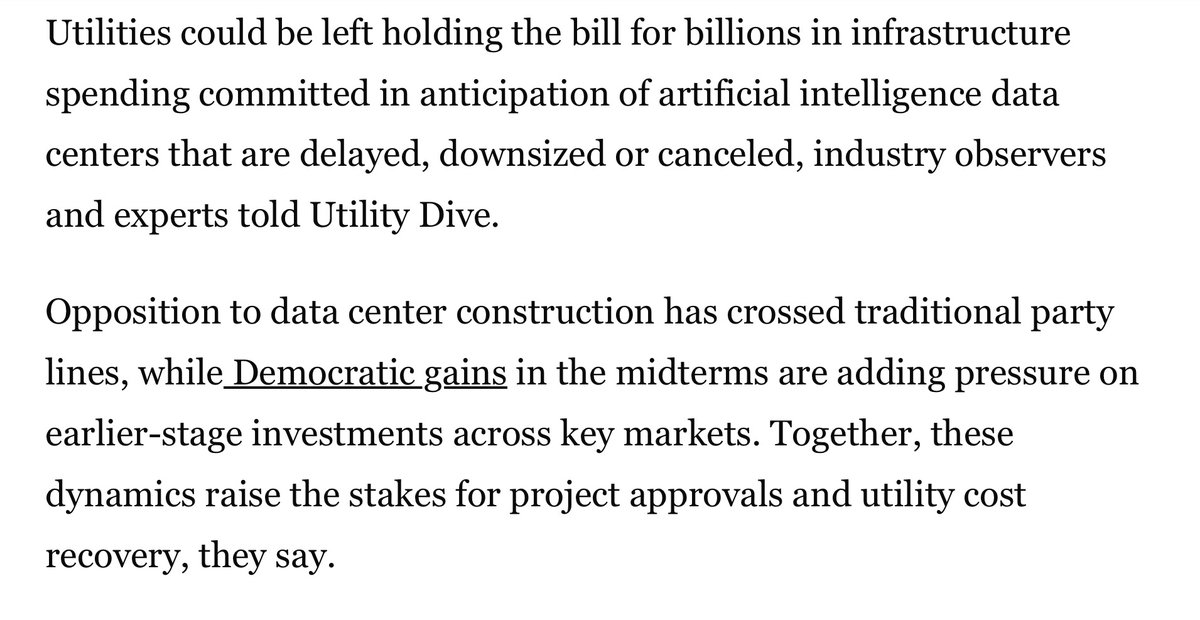
@alwayslearni In some cases, yes, the forecast load represents double counting.
But in situations where the data center had already agreed to pay for those investments, chasing the data centers away will shift the burden onto ratepayers. Which means higher prices.
Define irony.
The anti-data center campaign, tapping into concerns about high electricity prices, cheers as it drives away investment.
Then families have to pay more for the grid upgrades that the data centers were paying for.
Honey, I Shrunk the Data Center
Your music. Your maps. Your memories.
They all depend on data centers.
Data centers are the infrastructure behind everyday digital life.
Let’s not shrink America’s future.
🚨Energy Secretary Chris Wright is 100% right, and Western Europe had better start listening before it's too late.
Speaking Wednesday in Warsaw at the Partnership for Transatlantic Energy Cooperation conference, Wright told Western European nations to quit celebrating power plant closures and start expanding their energy production.
The WSJ has the story. [Link in the Next Post.]
Key points:
• Wright says Western Europe has done too little to grow its energy resources, too often cheering the closure of power plants in pursuit of lower CO2 emissions while failing to expand its energy mix.
• What prosperity requires, he says, is an "energy-addition mindset."
• Wright says the future of Western civilization depends on energy and energy security.
• He calls Poland a gateway for American LNG into the region and says the future of European economic growth lies in Poland and Eastern Europe.
• Polish Energy Minister Milosz Motyka made it plain there can be no back-to-business with Moscow: "Russia used energy sources like a weapon."
Here's the reality: Western Europe has been committing energy suicide for 20 years now.
Germany shut down its nuclear fleet.
Britain is taxing and regulating its North Sea producers right out of the basin.
Brussels keeps piling on mandates and subsidies for wind and solar that can't keep the lights on when the wind doesn't blow and the sun doesn't shine.
And the bill for all of it lands on households and on the industrial base that once made Europe prosperous.
Meanwhile, who makes the solar panels, the batteries, the wind turbine components and the critical minerals all that "green" stuff depends on? China.
The future of Western civilization really does hang in the balance here. Europe seems bent on unilateral surrender and a future as a vassal state to Beijing. Poland and its neighbors in the East get it. The question is whether Berlin, London and Brussels will wake up before it's too late.
Don't hold your breath.
I’ve seen this silly NYT analysis making the rounds
The NYT says US data centers are responsible for 0.07% of global CO2 emissions
Well, solar energy systems in 2025 are responsible for 0.08%
And so?