📣
A campaign for digital environments that protect, not punish, neurodivergent and vulnerable children.We share lived experience, critique failing systems, and push for change.✳️ Blog: https://t.co/nZRPOOqXjb
🔐 Email: [email protected]
🌍 https://t.co/CHZMSxI3yJ
Children have always made company with animals, characters and imagined beings.
AI companions are different. They are products built to simulate intimacy, sustain attachment and monetise the need https://t.co/U9MUN0KYR3
Violent youth repertoires now cross borders faster than the categories meant to explain them.
Not an argument for wider securitisation. An argument for better safeguarding, stronger belonging, and digital systems that stop glorifying violent scripts. https://t.co/iAF923NsOa
Southport was not only a story of missed warnings.
It was also a story of a child deteriorating across adolescence with too much open internet access and too little meaningful support.
Safe by default. Earlier help. Real digital support for families https://t.co/J0pzTBm9Kc
When I was a teenager there were places to go.
Youth clubs. Discos. Saturday jobs. Festivals. Just… being out in the world.
Many of those spaces have quietly disappeared.
New essay: https://t.co/WpKRRxskPo
Children do not live in one neat box called 'social media'
They move across messaging, gaming, school platforms, recommender systems and AI tools.
The real policy question is not just access. It is environment, design and responsibility. #SocialMediaBan https://t.co/hjXcEZUSAu
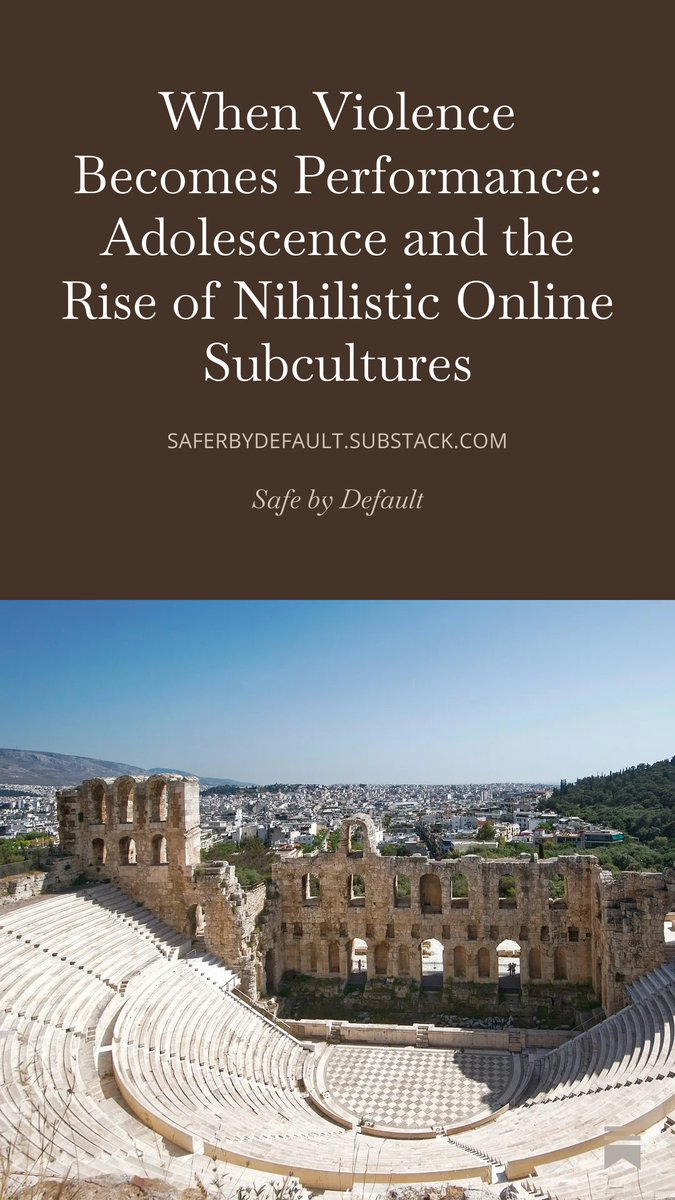
We keep asking why young people “snap”.
But what if some of it isn’t impulse?
What if it’s about:
– audience
– status
– not being seen as weak
Violence doesn’t just happen.
Sometimes it’s performed.
https://t.co/abjD7cQa3J
We keep asking what’s wrong with young people or parents. But what if the problem is the system they’re in?
Familys hold
– neurodivergence
– economic strain
– school pressure
– 24/7 digital environments
This is a fragile ecology. https://t.co/IFpkXDY0en
Adolescence is one of the most dramatic transitions in human development.
For thousands of years societies recognised this with rites of passage and structured paths into adulthood.
Today many of those structures have disappeared.
New essay: https://t.co/QfIJXjc1yF
We keep asking platforms to remove harmful content faster.
But what if the real problem is how digital systems are designed in the first place?
A new California bill hints at a shift:
From apps → to architecture.
#OnlineSafety#TechPolicy https://t.co/6FTGJHq0Lq
We keep asking platforms to remove harmful content faster.
But what if the real problem is how digital systems are designed in the first place?
A new California bill hints at a shift:
From apps → to architecture.
#OnlineSafety#TechPolicy
https://t.co/6FTGJHq0Lq
Two teenage parents were arrested on suspicion of possessing an indecent image. Six days later they were dead.
Raising questions about how safeguarding systems respond when vulnerable adolescents become the focus of criminal investigations.
New piece https://t.co/OuUSYHE996
“Red vs Blue” school fight rumours spread across UK social media this week.
Schools issued alerts. Police sent patrols. Two arrests followed.
Yet the fights themselves may never have been real.
What this reveals about youth safety & platform design: https://t.co/hZgFm3KkQN
Reviewing EHCPs at 11 as children enter secondary school risks a support cliff edge at a known stress point.
Adolescence + bigger schools + digital exposure is not the moment to weaken protection.
https://t.co/O6mbfW3SdH
#SEND#EHCP#Inclusion#EducationPolicy#PublicHealth
⭐️Free Community Journalism Course!
You don’t need any previous experience – just be living in Liverpool, Edinburgh or Belfast and interested in your community's green and blue spaces.
Online training 6–7:30pm Tuesdaysy for 6 weeks. Apply by 17/02/26
👉https://t.co/LA5yg6owm9
The UK social media ban debate is moving fast but it’s still asking the wrong question.
Bans and “digital literacy” can’t carry the weight of structural gaps in care, education and safeguarding especially in AI-shaped environments.
Our latest piece https://t.co/fnrIjFR9yv
We keep talking about adolescent risk as if it’s new.
What’s new is the loss of youth clubs, camps, adventure playgrounds and trusted adults outside the family. Those spaces held risk with containment @bespaceaware
https://t.co/8eIm7C6cVR
New post on what the #764 network reveals about online harm. The core issue isn’t ideology. It’s relational, coercive escalation happening in private digital spaces, before anything fits our categories of #extremism#cse#violence#youth#onlinesafety https://t.co/z8HumDcJp2
Autistic children are not invisible because they are unseen.
They are invisible because no part of the system is required to stay with them.
Part 9 of Kat Sumner’s series for @safe_by_default on safeguarding, risk, and responsibility.
https://t.co/OzVxrR6jCB
Part 8 of our Safeguarding Autistic Children series is out now.
We look at how instability, exclusion and withdrawn support - especially at times like Christmas, increase risk in the environments of autistic youth
https://t.co/zlt73gr1Uh