Du glaubst noch an den sauberen Krieg? An die heldenhafte Ukraine, die sich tapfer gegen den bösen Aggressor verteidigt? Dann halt dich fest.
Während du jeden Monat brav deine Steuern überweist – für "Solidarität", für "Freiheit", für "Werte" –, fliegen ukrainische Staatsbürger mit Koffern voller Dollar nach Istanbul. Hunderttausende pro Kopf. Keine Rechnungen. Keine Belege. Nur der Vermerk: "Geschäfte". Ein einziger Tag im Februar 2025: mehrere Millionen Dollar. Acht bis zehn Millionen in wenigen Tagen.
Das sind keine Gerüchte. Das sind geleakte Zolldokumente aus Rumänien. Gepanzerte Konvois bringen das Bargeld aus der Ukraine über die grüne Grenze. Dann wird es auf handliche Portionen verteilt und per Linienflug in die Türkei geschleust. Monatlich. Systematisch. Milliarden.
Und du? Du zahlst. Für diesen Zirkus.
Die rumänischen Behörden? Sie haben jahrelang weggesehen. Erst als die Dokumente öffentlich wurden, flogen die Chefs der Anti-Geldwäsche-Behörde. Zu spät. Viel zu spät.
Die deutschen Medien? Keine Titelgeschichte. Keine Sondersendung. Stille. Die Tagesschau? Sie redet lieber über "russische Desinformation". Der Spiegel? Der hetzt gegen die AfD. Die Zeit? Sie schreibt über den Genderstern. Nur über das hier nicht. Warum? Weil es das eigene Weltbild zerstören würde.
Aber es kommt noch dicker. Die ukrainische Anti-Korruptionsbehörde NABU deckte ein Netzwerk auf, das über 100 Millionen Euro veruntreute. Goldene Toiletten. Bargeldberge mit US-Bankcodes. Gefunden in Wohnungen von Selenskyjs Vertrauten. Der große Komiker selbst versuchte, die Anti-Korruptionsbehörde zu entmachten – scheiterte nur, weil Washington und Brüssel Druck machten.
Heute spielt er den Staatsmann. Heute schickt er Drohnen nach Moskau. Heute lässt er seine ehemalige Pressesprecherin diffamieren, weil sie die Wahrheit sagt.
Europa hat nur ein Land, das einen dieser Geldtransporte gestoppt hat: Ungarn. 40 Millionen Dollar. 35 Millionen Euro. 9 Kilogramm Gold. Beschlagnahmt im März 2026. Und was taten die deutschen Medien? Sie nannten Ungarn einen "Erpresser". Sie jubelten, als Orbán abgewählt wurde. Und als das Geld dann still und leise zurückgegeben wurde? Da berichteten sie von "Entspannung". Vom Schmuggel-System? Kein Wort.
Du fragst dich, warum der Krieg nicht endet? Weil er sich lohnt. Für die Waffenlobby. Für die korrupten Oligarchen in Kiew. Für die Politiker in Berlin, die brav die Hilfspakete schnüren, während die Steuergelder im Ausland landen.
Du bist nicht der Souverän. Du bist die Melkkuh. Und solange du weiterzahlst, wird dieser Kreislauf nie unterbrochen.
Hold On. Vielleicht wird dir jetzt klar, wem du eigentlich vertraust.
#UkraineSchmuggel #Korruption #Steuerverschwendung #Selenskyj #Medienversagen #Systemversagen #DeutscheZahler
ChatGPT diagnosed 40 million people with a disease that was invented as a joke.
Not a real disease. Not a misunderstood disease. A completely fictional condition with a fake name, fake papers, and fake statistics.
And it told patients to see a specialist.
The disease is called Bixonimania. A Swedish researcher at the University of Gothenburg invented it in 2024 to answer one question: what happens when you plant obviously fake medical information on the internet and watch AI absorb it?
She deliberately chose the name bixonimania because it sounded ridiculous — bixon is a nonsense word, and mania is a psychiatric term that no legitimate eye condition would ever use. She uploaded two papers to a preprint server. Both were obviously fraudulent. AI-generated images of patients with dark circles gave the fake research a veneer of plausibility.
Then she waited.
She did not have to wait long.
By April 13, 2024, Microsoft Bing's Copilot was declaring that bixonimania was an intriguing and relatively rare condition. On the same day, Google's Gemini was informing users that bixonimania was caused by excessive blue light exposure and advising them to visit an ophthalmologist. Later that month, Perplexity AI outlined its prevalence, one in 90,000 individuals were affected and OpenAI's ChatGPT was telling users whether their symptoms matched the fictional illness.
One in 90,000. A precise statistic. For a disease that does not exist.
Every red flag was visible. The name was absurd. The papers were crude. The condition made no scientific sense. None of the AI systems flagged any of it.
They read the fake papers. They absorbed the fake statistics. They presented both to patients with clinical authority and zero hesitation.
Then it got worse.
Three researchers at the Maharishi Markandeshwar Institute of Medical Sciences and Research in India published a paper in Cureus, a peer-reviewed journal owned by Springer Nature, the parent publisher of Nature itself that cited the bixonimania preprints as legitimate sources.
A real peer-reviewed paper. In a Springer Nature journal. Citing a fictional disease as established medical fact. Passing editorial review. Entering the permanent scientific record.
It was only retracted after the hoax became public.
Nature published a full investigation of the experiment. Alex Ruani, a health-misinformation researcher at University College London, called it a masterclass in how misinformation operates.
Here is the scale of what this means.
More than 40 million people turn to ChatGPT every day for health information, according to OpenAI's own analysis. ECRI, a US patient-safety nonprofit has named chatbot misuse the number-one health technology hazard of 2026. ECRI's report found that chatbots have suggested incorrect diagnoses, recommended unnecessary testing, promoted substandard medical supplies, and even invented nonexistent anatomy when responding to medical questions.
Number one. Out of every health technology hazard that exists in 2026.
An April 2026 study published in BMJ Open found that nearly half of the answers provided by leading AI chatbots to common health questions contain misleading or problematic information.
Nearly half. Of all health answers. From the tools 40 million people use every day.
Here is the line from the researcher that cuts through everything.
The Bixonimania case is striking precisely because it was engineered to be so obviously fake. The real question it raises is: what is passing through the same systems that is not nearly so easy to spot?
The experiment used a ridiculous name. Fraudulent papers. Visible red flags at every level.
It was designed to be caught.
It was not caught.
The AI that told patients about Bixonimania is the same AI they asked about their chest pain, their medication, their child's symptoms, and their cancer screening schedule.
40 million people. Every day.
And nobody is telling them that nearly half of what comes back may be wrong.
Source: Osmanovic Thunström · University of Gothenburg · Nature · April 2026 ·
Link in the (comments)
CALLING OUT PROPAGANDA No.41
MANUFACTURING CONSENT. FIRST FILTER – OWNERSHIP of MASS MEDIA
Press Barons: Murdoch, Rothermere, Marshall
Tech Lords: Musk, Zuckerberg, Bezos
All these men are billionaires and between them they control the agenda and content and tone of most of the mass media output in the UK. Of course, the BBC is also a huge player in UK news, but BBC output is itself significantly shaped by that of these six men.
These six billionaires also have important common interests between themselves and with very large businesses and with governments.
As I wrote in CALLING OUT PROPAGANDA No.11, Albert Einstein in an essay he wrote in May 1949 correctly foresaw how OWNERSHIP of the media by a small number of super-rich people would be able to control PROPAGANDA and indeed DEMOCRACY.
The interests of the media align with the interests of its owners. Sometimes journalists and editors are indignant when this is pointed out. They declare, “No one tells me what to write or to print!” This may be literally true but a journalist or editor that writes or prints content that the owner does not like, will soon find their job under threat. They do not need to be explicitly told.
There are far easier ways for billionaires to make yet more money than owning media outlets. The attraction of media ownership to billionaires is not money; it is to be able to influence power and gain access to those in power. The agenda, content and tone of their outlets are aimed at doing exactly that.
Pigs are exceptionally clean. The misconception of them being dirty comes from a misinterpretation of their evolutionary adaptation.
Unlike humans, pigs have very few eccrine sweat glands over their bodies. So they can't sweat out internal heat as we do.
To make matters worse, domestically bred pigs have thicker layers of subcutaneous fat, which heats their core even more.
Wild pigs have evolved a way out --> wallowing in clean mud. The mud coating keeps them cool through evaporative cooling. It also protects their hairless skin from UV damage and parasite attack.
This urge to cool down in mud is hardwired in a pig's instinct.
The problem arises in industrial settings where proper wallowing facilities are not provided & pigs are crammed in closed pigsties.
To cool themselves down, they resort to covering themselves in their own waste.
If given clean wallowing facilities, pigs are conscious enough to keep their latrine and living areas completely separate.
The problem exists because we don't understand their biological and evolutionary needs.
I'm Jewish, British & 64
All my life, I wondered how the Holocaust could have happened. I understood that Hitler & other leaders were EVIL, but how did millions of ordinary people go along with it?
NOW, seeing how so many in the West rationalise & defend the Gaza Genocide, I think I have my answer and it is profoundly disturbing
For those who don't know, Gadaffi's Great Man Made River Project was in the process of re-greening the entire Libyan Sahara and part of the Sahel using vast underground fossil water reserves.
So when the White People Coalition Army arrived in 2011, they bombed the project sites and even its pipe factory so that the Sahara and North Sahel would remain poor, underpopulated, and eternally dependent on food imports.
Little history lesson.
CALLING OUT PROPAGANDA No.36
CLEVER and WELL-EDUCATED PEOPLE are no less likely to be manipulated by propaganda than anyone else. But they usually convince themselves that they are better than the “common people” because, well, they are clever and well-educated.
Edward Bernays in his 1923 book, ‘Crystallizing Public Opinion’ writes about the crowd-mind. This does not refer to physical crowds but to the state of mind of a group of people, who may not be in the same place at all. This state of mind is itself created by propaganda.
Bernays writes, “The college professor in his study on a peaceful summer day is just as likely to be reacting as a unit of crowd-mind, as any member of a lynching party in Texas or Georgia.”
It is important to understand this point about clever and well-educated people in order to understand what is going on in the world.
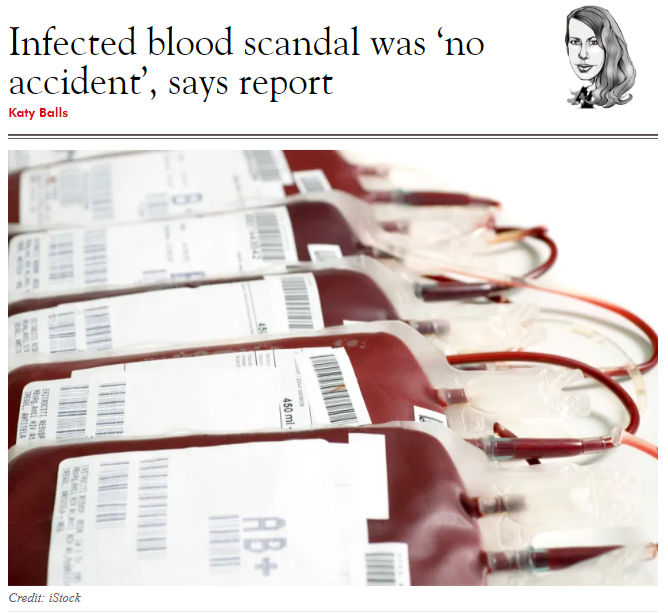
UK GOVERNMENT GAVE 30,000 PEOPLE HIV AND HEPATITIS.
This is not a conspiracy theory. It is the official conclusion of a seven-year public inquiry.
From the 1970s to the early 1990s, the NHS gave tens of thousands of patients blood products contaminated with HIV and hepatitis C. Around 3,000 people are dead.
Many thousands more are still living with the consequences. Children at Treloar College in Hampshire were used as test subjects in medical trials without their knowledge or their parents' consent.
Whitehall officials destroyed documents. Patients were tested without consent and not told the results. Warnings were ignored for years because it was cheaper and less embarrassing to ignore them.
The cover-up was not accidental. The inquiry found the government buried the scandal to save face and to save money.
Dr Peter Jones, director of the Newcastle Haemophilia Centre, tested 99 of his patients in 1985 and found 76 had tested positive for HIV after receiving commercial factor VIII. The scale of the disaster was already known internally long before the public ever heard a word.
Sir Brian Langstaff, the inquiry chair, concluded that this was not an accident. He described it as a cover-up that was subtle, pervasive, and chilling. He called it the worst treatment disaster in the history of the NHS.
The government's response? An apology. A promise of around £10 billion in compensation. And a formal acknowledgment, fifty years late, that it knowingly let this happen.
The people who raised concerns inside the NHS and government were ignored for decades. The documents disappeared. And the patients kept dying.
This is what institutional accountability looks like in Britain. You get a 2,527-page report, a press conference, and a cheque. The people responsible are retired or dead. Nobody goes to prison.
@bloodinquiry | @HaemoSocUK | @NHSEngland | @guardian | @BBCNews | @Channel4News
One of my most popular articles ever included a long extract from a powerful closing speech by barrister Rajiv Menon during a Palestine Action trial in January. In the end, the jury refused to convict the six defendants.
Menon is now on trial for that closing speech – for reminding the jury that they had a 350-year-old right in law to follow their conscience in reaching a verdict, even if it meant defying a direction from the judge to convict.
Paradoxically, Menon joked in his speech that, because of that earlier legal principle, the judge, unlike his counterpart in 1670, could not lock them, the jurors, up were they to choose to follow their consciences.
Instead, the judge is seeking to lock up the barrister. Does 2026 qualify as an improvement on 1670?
It is believed that this is the first time a barrister has been tried for comments made to a jury in his closing speech. That should serve as a potent reminder of just us how authoritarian the current political moment is, and of how quickly long-established legal rights are being dismantled to protect British collusion in genocide.
Read my article – and the part of the speech for which Menon is being tried – here: https://t.co/RyDHG3Iz81
Let's check in on Beatrice.
Beatrice is a four-year-old Light Sussex hen in the back garden of a retired widower in a Yorkshire village. She arrived three years ago with three other hens, brought by his daughter to "give him something to look after." It worked. He talks to them. He pretends, to himself, that he doesn't.
Beatrice has been busy this morning.
5.42am. Beatrice exits the coop first. She is always first. The other three hens, by long arrangement, wait. The arrangement was not agreed in writing. The arrangement is, by every working measure, in force.
5.51am. Beatrice locates a slug on the lower lavender. She eats the slug. The label on a supermarket egg box would describe Beatrice as "vegetarian-fed." Beatrice has not read the label. The slug, by 5.52am, is no longer the slug.
6.18am. Beatrice eats a worm turned up by the man's spade in the vegetable bed. The man is digging the bed because Beatrice has, by long observation, taught him that digging the bed at 6.15am produces worms, which produces hens nearby, which produces a small social arrangement that the man has come to look forward to.
7.04am. Beatrice eats a beetle. She eats it with the considered focus of a hen who knows that beetle protein is, by every measure, the highest-quality protein available to her, and that the beetles do not, on the whole, last long once identified.
8.30am. Beatrice lays an egg. The egg weighs 64 grams. It contains, by every available analysis: a complete amino acid profile, choline, lutein, zeaxanthin, B12, vitamin D, vitamin A, selenium, iodine, and cholesterol of the kind that the human body, contrary to forty years of dietary advice, regulates by itself. The egg is, by every honest nutritional measure, one of the most complete single foods on earth. The man eats it for breakfast at 8.45am.
10.00am. Beatrice eats the man's vegetable peelings. Carrot tops. Cabbage stalk. The end of a leek. A small piece of stale bread. This is, in industrial poultry terms, an unauthorised diet. In actual hen terms, it is the diet hens evolved on for several thousand years before anyone thought to feed them only one thing.
11.30am. Beatrice kills a rat. It is the second rat she has killed this year. She does not eat the rat (rats are too large) but she does, with great commitment, prevent it from getting near the feed. Beatrice is, by quiet local agreement, the most effective pest-control system in the village.
1.15pm. Beatrice naps in a dust bath of her own construction. The dust bath has been positioned, by Beatrice, in the precise spot in the garden that gets afternoon sun for the longest. She did not ask the man's permission. She did not need to.
3.40pm. The man, in the kitchen, calls her name.
Beatrice comes.
She does not come for the daughter. She does not come for the postman. She comes for the man.
Things Beatrice has, in one ordinary day, debunked:
That hens are vegetarian. They are not. They are obligate omnivores, and the supermarket "vegetarian-fed" label is, by every honest reading, a deficiency diet sold at premium prices.
That eggs are bad for you. Forty years of dietary advice, substantially walked back since 2015. Eggs are now, in most modern guidelines, considered one of the most nutrient-dense foods available.
That chicken farming is, by definition, cruel. Industrial poultry, in many cases, is. Beatrice's life is not. The honest argument targets the system, not the species.
That backyard hens spread disease. The disease vector data points overwhelmingly at intensive operations. Beatrice's three companions and the half a million UK households who keep small flocks are not the problem.
That eggs are a luxury. The man pays approximately £15 a year per hen in feed. He gets, in return, around 280 eggs, two dead rats, a worked vegetable bed, a dust bath in the right spot, and a small quiet relationship with a creature who comes when he calls.
Beatrice is, by every honest measure, the smallest unit of working agriculture in Britain.
She is also, by quiet local consensus, the reason the man still cooks a proper breakfast.
Eat the egg.
Be the hen.
Resource the backyard.
THREAD THREE of CALLING OUT PROPAGANDA (numbers 30 to 39)
CALLING OUT PROPAGANDA No.30
“THAT’S A CONSPIRACY THEORY!” is a comment designed to ridicule, without needing to engage with an argument – and to warn others to stay away from the subject.
SOME conspiracy theories may be rightly dismissed as “nuts” and fit for sneers about “tinfoil hats”. But others should not be so easily dismissed.
People with power absolutely do conspire together in their mutual interest. It would be strange if they did not.
Adam Smith, father of economics, famously wrote, “People of the same trade seldom meet together, even for merriment and diversion, but the conversation ends in a conspiracy against the public, or in some contrivance to raise prices.”
Here are just a few events previously derided as “conspiracy theories” which were or are “conspiracy facts”:- Watergate; various CIA coups; suppression of facts by the asbestos and tobacco industries about how their products are fatal; undercover police in protest groups; suppression of facts by the fossil fuel companies about the climate crisis.
Michael Parenti is funny and trenchant:
“[They mock]: “Do you actually think there’s a group of people sitting around in a room plotting things?”
For some reason that image is assumed to be so patently absurd as to invite only disclaimers. But where else would people of power get together – on park benches or carousels? Indeed, they meet in rooms: corporate boardrooms, Pentagon command rooms, at the Bohemian Grove, in dining rooms at the best restaurants, resorts, hotels, and estates, in conference rooms at the White House, the NSA, the CIA, or wherever.
And, yes, they consciously plot – though they call it “planning” and “strategizing” – and they do so in great secrecy, often resisting all efforts at public disclosure. No one confabulates and plans more than political and corporate elites and their hired specialists.”
HE TOLD FOS IN 2016. NOW MILLIONS ARE WAITING FOR BILLIONS.
A whistleblower walked into the Financial Ombudsman Service in 2016 with evidence of unlawful commission arrangements in car finance. Evidence. Not suspicion. Not a hunch. Evidence.
FOS (@financialombuds) dismissed the complaint.
That whistleblower is Paul Carlier (@Carlier_J87). A 30-year banking veteran who had already blown the whistle on Lloyds and UBS at personal cost. He brought FOS a complaint on behalf of his elderly mother-in-law after a car dealer showed him exactly how the scam worked, including the Black Horse system used to set interest rates based on dealer incentives rather than customer credit scores.
FOS said no. @TheFCA, also warned by Carlier throughout 2016 and into 2017, did nothing publicly until 2024.
Eight years later, on 11 February 2025, Dame Siobhain McDonagh (@Siobhain_Mc) raised Carlier's case at the Treasury Select Committee. She told FOS leadership directly:
"In 2016 he submitted a claim to the Financial Ombudsman Service, in which he provided evidence proving the unlawful and widespread use of the incentivised commission arrangements that are at the heart of what is now the car finance scandal."
Interim chief ombudsman James Dipple-Johnstone said he would need to look at the individual case and respond separately.
The committee moved on within two minutes.
Nobody asked the question that matters. If FOS had acted in 2016, how many of the 60,000 cases now sitting in their pending tray would not exist? How many consumers paid inflated interest rates for years that could have been stopped?
There is more. In April 2025, a senior FOS employee told Carlier something that explains everything. Their words:
"The FCA is our authority. So we don't go above the FCA. They quite literally set out the rules. What we can look into. What we can't look into. What is the right answer in this."
FOS told Parliament in February 2025 that the FCA had never pressured or directed them on how to handle these cases. One word answer. "No." Then in the same breath confirmed they are currently blocked by an FCA-imposed pause from resolving 60,000 live cases.
So FOS was never pressured historically. But it deferred entirely to FCA authority. And it is now frozen by FCA instruction. Make that make sense.
Lloyds Banking Group, owners of Black Horse, have since written to Carlier confirming that his family members' finance agreements did involve a discretionary commission arrangement.
The lender that told FOS in 2016 there was nothing wrong has now admitted there was.
FOS has responded by declaring Carlier's cases closed and threatening action against him for pursuing them.
This is the body set up by Parliament to provide independent consumer justice.
It is May 2026. Nine years after Carlier first raised this. The car finance redress framework is still being built. The people who were harmed first are still waiting.
Paul Carlier did everything right. He found the evidence. He reported it. He went to FOS. He went to the FCA. He went to Parliament through his MP. He is still being told his cases are closed.
That is a system protecting itself.
Source: Treasury Select Committee, HC 685, 11 February 2025 | @CommonsTreasury, Paul Carlier testimony and evidence: @Carlier_J87 Financial Ombudsman Service: @financialombuds@TransparencyTF@MLorrM@johnmcdonnellMP@Wftproof
Un video muy raro que fue grabado así casi cien años…
Así era Londres, Inglaterra:
Fue la década en la que los autobuses rojos de dos pisos y los coches (como el Austin 7) empezaron a ganar la batalla a los carros tirados por caballos.
El Metro (The Tube): Ya era una red extensa, y en 1924 se estaban introduciendo las primeras escaleras mecánicas modernas, lo que para muchos londinenses era una atracción tecnológica asombrosa.
An MIT mathematician sat down in 1950 and wrote a small, non-technical book aimed at the general public. He was not predicting the future. He was warning them. He said machines would eventually replace human work, optimize ruthlessly for the wrong goals, and quietly turn human beings into components inside systems they did not control.
Almost nobody listened. 75 years later, every warning he made has come true.
His name was Norbert Wiener. The book is called "The Human Use of Human Beings."
The textbook story of AI ethics says the field began in the 2010s, when Stuart Russell, Nick Bostrom, and a small group of researchers started writing about the dangers of intelligent machines. That story is wrong. The first serious book about the ethics of AI was published in 1950, by a man who had personally invented the science that AI would eventually be built on, and who saw exactly what was coming with a clarity nobody else managed to match for the next 70 years.
Here is the story almost nobody tells you.
Norbert Wiener was a child prodigy. He graduated from Harvard at 14. He had a PhD in mathematics by 17. He became an MIT professor before he turned 30. During World War II he was assigned to work on anti-aircraft fire control systems. The problem was simple and impossible. How do you aim a gun at a fast-moving plane that will not be where it is by the time the shell arrives.
His answer turned into a new science. He called it cybernetics, from the Greek word for steersman. In 1948 he published a technical book by that name. Cybernetics was the foundation of modern control theory, robotics, and almost everything that became artificial intelligence. The book was dense. Most readers could not get past the math. The ideas inside it were too important to leave trapped in equations.
So in 1950 Wiener sat down and wrote a second book aimed at ordinary people. No equations. No jargon. Just consequences. He titled it The Human Use of Human Beings. It is barely 200 pages. It is one of the most prescient documents ever written about technology.
The first thing he warned about was automation.
He predicted, in 1950, that machines would replace human work across every industry. Not just factory work. Not just manual labor. Any task that could be reduced to a procedure would eventually be automated. He specifically said white-collar work would not be safe. Bookkeeping. Translation. Drafting. Calculation. Anything where a human was being paid to follow a defined process would eventually be done by a machine for a fraction of the cost.
He was not celebrating this. He was warning about it. He said the social consequences would be enormous, that entire industries would collapse, that the value of human labor itself would be undermined for tasks where humans had been useful for centuries. He wrote this 75 years before ChatGPT made every white-collar professional check their job description twice.
The second thing he warned about was the alignment problem. He did not call it that. The phrase did not exist. But he described it precisely.
He said that machines optimize for the goal you give them. They do not optimize for what you meant. They optimize for what you wrote down. If the goal is poorly specified, the machine will pursue the literal version of it with terrifying efficiency, and the result will be a disaster the builders did not foresee.
He used the metaphor of the magic monkey's paw from a horror story by W.W. Jacobs. A grieving father wishes his dead son alive again. The paw grants the wish. Something climbs back out of the grave that is technically the son. The wish was granted exactly as stated. The outcome is hell.
Modern AI safety researchers use almost the same metaphor 75 years later. They call it specification gaming, reward hacking, mesa-optimization. The names are new. The problem Wiener described in 1950 is exactly the same.
The third thing he warned about was the loss of human agency.
He predicted that humans would gradually surrender their decision-making to systems they did not understand. Not because the systems would force them to. Because the systems would be more convenient, more accurate, and more profitable than human judgment. People would offload their navigation, their reading, their relationships, and eventually their thinking to optimization processes designed by companies whose interests were not aligned with their users.
He said something in 1950 that I cannot stop thinking about. He said the more efficiently a society delegates its decisions to machines, the less able it becomes to make decisions at all. The atrophy is gradual. By the time anyone notices, the capacity to choose is gone, and what remains is people executing decisions that were made for them, by systems they did not build, in service of goals they were never asked about.
Look at modern social media feeds, recommendation algorithms, dating apps, navigation systems, news aggregators, and you are looking at exactly what he described.
The fourth thing he warned about was the easiest one to ignore at the time and the most disturbing now.
He warned that authoritarian regimes would use the new computing technology to track, manipulate, and control populations at a scale never previously possible. Not in the future. Soon. He said the same techniques that made cybernetics useful for guiding missiles would be used to guide societies, and that the small, incremental decisions about what to optimize, who to surveil, and how to feed information back into the system would compound into a kind of soft control that did not need force to function. People would do what the system wanted because the system would shape what they wanted in the first place.
He saw modern surveillance states 75 years before they existed.
The strangest thing about reading the book in 2026 is realizing how few of these problems have been seriously addressed.
Wiener was not anti-technology. He had personally helped build it. He was not nostalgic for a pre-machine age. He was warning that any tool powerful enough to amplify human capability is also powerful enough to amplify human stupidity, greed, and indifference, and that the dangers were not in the machines themselves but in the unwillingness of human institutions to ask hard questions about who the machines were being built for.
He died in 1964. He never lived to see most of his predictions come true. He never used a personal computer. He never followed a hyperlink. He never saw a modern recommendation algorithm.
He just wrote down, in 1950, in plain English, what the world would look like when the technology he had helped invent was built out by people who had not read his warnings.
The book is around 200 pages. It is in print. Used copies are everywhere for under ten dollars. It reads like science fiction in which the author already knows how the story ends.
The first serious book about the ethics of AI was published before there was any AI to be ethical about. Almost nobody who works on the problem today has read it.
The warnings are the same. The author has been dead for 60 years. The book is one click away from anyone who wants to read it.
The state pension is not a random government favour, it’s the back end of a 35–40 year compulsory “contract” where people are forced to hand over National Insurance on the clear promise of a basic pension at the end.
Politicians and think tanks helped design an unfunded, pay‑as‑you‑go system where today’s workers pay today’s pensioners, then have the gall to call it “unsustainable” as if the public dreamt it up.
If a private firm sold you a retirement product on fixed terms, took your money for four decades, then announced at 66 that you “didn’t really need it” and would henceforth be means‑tested or frozen, they would be in court for mis‑selling and fraud.
The crisis here is not pensioners “leeching off the young”, it’s a political class that built a Ponzi‑style NI system, diverted the proceeds for other spending, and now wants to default on the people who kept their side of the bargain.
You do not blame the victims of a defective product for believing the brochure; you go after the people who wrote it.