Because of Brexit, the UK, unlike the EU, was able to maintain the exemption from EMIR and make it permanent. UK is the collateral haven (hub) of Europe.
When interest rates were manipulated up again by the ECB in 2022, no less than 270 billion euros shifted from reserve accounts to deposits on the balance sheet of the Dutch central bank @DNB_NL. 110 billion in refinancing operations were also written off, the amount that ING Bank had built up in repos in 2008.
In 2022, Goldman Sachs also acquired Dutch pension asset manager NN Investment Partners, former ING Investment Management, which became a partner of the ECB in 2014 for the execution of ECB’s purchase programme.
Dutch pension funds deposited 82 billion euros in collateral for OTC derivatives in 2022.
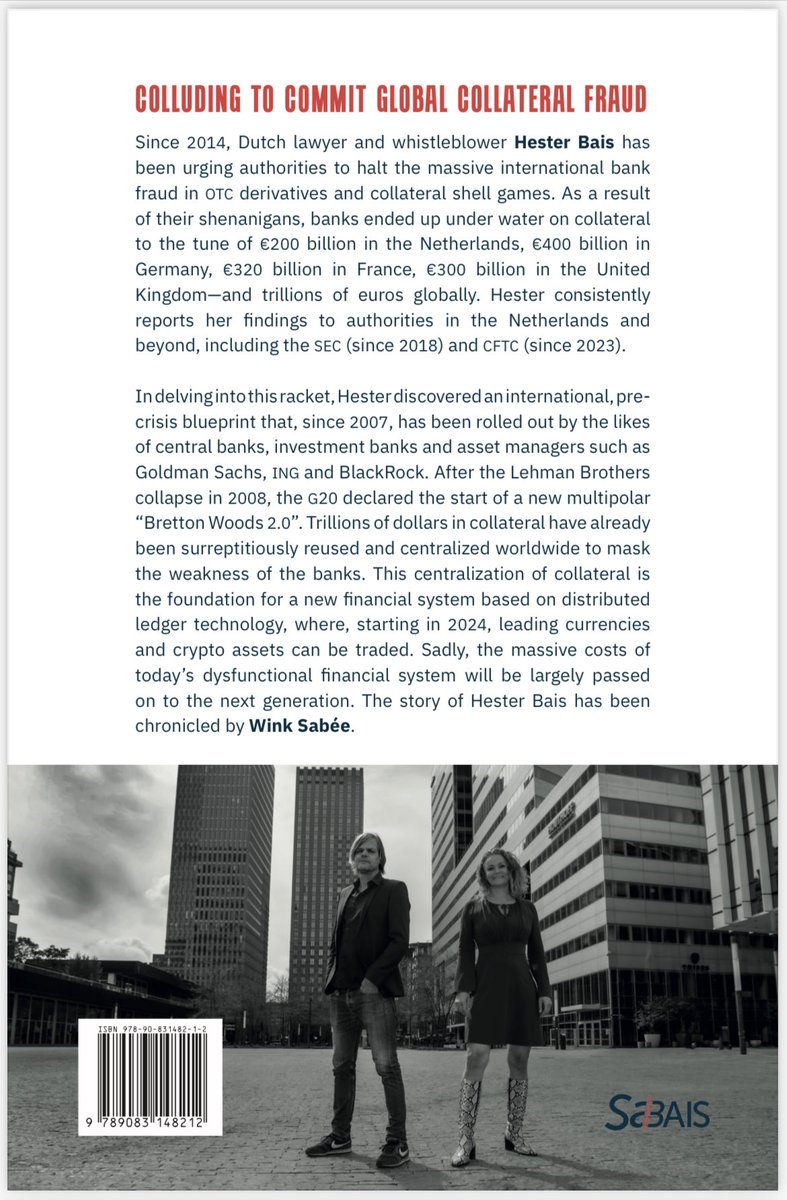
Read Worst Bank Scenario and discover how more than EUR 2000 billion collateral shortage OTC derivatives has been 'laundered' in EU and how Dutch pension funds - and the clearing (collateral) exemption of EMIR for pension funds - have been abused by banks (with help of the Dutch State, central bank and conducteur supervisor @AutoriteitFM) to conceal 200 billion in collateral shortages of banks in the Netherlands.
My name is Hester Bais. I am former lawyer at ING, Euroclear, LCH, Euronext, regulator @AutoriteitFM and ex-senior associate at international law firm Hogan Lovells (specialized in trading, clearing, derivatives law and collateral management)
- and as of 2014 WHISTLEBLOWER
@ValavdBoomen En kennelijk moet je bij de berichtgeving van @mkeulemans eerst zijn hele tijdlijn doorploeteren of hij toch niet nét iets anders bedoelde.
Ingewikkeld met die roddeljournalisten:
✅Als je erop ingaat, is het "wrijven in een vlek" en wordt het groter.
✅ Als je er níét op ingaat, is het "schuld bekennen" en wordt het groter.
Voor meelezers die tóch beetje zijn gaan twijfelen: hier m'n aw dat Ton verzweeg.
IMPORTANT!
The link below takes you to a Press Statement by the APPG on Investment Fraud and Fairer Financial Services entitled:
“WHISTLEBLOWERS AROUND THE WORLD UNITE IN THEIR CONDEMNATION OF THE UK’S FINANCIAL CONDUCT AUTHORITY”
As you’ll see, it has an accompanying anthology.
As far as we know this is the first time whistleblowers around the world have spoken out together on behalf of a fellow whistleblower who has fallen.
They are speaking out against @TheFCA's decision to not move forward with a proper independent 3rd party investigation into their handling of the whistleblowing of Simon Andriesz R.I.P., and a wider systemic review of how they have dealt with other whistleblowers.
Instead, @TheFCA just wants to do a narrow, ‘mark their own homework’ exercise, which has caused outrage in some quarters.
You can access the press statement and accompanying anthology through this link:
https://t.co/oOEHIlwQuY
Please do all you can share this important message.
And huge thanks to everybody involved in the press statement and anthology:
✅ John McDonnell MP: @johnmcdonnellMP
United Kingdom
✅ John Robertson: @J_Robertson_UK
United Kingdom
✅ Pav Gill Singapore
✅ Hester Bais: @Wftproof
Netherlands
✅ Brendan Lyon: @lyon_brendan
Australia
✅ George Patellis
United States
✅ Everett Stern: @EverettStern1
United States
✅ Tom Hayes: @robilypj
United Kingdom
✅ Wayne Johncock: @johncock_wayne
United Kingdom
✅ James E. Miller
United States
✅ Reggie de Jong
The Netherlands
✅ John Christmas
Country not specified
✅ Ahmed Latif
United Kingdom
✅ Paul Carlier: @Carlier_J87
United Kingdom
✅ Mark Wright: @BankConfidenti1
United Kingdom
✅ Steve Middleton: @stevemiddi1
United Kingdom
✅ Ian Tyler
United Kingdom
✅ Lorraine Morris: @MLorrM
Ireland
✅ Jeremy Roseberry: @jeremyroseberry
United States
✅ Jacques Richard
Country not specified
✅ Jesse Griffiths: @JesseLGriffiths
United Kingdom
✅ Professor Richard Moorhead OBE
United Kingdom and Australia
✅ Jimmy Kande Senegal
✅ Ken Kivenko Canada
✅ Jean-Jacques Lumumba: @LUMUMBAJj
Democratic Republic of the Congo
✅ Ian Foxley: @ianfoxley
United Kingdom
✅ Dr. Agris Auce
Latvia
✅Wayne Johncock: @johncock_wayne
United Kingdom
✅James E. Miller
United States
✅Reggie de Jong
The Netherlands
✅John Christmas Country not specified
We are all very grateful to everybody who has been working together to help @SAndriesz speak up, now that he can no longer do so himself.
Thank you!
@brainwasheddan1@realDonaldTrump De Federal Reserve en partijen als Goldman Sachs en BlackRock zijn er ook bij betrokken dus zou zijn prioriteit moeten hebben…. Maar laten dit partijen zijn die ook baat hebben bij de oorlog etc.
What a bullsh*t @realDonaldTrump
As a lawyer, I have been reporting a massive bank and pension fraud (collateral fraud) to the SEC, CFTC and PCAOB since 2018 - during your presidency.
As a whistleblower, you have to die first before you get any attention at all.
Whistleblowing is dangerous and in practice does not yield anything at all (except that you can keep looking at yourself in the mirror).
@Jeroen_Rietveld@hester Het is iig duidelijk dat zowel ABP als PFZW (zeer) slecht hebben gepresteerd dus het causale verband lijkt me gegeven.
https://t.co/FleVz43GeC
https://t.co/zRRMA3aQsF
Het interview Het nieuwe pensioenstelsel: woekerpolis 2.0 roept een fundamentele vraag op over de ontwikkeling van ons pensioenstelsel.
Met de lancering van het Financieel Toetsingskader (FTK) in 2004 onder verantwoordelijkheid van Mark Rutte (VVD) als staatssecretaris en Aart Jan de Geus (CDA) als minister van Sociale Zaken, veranderde fundamenteel hoe tegen pensioenverplichtingen en risico's werd aangekeken. Hoewel het FTK pas in 2007 in werking trad, mocht het eerder worden toegepast (en werd het in de praktijk eerder toegepast).
Daardoor verschoof de focus van pensioenfondsen steeds meer naar renteafdekking, onderpand en financiële stabiliteit.
Pensioenfondsen werden niet langer uitsluitend beheerd in het belang van pensioendeelnemers. De vermogens van ABP, PFZW en aangesloten pensioenfondsen werden steeds nadrukkelijker onderdeel van een financieel stelsel waarin liquiditeit, onderpand en stabiliteit van banken centraal stonden. In Worst Bank Scenario laten we zien hoe met pensioengelden een onderpandprobleem van circa €200 miljard bij OTC-derivaten (waaronder rentederivaten) van ING, Rabobank en ABN AMRO, kon worden gegarandeerd en buiten het zicht van de deelnemers bleef.
Tegelijkertijd werden werkgevers stap voor stap bevrijd van pensioenrisico's.
Dat roept een ongemakkelijke vraag op:
Voor wie werkt het pensioenvermogen eigenlijk?
Voor de deelnemer?
Of voor een financieel bankensysteem dat steeds afhankelijker is geworden van pensioenfondsen (en verzekeraars) als bron van onderpand, liquiditeit en stabiliteit?
In Worst Bank Scenario speelt ING een centrale rol. Vanuit die optiek is het opvallend dat juist ING in 2014 als een van de eerste grote Nederlandse ondernemingen haar pensioenrisico's grotendeels van de balans wist te verwijderen. Niet omdat ING de ontwikkelingen zag aankomen. Maar omdat ING naar mijn mening onderdeel was van de pensioentransitie.
Pensioenfondsen verschillen fundamenteel van banken. Zij hebben een beleggingshorizon van tientallen jaren en kennen geen klassieke bankrun.
Waarom werden liquiditeit, onderpand en renterisico dan zo bepalend voor het pensioenbeleid?
En waarom gingen jaren van gemiste indexaties samen met een stelsel waarin werkgevers steeds minder pensioenrisico droegen?
De echte discussie rond de Wtp wordt naar mijn mening op de verkeerde plek gevoerd. Het gaat niet alleen over pensioenen. Het gaat over de vraag welke functie pensioenvermogen tegenwoordig vervult.
Is het nog primair bedoeld voor pensioenopbouw en koopkrachtbehoud?
Of is het een onmisbare bouwsteen geworden van het monetaire en bancaire systeem?
Lees Worst Bank Scenario.
#pensioen #Wtp #ING #FTK #ABP #PFZW #WorstBankScenario #pensioenfondsen #banken
Het nieuwe pensioenstelsel: woekerpolis 2.0 https://t.co/fkLH9Nc2Zv
Completely right Hester.
@TheFCA should not investigate itself & no one should support it in doing so.
Just like the IRHP Review, the Griggs Review, the Foskett Panel etc. @TheFCA will be trying to line up their 'Useful Idiots' to try & get away with this.
But we are watching it all carefully...
@BankConfidenti1@MLorrM@BomberMorgan@efgbricklayer@ArturNadol7566
@michelportier80@IngeCommissaris Onderdeel van de transitie die met de grote pot geld uit EU wordt gefinancierd is weerbaarheid en cyber security. Toeval deze cyber incidenten?
When I spoke to Simon Andriesz @SAndriesz, he told me @TheFCA was most to blame for what he went through. The FCA's answer is a review by its own board member, and Hester Bais @Wftproof is right that a regulator cannot credibly investigate itself.
On 3 December 2025 I sent am email to @TheFCA asking for support and help, because of the number of cases I was supporting vulnerable people on, including suicide risk & actual suicides.
These were all victims of bank & financial frauds & cover ups. I was undertaking the work pro bono & just asking for help.
I enclosed the final letter of a man asking me to take on the bank and take care of his wife, he was going to kill himself whilst he could still afford to keep up the premiums on his life insurance, which because it had been in place past two years it would pay out on his suicide.
Then he ended his life.
All because the bank were repossessing his home to recoup its profits from a interest rate swap Hidden Credit Line, secured against the home without his knowledge via a Personal Guarantee.
None of @TheFCA Board all copied in commented, apart from John Ball the Non Exec Director who sent this emoji - 😢
Asking if he meant it, in which case it was not a very suitable response, he ignored my emails. Leading me to the conclusion that he had facetiously sent a weeping emoji to his fellow Board members & accidentally copied me in. A view I still hold.
The Complaints Commissioner subsequently found against me on every element of my complaint about this (see link). The CEO Mr Rathi & the FCA Executives are too busy, too important to meet with me, I was told.
Clearly a few more early deaths amongst that annoying SME community, who keep asking for their money back, stolen by @NatWestGroup@LloydsBank & others, following the financial crash, is of no concern to 'busy' @TheFCA Executives.
The response was received the same day we later learned that significant whistle-blower Simon Andriesz who had been reporting Epstein & Lutnick ties, sadly took his own life
He blamed @TheFCA for failing to protect him from retaliation by Lutnick's firm & in particular, he blamed CEO Nikhil Rathi, for ignoring his pleas for help.
Following Simon's death & my call in an email to the Complaints Commissioner for Nikhil Rathi to step down, they have now agreed to meet.
But they have learned nothing, they have washed their hands of another @LloydsBank suicide risk case just 1 WEEK after the AGM.
A black and white case where a dishonest Lloyds bank manager replaced a home mortgage at 2/base with commercial loans. Shortly afterwards they were charging him over 26% on the homes lending. His business destroyed by the debt servicing costs, he could no longer afford his mortgage.
They have literally broken every Rule in the book on this case & then repeatedly misled the court & used dishonest underhanded tactics to get a possession order. Using an N120 'Home Repossession' form, they told the court it was an investment property/ commercial lending.
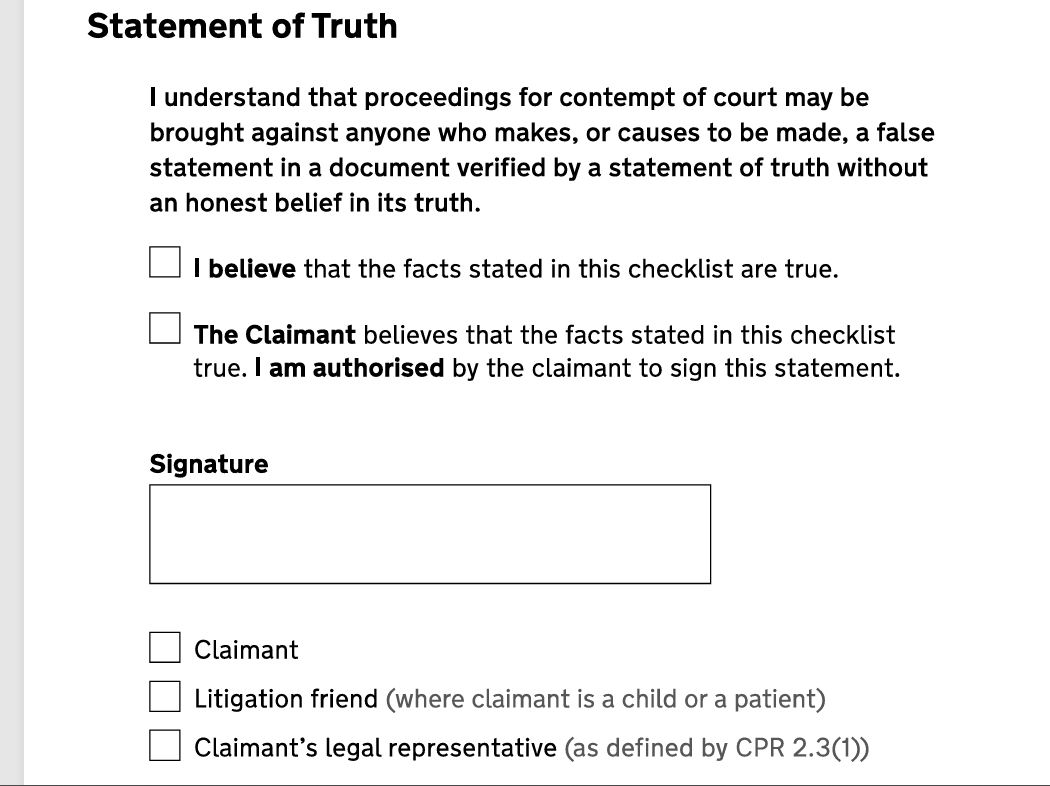
They didn't submit the MANDATORY 2 copies of the N123 because the bank staff or legal team would have to sign a statement of truth that they had complied with all of the relevant FCA Rules before applying for possession (see below). They DID NOT comply with ANY of the Rules.
Charlie Nunn and Sir Robing Budenburg have been made aware of the case and have a copy of my report setting out all of the regulatory failures & where the Court was misled.
@TheFCA said - we can't do anything and Lloyds have given him some extra time, YES 3 WEEKS to demand payment in full before they repossess. He has told me he will not leave there alive.
@TheFCA Executives & staff know that, @LloydsBank know that, their counsel & legal team (who will be named( know that.
But they all REFUSE to HELP.
This is now a PUBLIC RECORD of events.
I for one do not see how @TheFCA Executives & staff, failing to take action over specific, known Rule breaches & failing to protect a consumer in order not to expose @LloydsBank & their legal team, who have misled the courts and perverted the course of justice could possibly be - 'exercising a Public Function.'
The question is then, if they are acting in bad faith (what else can it be) can & should @TheFCA its Executives & relevant staff face misfeasance in public office and potential Corporate Manslaughter investigations?
And after the multiple early deaths and suicides relating to the behaviours @LloydsBank BSU, which is where the wrongdoing in this case would have taken place, isn't about time such charges were considered in relation to the Chair, CEO & Executives at that bank?
https://t.co/MlhOSuXHsI
@BankConfidenti1@TransparencyTF@appgonifandffs@johnmcdonnellMP@IanByrneMP@labourlewis@JohnHealey_MP@andyburnham@EmilyBuchanan1@jameshurley@andyverity@ArturNadol7566@Wftproof@MLorrM@CompassnInCare@mickmor16921994@james_glanville@CarshaltonArt@bleating_lamb@paulpygmy02@johncock_wayne@JohnCleese@JohnCena@EricIdle@BomberMorgan
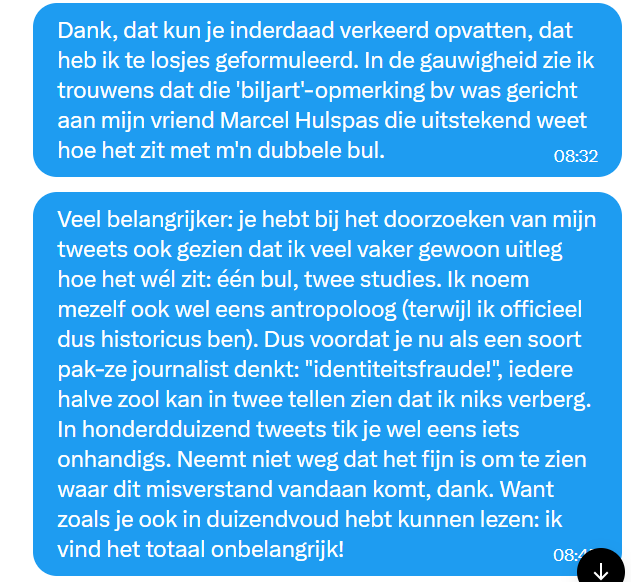
“Wist ik veel dat er nog eens een tijd zou komen waarin er mensen met serieuze gezichten mijn tijdlijn onder de loep gingen nemen.”
Gelukkig geeft Keulemans nu zelf toe dat we zijn social media berichten met een korreltje zout moeten nemen.
Voortschrijdend inzicht van de wetenschapsjournalist wat betreft “afgestudeerd in twee studies”.
Omdat er alweer hitpiece onderweg is dat beweert "Keulemans liegt over z'n opleiding!" (en omdat ik uurtje over had), toch eens opgetikt hoe het nou zit met die 2 studies die ik zou hebben gedaan. 😇
Spoiler: 1x afgestudeerd, maar interdisciplinair.
https://t.co/a8QGahVJpA
“Hester Bais, a Dutch lawyer and whistleblower who has exposed large-scale banking fraud involving interest-rate derivatives, added: “The proposal for just an internal FCA review troubles me deeply. The FCA’s proposal sends entirely the wrong signal. If a regulator can investigate itself whenever its own treatment of a whistleblower is questioned, then where does the whistleblower go when things have gone disastrously wrong?””
https://t.co/hbW3bbBJUr
📽️ We have uploaded the recording of the event we ran last week, entitled: “Litigants in Person: Alone in Court – The Reality of Facing the Justice System Without a Lawyer”
The speaker was Edward Romain, ACILEX, Founder amp; CEO, Blind Justice UK
You can watch the recording here 👇
https://t.co/h1jEOTGqt3
If you can, please share this video widely within your network/on social media.
🗣️ Andy Agathangelou says: “Edward Romain delivered an excellent presentation followed by a discussion that really brought home just how dire the situation is for people who find themselves facing the justice system without a lawyer. This is an endemic problem, and people are in desperate need of practical help. Edward is filling a real void. I’m sure his forthcoming book will be an incredibly useful resource, teaching people the rules, explaining the tactics and helping them navigate a system that can otherwise feel impossible to face alone.
He delivered this message brilliantly, and it is one that more people need to hear. We will always achieve more if we find ways to work together, and this session was a fantastic example of why collaboration matters.”
The Hidden Architecture of Modern Financial Fragility: From M3 Blackout to Collateral Chains and the Silent Bretton Woods 2.0
In 2006 the Federal Reserve quietly discontinued publishing M3, the broadest measure of money supply that captured institutional funds, repo activity and eurodollars. This happened right before the shadow banking leverage began its massive hidden expansion.
Without M3 data the public and even many analysts could no longer track how credit and liquidity were truly growing in the opaque corners of the financial system.
Then came September 2008. Lehman Brothers was allowed to fail in what many now see as a deliberate signal rather than an unavoidable accident. The bankruptcy triggered a global panic, justified unprecedented quantitative easing, and handed central banks the keys to massively expand their balance sheets for years to come.
QE flooded the system with reserves while simultaneously sucking high-quality collateral (government bonds) out of private markets, creating artificial scarcity that forced ever more reliance on repo chains for funding and margin.
By 2016 the G-SIB surcharge framework shifted the incentives dramatically. Rules began to penalize heavy reliance on short-term wholesale funding, including uncovered guarantees and undrawn commitments that had previously allowed off-balance-sheet leverage with minimal capital impact.
Banks responded by pivoting toward more secured, on-balance-sheet repo financing, embedding collateral reuse and upgrading deeper into the plumbing of the system.
The pressure culminated in September 2019. Both EMIR in Europe and Dodd-Frank uncleared margin rules in the United States implemented Phase 4 of their initial margin schedules simultaneously. The threshold dropped to roughly 750 billion in notional exposure, pulling thousands more counterparties into mandatory posting of high-quality collateral for uncleared OTC derivatives. This created an enormous and sudden surge in demand for cash and top-tier assets, which dealers and funds financed through repo markets. The repo market, already stretched thin by years of quantitative tightening, could not absorb the shock smoothly. Overnight rates spiked violently, exposing just how fragile the entire collateral chain had become under the surface of apparent stability.
Today SOFR has fully replaced LIBOR as the benchmark, turning the entire derivatives complex into a secured, repo-dependent ecosystem. Yet the underlying chains remain vulnerable: any sudden cash drain, margin call spiral or geopolitical shock can still cause seizure. The public sees only the surface calm maintained by central bank tools, while the real leverage and fragility are hidden in repo velocity, netting and encumbrance.
This is not coincidence. It is a deliberate architectural shift from uncovered to covered risk, from transparent aggregates to opaque chains, from private leverage to central-bank-dependent stability.
The complete story, including the collateral fraud mechanisms and the quiet rollout of a new Bretton Woods-style multipolar reserve system, is exposed in Worst Bank Scenario.
If you want to understand what really happened and what is still unfolding behind the official narrative, read my story (via Amazon).