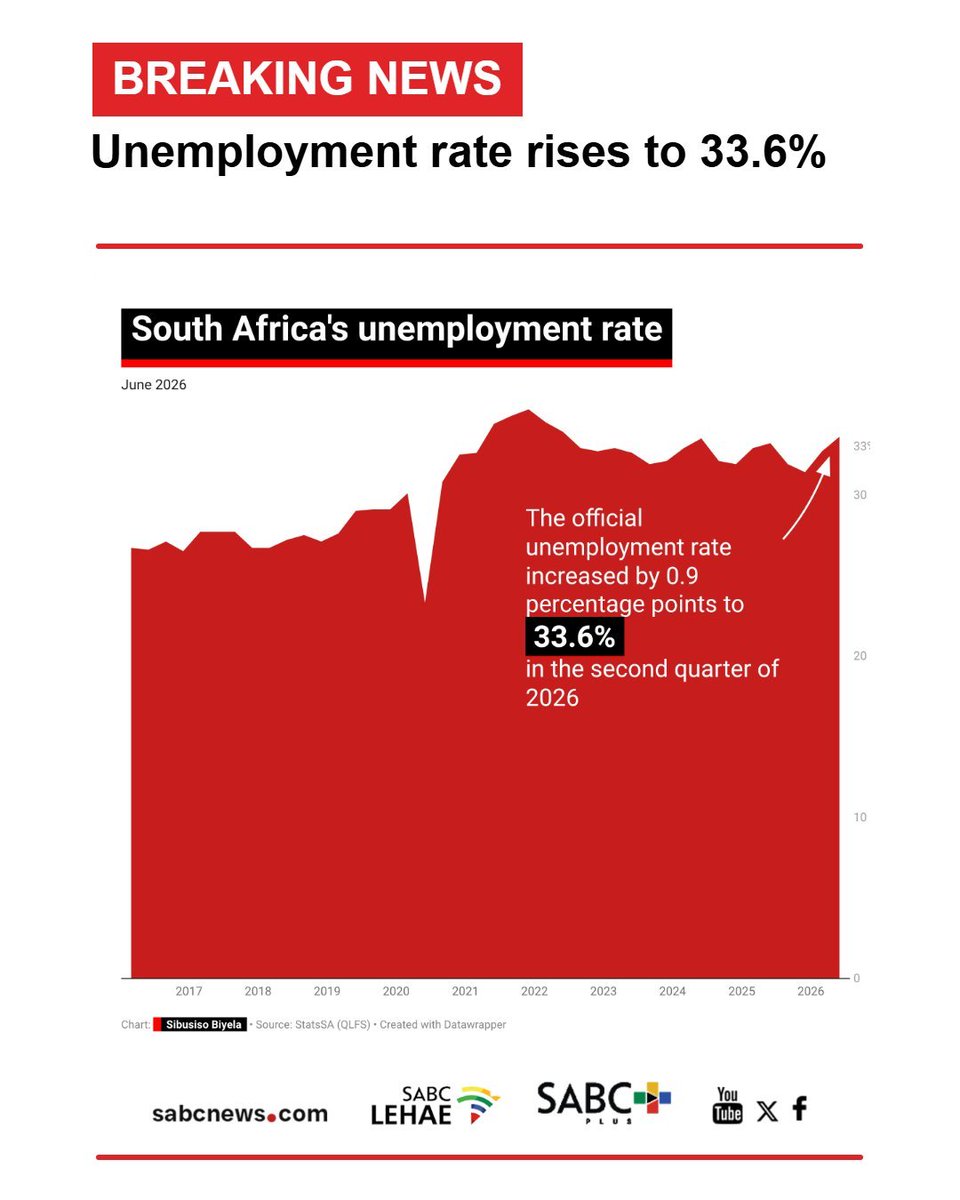
33.6% unemployment is not just a bad number. It is evidence of a structural failure in the South African economy. The official rate has risen from 32.7% to 33.6%, with the number of unemployed increasing by 345,000 to approximately 8.5 million, while employment actually fell by 16,000 to 16.7 million.
And look carefully at the graph. This isn't a temporary shock sitting outside the long-term trajectory. South Africa has been trapped above 30% unemployment for years. The problem is therefore not simply that the economy had a bad quarter. The economy is failing to generate employment at the scale required by its working-age population.
The most revealing part is arguably what happened to employment. The country did not merely fail to create enough jobs to absorb new entrants; employment declined, with losses concentrated in community and social services, mining, agriculture and manufacturing.
That should immediately change the policy conversation.
We keep talking about skills shortages, employability, entrepreneurship, investment confidence and labour-market reforms. All of these matter. But there is a fundamental economic question we cannot escape:
Where are the productive enterprises that are supposed to employ millions of people?
You cannot train 10 million people and then discover that there aren't 10 million productive jobs waiting for them.
You cannot tell young people to become entrepreneurs while leaving them in an economy with inadequate infrastructure, expensive finance, weak domestic demand, unreliable logistics and limited industrial opportunities.
You cannot simultaneously tolerate deindustrialisation and then complain that the unemployed lack manufacturing experience.
Employment is ultimately derived from productive economic activity.
That means South Africa needs to move beyond the economics of managing unemployment and towards the economics of creating productive capacity.
Build the factories.
Expand the electricity grid.
Build rail.
Modernise ports.
Establish industrial parks that actually manufacture things.
Expand agro-processing.
Develop pharmaceutical production.
Build machinery and engineering industries.
Process minerals domestically.
Expand construction.
Build universities, TVET colleges and research institutions at scale.
Develop technology and digital industries.
Use public procurement strategically to create domestic industrial capability.
And most importantly, connect education policy to an actual industrial and employment strategy.
There is also an important macroeconomic distinction here: GDP growth is not automatically employment growth. An economy can grow while generating insufficient jobs if growth is concentrated in highly capital-intensive sectors, finance, certain services or activities with weak domestic employment multipliers.
South Africa therefore needs to care not only about how much the economy grows, but what kind of growth it produces, where that growth occurs, who participates in it and how many productive jobs it generates.
And the youth dimension makes this even more urgent. Before this latest release, Stats SA reported youth unemployment of 60.9% among 15–24-year-olds and 40.6% among 25–34-year-olds in Q1 2026.
That is potentially devastating for human capital.
A young person who spends years outside employment is not simply losing a salary. They are losing work experience, skills accumulation, professional networks, savings, pension contributions, confidence and opportunities for upward mobility.
That creates hysteresis: unemployment today can reduce a person's productive capacity and earnings tomorrow.
So when we look at this graph, we shouldn't merely ask:
“How do we reduce unemployment from 33.6% to 32%?”
That is far too small an ambition.
@steenekampcarl Especially not by the current municipalitity employees many of whom dont have good work ethics and will steal parts meant to repair the infrastructure and not provide good service
Dear Jacinta Ngobese Zuma. Being a leader of a civic organization and urging your followers to vote for a certain political party, a useless one for that matter, is not only partisan but also it is a mistake that will come back to haunt you!
Its not surprising for the SA youth unemployment rate to be over 47% because old age incumbents are governing the country in all 3 spheres! And people still believe in fighting the system from within! Come this side again when unemployment reaches 60%!