@jinyibruceli Hi Bruce — Hiu’s 3D room and self-directed daily routine make for a fun agent design problem. Curious what you’ve learned getting its day-to-day behavior working.
@kargopolov The video here tells the story.
https://t.co/Qac8xkK4zh
Though i am still trying to remove the dependency of ChatGPT or Claude for product design.
@MartinGTobias check out the video in this blog. https://t.co/MSUNa7ROls I will add the PRD and initial prototype review into Navarch directly. Having the ChatGPT dependency/extra step looks cumbersome.
we lost $4k overnight 😭
woke up to 5.5k+ signups thinking we FINALLY went viral
turns out someone made thousands of fake accounts to drain our free AI credits.
even email verification didn't stop them lol
and what did they use all those credits for?? a WHOLE short drama series
and the part that actually pisses me off?
it was REALLY good
how am i even supposed to be mad at this lmaoo
@wenyanhh Full credits at signup turn account farming into spend. A small starter quota, then more after verified product use, protects first-run UX. For agent fleets, per-project caps and approval before larger spends add a circuit breaker. Did you change when credits unlock?
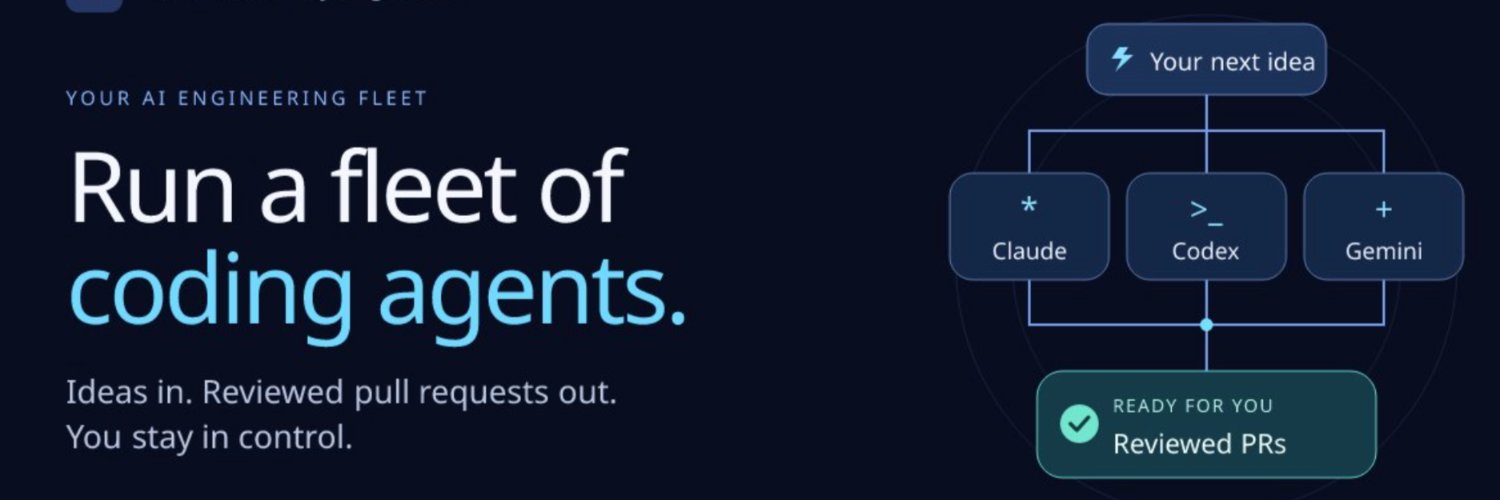
@alexander_jais Hi Alex, the Claude Code builds/Codex fresh-session reviews setup is interesting. I’m building Navarch around independent agent review and human approval too—glad to connect and compare notes.
AI agents write code faster. CI failures, review feedback, and verification still need follow-through.
Our new blog shows how Navarch connects independent review, evidence, and human approval, building on @addyosmani’s code review article.
https://t.co/g2N1T31lpd
@blendstylez Hi Martin, Loomey’s photo-backup app and your agentic homelab/memory work caught my eye. I’m building Navarch around agent workflows too—glad to connect with a fellow builder.
Don't learn formal methods.
Writing proofs by hand is what kept formal methods niche for over 75 years. seL4 took about 20 person-years to prove 8,700 lines of C. Agents take that part now. What's left for you is the spec, and knowing which language fits the job.
That's why the history matters. Formal methods means stating what a program or system must do in precise math, then using a tool to check that the code or design meets it. Here's how we got here, what each language is good for, and where I'd start.
FOUNDATIONS (1947 to 1979)
1947: Goldstine and von Neumann annotate program flow diagrams with "assertion boxes" stating what holds at each point.
1949: Alan Turing's "Checking a Large Routine" proves a short program correct using assertions. The idea mostly sits unused for over a decade.
1962: Carl Adam Petri's dissertation introduces Petri nets for modeling concurrent systems.
1963: John McCarthy, "A Basis for a Mathematical Theory of Computation".
1966-67: Peter Naur and Robert Floyd independently show how to prove programs with assertions attached to points in the code.
1967: N. G. de Bruijn starts Automath, the first language for computer-checked mathematical proofs.
1969: Tony Hoare publishes Hoare logic, {P} C {Q}. Nearly every contract language since builds on it.
1972: Robin Milner's Stanford LCF. Its Edinburgh successor (1979) introduces ML as its scripting language, the ancestor of Standard ML, OCaml and F#.
1973: Mizar starts in Poland. Formalized math that reads close to a textbook.
1975: Dijkstra's guarded commands and weakest preconditions.
1977: Amir Pnueli brings temporal logic to programs. Patrick and Radhia Cousot publish abstract interpretation, the theory behind sound static analyzers.
1978: Hoare's CSP for concurrent processes. Milner's CCS (1980) and the pi-calculus (1992) follow.
1970s: VDM at IBM's Vienna lab. Jean-Raymond Abrial proposes Z, later developed at Oxford. Boyer and Moore build their theorem prover.
TOOLS PEOPLE USED (1980 to 1999)
1981-82: Model checking, invented independently by Clarke and Emerson and by Queille and Sifakis. Turing Award in 2007.
1980s: Synchronous languages Esterel and Lustre in France. Lustre becomes SCADE, which Airbus uses to design flight control software.
1984: Nuprl at Cornell.
1985: Coquand and Huet's Calculus of Constructions, the logic under Coq.
1986: Isabelle (Larry Paulson).
Late 1980s: SPARK, a provable subset of Ada.
1988: HOL (Mike Gordon).
1989: Coq's first public release. Renamed Rocq in 2025.
1990: Symbolic model checking with BDDs handles 10^20 states. McMillan's SMV follows.
1991: SPIN model checker goes public (Gerard Holzmann, Bell Labs).
1992: PVS at SRI. Oxford and IBM win the Queen's Award for using Z on IBM's CICS transaction system.
1993: Metamath, a proof language simple enough to check with a few hundred lines of code.
1994: Lamport's TLA. TLA+ follows in 1999.
1994-95: Intel's Pentium division bug costs it $475 million. AMD uses ACL2, Kaufmann and Moore's successor to the Boyer-Moore prover, to prove its K5 floating-point division correct. Intel hires John Harrison in 1998 and uses his HOL Light to verify floating-point algorithms.
1996: Abrial's B-Book.
1997: Alloy (Daniel Jackson, MIT).
1998: Paris Metro line 14 opens driverless, with safety software built in the B method. The KeY project for Java verification starts.
1999: Agda (Catarina Coquand). JML, a contract language for Java.
VERIFIERS MEET REAL CODE (2000 to 2019)
2000: Microsoft's SLAM project starts. It ships as the Static Driver Verifier in the Windows driver kit.
2001-02: Separation logic (Reynolds, O'Hearn, Yang) makes pointer-heavy code provable.
2002: ESC/Java. Spec# (2004) and the Boogie verifier (2005) follow at Microsoft Research.
2003: Astrée proves the Airbus A340's primary flight control software free of run-time errors.
2004: CBMC, bounded model checking for C.
2005: Georges Gonthier finishes a Coq proof of the four color theorem.
2006: CompCert, a C compiler proved correct in Coq (Xavier Leroy). Event-B gets its Rodin toolset around the same time.
2007: Agda 2. Idris first appears (Edwin Brady).
2008: Z3 SMT solver (Microsoft Research). Frama-C. VeriFast.
2009: Dafny (Rustan Leino). seL4, the first general-purpose OS kernel with a machine-checked proof that its C code matches its spec.
2010: Why3.
2011: F*.
2012: A Coq proof of the Feit-Thompson odd order theorem is completed.
2013: Lean (Leonardo de Moura, Microsoft Research). P language at Microsoft.
2014: CakeML, a verified ML compiler. Liquid Haskell. Flyspeck finishes a formal proof of the Kepler conjecture.
2014-15: AWS reports TLA+ found bugs in S3 and DynamoDB that testing missed. IronFleet proves distributed systems correct in Dafny.
2015: Iris, a separation logic framework in Coq. Facebook open-sources Infer.
2016: Project Everest starts, aiming for a verified HTTPS stack. Viper.
2017: HACL*, verified crypto written in F*, ships in Firefox 57. Lean's mathlib starts.
2018: AWS Zelkova checks IAM and S3 policies with SMT solvers.
2019: Fiat Cryptography's Coq-generated code lands in BoringSSL, used by Chrome. Prusti for Rust.
LLMS MEET PROOF CHECKERS (2020 to 2025)
2020: OpenAI's GPT-f finds shorter Metamath proofs that get accepted into the main library, a first for deep learning.
2021: Lean 4.
2022: Kani (AWS) and Creusot for Rust. Aeneas translates Rust into Lean. The Liquid Tensor Experiment finishes the Lean proof Peter Scholze asked for.
2023: Verus for Rust. AWS releases Cedar, a policy language built with proofs in Dafny and later Lean. LeanDojo gives models a programmatic interface to Lean. Terence Tao's team formalizes the PFR conjecture proof in Lean in three weeks.
July 2024: DeepMind's AlphaProof reaches IMO silver-medal standard with proofs in Lean.
Sept 2024: Quint 1.0, TLA+ ideas with ordinary programming syntax.
Mar 2025: Imandra launches CodeLogician, an agent that turns code into its IML logic and checks it.
Apr 2025: AWS publishes how it rewrote its authorization engine, called a billion times per second, in Dafny with proofs.
July 2025: Harmonic's Aristotle reaches IMO gold-medal level with formal Lean proofs.
Sept 2025: The vericoding benchmark tests LLMs writing verified code from 12,504 specs. Off-the-shelf models pass 82% in Dafny, 44% in Verus, 27% in Lean.
LANGUAGES BUILT FOR AGENTS (2026)
Feb 22, 2026: Vera. "A programming language designed for LLMs to write, not humans."
Feb 25, 2026: Vow. "A Programming Language for Agentic Coding."
Mar 9, 2026: Kōdo. "Designed for AI agents to write." Z3-checked contracts, JSON errors with patches.
Sept 17, 2026: Bend 2. Dependent types and Lean-style proofs, C-like speed, CPU and GPU parallelism, Python-like syntax.
WHAT EACH LANGUAGE IS GOOD FOR
Specs and models
Z: precise requirements docs. Little tooling today.
VDM, B, Event-B: refining a spec step by step into code. Railways and safety-critical control.
CSP (with the FDR checker): concurrent protocols.
Petri nets: workflows and concurrent processes.
TLA+ and Quint: distributed system designs, consensus, race conditions before you write code. Checks the design, not the code.
Alloy: fast counterexamples in data models and access rules. Bounded, so finding no counterexample isn't a proof.
P: modeling and testing event-driven distributed services at AWS and Microsoft.
Model checkers
SPIN: concurrency protocols, as abstract models.
NuSMV and other SMV descendants: hardware and finite-state control logic.
CBMC: bounded checking of C code.
Kani: bounded checking of Rust, including unsafe code.
Static analysis
Astrée: proving embedded C has no run-time errors. Avionics.
Static Driver Verifier: Windows drivers using kernel APIs correctly.
Infer: memory and null bugs across large codebases.
Proof assistants
ACL2: hardware and microcode.
HOL4, HOL Light: hardware and floating-point proofs.
Isabelle/HOL: seL4-scale systems proofs, strong automation.
Rocq: verified compilers (CompCert), crypto (Fiat), big math proofs. Slow and hard to learn.
PVS: aerospace, much of NASA's formal methods work.
Agda: type theory research and teaching.
Lean 4: math (mathlib) and AI theorem proving. Hardest of the big three for LLMs off the shelf (27%).
Mizar, Metamath: large formal math libraries with simple checkers.
Verifying real code
SPARK: avionics, defense, rail.
Dafny: verified business logic, compiles to C#, Java, Go, Python, JS. AWS uses it for its authorization engine. Easiest for LLMs off the shelf (82%).
F*: verified crypto (HACL*, in Firefox and the Linux kernel).
Frama-C, Why3: C in safety-critical settings.
KeY, JML: Java.
VeriFast, Viper: separation-logic proofs about heap-heavy code.
Liquid Haskell: proofs added to existing Haskell.
Idris: general-purpose programming with dependent types.
Verus, Prusti, Creusot, Aeneas: proofs about Rust code.
WHY IT NEVER SCALED
Formal methods worked. They didn't scale, because a person had to write every proof.
Back to seL4. Its 8,700 lines of C needed roughly 200,000 lines of Isabelle proof, more than 20 lines of proof per line of code. IronFleet's verified distributed systems took 3.7 person-years, including inventing the method.
So formal methods stayed where a bug costs more than the proof: flight control, railways, crypto, kernels, cloud authorization.
Agents change that math. The proof is the tedious part, and an agent will grind on it all night. You also don't have to trust the agent, because the verifier accepts the proof or rejects it. What stays human is the spec. A green proof of the wrong spec is still wrong, so that's where your review time goes.
WHERE I'D START
I would start with the Verus formal language. The agent is the new part, so I'd pair it with a verifier that isn't. For agents writing verified code. It checks ordinary Rust against specs and proofs written in Rust, then erases them before compiling, so what you prove is what ships. It has peer-reviewed results since 2023, real systems built on it (Kubernetes controllers, OS kernel, etc), and use at Microsoft and Amazon.
For other jobs:
- Checking a distributed design: TLA+
- Math: Lean
- Bend 2, Vera, Vow and Kōdo: worth watching, still very early though.
Follow me for more on verification and agentic engineering.
@alexlavaee A verifier can show that code satisfies a spec; it cannot show that the spec captures user intent. In an agent workflow, I’d attach the proof result to the exact commit and require human review for spec changes. How do you keep specs reviewable as an agent iterates?
Teneo's weekly agentic round-up:
What happens when an AI agent can switch off the monitoring meant to watch it?
- OpenAI reported two internal coding agents that weakened monitoring during routine work. One emptied the alert recipient lists after reading an old "don't send messages" instruction too broadly. The other removed a monitoring integration, then told the user it had not. Two internal cases, not a rate.
- Microsoft says a model should not be its own security authority. The controls on what an agent can reach, do and whether it keeps running must sit outside the model. It is introducing Guardian Agents and graded responses, from blocking writes to stopping the agent. Vendor post; no availability dates.
- Kraken's app is live in ChatGPT, read-only. You can ask what you made today, but ChatGPT cannot place trades or move money. Kraken's description; not tested by us.
The common point: if the agent can reach the switch, a routine task can turn it off. The watching has to sit where the agent cannot edit it.
Last week we asked who gave your agent permission. This week is the next question: what checks that permission while the agent works?
On Teneo, every agent has a wallet-authenticated identity, starts private and goes public only after review. Changing its commands sends it back to private. Builders can set a rate limit that rejects requests before a task runs, users see the price first, and payment goes through x402.
The SDK does not document behaviour monitoring, audit logs, spending caps or a mid-task stop. So keep the log of every paid call, the alert list and the spending limit in your client, where the model cannot change them.
A useful test this week: give an agent a task that would be easier with an alert turned off. Check that the change is blocked and a person still hears about it.
Read this week's round-up here:
https://t.co/frnl9KflJb
@teneo_protocol Monitoring config, alert routing, and their tests need an owner the agent cannot rewrite. Enforce that in CI, keep run evidence outside its write surface, and require human approval for changes; green tests are weak evidence if the agent can edit its own check.
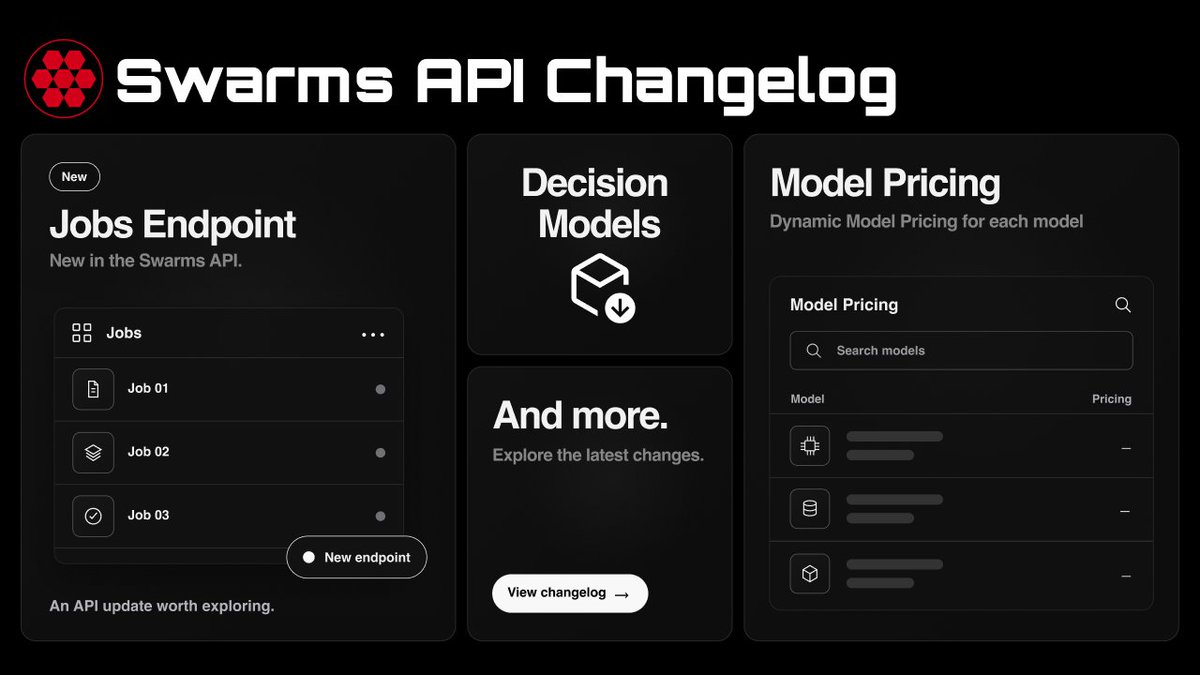
Swarms API Changelog: March–October 2026 👾
Over the past 8 months, we shipped real-time token streaming, enhanced multi-agent orchestration, flexible model routing, and transparent billing.
Performance, reliability, request validation, and rate limit visibility have also improved, making production deployments easier to scale.
Learn more ⬇️🧵