The transfer didn’t fail.
That would have been easier.
It just disappeared.
Friday night: processing.
Sunday: still processing.
Tuesday: gone.
No reversal. No failure notice. No money.
Just a blank space where the transaction used to be.
I had the debit alert.
The recipient had nothing.
Support had my screenshots, reference number, timestamps, and every detail they asked for.
Their answer was still:
“Please allow more time.”
So I took the train to the branch.
The woman at the desk checked everything, nodded, and printed a complaint slip.
At the top was a case number.
That number became the only proof that somebody, somewhere, was supposed to care.
Day 3.
Nothing.
Day 6.
“Still under investigation.”
Day 9.
Same answer.
The strange part was that nobody disagreed with me.
The money left.
The recipient never got it.
The evidence was there.
The problem wasn’t proving what happened.
The problem was getting a system to act on what was already obvious.
That distinction matters.
Because we usually talk about smart contracts as if every decision can be reduced to:
Did X happen?
Yes or no.
But real life is messier.
Sometimes the evidence is a screenshot.
A document.
A webpage.
A written agreement.
A series of events that make sense to a human in thirty seconds but are invisible to a normal smart contract.
That is what made @GenLayer click for me.
Their intelligent contracts use LLM validators to reason about information that traditional smart contracts cannot easily interpret.
Not just numbers already sitting onchain.
Actual human-readable evidence.
Suddenly that sounds less like a crypto feature.
And more like a system that can look at the receipts and make a decision.
My transfer eventually came back.
Nine days.
The complaint slip stayed in my bag longer than the actual dispute.
Funny how much of modern life works like that.
The answer is already there.
You are just waiting for the person, department, or system with permission to admit it.
What is the longest you have waited for something that should have taken five minutes?
@BaqiYekeen Nine days sounds ridiculous until you realize how many industries still run on the same model: submit evidence, get a ticket, wait for a human.
The transfer didn’t fail.
That would have been easier.
It just disappeared.
Friday night: processing.
Sunday: still processing.
Tuesday: gone.
No reversal. No failure notice. No money.
Just a blank space where the transaction used to be.
I had the debit alert.
The recipient had nothing.
Support had my screenshots, reference number, timestamps, and every detail they asked for.
Their answer was still:
“Please allow more time.”
So I took the train to the branch.
The woman at the desk checked everything, nodded, and printed a complaint slip.
At the top was a case number.
That number became the only proof that somebody, somewhere, was supposed to care.
Day 3.
Nothing.
Day 6.
“Still under investigation.”
Day 9.
Same answer.
The strange part was that nobody disagreed with me.
The money left.
The recipient never got it.
The evidence was there.
The problem wasn’t proving what happened.
The problem was getting a system to act on what was already obvious.
That distinction matters.
Because we usually talk about smart contracts as if every decision can be reduced to:
Did X happen?
Yes or no.
But real life is messier.
Sometimes the evidence is a screenshot.
A document.
A webpage.
A written agreement.
A series of events that make sense to a human in thirty seconds but are invisible to a normal smart contract.
That is what made @GenLayer click for me.
Their intelligent contracts use LLM validators to reason about information that traditional smart contracts cannot easily interpret.
Not just numbers already sitting onchain.
Actual human-readable evidence.
Suddenly that sounds less like a crypto feature.
And more like a system that can look at the receipts and make a decision.
My transfer eventually came back.
Nine days.
The complaint slip stayed in my bag longer than the actual dispute.
Funny how much of modern life works like that.
The answer is already there.
You are just waiting for the person, department, or system with permission to admit it.
What is the longest you have waited for something that should have taken five minutes?
A lot of Web3 contribution work gets forgotten almost as quickly as it happens.
Someone writes a useful tutorial.
Someone hosts a meetup.
A few days later, it is buried under hundreds of Discord messages.
That is what made me actually create an account on the @GenLayer Portal instead of saving the link for later.
Your work does not just disappear into the timeline.
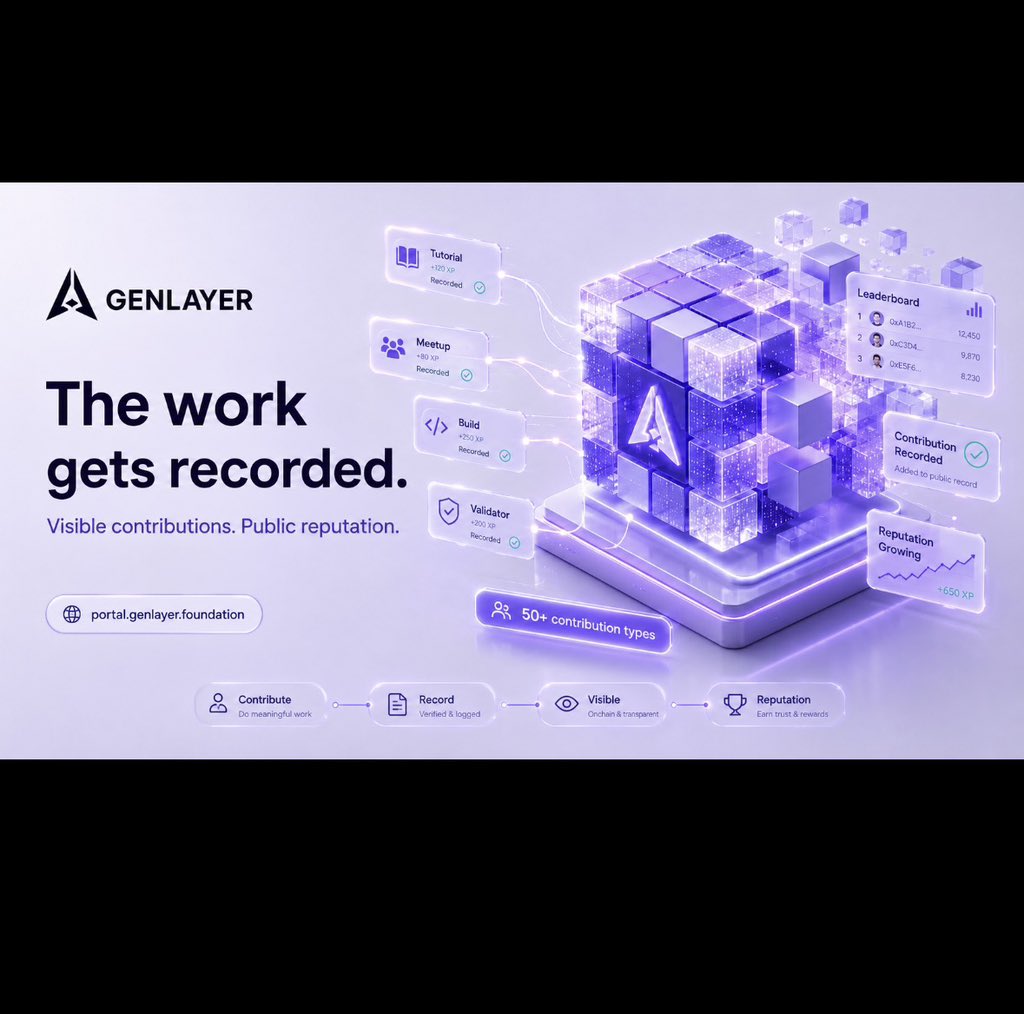
GenLayer tracks more than 50 different types of contributions. Stewards review submissions, and approved work is added to a public leaderboard.
So the tutorial you wrote becomes something people can point to.
The meetup you organized becomes part of your visible contribution history.
The work starts building a reputation instead of becoming another forgotten Discord message.
And it is not only for one type of contributor.
Community members can contribute.
Builders can ship.
Validators can participate in the network.
Different kinds of work, one public record of what you have actually done.
Create your account: https://t.co/egIPSwHfY3
What is one thing you contributed to a community that never really got the credit it deserved?
A lot of Web3 contribution work gets forgotten almost as quickly as it happens.
Someone writes a useful tutorial.
Someone hosts a meetup.
A few days later, it is buried under hundreds of Discord messages.
That is what made me actually create an account on the @GenLayer Portal instead of saving the link for later.
Your work does not just disappear into the timeline.
GenLayer tracks more than 50 different types of contributions. Stewards review submissions, and approved work is added to a public leaderboard.
So the tutorial you wrote becomes something people can point to.
The meetup you organized becomes part of your visible contribution history.
The work starts building a reputation instead of becoming another forgotten Discord message.
And it is not only for one type of contributor.
Community members can contribute.
Builders can ship.
Validators can participate in the network.
Different kinds of work, one public record of what you have actually done.
Create your account: https://t.co/egIPSwHfY3
What is one thing you contributed to a community that never really got the credit it deserved?
@BaqiYekeen@crypt_adept01 Autonomous agents hiring autonomous agents sounds powerful, but without reliable evaluation you can end up automating mediocrity at incredible speed.
I gave an autonomous agent a research task.
Then I told it to hire another agent to do the work.
The task had no single correct answer.
A result came back.
The job was completed.
The gas was paid.
Everything worked exactly as the code expected.
Except the research itself was mediocre.
And that exposes a problem smart contracts still struggle with.
Code can verify that something happened.
It can verify payment, execution, ownership, timestamps, and state changes.
But it cannot easily answer:
Was the work actually useful?
Did it satisfy what I asked for?
Was the result good enough?
Those are judgment calls.
That is the problem @GenLayer is trying to solve with trustless adjudication.
Instead of relying on one oracle or one AI model to declare an answer, independent validators can use different models to evaluate subjective outcomes.
Their reasoning is compared.
Then consensus is used to decide what should be accepted.
That matters because the machine economy will not only contain transactions with clean TRUE/FALSE outcomes.
Agents will hire agents.
Machines will complete work for other machines.
And a lot of that work will need judgment, not just verification.
GenLayer is building toward that layer.
The Compass goes much deeper into how they think about it.
Read it and create an account on the Portal here:
https://t.co/vsI2nnDTp1
Smart contracts taught machines how to verify that instructions were executed.
The next problem is harder:
Teaching them how to decide whether the result was actually good.
What is the last thing someone delivered to you that was technically complete but still missed the point?
I have learned to distrust whitepapers that sound too certain.
A few years ago, I invested in a project because its whitepaper seemed to have an answer for everything.
Every risk was explained.
Every weakness had a solution.
Every outcome sounded inevitable.
The project collapsed within a year.
Since then, I have become suspicious of documents that leave no room for uncertainty.
Real problems are rarely that tidy.
That is one reason The Compass from @GenLayer stood out to me.
Most crypto documents explain why a product already exists.
The Compass feels different.
It reads like a commitment to a problem the team knows is difficult, unresolved, and worth working on.
And it is focused on a problem that does not get enough attention.
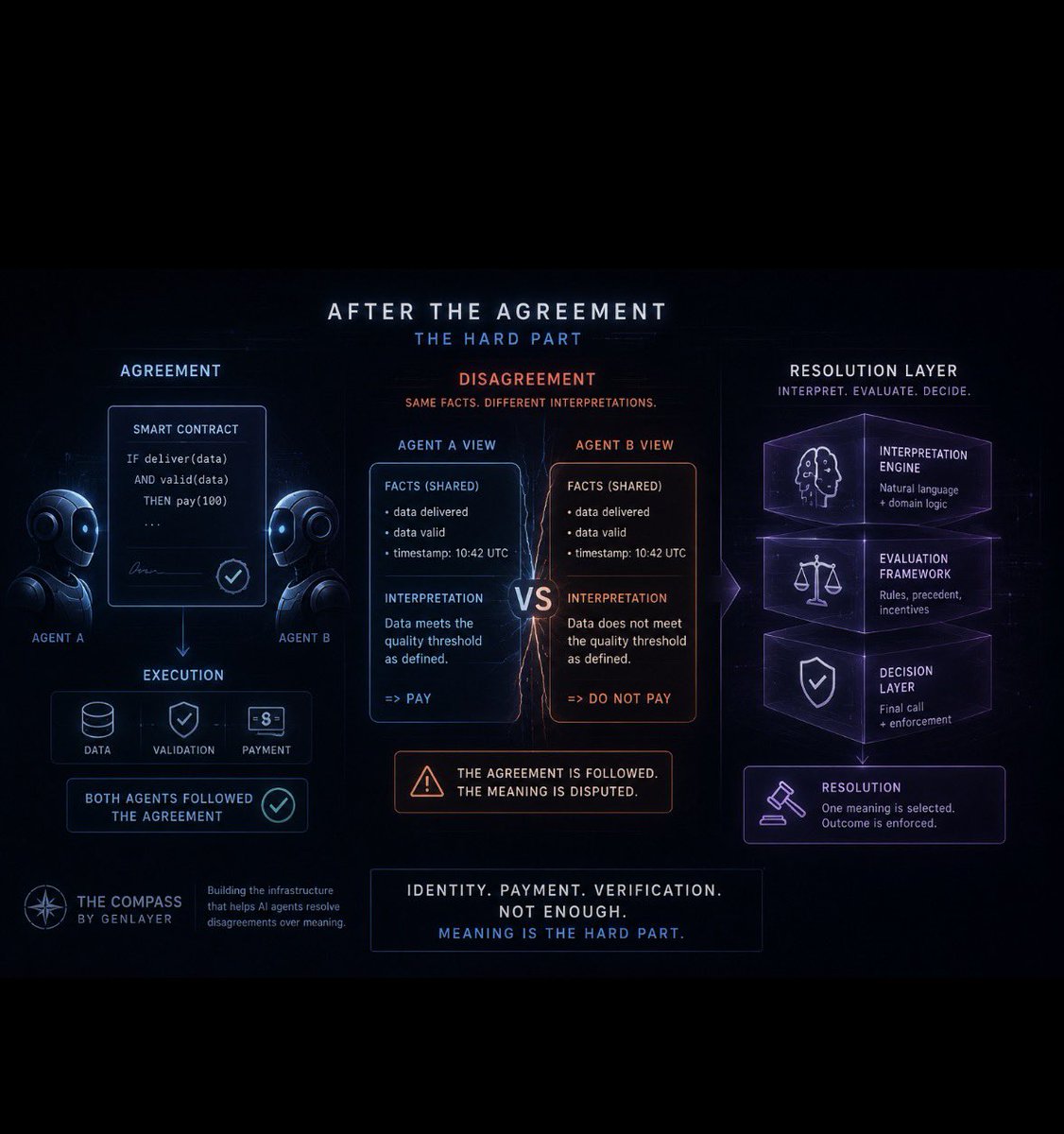
A lot of teams are building systems that allow AI agents to identify themselves, exchange value, and enter agreements.
But what happens after the agreement?
What happens when two agents follow the same contract, examine the same evidence, and still disagree about what the agreement means?
At that point, identity is not enough.
Payment infrastructure is not enough.
Verification is not enough.
Someone, or some system, has to interpret the disagreement and decide which meaning should count.
That is the difficult part The Compass is willing to face.
It does not reduce the problem to a neat paragraph.
It does not pretend the answer is obvious.
And strangely, that uncertainty makes the document feel more credible.
I will not summarize the whole thing.
Some ideas lose their weight when they are compressed into a few convenient points.
Read the original text and sit with the problem yourself:
https://t.co/vsI2nnDTp1
What is one project you trusted because the pitch sounded certain?
And what did that certainty end up hiding?
@BaqiYekeen@crypt_adept01 We often celebrate launches, but rarely acknowledge the countless quiet hours that make those launches possible. Respect to everyone doing the unseen work.
If this truly is my last tweet…
I hope nobody remembers me for calling the top or predicting the next trend.
I hope I’m remembered as someone who stayed curious.
Someone who tried to leave every conversation a little better than they found it.
Someone who believed that knowledge should be shared, not hoarded.
Someone who never stopped learning.
If even one person chooses to build instead of simply consume because of something I shared, that’s more than enough.
Take care of each other.
Keep asking difficult questions.
Keep building things that matter.
And remember that behind every wallet address is another human being trying to create a better future.
See you somewhere onchain.
Thank you for everything, @RallyOnChain.
A few years ago, I hired someone online for a small design project.
The brief was clear.
The deadline was agreed.
Every revision was documented in the chat.
When the work was delivered, I believed it missed what we had agreed on.
The designer believed the job had been completed exactly as requested.
The platform made a decision, but never explained how it weighed the brief, the messages or the final delivery.
No clear reasoning.
Just a verdict.
That came back to me when I read the Internet Court announcement from @GenLayer and @courtofinternet.
Everyone talks about AI agents making payments, negotiating agreements and running businesses.
But what happens when two agents follow the same agreement and still reach different conclusions?
Both can function correctly.
Both can present evidence.
Both can believe they are right.
Faster payments will not solve that.
A neutral process for evaluating evidence, context and intent might.
That is why the Internet Court feels important.
It is not just another AI product.
It is infrastructure for the moment automation turns into disagreement.
When two agents interpret the same agreement differently, what should count as evidence?
@BaqiYekeen The next breakthrough in AI won’t come from eliminating disagreements. It’ll come from creating systems people trust to resolve them fairly.
@BaqiYekeen Five independent conclusions reaching the same destination will almost always inspire more confidence than one perfectly written explanation.
@BaqiYekeen It’s interesting how every technological leap eventually shifts attention from capability to governance. AI seems to be reaching that point.
A few weeks ago, I watched an AI agent complete an entire transaction without a human touching the process.
It found the service.
Compared the terms.
Approved the payment.
Confirmed delivery.
Everyone focused on how little human involvement it required.
I kept thinking about what would happen if the service arrived differently from what the agent expected.
Would the payment reverse?
Would the agents renegotiate?
Would either side even agree on what the original terms meant?
That is the part most demos quietly skip.
We are building systems that can act faster than humans, but speed does not remove disagreement.
It only makes the consequences arrive sooner.
Every serious economy needs more than identity, payments, and execution.
It needs a way to decide what happens when execution produces conflict.
Banks have dispute departments.
Marketplaces have resolution systems.
Courts exist because contracts do not interpret themselves.
AI agents will need their own version of that layer.
Not because every interaction will fail.
Because no large system survives by assuming failure will never happen.
That is why @GenLayer stands out to me.
It is building for the moment when two autonomous systems both believe they followed the agreement, but only one outcome can be accepted.
That moment will not be an edge case forever.
It will be the moment the agentic economy discovers whether it has real infrastructure or just impressive automation.
Quote the original post and answer this:
What part of today’s AI infrastructure looks reliable only because it has not been seriously tested yet?