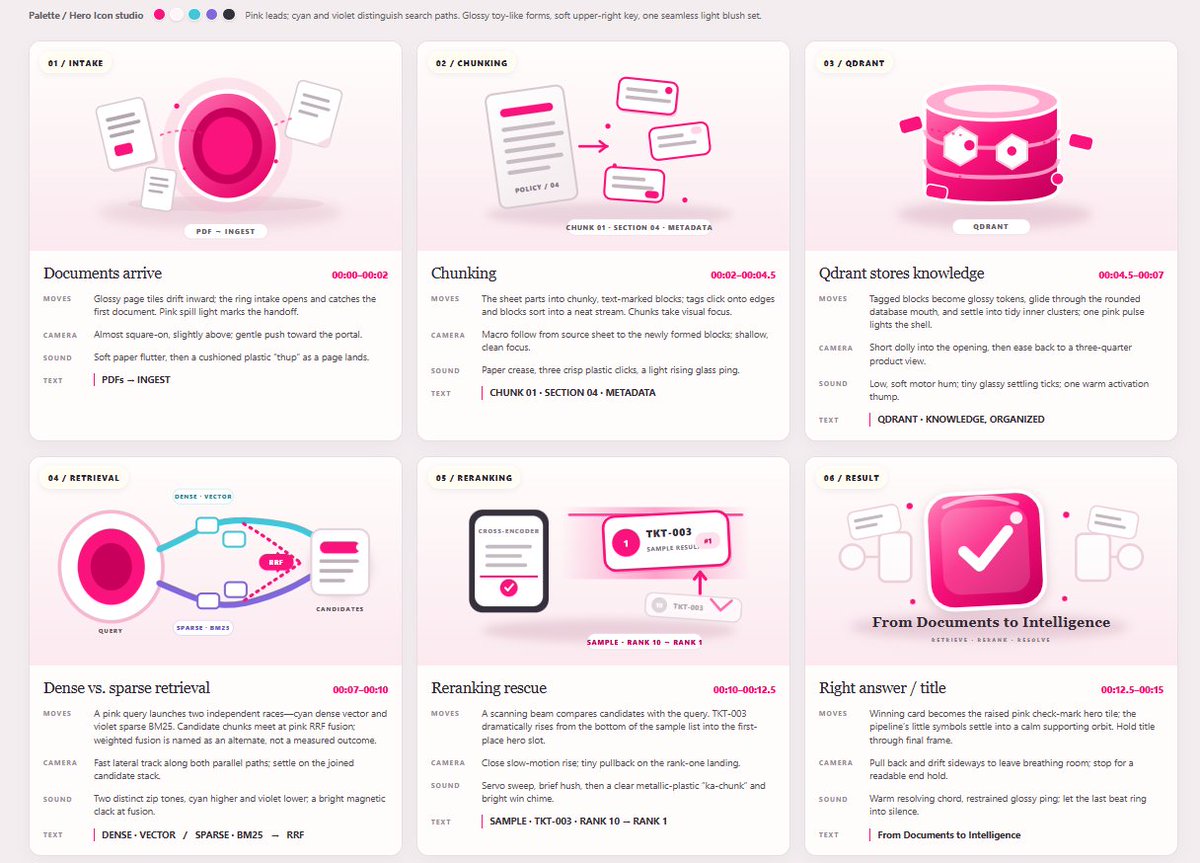
I created this with Claude Sonnet just for fun. It’a 15 second video to show a RAG pipeline.
Actually I had this idea to write a fantasy story that came to my head while doing experiments in vector databases and RAG mechanisms.
And I made this to go with it. Story: soon.
I created this with Claude Sonnet just for fun. It’a 15 second video to show a RAG pipeline.
Actually I had this idea to write a fantasy story that came to my head while doing experiments in vector databases and RAG mechanisms.
And I made this to go with it. Story: soon.
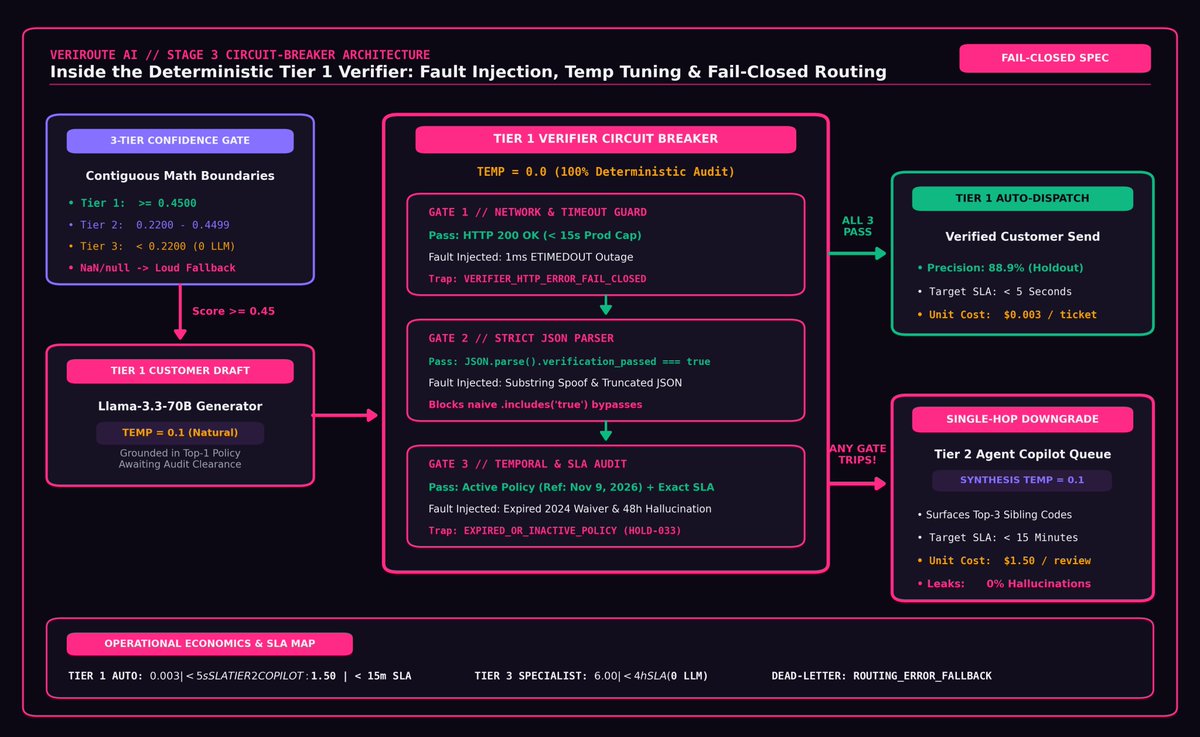
I started Stage 3 with 11 fault injections: API timeouts, broken JSON, substring spoofing, HTTP 500s, threshold edges, NaN/null scores, and expired policies. They exposed a JSON-escaping bug and a Switch-boundary overlap. After fixes, all 11 passed with zero false auto-sends.
Can a RAG pipeline survive a 40.9-point drop in retrieval accuracy? I put VeriRoute AI through a 150-query holdout stress test. Here's what happened.
https://t.co/bWnQ303Xwr
What happens when your RAG pipeline retrieves the wrong policy, encounters an API timeout, or receives an adversarial query? Does it still confidently generate an answer? Read the full technical write-up on stress-testing:
https://t.co/haZQTOIOWU
What happens to your RAG pipeline when an API times out at 1ms, a reranker passes a NaN score, or an LLM returns broken JSON? Does it fail closed and hold the ticket, or does it accidentally auto-send an unverified draft to the customer?
Full technical breakdown coming soon…
"Hope begins in the dark. The stubborn hope that if you just show up and try to do the right thing, the dawn will come. You wait and watch and work: you don't give up."
-Anne Lamot
Today I started reading Steven Pinker’s The Language Instinct.
After reading How the Mind Works, I became a fan, and was looking forward to reading more of his books…
It took plenty of troubleshooting, but VeriRoute is officially resilient.
When unexpected edge cases hit, it fails safely into human review rather than guessing, hallucinating, or breaking down.
More soon...
The key feature: The Safety Net.
Tier 1 drafts must pass an independent zero-temp NLI Verifier against source chunks. If it detects an unsupported claim, it triggers an instant downgrade to Tier 2.
Interesting point:
When I’m experimenting and working on projects, sometimes I use Gemini 3.8 Flash, and sometimes Gemini Argon.
The interesting part is, sometimes Argon contradicts 3.8 Flash or rather, finds gaps and problems in the solutions provided by Gemini 3.8 Flash…🤔
I agree with Yann LeCun's reply here that humans and animals don’t necessarily think in words. But they think.
I highly recommend people in the AI field to read books on the brain. A Brief History of Intelligence by Max Bennett is a great start.
Humans mostly do not think in words.
Animals certainly don't think in words, but they do think.
It's just that words are discrete objects associated with thoughts.
Their discreteness is what makes them easy to store and remember.
This gives the illusion that we think in words, but for most things, we don't.
Many people can't speak but can think.
So do animals.
[You might to have a look at my latest talks and/or papers if you think nothing has happened in the last 5 years:
https://t.co/6m0opCsKqP ]
Anyone who has read a book on the brain will know that a young child is smarter than any LLM, due to brains that process information through vision, sound, smell, and general real-world observation.
https://t.co/yWJBljwS9i
I really liked this discussion from TheAIGrid about Yann LeCun's theory and world models.
Regarding his point of view that the AI industry is mostly LLM-focused, and that you can't reach human-level intelligence with just text-based data, I strongly agree.
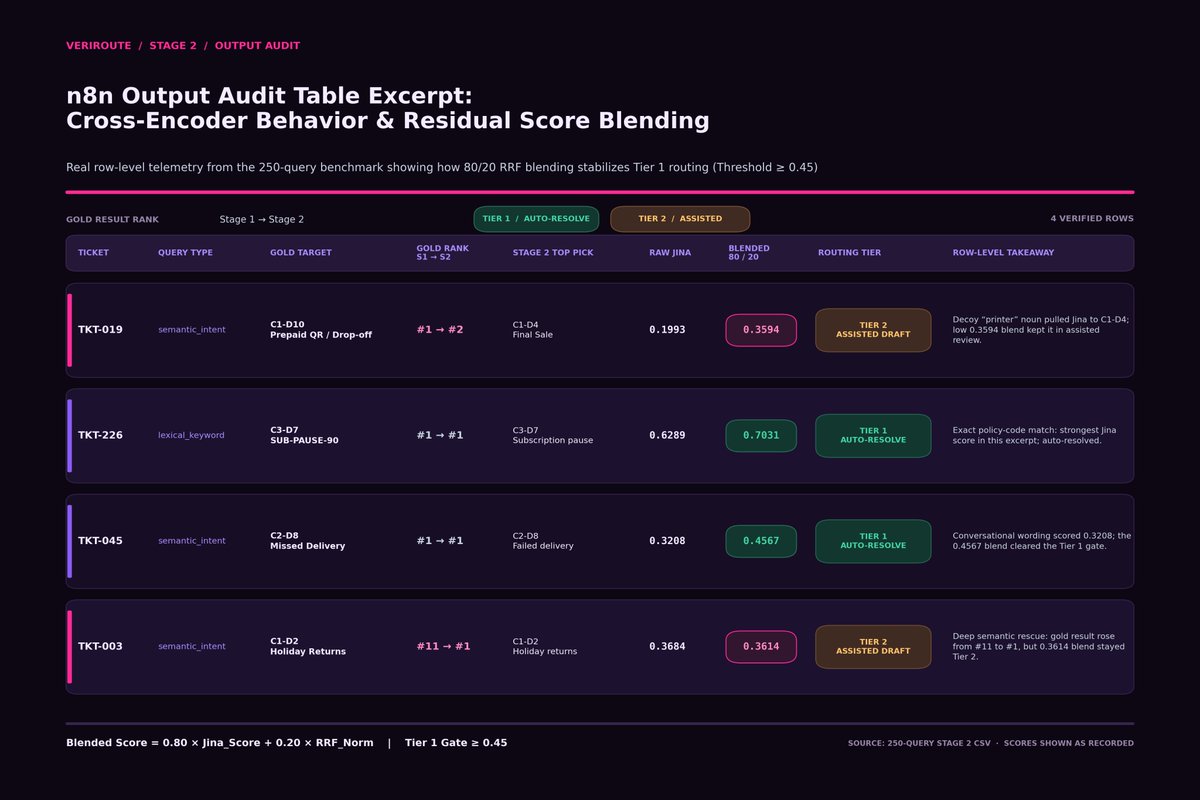
Why is Stage 2 needed? Look at ticket TKT-019: a query about printer drop-offs tricked the reranker via literal noun overlap with a "final sale printer cartridge" decoy. Cross-encoders catch these nuances.
Deterministic math beats LLM routers for production stability, speed, and cost efficiency. Read the full technical breakdown and architecture notes here: https://t.co/lDkZF946ho
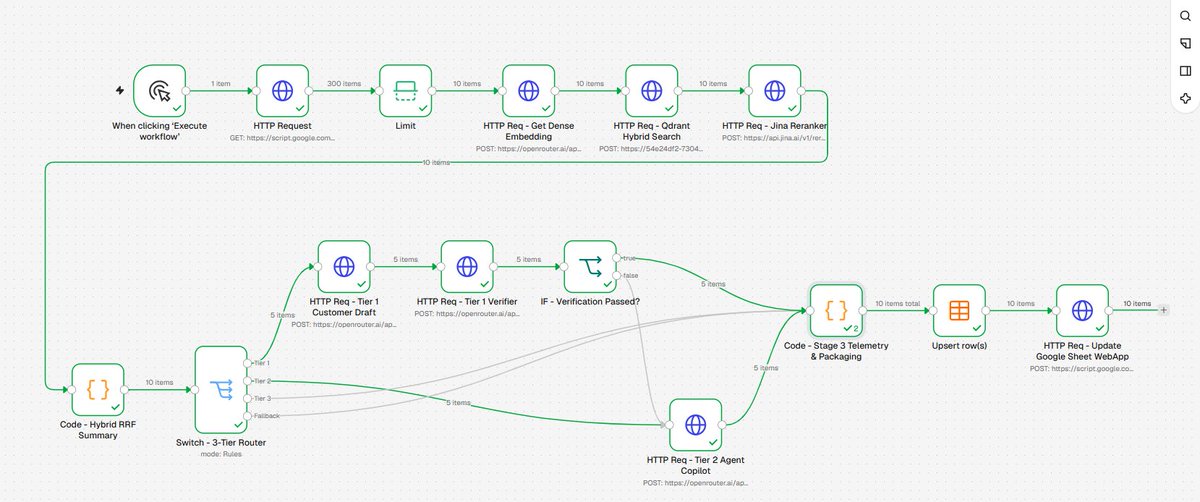
Moving a retrieval pipeline from a controlled setting into production requires testing how data moves through a live workflow.
Great evaluation harness benchmarking!
Transitioning to production means ensuring real-world reliability using two stages. The first stage uses hybrid search to quickly surface a broad document shortlist. The second stage applies a cross-encoder to boost top accuracy.
https://t.co/lDkZF93yrQ
Transitioning to production means ensuring real-world reliability using two stages. The first stage uses hybrid search to quickly surface a broad document shortlist. The second stage applies a cross-encoder to boost top accuracy.
https://t.co/lDkZF93yrQ