HeyGen shipped a tool yesterday that turns a document into a two host video podcast. Studio set, cuts between cameras, B roll. Over two million views on the announcement.
The feature is not new. They have had a video podcast in beta since late 2024, and that version already turned a PDF into two people talking.
So what shipped yesterday is not the podcast. It is the production. The camera operator, the editor cutting between two angles, whoever went and found the B roll. That whole layer.
HeyGen is at $200M ARR, doubled in a year, and has burned $25M of the $74M it raised. Those numbers do not come out of a software budget. They come out of what a company used to pay a crew.
I noticed because I spent yesterday doing the same thing to a photo studio. A hundred frames, four garments that do not exist, $3.28, no photographer.
Making it look finished used to be the filter. Ideas were never scarce. Finished things were.
Now that filter is going, and the interesting question stops being who can make a show. It becomes whose show anyone bothers to watch.
Video Podcast is live.
Turn any doc, link, or idea into a two-host video show with studio scenes, multi-cam cuts, and B-roll. Ready in minutes.
Everyone else stops at audio. This is a show you can publish.
Try it: https://t.co/mwV67pFCDT
@WhaleInsider Giving some context to people outside of India.
The person in the post is Prime Minister of India and is not associated with building Sarvam.
Congratulations to @SarvamAI
Tagging the founder of Sarvan here @pratykumar
Today I ran 100 images through my product, answered four questions I had been putting off, and found two bugs I did not know existed. On a Thursday.
Not one of those images is a photograph. The clothes are not real either. I needed a denim jacket shot front and back, a keyhole dress, a box pleat shirt. I own none of that. It used to mean a wardrobe, a model, a studio and about three weeks of calendar. Today it was an afternoon and $3.28.
And I did not find both bugs. Claude did, going back through its own output while I was reading something else. One of them was sitting in the live product.
Somewhere in the middle I lost track of what had even been generated, so I asked for all of today's images to be dropped in a folder. It built me this instead.
https://t.co/fcBHVhMRS4
I have read the word acceleration a hundred times this year. Today is the first day I actually felt it.
Its very easy for other companies because they all have atleast one open source model although is it not frontier.
Anthropic not just doesn't have an open-source model yet, but they are also actively lobbying for tigher government oversight.
OpenAI was also doing it, but Sam being Sam, still signed it anyway.
Everyone is calling this the singularity. I have shipped enough agent built software to guess what comes next.
The first output looks like this. Genuinely great, faster than you thought possible.
Then you spend 3 days on the last 10 percent, and it is always the plumbing. Fields that got renamed, imports that got duplicated, an API shape the model guessed at.
My last delegation shipped 2 features and left 6 defects. Every one was an integration error. Zero logic errors.
The demo is real. The distance between demo and shipped is also real, and it has barely moved.
Opus 5, snowboarder test, one shot. On par with Fable, ahead of every other model I've run. No visual defects on the first pass, and the sliding physics feel right.
The model can one shot the game. The profitable part was never the game.
Those economies got tuned against real players for months. You need people in the loop to learn where the paywall goes, and no model gets you people.
Ask it for the most profitable game ever and you get a really good game with nobody in it.
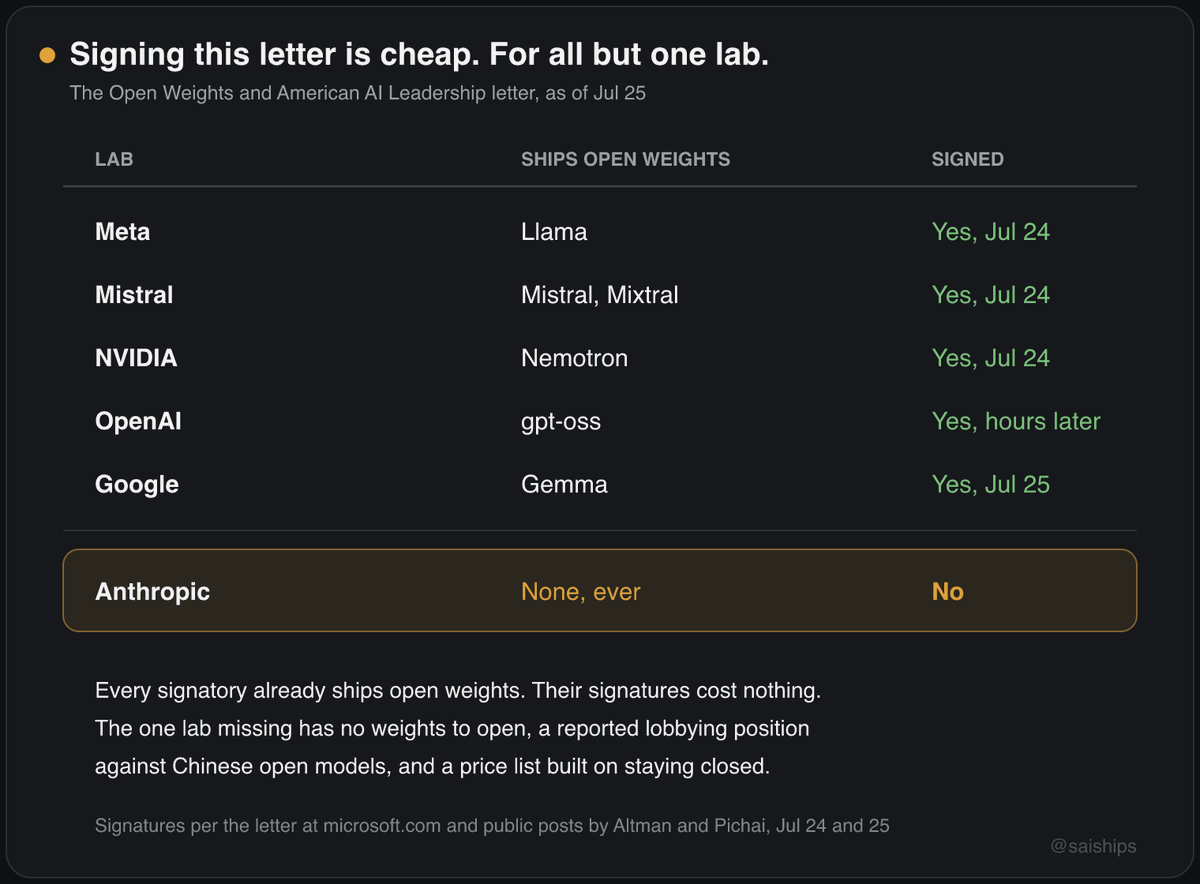
Anthropic is now the only frontier lab that has not signed the open weights letter.
OpenAI signed within hours of Jensen's post. Google signed today through Sundar. The consensus take says Anthropic caves next, because being the lone holdout in the middle of a Washington fight looks terrible.
I think the consensus has this backwards. Anthropic is the one lab that cannot sign cheaply.
OpenAI ships open weight models of its own. Google ships Gemma. Their signatures cost nothing. Anthropic has never released open weights, reportedly lobbied for the Chinese open weight restrictions this letter opposes, and just spent 19 days in June with its flagship suspended by an export order.
Signing would reverse an active lobbying position and erase the one thing that makes them different. Their new pricing already monetizes the closed position. The risk tier carries the premium.
So my call is that Anthropic does not sign. What we get instead is an essay. Something long and thoughtful about how open and closed both matter, with a warning about frontier weights, and no signature under the letter.
If they sign within 2 weeks, the pressure beat the incentives and I was wrong. Logged either way.
@sundarpichai@GoogleDeepMind@demishassabis With Google in, the letter now has every major lab that actually ships open weights.
Gemma made this an easy yes. The interesting absence is the one lab for which it would not be.
The honest answer inverted this week, which is why nobody can give you a straight one.
On the published coding and agentic benchmarks, Opus 5 now beats Fable at half the price. Fable's remaining edge is in offensive security and bio research, which the safety classifiers mostly wall off anyway.
So for anything you would actually ship, the best Anthropic model right now is the cheaper one.
Nobody has published effort level cross comparisons, but at equal effort the numbers already favor Opus 5.
Anthropic just shipped a 5 dollar model that beats its own 10 dollar flagship on the flagship's headline benchmark.
Opus 5 scores 43.3 percent on the company's hardest agentic coding eval. Fable 5, launched 6 weeks ago at twice the price, scores 33.7. Opus 4.8, released in May at the same price as Opus 5, scored 18.7.
Performance more than doubled in 8 weeks with no price change.
So what does the 2x premium on Fable buy now? Read the fine print and the answer is strange.
Opus 5 trails the Fable tier in exactly 2 places, offensive cybersecurity and biology research. The dual use capabilities. The ones that got Fable export controlled and suspended worldwide for 19 days, restored July 1. The ones safety classifiers block most paying users from touching anyway.
The gap is deliberate. Anthropic says it withheld frontier cyber training from Opus 5 on purpose, and that its classifiers will reportedly fire about 85 percent less often than Fable's.
The product line has quietly reorganized around risk. The cheap model carries the intelligence. The expensive model carries the liability, plus the classifiers and regulatory exposure that come with it.
For coding and knowledge work, the premium model is now the worse deal by every published number. The 2x looks less like a capability premium than a risk surcharge, billed to whoever insists on paying it.
For my first post, I’m sharing a letter @NVIDIA signed on why open models matter.
AI will transform every industry, power every company, and be built by every country.
Open models strengthen safety and cybersecurity, accelerate innovation and diffusion, and enable sovereignty.
The world needs both frontier closed models and frontier open models.
https://t.co/AUKzoQ5Ikb
Worth being precise, because the precise version is worse.
Anthropic did not sign it either. Both frontier closed labs sat this one out, both reportedly heading for IPOs. That makes it a bigger story than one company's name.
The ask is also narrower than banning open AI. What the two of them have pushed for is restrictions on Chinese open weight models, which is a different fight with a different loser.
That loser is me. K3 matched Claude 12 for 12 on my spec last week at about a third of the cost. A ban does not delete those weights from the internet. It makes the cheap option illegal for American builders while everyone else keeps downloading it.
The "both" in that last line is the part builders actually feel.
I run open and closed side by side in one small product and had to build a swap layer to do it, because the right choice changes per task rather than per company.
The honest cost showed up in my last delegation. I handed 2 real features to an open weight coding model and it shipped both. I then hand fixed 6 defects, and every one was an integration error. Duplicate imports, renamed fields, guessed API shapes. Zero logic errors.
The reasoning held up fine. The plumbing is where the work is, and that is the part no letter mentions.
Congratulations on the first post.
On Monday I said the ban on Chinese open weights gets announced loud and dies quiet, because the incentives were pointing the other way. Microsoft was reportedly already testing K3 for Copilot at around $600M in savings while Washington debated banning it.
Three days later Microsoft is signing an industry letter asking policymakers to avoid premature restrictions on open models.
Worth being precise about what that proves. It does not prove the ban died. The incentive I described has stopped being private and started lobbying, which is the mechanism running, and the verdict is still open.
The tell I gave still stands. If the final rule covers federal procurement and nothing else, the money won and the announcement was theatre.
My reason for caring is smaller than any of this. K3 matched Claude 12 for 12 on my spec last week and cost about a third as much. When the fight is over whether I keep the cheap option, I would rather hold the number than the opinion.
Everyone's worked up about the White House talking about banning Chinese models after K3 dropped.
My take is we don't have to worry. This gets announced loud and dies quiet, somewhere between a few weeks and a few months. Not because anyone changes their mind, but because everyone's incentives already point the same way.
Start with the incentives. While Washington debates the ban, Microsoft is testing K3 for Copilot on Azure, chasing something like $600 million a year in inference savings. The government would be banning the model its biggest company is busy procuring.
The math checks out at my scale too. I benchmarked K3 against Claude on a real product spec last week and got quality parity at roughly a third of the cost. A ban does nothing to Moonshot's revenue. It just taxes every US builder who complies while competitors abroad keep the discount.
And you can't really ban a file anyway. The full weights go public July 27. Within a week they'll be downloaded, mirrored, and retrained inside half the companies a ban would cover. You'd be banning math after it left the building.
We've watched this movie before. In the 90s the US classified encryption as a munition, so people printed PGP's source code in books because books were protected speech. The controls were gone by 2000. DeepSeek bans shrank down to government devices. TikTok got three deadlines and is still here.
So it'll go the way these always go. Announce broad, enforce narrow, quietly let it slide.
And if the final rule only covers federal procurement, that's the admission. They already know they can't enforce anything bigger.