Just launched my own Real Madrid fan page! ⚪️💫 I’ll be posting match reviews, thoughts, and all things Madridista. Hala Madrid! 🤍
https://t.co/PQ7osH4VYP
As my final act of love for Ronaldo, I will become the most disciplined,focused and obsessed version of myself. Win or lose does not matter, but I will never quit without a fight. No matter how bad it hurts, how lonely it gets, or how sad I feel, I will never give up on my dream.
If you’re a Full-Stack Developer in 2026, you must have knowledge of these skills :
Start with JavaScript.
Then TypeScript.
Then understand why JavaScript behaves like JavaScript.
Frontend ?
Easy. Just master React, Next.js, server components, client components, hydration, re-hydration, de-hydration, and whatever new rendering strategy drops tomorrow morning.
CSS ?
Yes. But also Flexbox, Grid, Tailwind, design systems, accessibility, performance, animations, and why one div still refuses to center.
Backend is simple too.
Node.js, Express, NestJS, REST, GraphQL, WebSockets, background jobs, queues, auth, JWT, OAuth, RBAC, caching, rate limiting, and explaining to juniors why “it works on my machine” is not a deployment strategy.
Databases?
Just SQL, NoSQL, indexes, transactions, query optimization, data modeling, ACID, BASE, migrations, ORMs, and knowing when MongoDB is a bad idea (which is most of the time, but don’t say it out loud).
Cloud & DevOps
basic stuff. Docker, CI/CD, cloud platforms, serverless, load balancers, CDNs, environment variables, secrets management, monitoring, logging, scaling, and waking up at 3 AM because production is down.
Security?
Oh that’s just OWASP Top 10, XSS, CSRF, SQL injection, HTTPS, tokens, session handling, API security, and knowing that security is everyone’s responsibility..especially yours.
AI?
Yes, you must use AI. But also not blindly trust AI. But also integrate AI. But also clean up AI-written code. Congrats, you’re now the human debugger for machines.
Testing?
Unit tests, integration tests, E2E tests, performance tests. Because if something breaks in production, it’s obviously your fault.
Architecture?
Monoliths are bad. Microservices are worse. Distributed systems are a lifestyle choice. Scalability is a problem you don’t have..until suddenly you do.
Soft skills?
Communicate clearly. Take ownership. Think like a product manager. Write documentation no one will read. Explain complex things simply. Stay calm under pressure. Smile while everything is on fire.
And finally, Stay curious. Keep learning. Because the tech stack you mastered last year is already outdated.
But hey.. You get the title “Full-Stack Developer”,
Which basically means: Frontend engineer
Backend engineer
DevOps engineer
Security engineer
AI integrator
System designer
QA tester
And emotional support for the application.
Totally reasonable expectations. Very balanced. Absolutely sustainable.
Welcome to 2026.
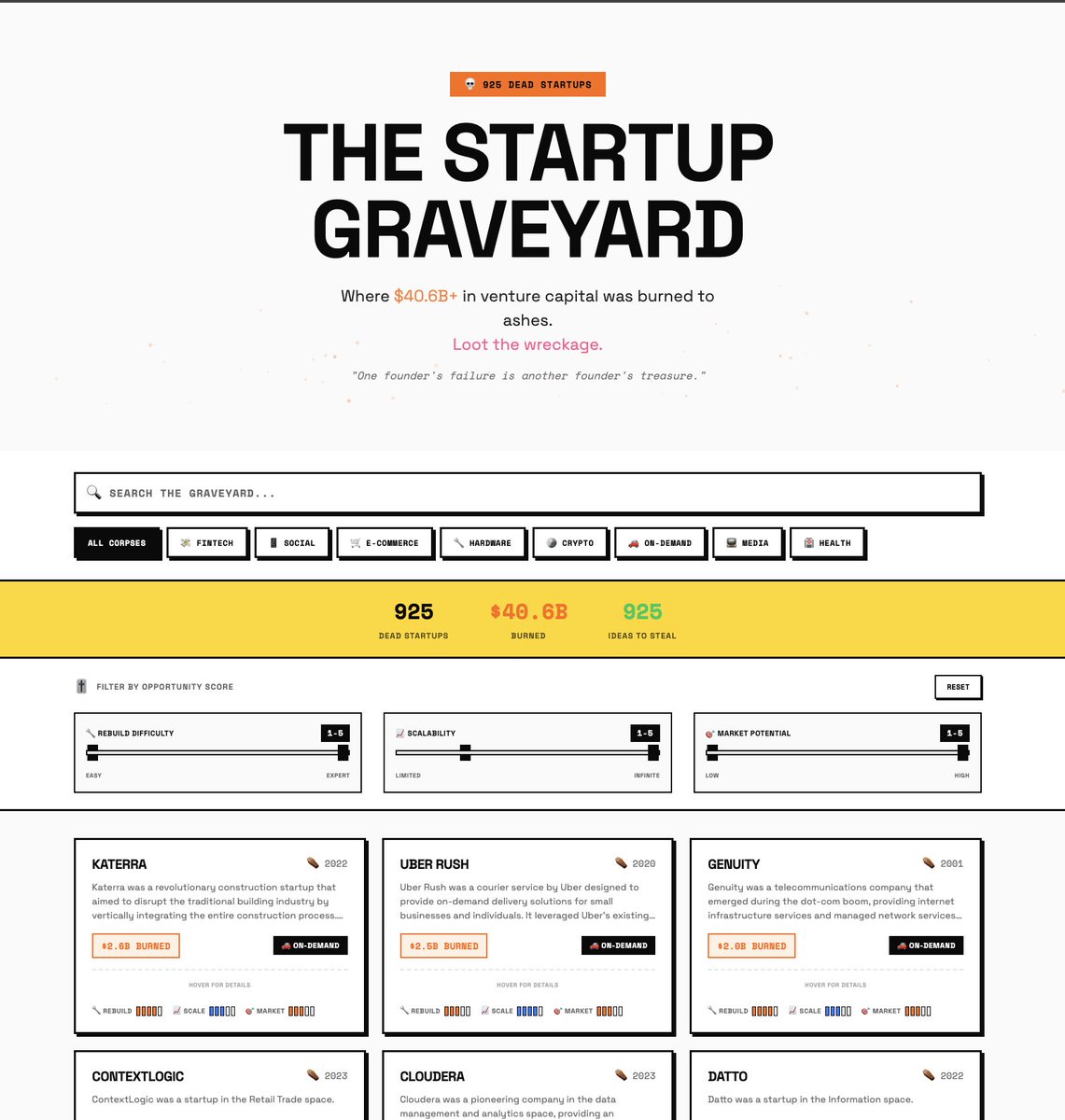
Someone curated 925 failed VC-backed startups, broke down why they failed, and how to make it work with today’s tech -
https://t.co/NFUhrhe7P2
Cool fr🙌
Going for a Reactjs Interview ?
Be ready to discuss performance.
15 points that you must discuss when it comes to performance based questions:
1. Prevent Unnecessary Re-renders: Use React.memo, useMemo, and useCallback appropriately
2. Optimize Component Structure: Break large components into smaller, focused ones to reduce render cost
3. Lazy-Load Components: Use React.lazy and Suspense for code splitting
4. Use Concurrent Features: Leverage React 18’s concurrent rendering and startTransition for non-urgent updates
5. Avoid Inline Functions in JSX: Prevent re-creation of functions on every render
6. Debounce and Throttle Event Handlers: For scroll, resize, and input events
7. Minimize DOM Manipulations: Use virtual DOM efficiently and avoid direct DOM updates
8. Optimize Lists: Use key properly, consider virtualization (react-window, react-virtualized) for large lists
9. Memoize Expensive Calculations: Use useMemo for derived state or heavy computations
10. Profile with React DevTools and Chrome DevTools: Identify slow components and bottlenecks
11. Use Efficient State Management: Keep local state minimal, prefer useReducer or Zustand/Redux for complex state
12. Code Splitting and Tree Shaking: Remove dead code and dynamically load routes or heavy libraries
13. Optimize Images and Assets: Use responsive images, lazy-load media, and modern formats (WebP, AVIF)
14. Reduce Third-Party Script Impact: Defer analytics, ads, and external libraries to avoid main thread blocking
15. Monitor Real User Metrics: Track LCP, INP, TBT, and hydration performance with RUM tools
Job Hunting in tech? This might help.
Been helping a lot of folks with job hunting lately.
Most people are stuck on the basics like how to reach out, why they don’t get replies, or how to stand out on LinkedIn.
So I wrote a few short, practical guide to make things easier:
1. How to Use LinkedIn for Tech Jobs
https://t.co/b6oQijrw2Q
2. Why Freshers Don’t Hear Back (And What to Do About It)
https://t.co/2DlObJhXpX
3. How to Reach Out to Recruiters Without Being Ignored
https://t.co/IHTY1587TL
4. Why Recruiters Ask for Your Current and Expected CTC
https://t.co/aBOUpGupWQ
5. Why Product-Based Companies Avoid Certain Resumes
https://t.co/wPBKQpWvet
6. Why LinkedIn Feels So Weird and How That Can Help You Get Hired
https://t.co/b6oQijrw2Q
Reposts appreciated, might help someone land a role they care about.
Happy Job Hunting :)
a very good thing to move forward from cruds is to start caching and handle cache invalidations very well.
- separate all concerns. [repository for db calls, config, service for business logic, router and handler]
- writing good middlewares (auth, logger, rate limiters)
- metrics with prometheus
- use mqs for asynchronousity
- can write some microservices too
- grpc
My friend just cracked three offers 24 LPA, 28 LPA, and 40 LPA, all within 15 days. 🤯
He had just 1+ year of experience and was interviewing for frontend-heavy roles at startups.
I asked him to share his preparation roadmap, and here it is for anyone gearing up for frontend interviews 👇
1. Checks the current path
2. Matches it with a <Route>
3. Renders the right component dynamically
Navigation is done with <Link> (not <a>), so no page reload.
This makes routing fast, smooth, and SPA-friendly 🚀
🚦 How React Router Works
React apps are Single Page Applications (SPA) → only one index.html is loaded.
React Router uses the browser’s History API (pushState, popstate) to update the URL without refreshing the page.
When the URL changes, React Router: