⚠️Sensitive Content ⚠️
🚨BREAKING: A 10 year old Palestinian child is fighting for his life after surviving an Israeli airstrike that killed his father in Gaza, He suffered severe facial injuries and a critical brain injury.
Documented by Dr. Jamal Salha - Gaza
⚠️Sensitive Content ⚠️
🚨BREAKING : Critically injured infants and children continue arriving at hospitals after intense Israeli airstrikes across Gaza last night and into today.
Tired of gambling on which article will go viral on Discover?
Here's one simple rule: match or kill.
Every article idea either matches your audience, or you don't publish it. No "let's try it anyway". No "it's interesting, so why not".
Sounds harsh. It's actually the most liberating rule in Discover.
It rests on one thing: knowing who Google actually sends to your site. Not who you think you write for, who actually reads you.
Once you know that, every idea runs through four questions:
- Does it match who they actually are (age, country, gender)?
- Does it match what they're into (their real interests, often broader than your niche)?
- Does it trigger one of the emotions that make them click?
- Does it fit your core topic, or a genuine adjacent interest?
Can't say yes to at least 3 out of 4? Don't write it. Or reframe it until it fits.
Most editorial teams work on "is this interesting? is this on-brand?" That's not enough. Discover doesn't care about your brand criteria. It cares whether your readers engage.
The pushback is always the same: "this feels constraining, we want to write what interests us."
Here's the reframe:
Writing for the audience Google sends you isn't selling out. It's serving the readers you actually have, instead of the ones you imagine.
Quality is defined by your readers, not by your newsroom.
One nuance, and it matters most when you're starting out. Before you know your audience, you have to find it. So keep a deliberate share of your output, say 20%, as test articles: different angles, different topics, watching how the feed reacts. That's how you build the audience picture the rule depends on. Once the data is clear, match or kill takes over.
Most publishers resist this rule. The ones who accept it watch their Discover traffic climb.
Where do you stand: match or kill, or trust your gut?
Most publishers with real Discover traffic are still writing for the wrong audience.
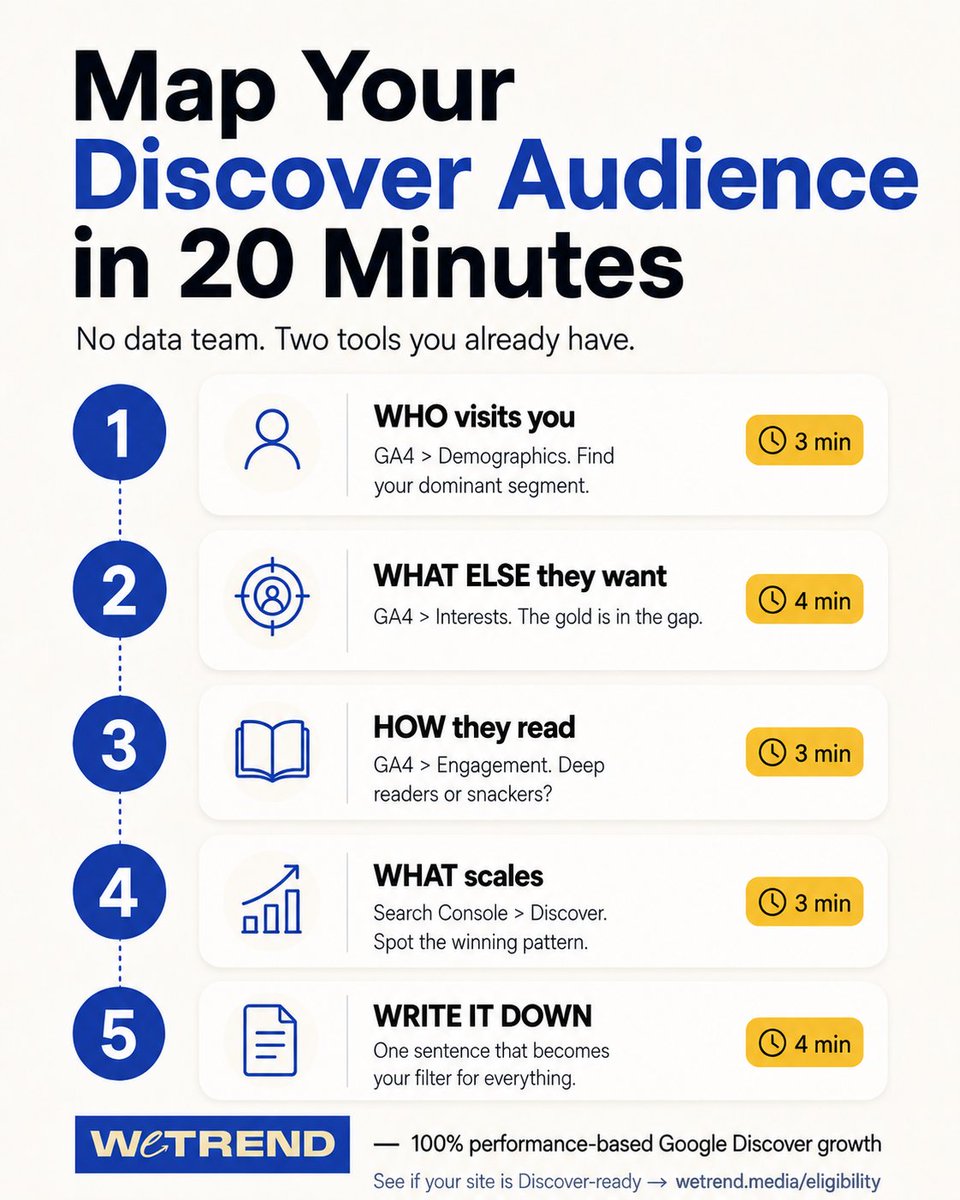
Here's the 20-minute exercise that grew Discover traffic for several clients, doubling or even more it in the best cases.
Two tools you already have. No data team needed.
Here's how to find the audience Google actually sees. Bookmark this, run it on your site.
1. WHO actually visits you (3 min)
GA4 → Reports → User → User attributes → Demographic details.
Age, gender, top countries, language. Don't average. Write down the dominant segment.
If you target women but 60% of readers are men, that's a signal, not a rounding error.
2. WHAT ELSE they care about (4 min)
Same report. At the bottom of the table, click the dimension (e.g. "Country") and switch it to "Interests".
You'll see the interest categories Google assigns your audience. The gold is in the gap between your stated niche and what they're actually into. These are angles you'd never have guessed.
(Report empty? Turn on Google Signals in Admin → Data Collection, then give it 24h.)
3. HOW they read (3 min)
GA4 → Reports → Engagement → Pages and screens.
Over 2 min engagement? Deep-reading audience, long articles work. Under 30 sec? Snackable wins. High returning rate? Discover loves that signal of trust.
4. WHAT actually scales (3 min)
Search Console → Performance → Discover. Last 90 days, sort by clicks.
For your top 20 articles, name the topic, the angle, and the emotion. Find the dominant pattern: that's what works for your audience, not what you assumed.
Then go beyond volume and add the CTR. Above 10%, your audience and the topic are aligned. Below 5%, there's a gap between who Google shows you to and who you write for.
More on CTR next week, it's where titles begin.
5. WRITE IT DOWN (4 min)
Cross it all and you get your core persona, plus 2-3 secondary audiences (the bigger the site, the more you'll find).
Lead with the core: it's your filter for every title, image, topic. The secondary ones are your next growth angles.
Boil the core down to one line:
"Women 35-54 in the US, into lifestyle and home, drawn to stories about how people live."
A real example. A celebrity news site in our network thought it was, well, just that. Then the data showed a strong "Home & Habitat" interest in their audience. So they ran articles on the homes of the stars they covered.
Their Discover traffic doubled in two months. Same celebrities, different angle, because they finally wrote for the audience Google saw, not the niche they assumed.
Do this once, then re-run it every quarter, and right after any Google update. Audiences drift, and updates reshuffle them. Catch the shift before your traffic does.
Knowing your audience isn't a feeling. It's 20 minutes with data you own.
Run it on your site, then tell me what surprised you most. Comments are open.
👉 Tomorrow: once you know who reads you, how to read your own Google ad profile to reverse-engineer the algorithm's logic.
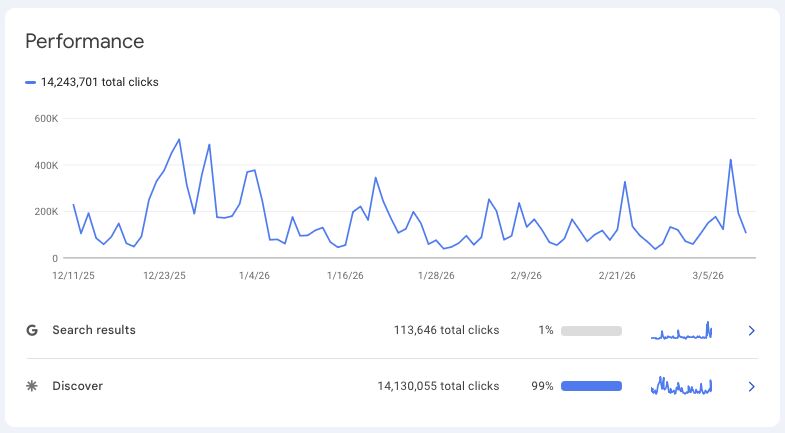
We found 14 million readers this editorial site didn't know it could reach.
Their SEO was already solid.
But a much bigger audience was sitting just out of reach, one they were never going to find through search.
We didn't change who they were. We helped them reach the readers they didn't know they had.
Over the next few weeks, I'm going to break down exactly how we did it, step by step. Not theory, the actual playbook.
It starts with the piece almost everyone gets wrong: audience.
That's the most common reason editorial sites never take off on Discover: they confuse their niche with their audience. They keep optimizing for the readers they already know, and never go looking for the ones Google is ready to send them.
Here's the trap.
You think in terms of your topic, your vertical, your beat. "We're a cinema site." "We're a finance site." So you write for the audience that label implies.
Logical for SEO. Quietly fatal for Discover.
Because Google doesn't push your content based on your stated niche. It pushes it to the people who actually stop scrolling, click, and come back, whoever they are.
And those people are often interested in far more than your niche suggests. Miss that, and you keep writing slightly beside what Google is ready to reward you for.
So instead of guessing, we read Google's own data to see how it reads a site.
Here's the simplest example, a 3-minute move you can run right now. It won't map your whole audience, that comes later this week, but it proves one thing:
1. Open Chrome on desktop. In the URL bar, type:
chrome://topics-internals/
2. Click the "Classifier" tab.
3. Enter your own domain (hostname only, no https). Google shows you the topics it associates with your site.
Don't be surprised if the tags and clusters Google has assigned to you are nothing like what you expected.
That surprise is the point: it's the gap between the niche you claim and the one Google actually files you under.
This little tool isn't the destination. It's the proof of concept: in 30 seconds, it shows that Google has its own read of your site, one you don't control and probably can't guess.
Once you accept that, the real work begins.
Then try three more domains: your closest competitor, the biggest publisher in your space, and a site you'd love the algorithm to confuse you with. The differences are where your next moves hide.
Consider this a warm-up. The Classifier is the smallest example of a bigger habit: using Google's own data to understand how it sees you.
All week, I'm going deeper, with the tools that map your real Discover audience:
- The little-known ways to make Google's data reveal who actually reads you
- How to read your own Google ad profile to reverse-engineer the algorithm's logic
- Pulling your true audience from GA4: affinity categories, in-market segments, and the adjacent interests that become your next content angles
Stop thinking in niches. Start thinking in audiences.
On Discover, that shift is the difference between a flat line and a takeoff.
👉 Tomorrow: the full 20-minute version that builds your complete Discover audience profile. Stay tuned.
Jewish-American orthopedic surgeon Mark Perlmutter, who worked in Gaza, said Israeli soldiers took two Palestinian children, tied their hands behind their backs, and buried them alive at Nasser Hospital — their cries muffled by the dirt poured over them.