Pleased to share that my article on the theological justifications of Jihad in contemporary India has been published in Politics, Religion and Ideology. https://t.co/se1m5NanBt
When the West Found Jihad Useful
by Sajid Farid Shapoo
https://t.co/MLUN0zfxjM
Sajid Farid Shapoo examines how Western powers, particularly the United States and Britain, treated Islamic identity and jihad as strategic tools during the Cold War. Tracing developments from the Middle East to Afghanistan, the article argues that anti-communist policies helped expand the global reach of militant Islamist networks. It situates Saudi Arabia, Pakistan, and other regional actors within a broader geopolitical framework rather than portraying them as passive instruments of the West. The essay reflects on how Cold War alliances, covert operations, and ideological calculations contributed to long-term consequences that later reshaped global politics and security debates.
When the West Found Jihad Useful.
During the Cold War, the US and UK often found Islamic identity a useful counterweight to Soviet influence. In doing so, they repeatedly drew on the language of jihad for strategic purposes. @ColinPClarke@yashoazad
https://t.co/ivzIStp88o
'Mohenjo-daro city is not older than Egyptian cities. Here’s what the recent dig really shows'
Disha Ahluwalia @ahluwaliadisha, archaeologist and junior research fellow, Indian Council of Historical Research, writes
#ThePrintOpinion
https://t.co/iMRlnXOIRv
Iran’s nuclear future will be decided not only in centrifuge halls or command bunkers, but in the struggle between theological limits and strategic fear.
https://t.co/tFW8XrKyDs
#Iran#NuclearWeapons#MiddleEast#Geopolitics#SecurityStudies
Khamenei’s death may have done more than remove Iran’s leader. It may have removed the last moral restraint on its nuclear ambitions. Can theology still restrain a state that feels existentially threatened?
https://t.co/tFW8XrKyDs
Iran’s nuclear future will be decided not only in centrifuge halls or command bunkers, but in the struggle between theological limits and strategic fear.
https://t.co/TRFt1pOdP3
Those of you who think that Iran-Israel rivalry is both pathological and ideological may find this 2024 article revealing. #IranWar#israel
https://t.co/Aw7J4jeMpO
https://t.co/eqXkXRpRoL
As Saudi Arabia and the UAE recalibrate their rivalry, India finds itself walking a geopolitical tightrope in a Gulf no longer united by seamless alliances.
India’s Gulf Test: Navigating Saudi–UAE Competition
by Sajid Farid Shapoo
https://t.co/wDLoAP5W0G
As Saudi Arabia and the UAE recalibrate their rivalry, India finds itself walking a geopolitical tightrope in a Gulf no longer united by seamless alliances. Behind high-profile visits and strategic partnerships lies a deeper clash of power models, regional ambitions, and competing visions of influence. For New Delhi, the challenge is not choosing sides but navigating a fragmented Middle East while preserving strategic autonomy, economic interests, and regional stability. This moment reveals how shifting Gulf dynamics could reshape India’s diplomacy, security calculus, and role in an emerging multipolar order—where balance, not allegiance, may determine the future.
I write that Pakistan’s nuclear arsenal, escalation posture, and the institutions to manage it were built to deter and, if necessary, counter New Delhi—not to manage crises with Israel or Iran. https://t.co/6vYz8WQ6Np via @countercurrents
Extended deterrence sounds reassuring on paper. In practice, it is fraught, contingent, and often unreliable. The recent Saudi–Pakistan defense pact should be viewed as strategic optics and prudent hedging, rather than a NATO-style nuclear guarantee.
Saudi–Pakistan Pact and the Limits of Extended Deterrence
by Sajid Farid Shapoo
https://t.co/bR7m1WCqBQ
When Saudi Arabia and Pakistan announced a Strategic Mutual Defence Agreement (SMDA) in mid-September—pledging that any aggression against one would be treated as aggression against both—commentary quickly veered toward nuclear hyperbole. A fleeting remark from Pakistan’s defence minister that “what we have—our capabilities—will be available” briefly fed that narrative before being walked back. Soon after, analysts rushed to suggest that Riyadh now sat under a Pakistani nuclear umbrella. Saudi officials have, however, studiously avoided any nuclear language—and prudently so. The history and logic of extended deterrence—credible promises to use nuclear or major conventional force on another’s behalf—make it a poor and risky fit here.
Saudi–Pakistan Pact and the Limits of Extended Deterrence
by Sajid Farid Shapoo
https://t.co/bR7m1WCqBQ
When Saudi Arabia and Pakistan announced a Strategic Mutual Defence Agreement (SMDA) in mid-September—pledging that any aggression against one would be treated as aggression against both—commentary quickly veered toward nuclear hyperbole. A fleeting remark from Pakistan’s defence minister that “what we have—our capabilities—will be available” briefly fed that narrative before being walked back. Soon after, analysts rushed to suggest that Riyadh now sat under a Pakistani nuclear umbrella. Saudi officials have, however, studiously avoided any nuclear language—and prudently so. The history and logic of extended deterrence—credible promises to use nuclear or major conventional force on another’s behalf—make it a poor and risky fit here.
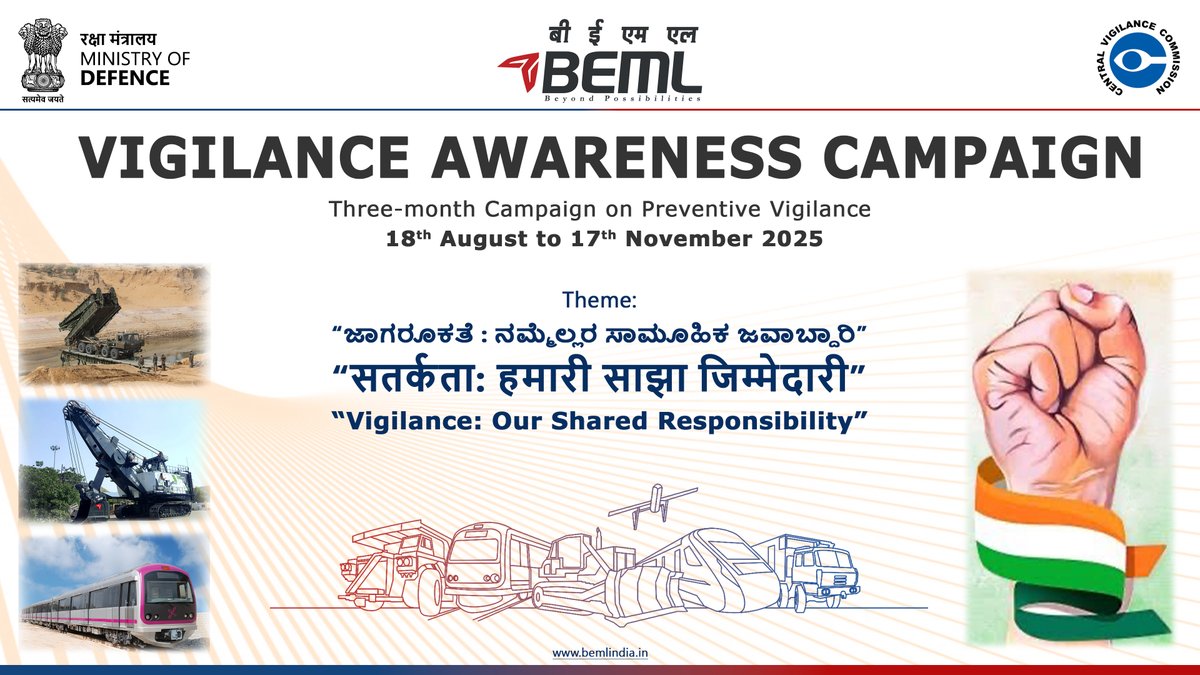
At BEML, we believe vigilance is not just an obligation – it is our shared responsibility.
Join us in the Vigilance Awareness Campaign (18thAugust – 17th November 2025) to strengthen transparency, integrity, and accountability.
#VigilanceAwareness#BEML#CVC#Integrity #PreventiveVigilance