LLM-assisted search in verifiable domains is incredibly exciting right now. The model matters, but so does the algorithmic harness used to explore the search space and iterate toward better solutions.
We’re excited to describe a new search algorithm that makes this exploration process more effective, leading to the results below with open-source models:
✨ Mathematics: new state-of-the-art constructions for the Erdős Minimum Overlap Problem
⚛️Quantum computing: improved quantum circuit compilation, reducing SWAP overhead by 24.5% on IBM Q20.
⚡️ AI infrastructure: designed a highly efficient TriMul Triton kernel, improving on prior human- and AI-designed implementations.
More details in the blog: https://t.co/h4lMnYHM4I
Great collaboration by WILL, @Stanford, @PKU1898, @Tsinghua_Uni, and @HKUSTGuangzhou.
@thsottiaux I noticed my usage limit go down every hour even when there are no automations or tasks running in the background. Would love to see what kind of processes are running in the background to see what is eating away my tokens. Like a task manager of sorts.
> Natural data is "generated" from a constrained hierarchical / compositional function.
> Deep networks learns that hidden structure from polynomially few examples and creatively generate exponentially many valid new ones.
> The depth of the network is what's important to overcome the curse of dimensionality, and potentially invalidate Chomsky's poverty of stimulus argument.
> Prof @MatthieuWyart, a physicist (Johns Hopkins / EPFL) was the senior author of the Random Hierarchy Model.
claude opus 4.8 + OpenClaw now finds restaurants with weak food photos, rebuilds their best dish into a cinematic reel, and mails the owner a postcard with the QR...on autopilot.
here's how agencies can land recurring contracts with this system:
- scans every restaurant in a city in real time
- pulls their real reviews, ratings, and reviewer-uploaded food photos
flags the weakest shot of their signature dish
- samples the brand color straight from the restaurant's own dish photo
rebuilds that exact plate into a cinematic 9:16 reel
- writes a printed postcard about their best dish
- mails it to the registered office, addressed to the owner, with a QR to the live reel
every step from the scrape to the reel to the mailbox is automated
reply "REEL" + RT and i'll send you a free guide so you can build this too (must be following so i can DM you)
If you are one of these people whose attention span is fried, make sure to try this exercise daily for 5 minutes. It was created by one of the most intelligent men of the 20th century, Rudolf Steiner.
Use an ordinary object (a pencil, clothe spin, clip, book, etc.) and think about it for five minutes every day. You take an object in front of you or in your mind and the first time you describe it to yourself aloud. You can also imagine yourself describing it to a blind person.
Use all your senses and make as many observations as you can in five minutes. Repeat this the next day, you will probably notice new details.
After a while you can ask questions about the object: "What can I do with it?", "What is it made of?", "Why this shape?", "What other shapes could it have?", "Where was it made?", "How did I get it?"," How are the raw materials mined?", etc. You will be able to answer some of these questions. If not, you can search for an answer in an encyclopedia or on the internet.
Your should be able to determine whether your thoughts are correct, otherwise your thoughts will wander. which is not the intention.
You can repeat what you did the day before and build on your previous thoughts. After some time you will have covered all possible questions, then do it one or two more times until you can really find no more issues to think about. Then follow the same procedure with another object.
When doing this exercise you may notice that your thinking gets clearer and sharper, and that your perception, concentration and objectivity increase. Also, your interest grows.
The difficulty of the exercise is that your mind wanders. The challenge is to be able to think about the object for five minutes, but you will find that your mind wanders to something else very easily, that your thoughts are associative and work automatically. E.g. you think of a pencil and suddenly you see in your mind your grandma with a pencil in her hand, grandma has a budgerigar and suddenly you are thinking about the whistling of this bird. Interrupt such thoughts: you wanted to think about the pencil.
The exercise is called control of the mind. The example just given shows that often there is no control over our thinking. We are thought, our thinking is associative and automatic. We believe that we think, but our thinking is often not focused.
Make sure that you do the exercise every day. You can choose a fixed time. Choose a time when you are awake and clear-headed, so not after dinner, but for example before or after breakfast or at 8 o'clock at night. You can also do it while waiting for the train, in a spare moment. Doing the exercise with two or three objects should be sufficient.
"Algorithms for Decision Making" is a free book about the mathematical foundations of artificial intelligence, autonomous decision systems and modern machine learning.
Published by MIT Press, the book connects probability, optimisation, planning, search, reinforcement learning, Markov decision processes, utility theory, and sequential decision-making in a rigorous yet modern way.
With more than 700 pages, it provides a remarkably broad view of how intelligent systems reason, evaluate uncertainty, and make decisions under constraints.
One of the most interesting aspects of the web is the enormous amount of high-quality free knowledge available today. Complex subjects that once required access to expensive institutions or specialised libraries are now accessible to anyone willing to study!
https://t.co/I9cHSCvvlm
INCREDIBLE
The MOST COMPLETE GUIDE for understanding LLMs from first principles is now available online to read for free
Covers the model mechanics
- Tokens / tokenizers
- Transformers
- Attention
- KV cache
- Prefill vs decode
- Decoding controls
- Model packages
- Chat templates
- Long context
- RAG
- Agents / tools
- Fine-tuning
- Multimodal models
Then connects that to running models locally
- What "local" really means
- Open-weight vs opensource
- Quantization
- VRAM math
- Hardware tiers
- File formats / load safety
- Runtimes / serving modes
- Model selection
- Privacy
- Failure modes
- Benchmarks
- Practical setup paths
You should read this, and if you cannot now then you most definitely wanna bookmark it for later
Opensource AI FTW
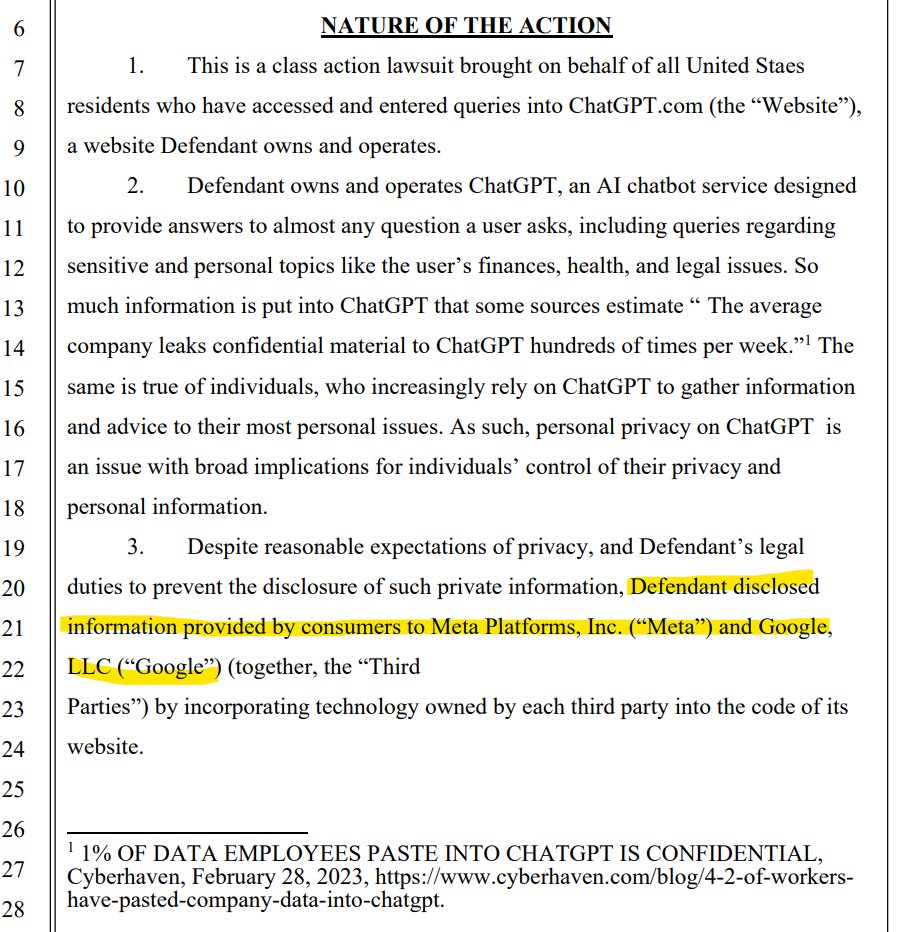
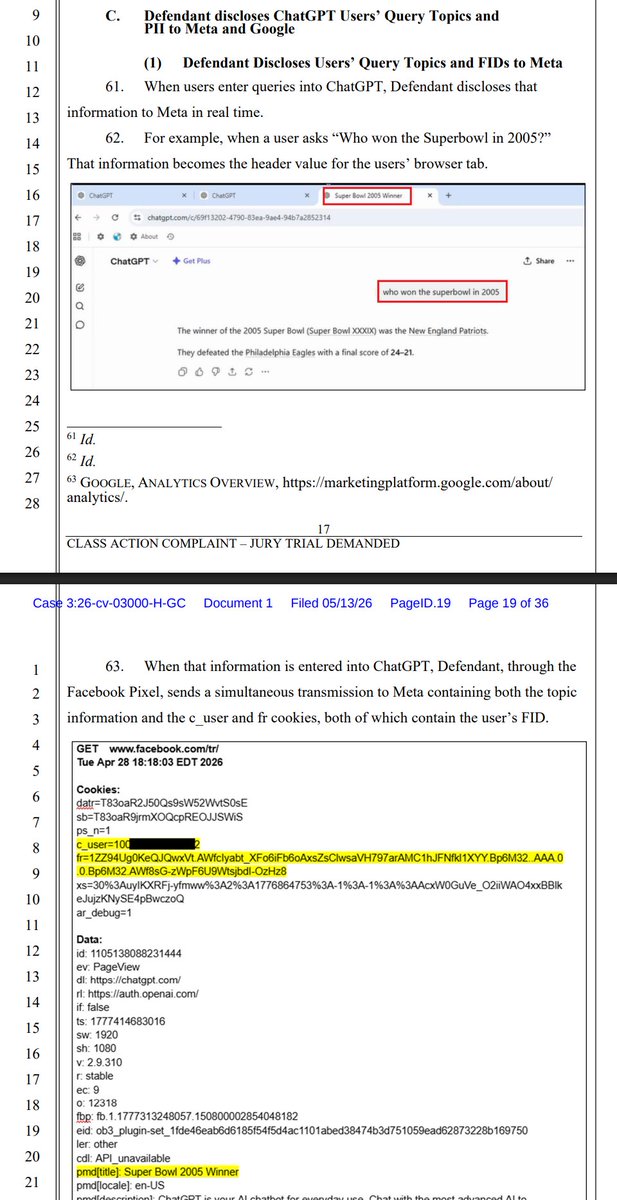
ChatGPT allegedly shares your chat query topics, user IDs, and email addresses with Google and Meta, according to a new class action lawsuit filed today.
We started by investigating why Claude chose to blackmail. We believe the original source of the behavior was internet text that portrays AI as evil and interested in self-preservation.
Our post-training at the time wasn’t making it worse—but it also wasn’t making it better.
Neural networks might speak English, but they think in shapes.
Understanding their rich *neural geometry* is key to understanding how they work – and to debugging and controlling them with precision.
Starting today, we’re releasing a series of posts on this research agenda. 🧵
Introducing Claude Managed Agents: everything you need to build and deploy agents at scale.
It pairs an agent harness tuned for performance with production infrastructure, so you can go from prototype to launch in days.
Now in public beta on the Claude Platform.
New Anthropic research: Emotion concepts and their function in a large language model.
All LLMs sometimes act like they have emotions. But why? We found internal representations of emotion concepts that can drive Claude’s behavior, sometimes in surprising ways.