Agentic Workflows are now in public preview, enabling automation of reasoning-based tasks using coding agents inside GitHub Actions.
• Define workflows in natural language Markdown, compiled to Actions YAML
https://t.co/wPzYduFayU
We have a draft of new report from GitHub Next! 🚀
https://t.co/2oEAVO7OCD
The Impact of Automated Repository Maintenance Assistance
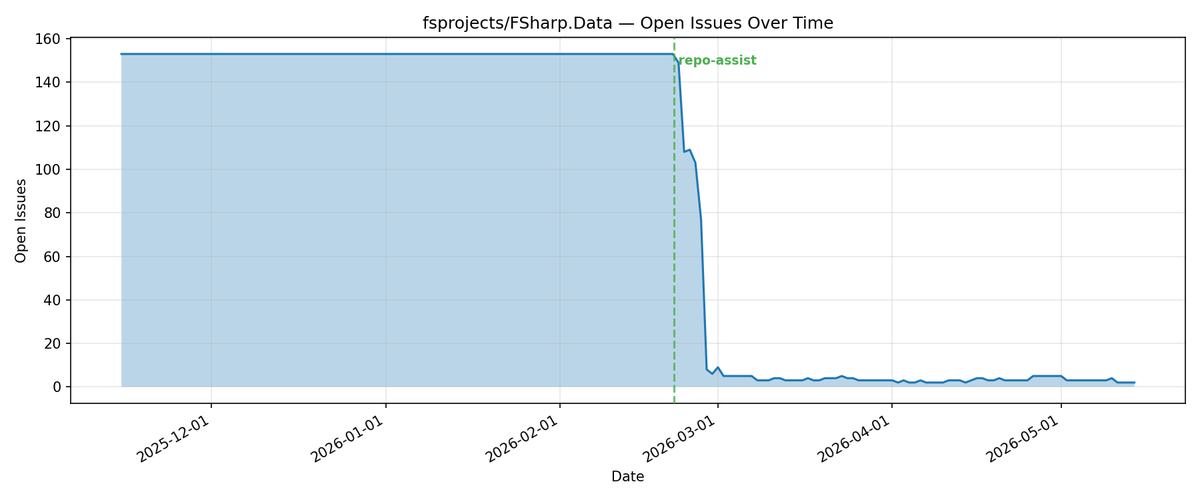
- We analyze the impact of 🌈 Repo Assist, a proactive AI repository agent implemented as a GitHub Agentic Workflow, across 13 open source repositories in early 2026.
- The agent reduced open issue counts in every repository - 578 issues total.
- The repositories, which were largely dormant, achieved median velocity increases of 8× for issue closure and 10× for PR merges, transforming largely dormant projects into actively maintained ones.
- We model repositories as human-agent software factories - the factory’s throughput is gated by human decision-making.
Read the draft in our repository https://t.co/2oEAVO7OCD
Agentic repository automation changes almost everything about how we engineer software.
We've discovered this at GitHub Next over the last 6 months, and the rest of the world will (re)discover it too, over the coming years.
To help you take the journey faster, and be ahead of the wave, we've prepared a blog series for you called Peli's Agent Factory, where @pelikhan takes you on a journey through repository automation and its uses
https://t.co/L375vpyiGM
GitHub Actions now supports timezone settings for scheduled workflows plus using environments without triggering automatic deployments.
https://t.co/GRY7mtcXsD
We know we have work to do in maintaining our own open source surfaces for GitHub Actions (actions, runner-images, starter workflows, toolkits, etc.). That being said, I wanted to address what was discussed and also share what’s next for GitHub Actions:
With respect to `safe_sleep` in self-hosted runners (note: this never impacted GitHub-hosted runners)...
• We fixed the implementation causing an infinite loop on August 14th and cut a new runner release in October. So this bug has been fixed[^1] and released for a month or so. We missed closing the related issue[^2] as part of that release and then closed it on December 1st.
• As for burning CPU while sleeping, this is obviously not great from just a quality of engineering perspective, but this was an intentional change away from relying on the OS sleep to address a customer case where it didn't work when sleep was not available. We are fixing this now to use sleep if it's present and fall back to this implementation only if it's not available. This script is only used in 2 scenarios: updating the self-hosted runner when a new version is available and recovering from an unhealthy termination. With the infinite loop issue fixed, the CPU inefficiency, while still not great, should have very little real impact to self-hosted runners CPU utilization and zero GitHub Actions billing impact to customers. The biggest impact is customer configs using multiple self-hosted runners on the same machine. In that case, during the seconds that this sleep is running during an infrequent update or after an unhealthy runner termination, the other runners would suffer from CPU consumption.
• All of this is completely unrelated to any sleeps within workflows and jobs themselves.
As for file hash issue[^3], a hosted runner image update that started rolling out on November 22 caused failures related to an unintended breaking change in the runner agent cached in the image. This was rolled back on November 23, which mitigated all customer impact. Hosted runner agent updates have been paused until improvements identified from this are completed, but image updates were unblocked on the 25th to ensure we continue to provide security updates for our hosted runners.
GitHub Actions is a core primitive of GitHub and important to its future. Last year, GitHub gave away 11.5 billion build minutes for free to open source projects[^4] (which I think is about ~$184 million dollars). The Actions team’s priority for the last 18 months has been on scaling and reliability. In the last few months, the team has also focused on community asks and shipped support private/internal .github repos[^5], increased the actions cache size >10GB[^6], shipped Action workflow YAML anchors[^7], increased workflow dispatch limits[^8], and increased reusable workflow limits[^9].
As for what’s next, the Actions team is now going to be focused on:
• Support for timezones[^10] in scheduled jobs and updates to schedule reliability
• Return the run ID from workflow dispatch[^11]
• Adding a switch function for expressions so they have a conditional operator or function[^12]
• UX improvements, including faster page load times, better rendering for workflows with over 300 jobs, and a filter for the jobs list.
• Parallel steps[^13] (one of the most requested features from GitHub Actions community
I think this covers most of it, but we’ll follow up soon with more details in a proper blog post
[1] https://t.co/4Bw83s5kH3
[2] https://t.co/in3DddlhwI
[3] https://t.co/nwsbKMo8VZ
[4]https://t.co/S68HxmZM7D
[5] https://t.co/W5FlegEx4P
[6]https://t.co/29YKjUOdgT
[7] https://t.co/74fCyT3WQT
[8] https://t.co/OyytcLnvoR
[9] https://t.co/nO34W5Ub4B
[10] https://t.co/hjCRlQRVUw
[11] https://t.co/CK20tZixvy
[12] https://t.co/1Is8k96iid
[13] https://t.co/NN53LxEvh5
Set up your new GitHub Copilot agent for success! 🚀 This video will show you how to:
✅ Define clear, well-scoped issues.
⚙️ Utilize Copilot custom instructions effectively.
💻 Ensure a proper development environment setup.
🔗 Grant tool access via the Model Context Protocol (MCP).
Watch and then head over to Docs for more tips! 👇
https://t.co/FQlMsIrpFn
Starting off the new year with a big ship. Copilot Workspace, our agentic editor, is now available to all paid Copilot users. It’s as easy as Spec. Plan. Brainstorm. Implement. Build/Repair.
https://t.co/EEzjrx3YTT
GitHub Copilot now has a coding agent embedded right where you already collaborate with developers: on GitHub. And yes, you can access it from VS Code too. 🤖