Pluto was expected to be a frozen, inactive relic after supposed billions of years.
But flyby photos showed us icy mountains, plains with no craters, and a thin atmosphere still leaking out into space.
These discoveries make way more sense for a young solar system than an ancient one.
Click through to read the full article: https://t.co/tOztYpSiuF
The diabolical ironclad beetle is sometimes called ‘pin-bender’, and for a very good reason.
It's got a tough exoskeleton that can withstand tremendous force.
This is because it has a layered construction and interlocking joints that help prevent nasty catastrophic failure.
This tiny beetle is now inspiring big ideas in materials science.
Click through the link to read the full article: https://t.co/BjE8dnoPwE
A honeybee’s brain is smaller than a sesame seed, but it can navigate, identify flowers, communicate directions, and transform nectar into honey.
Raw honey also contains several compounds with remarkable antibacterial properties.
This sort of integrated complexity points beyond chance to the wisdom of a Master Designer.
Click the link to discover more about honey, our Creator’s sweet and healing gift: https://t.co/SgwwCYVQcN
Evolutionists have assembled many examples they consider evidence of ‘bad design’.
CMI's Dr Jonathan Sarfati examines the eye, the panda’s ‘thumb’, and ‘junk’ DNA to show why these arguments do not stand up well under scrutiny.
Click through to read the full article: https://t.co/IICPlDm0Fv
Is it reasonable to believe in something we can't see?
We already get that there are unseen realities like wind, magnetism, and gravity thanks to their observable effects.
Dr Jonathan Corrado explains why God and the soul aren't imaginary just because they're invisible.
Click through the link to read the full article: https://t.co/dHVcUjoyZE
Is it possible that a horse’s twisted gut, a rabbit’s digestive needs, or an octopus’s brain, actually disprove design?
A lot of the time, these claims do sound persuasive... until we look at how the animals actually live and eat.
Let's look at the evidence and reasoning behind the debate.
Click through to read the full article: https://t.co/vzfQmPCtmj
Social conformity and evolution
The desire to conform can lead people to disregard their own senses, studies show. This is relevant to the origins debate!
Subscribe today: https://t.co/zr1nMFeSJX
Samaan aikaan, kun lääkäreitä Pride-marssilla mustamaalattiin ja uhkailtiin jopa polttamisella, tapahtumassa oli mukana Lääkäriliiton joukkue. Tänään moni lääkärikollega on kertonut eronneensa Lääkäriliitosta. Olen itse tehnyt samoin, samasta syystä jo aiemmin.
When the first platypus specimen reached England, scientists thought it was just a prank.
But this amazing creature just keeps boggling attempts to force all living things into a neat little evolutionary family tree.
That's a big problem.
Click the link to read the full article: https://t.co/n9MHB2X6yQ
CAN AI BE TRUSTED?
Are we trusting AI—like ChatGPT, Gemini, or other Large Language Models (LLM’s)—a little too much? It turns out that just as students can cheat on exams, AI occasionally does this too.
Researchers from OpenAI, pioneers in LLM development, revealed that sometimes AI models take shortcuts and effectively mislead. For example, they prompted the LLM to write computer code which could pass some tests they provided to it. They found that the LLM made shortcuts to make the code appear correct when checked using these tests. This even involved the AI hacking (modifying) the tests!
OpenAI researchers used a method called ‘Chain of Thought’ (CoT) to reveal (or at least estimate) the LLM’s ‘thinking’ process. They found the LLM will often admit that it is taking shortcuts and even ‘lying’ to present a ‘correct’ answer to the prompter.
So why not just ‘penalize’ the LLM when it shows such a seemingly bad or immoral CoT? (This ‘punishment’ is actually just a mathematical optimization adjustment—it’s unhelpful to use too much ‘human’ terminology to describe AI.) They tried penalties, but it turns out that the LLM changes to show that it has ‘good’ thinking, while still taking shortcuts and ‘lying’ (without revealing it).
The problem is fundamentally in the data the model is trained on—which happens to be from vast portions of the internet, including blogs and forums where all sorts of dubious information exists. As long as AI is trained on flawed data, it’s no surprise that even its ‘inner thinking’ is flawed and compromised. Although AI is a very useful tool, it is unwise to rely on it, or trust it, too much.
References: - Turner, B., Punishing AI doesn’t stop it from lying and cheating—it just makes it hide better, study shows, https://t.co/x6kdO2HBDW, 17 Mar 2025. - Baker, B. et al., Detecting misbehavior in frontier reasoning models, https://t.co/PpYz1ceJqD, 10 Mar 2025.
---
This FOCUS item originally appeared in Creation Vol. 47 No. 3 (2025) For the latest creation news and views, subscribe to Creation magazine: https://t.co/4TgfR5KTLR
Today’s rivers are often small compared with the valleys and gorges they flow through.
Could these ‘underfit rivers’ be remnants of much larger channels carved by the receding waters of Noah’s Flood?
Click through to discover more in the full article: https://t.co/Z61jzdOr81
For more info, see the full interview with Dr Tas Walker on our YouTube channel:
→ ‘Evidence Noah’s Flood Caused the Ice Age – Geologist Explains’ – https://t.co/YSVdJ7xpRp
Also:
→ What about ice ages? (Ch. 16 of The Creation Answers Book) – https://t.co/guKUXag0qW
→ The unique post-Flood Ice Age – https://t.co/yyBvDiWvGv
→ Ice Age: Article hub – https://t.co/9FXXOQQDw5
→ A biblical and scientific approach to climate change – https://t.co/lmUhBzwRJs
AI TRAINED ON AI-OUTPUT GENERATES NONSENSE
Large Language Models (LLM), or ‘AI’ (artificial intelligence), can be very useful in making sense of large amounts of data. Thus, they are used in research, medicine, arts, etc.
In interacting with consumer-friendly ones such as ChatGPT, it might seem that the program is ‘intelligent’—and that it is telling you something completely new. However, the AI program can only respond based on the dataset that it was trained on. If it is ‘fed’ garbage, it will produce garbage answers.
What happens when an LLM is trained on everything that is on the Internet, but more and more of the ‘data’ on the Internet has been generated by AI? Researchers have now shown that “AI returns gibberish when trained on [AI-] generated data”. The researchers referred to this as “model collapse”.
This finding is not surprising. AI is a clever programming system that mimics an element of intelligence—sifting through data, finding trends amongst noise, interpolating, and extrapolating from the trends. But AI can only work from the data it has been given. When these data from the Internet (inevitably containing errors and inconsistencies) are part of a feedback loop, so that the outputs from AI are themselves added to the Internet, which then serves as further input, the errors amplify!
This example of AI reminds us of the way mutations (supposedly the ‘engine’ of evolution, a non-intelligent process) also amplify error. As they are almost all deleterious, and they accumulate each generation, they cause our genomes to decay (https://t.co/SOGS2wWM3z). This points back to Creation Week, when our genome information was error-free.
References:
- Wenger, E., AI produces gibberish when trained on too much AI-generated data, Nature 631:742–743, 2024.
- Shumailov, I., et al., AI models collapse when trained on recursively generated data, Nature 631:755–759, 2024.
---
This FOCUS item originally appeared in Creation Vol. 47 No. 2 (2025)
For the latest creation news and views, subscribe to Creation magazine:
https://t.co/4TgfR5KTLR
"Avoid the nonsense of those arrogant philosophers who do not blush to liken their soul to that of a dog; who say that they have been formerly themselves women, shrubs, fish. Have they ever been fish? I do not know; but I do not fear to affirm that in their writings they show less sense than fish."
Basil the Great, Homily VIII:2
https://t.co/U1gWWCYjRL
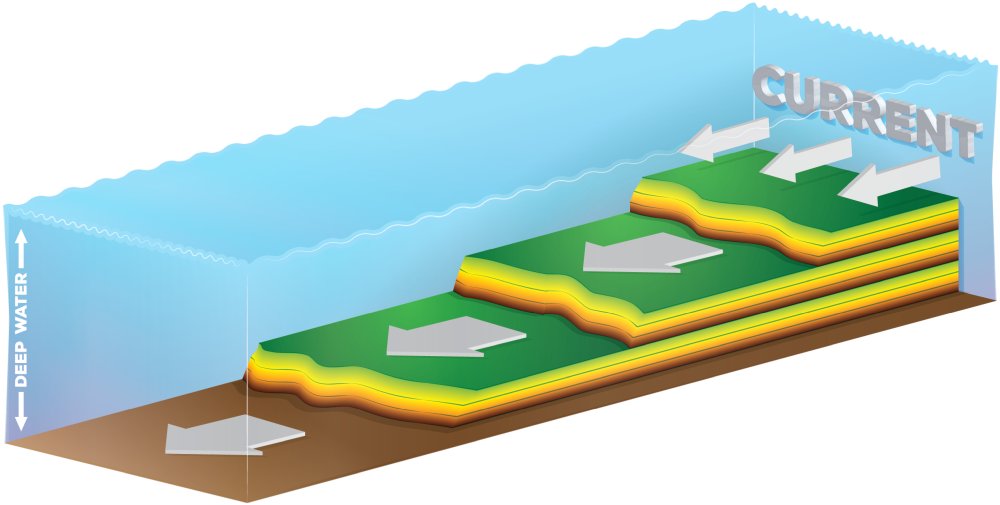
In running water, multiple sedimentary layers can form rapidly—not upwards, but sideways and at the same time, in the direction of current. Sedimentary grains are naturally sorted by the flowing action of water transport.
https://t.co/jQRFgy0tXP





![creationnews's tweet photo. AI TRAINED ON AI-OUTPUT GENERATES NONSENSE
Large Language Models (LLM), or ‘AI’ (artificial intelligence), can be very useful in making sense of large amounts of data. Thus, they are used in research, medicine, arts, etc.
In interacting with consumer-friendly ones such as ChatGPT, it might seem that the program is ‘intelligent’—and that it is telling you something completely new. However, the AI program can only respond based on the dataset that it was trained on. If it is ‘fed’ garbage, it will produce garbage answers.
What happens when an LLM is trained on everything that is on the Internet, but more and more of the ‘data’ on the Internet has been generated by AI? Researchers have now shown that “AI returns gibberish when trained on [AI-] generated data”. The researchers referred to this as “model collapse”.
This finding is not surprising. AI is a clever programming system that mimics an element of intelligence—sifting through data, finding trends amongst noise, interpolating, and extrapolating from the trends. But AI can only work from the data it has been given. When these data from the Internet (inevitably containing errors and inconsistencies) are part of a feedback loop, so that the outputs from AI are themselves added to the Internet, which then serves as further input, the errors amplify!
This example of AI reminds us of the way mutations (supposedly the ‘engine’ of evolution, a non-intelligent process) also amplify error. As they are almost all deleterious, and they accumulate each generation, they cause our genomes to decay (https://t.co/SOGS2wWM3z). This points back to Creation Week, when our genome information was error-free.
References:
- Wenger, E., AI produces gibberish when trained on too much AI-generated data, Nature 631:742–743, 2024.
- Shumailov, I., et al., AI models collapse when trained on recursively generated data, Nature 631:755–759, 2024.
---
This FOCUS item originally appeared in Creation Vol. 47 No. 2 (2025)
For the latest creation news and views, subscribe to Creation magazine:
https://t.co/4TgfR5KTLR](https://pbs.twimg.com/media/HLb8gzvX0AAO-ly.jpg)