Whoever is going to tell you to use promotion mode instead of seasonality adjustment started to advertise on Google yesterday.
Why?
First because is in Beta, and all the Google beta’s features will be 100% faulty.
Second because the reps are pushing for it, so do 2 + 2
Third because you don’t want to jeopardise your BFCM strategy with an “experiment”!
Claude and GPT are the new Google Ads reps.
For years, we advertisers had one extra opponent: the Google Ads rep calling our clients with very confident, very opinionated advice about their account.
Now there’s a second one.
Clients paste their account data into Claude or GPT, get a neat summary of “what’s wrong”, and come back to us asking for an explanation.
The problem isn’t the AI. The problem is the AI has zero context.
It doesn’t know the campaign is still in its learning phase.
It doesn’t know conversions take 12 days to be reported.
It doesn’t know we’re pacing budget ahead of Black Friday on purpose.
So it sees a dip and calls it a failure.
Right now, my team spends at least 1 hour a day reviewing these summaries and explaining why most points don’t apply.
AI is a great tool. But an analysis without context is just a confident guess.
Is anyone else dealing with this?
Google reps should go to jail for fraud.
And I’m not afraid to say that. I’m really sorry to my friends who work at Google, but their practices and tactics are so sneaky and misleading that someone should step in.
I’m speaking first as a business owner, and second as an advertiser.
I still remember the suggestions a sneaky rep gave me in 2015, when I was running my first online business. Suggestions that basically put the business out of business.
Now that we manage different clients, with different spend sizes and in different markets, I can really see their true colors.
They send suggestions without being asked, and they send reports to clients showing the “missing demand they’re not capturing,” with only one goal in mind: spend more and increase Google’s revenue.
They never, ever ask business questions like: What are your COGS? What’s your margin? What’s your contribution margin? Nothing. Why? Because they don’t care whether you make money. They only care whether you spend more and make more money for Google.
Now imagine a small business owner whose livelihood depends on his business. Imagine this poor person dealing with these snakes. In two months, they’d put him out of business.
And for what? To grow an already multibillion-dollar company?
Come on!
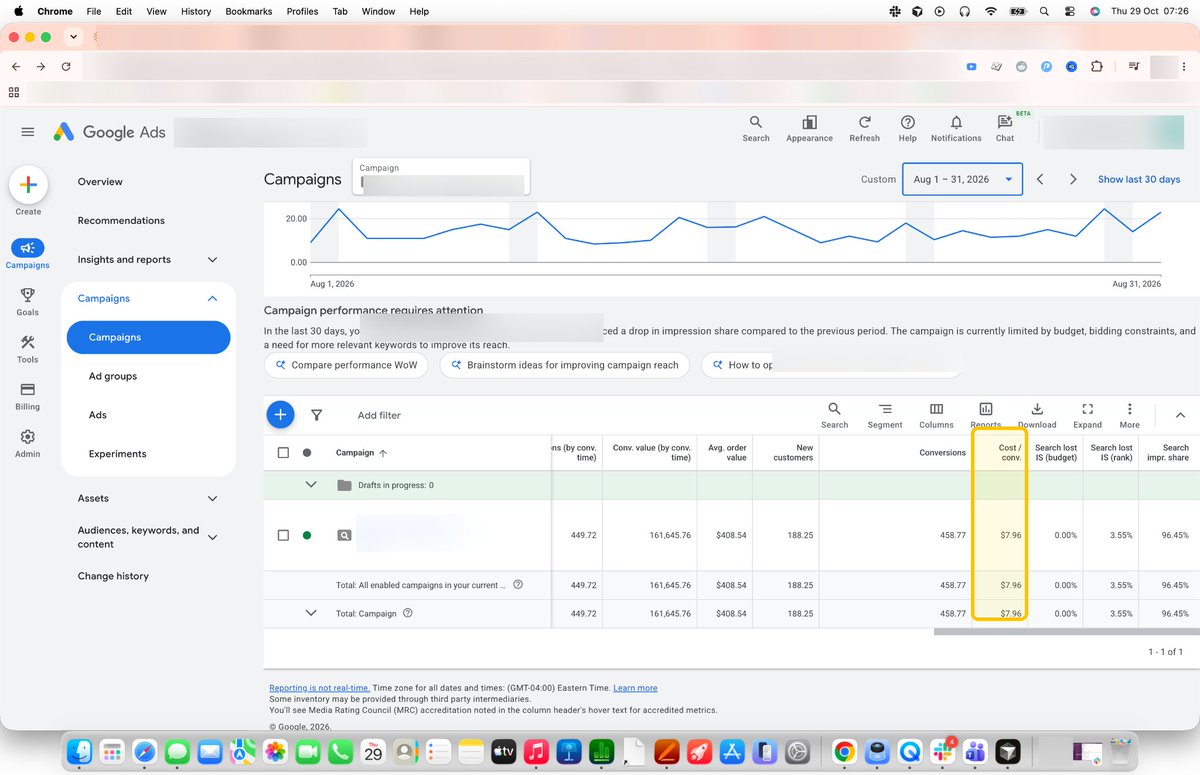
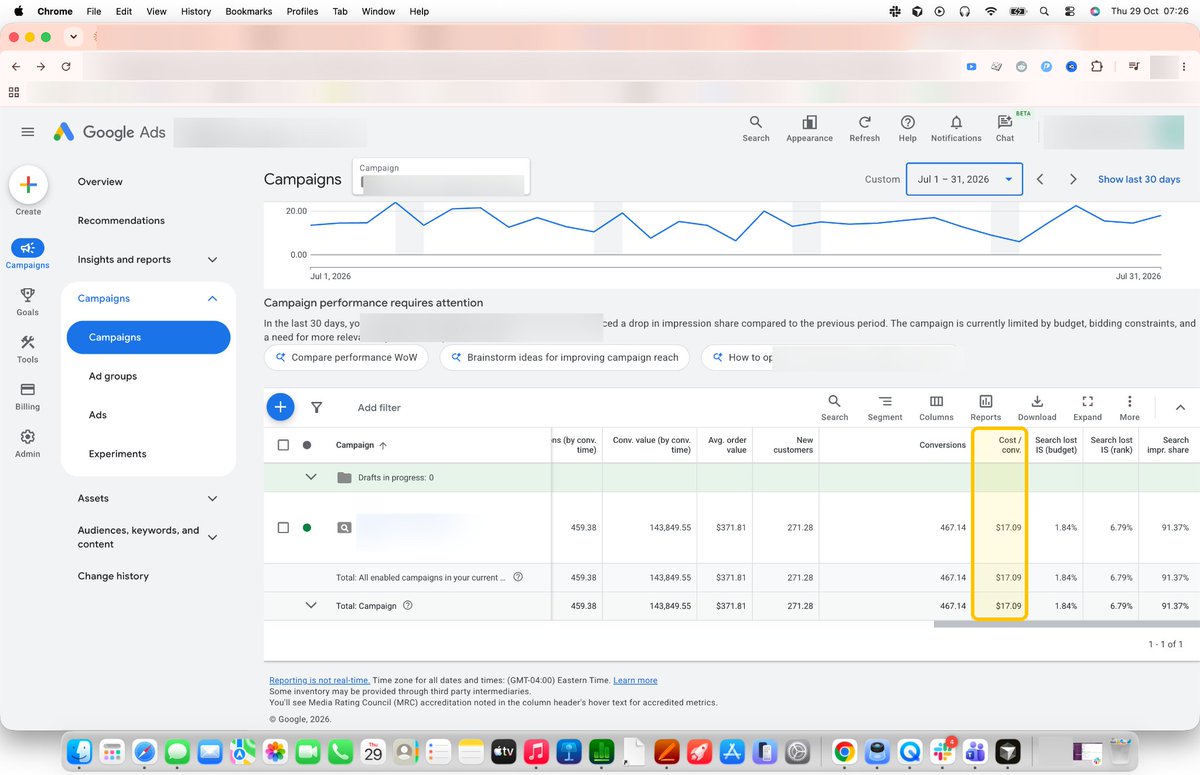
We cut a brand campaign's cost per conversion by 53% by changing the bidding strategy.
Avg CPC: $0.77 → $0.37
Cost per conversion: $17 → $7.96
Conversion value: $151K → $165K
Here's what was going on:
Real example. We took over this account in August 2026.
Before: $0.77 avg CPC, $17 cost per conversion, $151K conversion value.
After switching the bidding strategy: $0.37 avg CPC, $7.96 cost per conversion, $165K conversion value.
So before you touch your budgets or keywords, look at the page.
Conversion rate under 1% on high-intent traffic? That's your leverage. Fix the page first.
For lead gen, the structure is: promise first, then prove.
7 sections, top to bottom:
Hero: What am I getting?
Benefits: How does this help me?
Trust: why should I believe you?
Social proof: what do others say?
6/7
Objections: what if it doesn't work?
Urgency: why now?
BFCM can be very detrimental to your business.
In the last two weeks, I advised three of our clients not to run Black Friday and Cyber Monday offers.
Why?
Because when we looked at their data from last year, we found that only a small percentage of the new customers acquired during the sales period came back later in the year to buy at full price.
BFCM should be your best customer acquisition engine of the entire year, but if those new customers are only deal hunters, you are paying to acquire them at a discounted margin and they never come back.
Instead of making money, you are losing money.
So, instead of running Black Friday just because your competitors are doing it, first look at your historical data and check whether it makes sense for your business.
If you've stopped seeing Google as an incremental channel, look at your dashboard.
If most of your PMax revenue is from branded or returning customers, that's your answer.
A clean structure keeps those apart.
Prospecting campaigns go after people who don't know you yet.
A separate branded campaign captures the demand Meta and word of mouth have already created.